
talk-data.com talk-data.com

Topic

AWS Lambda

serverless faas aws

3

tagged

Activity Trend

5 peak/qtr
2020-Q1 2026-Q1

Activities

Showing filtered results

Filtering by: Databricks DATA + AI Summit 2023 ×
Backfill Streaming Data Pipelines in Kappa Architecture

Streaming data pipelines can fail due to various reasons. Since the source data, such as Kafka topics, often have limited retention, prolonged job failures can lead to data loss. Thus, streaming jobs need to be backfillable at all times to prevent data loss in case of failures. One solution is to increase the source's retention so that backfilling is simply replaying source streams, but extending Kafka retention is very costly for Netflix's data sizes. Another solution is to utilize source data stored in DWH, commonly known as the Lambda architecture. However, this method introduces significant code duplication, as it requires engineers to maintain a separate equivalent batch job. At Netflix, we have created the Iceberg Source Connector to provide backfilling capabilities to Flink streaming applications. It allows Flink to stream data stored in Apache Iceberg while mirroring Kafka's ordering semantics, enabling us to backfill large-scale stateful Flink pipelines at low retention cost.

Connect with us: Website: https://databricks.com Facebook: https://www.facebook.com/databricksinc Twitter: https://twitter.com/databricks LinkedIn: https://www.linkedin.com/company/data... Instagram: https://www.instagram.com/databricksinc/
Auditing Your Data and Answering the Lifelong Question—Is It the End of the Day Yet?

Huge volumes of data flow through a robust Kafka architecture, into several ETLs, receiving, transforming and storing the data. We clearly understood our ETLs’ workflow and our data architecture, from source to destination.

But how much did we know about the way our data makes though our systems? And what about the life long question, is it the end of the day yet?

In this talk I’m going to present to you the design process behind our Data Auditing system, Life Line. From tracking and producing, to analyzing and storing auditing information, using technologies such as Kafka, Avro, Spark, Lambda functions and complex SQL queries. We’re going to cover: * AVRO Audit header * Auditing heart beat - designing your metadata * Designing and optimizing your auditing table - what does this data look like anyway? * Creating an alert based monitoring system * Answering the most important question of all - is it the end of the day yet?

Connect with us: Website: https://databricks.com Facebook: https://www.facebook.com/databricksinc Twitter: https://twitter.com/databricks LinkedIn: https://www.linkedin.com/company/data... Instagram: https://www.instagram.com/databricksinc/

Self-Serve, Automated and Robust CDC pipeline using AWS DMS, DynamoDB Streams and Databricks Delta

Many companies are trying to solve the challenges of ingesting transactional data in Data lake and dealing with late-arriving updates and deletes.

To address this at Swiggy, we have built CDC(Change Data Capture) system, an incremental processing framework to power all business-critical data pipelines at low latency and high efficiency.

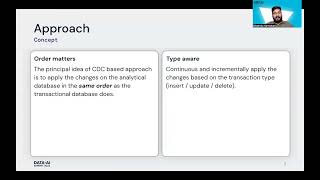
It offers: Freshness: It operates in near real-time with configurable latency requirements. Performance: Optimized read and write performance with tuned compaction parameters and partitions and delta table optimization. Consistency: It supports reconciliation based on transaction types. Basically applying insert, update, and delete on existing data.

To implement this system, AWS DMS helped us with initial bootstrapping and CDC replication for Mysql sources. AWS Lambda and DynamoDB streams helped us to solve the bootstrapping and CDC replication for DynamoDB source.

After setting up the bootstrap and cdc replication process we have used Databricks delta merge to reconcile the data based on the transaction types.

To support the merge we have implemented supporting features - * Deduplicating multiple mutations of the same record using log offset and time stamp. * Adding optimal partition of the data set. * Infer schema and apply proper schema evolutions(Backward compatible schema) * We have extended the delta table snapshot generation technique to create a consistent partition for partitioned delta tables.

FInally to read the data we are using Spark sql with Hive metastore and Snowflake. Delta tables read with Spark sql have implicit support for hive metastore. We have built our own implementation of the snowflake sync process to create external, internal tables and materialized views on Snowflake.

Stats: 500m CDC logs/day 600+ tables

Connect with us: Website: https://databricks.com Facebook: https://www.facebook.com/databricksinc Twitter: https://twitter.com/databricks LinkedIn: https://www.linkedin.com/company/data... Instagram: https://www.instagram.com/databricksinc/