talk-data.com talk-data.com

Topic

bayesian-statistics

26

tagged

Activity Trend

1 peak/qtr
2020-Q1 2026-Q1

Activities

26 activities · Newest first

Bayesian Statistics: An Introduction, 4th Edition

Bayesian Statistics is the school of thought that combines prior beliefs with the likelihood of a hypothesis to arrive at posterior beliefs. The first edition of Peter Lee's book appeared in 1989, but the subject has moved ever onwards, with increasing emphasis on Monte Carlo based techniques. This new fourth edition looks at recent techniques such as variational methods, Bayesian importance sampling, approximate Bayesian computation and Reversible Jump Markov Chain Monte Carlo (RJMCMC), providing a concise account of the way in which the Bayesian approach to statistics develops as well as how it contrasts with the conventional approach. The theory is built up step by step, and important notions such as sufficiency are brought out of a discussion of the salient features of specific examples. This edition: Includes expanded coverage of Gibbs sampling, including more numerical examples and treatments of OpenBUGS, R2WinBUGS and R2OpenBUGS. Presents significant new material on recent techniques such as Bayesian importance sampling, variational Bayes, Approximate Bayesian Computation (ABC) and Reversible Jump Markov Chain Monte Carlo (RJMCMC). Provides extensive examples throughout the book to complement the theory presented. Accompanied by a supporting website featuring new material and solutions. More and more students are realizing that they need to learn Bayesian statistics to meet their academic and professional goals. This book is best suited for use as a main text in courses on Bayesian statistics for third and fourth year undergraduates and postgraduate students.

Classic Problems of Probability

"A great book, one that I will certainly add to my personal library." --Paul J. Nahin, Professor Emeritus of Electrical Engineering, University of New Hampshire Classic Problems of Probability presents a lively account of the most intriguing aspects of statistics. The book features a large collection of more than thirty classic probability problems which have been carefully selected for their interesting history, the way they have shaped the field, and their counterintuitive nature. From Cardano's 1564 Games of Chance to Jacob Bernoulli's 1713 Golden Theorem to Parrondo's 1996 Perplexing Paradox, the book clearly outlines the puzzles and problems of probability, interweaving the discussion with rich historical detail and the story of how the mathematicians involved arrived at their solutions. Each problem is given an in-depth treatment, including detailed and rigorous mathematical proofs as needed. Some of the fascinating topics discussed by the author include: Buffon's Needle problem and its ingenious treatment by Joseph Barbier, culminating into a discussion of invariance Various paradoxes raised by Joseph Bertrand Classic problems in decision theory, including Pascal's Wager, Kraitchik's Neckties, and Newcomb's problem The Bayesian paradigm and various philosophies of probability Coverage of both elementary and more complex problems, including the Chevalier de Méré problems, Fisher and the lady testing tea, the birthday problem and its various extensions, and the Borel-Kolmogorov paradox Classic Problems of Probability is an eye-opening, one-of-a-kind reference for researchers and professionals interested in the history of probability and the varied problem-solving strategies employed throughout the ages. The book also serves as an insightful supplement for courses on mathematical probability and introductory probability and statistics at the undergraduate level.

Bayesian Estimation and Tracking: A Practical Guide

A practical approach to estimating and tracking dynamic systems in real-worl applications Much of the literature on performing estimation for non-Gaussian systems is short on practical methodology, while Gaussian methods often lack a cohesive derivation. Bayesian Estimation and Tracking addresses the gap in the field on both accounts, providing readers with a comprehensive overview of methods for estimating both linear and nonlinear dynamic systems driven by Gaussian and non-Gaussian noices. Featuring a unified approach to Bayesian estimation and tracking, the book emphasizes the derivation of all tracking algorithms within a Bayesian framework and describes effective numerical methods for evaluating density-weighted integrals, including linear and nonlinear Kalman filters for Gaussian-weighted integrals and particle filters for non-Gaussian cases. The author first emphasizes detailed derivations from first principles of eeach estimation method and goes on to use illustrative and detailed step-by-step instructions for each method that makes coding of the tracking filter simple and easy to understand. Case studies are employed to showcase applications of the discussed topics. In addition, the book supplies block diagrams for each algorithm, allowing readers to develop their own MATLAB toolbox of estimation methods. Bayesian Estimation and Tracking is an excellent book for courses on estimation and tracking methods at the graduate level. The book also serves as a valuable reference for research scientists, mathematicians, and engineers seeking a deeper understanding of the topics.

Bayesian Analysis of Stochastic Process Models

Bayesian analysis of complex models based on stochastic processes has in recent years become a growing area. This book provides a unified treatment of Bayesian analysis of models based on stochastic processes, covering the main classes of stochastic processing including modeling, computational, inference, forecasting, decision making and important applied models. Key features: Explores Bayesian analysis of models based on stochastic processes, providing a unified treatment. Provides a thorough introduction for research students. Computational tools to deal with complex problems are illustrated along with real life case studies Looks at inference, prediction and decision making. Researchers, graduate and advanced undergraduate students interested in stochastic processes in fields such as statistics, operations research (OR), engineering, finance, economics, computer science and Bayesian analysis will benefit from reading this book. With numerous applications included, practitioners of OR, stochastic modelling and applied statistics will also find this book useful.

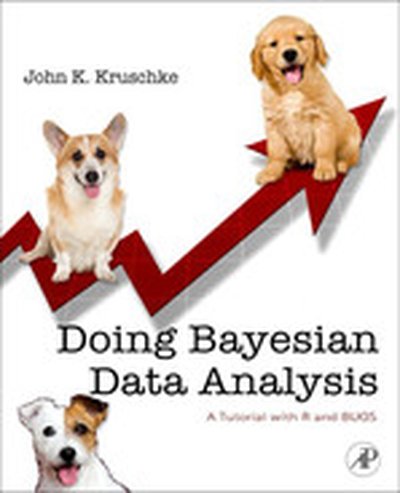
Doing Bayesian Data Analysis

There is an explosion of interest in Bayesian statistics, primarily because recently created computational methods have finally made Bayesian analysis tractable and accessible to a wide audience. Doing Bayesian Data Analysis, A Tutorial Introduction with R and BUGS, is for first year graduate students or advanced undergraduates and provides an accessible approach, as all mathematics is explained intuitively and with concrete examples. It assumes only algebra and ‘rusty’ calculus. Unlike other textbooks, this book begins with the basics, including essential concepts of probability and random sampling. The book gradually climbs all the way to advanced hierarchical modeling methods for realistic data. The text provides complete examples with the R programming language and BUGS software (both freeware), and begins with basic programming examples, working up gradually to complete programs for complex analyses and presentation graphics. These templates can be easily adapted for a large variety of students and their own research needs.The textbook bridges the students from their undergraduate training into modern Bayesian methods. -Accessible, including the basics of essential concepts of probability and random sampling -Examples with R programming language and BUGS software -Comprehensive coverage of all scenarios addressed by non-bayesian textbooks- t-tests, analysis of variance (ANOVA) and comparisons in ANOVA, multiple regression, and chi-square (contingency table analysis). -Coverage of experiment planning -R and BUGS computer programming code on website -Exercises have explicit purposes and guidelines for accomplishment