talk-data.com talk-data.com

Topic

generative-ai

26

tagged

Activity Trend

1 peak/qtr
2020-Q1 2026-Q1

Activities

26 activities · Newest first

Deep Dive into the Power Platform in the Age of Generative AI: Architectural Insights and Best Practices for Intelligent Business Solutions

Understand the full potential of Microsoft Power Platform with this comprehensive guide, designed to provide you with the knowledge and tools needed to create intelligent business applications, automate workflows, and drive data-driven insights for business growth. Whether you're a novice or an experienced professional, this book offers a step-by-step approach to mastering the Power Platform. This book comes with an extensive array of essential concepts, architectural patterns and techniques. It will also guide you with practical insights to navigate the Power Platform effortlessly while integrating on Azure. Starting with exploring Power Apps for building enterprise applications, the book delves into Dataverse, Copilot Studio, AI Builder, managing platforms and Application life cycle management. You will then demonstrate testing strategy followed by a detailed examination of Dataverse and intelligent AI-powered Applications. Additionally, you will cover Power pages for external websites and AI-infused solutions. Each section is meticulously structured, offering step-by-step guidance, hands-on exercises, and real-world scenarios to reinforce learning. After reading the book, you will be able to optimize your utilization of the Power Platform for creating effective business solutions. What You Will Learn: Understand the core components and capabilities of Power Platform Explore how Power Platform integrates with Azure services Understand the key features and benefits of using Power Platform for business applications Discover best practices for governance to ensure compliance and efficient management Explore techniques for optimizing the performance of data integration and export processes on Azure Who This Book Is For: Application developers, Enterprise Architects and business decision-makers.
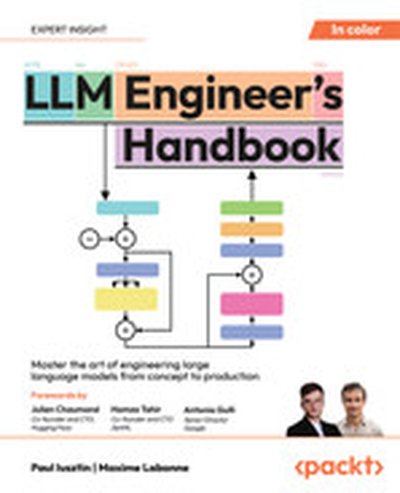
LLM Engineer's Handbook

The "LLM Engineer's Handbook" is your comprehensive guide to mastering Large Language Models from concept to deployment. Written by leading experts, it combines theoretical foundations with practical examples to help you build, refine, and deploy LLM-powered solutions that solve real-world problems effectively and efficiently. What this Book will help me do Understand the principles and approaches for training and fine-tuning Large Language Models (LLMs). Apply MLOps practices to design, deploy, and monitor your LLM applications effectively. Implement advanced techniques such as retrieval-augmented generation (RAG) and preference alignment. Optimize inference for high performance, addressing low-latency and high availability for production systems. Develop robust data pipelines and scalable architectures for building modular LLM systems. Author(s) Paul Iusztin and Maxime Labonne are experienced AI professionals specializing in natural language processing and machine learning. With years of industry and academic experience, they are dedicated to making complex AI concepts accessible and actionable. Their collaborative authorship ensures a blend of theoretical rigor and practical insights tailored for modern AI practitioners. Who is it for? This book is tailored for AI engineers, NLP professionals, and LLM practitioners who wish to deepen their understanding of Large Language Models. Ideal readers possess some familiarity with Python, AWS, and general AI concepts. If you aim to apply LLMs to real-world scenarios or enhance your expertise in AI-driven systems, this handbook is designed for you.

Integrating AI into Business Processes

Are you grappling with increasing productivity and enhancing creativity within your business processes? As businesses evolve in this digital age, the demand for swift, efficient, and innovative solutions is more pressing than ever. Traditional methods often fall short in keeping pace with the rapid changes and challenges that professionals face daily. Enter this report by Thomas Nield. This curated guide outlines the transformative power of generative AI in various business functions and serves as a much-needed solution to overcoming modern business hurdles. Discover how AI can be your ally in not just meeting but exceeding your productivity and creativity goals. You'll learn how to: Quickly find and use relevant images for presentations, blogs, and articles Save valuable time and refine your communications with AI-assisted email rewriting Easily distill large volumes of information into essential summaries Leverage AI for efficient data-gathering from the web, perfectly suited for analysis Utilize AI-generated text and visuals to craft compelling basic marketing materials

Prompt Engineering for Generative AI

Large language models (LLMs) and diffusion models such as ChatGPT and Stable Diffusion have unprecedented potential. Because they have been trained on all the public text and images on the internet, they can make useful contributions to a wide variety of tasks. And with the barrier to entry greatly reduced today, practically any developer can harness LLMs and diffusion models to tackle problems previously unsuitable for automation. With this book, you'll gain a solid foundation in generative AI, including how to apply these models in practice. When first integrating LLMs and diffusion models into their workflows, most developers struggle to coax reliable enough results from them to use in automated systems. Authors James Phoenix and Mike Taylor show you how a set of principles called prompt engineering can enable you to work effectively with AI. Learn how to empower AI to work for you. This book explains: The structure of the interaction chain of your program's AI model and the fine-grained steps in between How AI model requests arise from transforming the application problem into a document completion problem in the model training domain The influence of LLM and diffusion model architecture—and how to best interact with it How these principles apply in practice in the domains of natural language processing, text and image generation, and code

AI-Assisted Programming

Get practical advice on how to leverage AI development tools for all stages of code creation, including requirements, planning, design, coding, debugging, testing, and documentation. With this book, beginners and experienced developers alike will learn how to use a wide range of tools, from general-purpose LLMs (ChatGPT, Gemini, and Claude) to code-specific systems (GitHub Copilot, Tabnine, Cursor, and Amazon CodeWhisperer). You'll also learn about more specialized generative AI tools for tasks such as text-to-image creation. Author Tom Taulli provides a methodology for modular programming that aligns effectively with the way prompts create AI-generated code. This guide also describes the best ways of using general purpose LLMs to learn a programming language, explain code, or convert code from one language to another. This book examines: The core capabilities of AI-based development tools Pros, cons, and use cases of popular systems such as GitHub Copilot and Amazon CodeWhisperer Ways to use ChatGPT, Gemini, Claude, and other generic LLMs for coding Using AI development tools for the software development lifecycle, including requirements, planning, coding, debugging, and testing Prompt engineering for development Using AI-assisted programming for tedious tasks like creating regular expressions, starter code, object-oriented programming classes, and GitHub Actions How to use AI-based low-code and no-code tools, such as to create professional UIs

Generative AI on AWS

Companies today are moving rapidly to integrate generative AI into their products and services. But there's a great deal of hype (and misunderstanding) about the impact and promise of this technology. With this book, Chris Fregly, Antje Barth, and Shelbee Eigenbrode from AWS help CTOs, ML practitioners, application developers, business analysts, data engineers, and data scientists find practical ways to use this exciting new technology. You'll learn the generative AI project life cycle including use case definition, model selection, model fine-tuning, retrieval-augmented generation, reinforcement learning from human feedback, and model quantization, optimization, and deployment. And you'll explore different types of models including large language models (LLMs) and multimodal models such as Stable Diffusion for generating images and Flamingo/IDEFICS for answering questions about images. Apply generative AI to your business use cases Determine which generative AI models are best suited to your task Perform prompt engineering and in-context learning Fine-tune generative AI models on your datasets with low-rank adaptation (LoRA) Align generative AI models to human values with reinforcement learning from human feedback (RLHF) Augment your model with retrieval-augmented generation (RAG) Explore libraries such as LangChain and ReAct to develop agents and actions Build generative AI applications with Amazon Bedrock