talk-data.com talk-data.com

Topic

mathematica

10

tagged

Activity Trend

1 peak/qtr
2020-Q1 2026-Q1

Activities

10 activities · Newest first

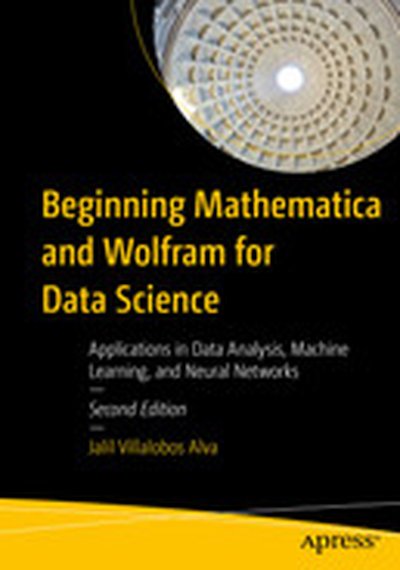
Beginning Mathematica and Wolfram for Data Science: Applications in Data Analysis, Machine Learning, and Neural Networks

Enhance your data science programming and analysis with the Wolfram programming language and Mathematica, an applied mathematical tools suite. This second edition introduces the latest LLM Wolfram capabilities, delves into the exploration of data types in Mathematica, covers key programming concepts, and includes code performance and debugging techniques for code optimization. You’ll gain a deeper understanding of data science from a theoretical and practical perspective using Mathematica and the Wolfram Language. Learning this language makes your data science code better because it is very intuitive and comes with pre-existing functions that can provide a welcoming experience for those who use other programming languages. Existing topics have been reorganized for better context and to accommodate the introduction of Notebook styles. The book also incorporates new functionalities in code versions 13 and 14 for imported and exported data. You’ll see how to use Mathematica, where data management and mathematical computations are needed. Along the way, you’ll appreciate how Mathematica provides an entirely integrated platform: its symbolic and numerical calculation result in a mized syntax, allowing it to carry out various processes without superfluous lines of code. You’ll learn to use its notebooks as a standard format, which also serves to create detailed reports of the processes carried out. What You Will Learn Create datasets, work with data frames, and create tables Import, export, analyze, and visualize data Work with the Wolfram data repository Build reports on the analysis Use Mathematica for machine learning, with different algorithms, including linear, multiple, and logistic regression; decision trees; and data clustering Who This Book Is For Data scientists who are new to using Wolfram and Mathematica as a programming language or tool. Programmers should have some prior programming experience, but can be new to the Wolfram language.
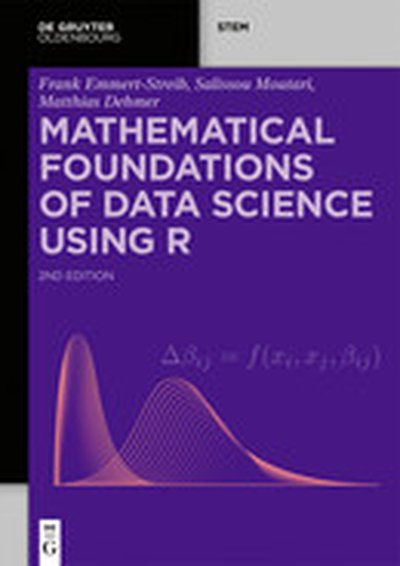
Mathematical Foundations of Data Science Using R, 2nd Edition

The aim of the book is to help students become data scientists. Since this requires a series of courses over a considerable period of time, the book intends to accompany students from the beginning to an advanced understanding of the knowledge and skills that define a modern data scientist. The book presents a comprehensive overview of the mathematical foundations of the programming language R and of its applications to data science.

Beginning Mathematica and Wolfram for Data Science: Applications in Data Analysis, Machine Learning, and Neural Networks

Enhance your data science programming and analysis with the Wolfram programming language and Mathematica, an applied mathematical tools suite. The book will introduce you to the Wolfram programming language and its syntax, as well as the structure of Mathematica and its advantages and disadvantages. You’ll see how to use the Wolfram language for data science from a theoretical and practical perspective. Learning this language makes your data science code better because it is very intuitive and comes with pre-existing functions that can provide a welcoming experience for those who use other programming languages. You’ll cover how to use Mathematica where data management and mathematical computations are needed. Along the way you’ll appreciate how Mathematica provides a complete integrated platform: it has a mixed syntax as a result of its symbolic and numerical calculations allowing it to carry out various processes without superfluous lines of code. You’ll learn to use its notebooks as a standard format, which also serves to create detailed reports of the processes carried out. What You Will Learn Use Mathematica to explore data and describe the concepts using Wolfram language commands Create datasets, work with data frames, and create tables Import, export, analyze, and visualize data Work with the Wolfram data repository Build reports on the analysis Use Mathematica for machine learning, with different algorithms, including linear, multiple, and logistic regression; decision trees; and data clustering Who This Book Is For Data scientists new to using Wolfram and Mathematica as a language/tool to program in. Programmers should have some prior programming experience, but can be new to the Wolfram language.
Mathematical Foundations of Data Science Using R

In order best exploit the incredible quantities of data being generated in most diverse disciplines data sciences increasingly gain worldwide importance. The book gives the mathematical foundations to handle data properly. It introduces basics and functionalities of the R programming language which has become the indispensable tool for data sciences. Thus it delivers the reader the skills needed to build own tool kits of a modern data scientist.

Introduction to Finite Element Analysis and Design, 2nd Edition

Introduces the basic concepts of FEM in an easy-to-use format so that students and professionals can use the method efficiently and interpret results properly Finite element method (FEM) is a powerful tool for solving engineering problems both in solid structural mechanics and fluid mechanics. This book presents all of the theoretical aspects of FEM that students of engineering will need. It eliminates overlong math equations in favour of basic concepts, and reviews of the mathematics and mechanics of materials in order to illustrate the concepts of FEM. It introduces these concepts by including examples using six different commercial programs online. The all-new, second edition of Introduction to Finite Element Analysis and Design provides many more exercise problems than the first edition. It includes a significant amount of material in modelling issues by using several practical examples from engineering applications. The book features new coverage of buckling of beams and frames and extends heat transfer analyses from 1D (in the previous edition) to 2D. It also covers 3D solid element and its application, as well as 2D. Additionally, readers will find an increase in coverage of finite element analysis of dynamic problems. There is also a companion website with examples that are concurrent with the most recent version of the commercial programs. Offers elaborate explanations of basic finite element procedures Delivers clear explanations of the capabilities and limitations of finite element analysis Includes application examples and tutorials for commercial finite element software, such as MATLAB, ANSYS, ABAQUS and NASTRAN Provides numerous examples and exercise problems Comes with a complete solution manual and results of several engineering design projects Introduction to Finite Element Analysis and Design, 2nd Edition is an excellent text for junior and senior level undergraduate students and beginning graduate students in mechanical, civil, aerospace, biomedical engineering, industrial engineering and engineering mechanics.

An Engineer's Guide to Mathematica

Free Mathematica 10 Update Included! Now available from www.wiley.com/go/magrab Updated material includes: - Creating regions and volumes of arbitrary shape and determining their properties: arc length, area, centroid, and area moment of inertia - Performing integrations, solving equations, and determining the maximum and minimum values over regions of arbitrary shape - Solving numerically a class of linear second order partial differential equations in regions of arbitrary shape using finite elements An Engineer's Guide to Mathematica enables the reader to attain the skills to create Mathematica 9 programs that solve a wide range of engineering problems and that display the results with annotated graphics. This book can be used to learn Mathematica, as a companion to engineering texts, and also as a reference for obtaining numerical and symbolic solutions to a wide range of engineering topics. The material is presented in an engineering context and the creation of interactive graphics is emphasized. The first part of the book introduces Mathematica's syntax and commands useful in solving engineering problems. Tables are used extensively to illustrate families of commands and the effects that different options have on their output. From these tables, one can easily determine which options will satisfy one's current needs. The order of the material is introduced so that the engineering applicability of the examples increases as one progresses through the chapters. The second part of the book obtains solutions to representative classes of problems in a wide range of engineering specialties. Here, the majority of the solutions are presented as interactive graphics so that the results can be explored parametrically. Key features: Material is based on Mathematica 9 Presents over 85 examples on a wide range of engineering topics, including vibrations, controls, fluids, heat transfer, structures, statistics, engineering mathematics, and optimization Each chapter contains a summary table of the Mathematica commands used for ease of reference Includes a table of applications summarizing all of the engineering examples presented. Accompanied by a website containing Mathematica notebooks of all the numbered examples An Engineer's Guide to Mathematica is a must-have reference for practitioners, and graduate and undergraduate students who want to learn how to solve engineering problems with Mathematica.

A Physicist's Guide to Mathematica, 2nd Edition

For the engineering and scientific professional, A Physicist’s Guide to Mathematica, Second Edition provides an updated reference guide based on the 2007 new 6.0 release, providing an organized and integrated desk reference with step-by-step instructions for the most commonly used features of the software as it applies to research in physics. For professors teaching physics and other science courses using the Mathematica software, A Physicist’s Guide to Mathematica, Second Edition is the only fully compatible (new software release) Mathematica text that engages students by providing complete topic coverage, new applications, exercises and examples that enable the user to solve a wide range of physics problems. Does not require prior knowledge of Mathematica or computer programming Can be used as either a primary or supplemental text for upper-division physics majors Provides over 450 end-of-section exercises and end-of-chapter problems Serves as a reference suitable for chemists, physical scientists, and engineers Compatible with Mathematica Version 6, a recent major release

Mathematica Cookbook

Visit the catalog page for Mathematica CookbookVisit the errata page for Mathematica Cookbook Mathematica Cookbook helps you master the application's core principles by walking you through real-world problems. Ideal for browsing, this book includes recipes for working with numerics, data structures, algebraic equations, calculus, and statistics. You'll also venture into exotic territory with recipes for data visualization using 2D and 3D graphic tools, image processing, and music. Although Mathematica 7 is a highly advanced computational platform, the recipes in this book make it accessible to everyone -- whether you're working on high school algebra, simple graphs, PhD-level computation, financial analysis, or advanced engineering models. Learn how to use Mathematica at a higher level with functional programming and pattern matching Delve into the rich library of functions for string and structured text manipulation Learn how to apply the tools to physics and engineering problems Draw on Mathematica's access to physics, chemistry, and biology data Get techniques for solving equations in computational finance Learn how to use Mathematica for sophisticated image processing Process music and audio as musical notes, analog waveforms, or digital sound samples

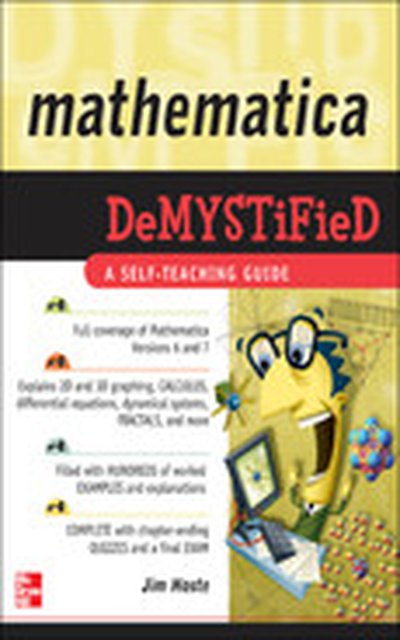
Mathematica DeMYSTiFied

Need to learn MATHEMATICA? Problem SOLVED! Take full advantage of all the powerful capabilities of Mathematica with help from this hands-on guide. Filled with examples and step-by-step explanations, Mathematica Demystified takes you from your very first calculation all the way to plotting complex fractals. Using an intuitive format, this book explains the fundamentals of Mathematica up front. Learn how to define functions, create 2-D graphs of functions, write basic programs, and use modules. You'll move on to 3-D graphics, calculus, polynomial, linear, and differential equations, dynamical systems, and fractals. Hundreds of examples with concise explanations make it easy to understand the material, and end-of-chapter quizzes and a final exam help reinforce learning. This self-teaching guide offers: A quick way to get up and running on Mathematica Coverage of Mathematica 6 and 7 Tips for avoiding and correcting syntax errors Details on creating slideshow presentations of your work No unnecessary technical jargon A time-saving approach to performing better on an exam or at work! Simple enough for a beginner, but challenging enough for an advanced user, Mathematica Demystified is your shortcut to mastering this fully integrated technical computing software.

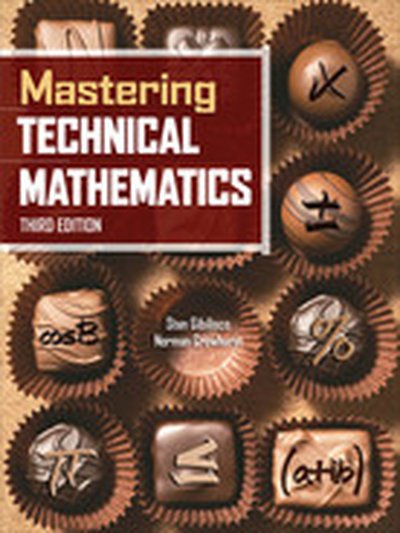
Mastering Technical Mathematics, Third Edition, 3rd Edition

A thorough revision of the classic tutorial of scientific and engineering mathematics For more than fifteen years, Mastering Technical Mathematics has been the definitive self-teaching guide for those wishing to boost their career by learning the principles of mathematics as they apply to science and engineering. Featuring the same user-friendly pedagogy, practical examples, and detailed illustrations that have made this resource a favorite of the scientific and technical communities, the new third edition delivers four entirely new chapters and expanded treatment of cutting-edge topics.