talk-data.com talk-data.com

Topic

microsoft-access

92

tagged

Activity Trend

1 peak/qtr
2020-Q1 2026-Q1

Activities

Showing filtered results

Filtering by: O'Reilly Data Engineering Books ×
Access Hacks

As part of the Microsoft Office suite, Access has become the industry's leading desktop database management program for organizing, accessing, and sharing information. But taking advantage of this product to build increasingly complex Access applications requires something more than your typical how-to book. What it calls for is Access Hacks from O'Reilly.This valuable guide provides direct, hands-on solutions that can help relieve the frustrations felt by users struggling to master the program's various complexities. For experienced users, Access Hacks offers a unique collection of proven techniques and tools that enable them to take their database skills and productivity to the next level. For Access beginners, it helps them acquire a firm grasp of the program's most productive features.A smart collection of insider tips and tricks, Access Hacks covers all of the program's finer points. Among the multitude of topics addressed, it shows users how to: work with Access in multi-user environments utilize SQL queries work with external data and programs integrate Access with third-party productsJust imagine: a learning process without the angst. Well, Access Hacks delivers it with ease, thanks to these down-and-dirty techniques not collected together anywhere else.Part of O'Reilly's best-selling Hacks series, Access Hacks is based on author Ken Bluttman's two decades of real-world experience in database programming and business application building. It's because of his vast experiences that the book is able to offer such a deep understanding of the program's expanding possibilities.
Access 2003 Programming by Example with VBA, XML, and ASP

This book is designed to take Microsoft Access users to the next step in programming. Its five parts cover an intro-duction to VBA programming, manipulating databases with ADO, using DDL, event programming, and using ASP and XML. With more than 300 hands-on examples and 11 custom projects, users can quickly build the toolset required for developing their own database solutions. Learn how to write and debug your programming code with the Visual Basic Editor, and understand and use common VBA programming structures such as conditions, loops, arrays, and collections. Learn how to create and manage databases with ActiveX Data Objects (ADO), and perform database tasks with Jet/Access Structured Query Language (SQL) and its Data Definition Language (DDL) component. Learn how to query and manipulate your database from a web browser with Active Server Pages (ASP) and export and import Access data to and from XML both manually and programmatically.

Modernizing IBM eServer iSeries Application Data Access - A Roadmap Cornerstone

In 1978 IBM introduced the System/38 as part of its midrange platform hardware base. One of the many outstanding features of this system was the built-in Relational Database Management System (RDMS) support. The system included a utility for defining databases, screens, and reports. This utility used a form named Data Description Specifications (DDS) to define the database physical (PF) and logical (LF) files (base tables, views, and indexes). In 1988, IBM announced the AS/400. The OS/400 operating system also contained a built-in RDMS, however, IBM offered Structured Query Language (SQL) as an alternative to DDS for creating databases. In addition, SQL Data Manipulation Language (DML) statements were made available as an ad hoc query language tool. These statements could also be embedded and compiled within high level language (HLL) programs. SQL Data Definition Language (DDL) has become the industry standard for defining RDMS databases. Many customers are in the process of modernizing their database definition and the database access. This IBM Redbooks publication will help you understand how to reverse engineer a DDS-created database along, and provides you with tips and techniques for modernizing applications to use SQL as the database access method. Additional Resources on DB2 for i Modernization:

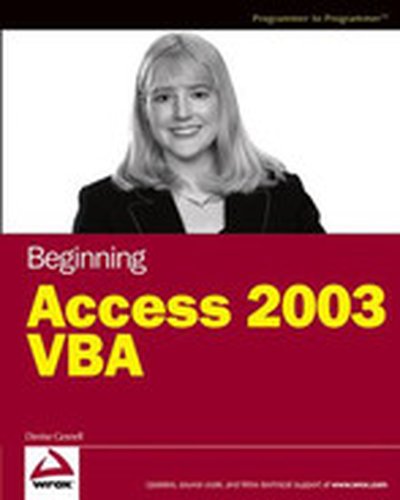
Beginning Access 2003 VBA

What is this book about? Written by an Access programmer with more than 10 years of VBA experience, this is the perfect guide for Access users who are ready to take their databases to the next level, or for programmers who are new to Access or VBA. Veteran Access developer Denise Gosnell shows readers the ins and outs of Access VBA and provides plenty of source code, and fully developed sample applications to guide you along the way. Not only do readers learn to build "stand-alone" desktop applications, but readers also learn how to integrate Access applications with Web Services, and SQL Server.

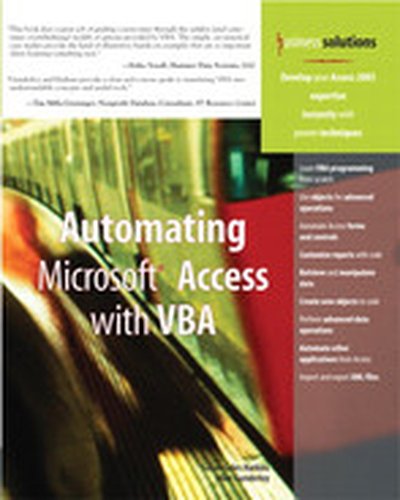
Business solutions Automating Microsoft® Access with VBA

If you use Microsoft Access in your every day business life but haven't learned to fully exploit the program, now's your chance. Automating Microsoft Access with VBA is a thorough introduction to programming Microsoft Accessing using Visual Basic for Applications (VBA). With this book, you will gain a working knowledge of VBA and be able to customize your Microsoft Access databases. You will cover topics that include: Operators and functions Debugging and error handling Menu commands Forms and reports Jet databases DAO object model Save money by learning to use VBA to customize your databases instead of paying someone else to do it for you!

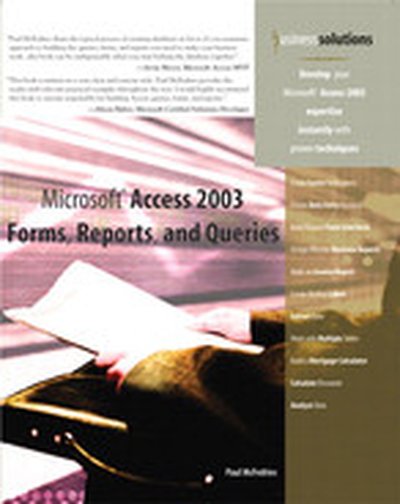
Microsoft® Access 2003 Forms, Reports and Queries

When it comes to job-productivity, we all want to be able to perform well, especially when it comes to challenging assignments. Anyone who works with Microsoft Access on a regular basis knows that this program can prove to be one of the most challenging. If you are looking for a way to get the most you can out of the primary Access tasks, Microsoft Access 2003 Forms, Reports and Queries is the learning tool that you need. Focusing only on the forms, reports and queries functions, this book provides you with practical know-how, real-world examples and techniques that you can put to use immediately. Learn to condense mountains of information into manageable molehills of useful knowledge, so that you can perform at your best!

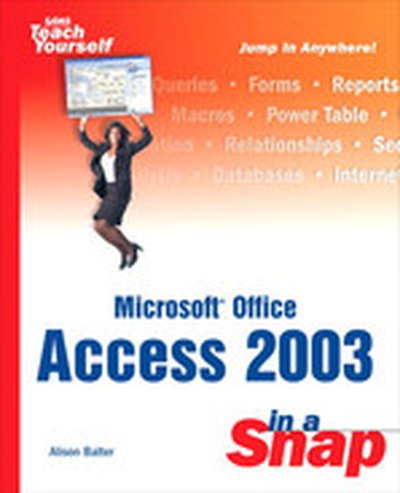
Microsoft Office Access 2003 in a Snap

Microsoft Access is a database development and maintenance program, but it can be confusing when trying to learn how to complete the tasks required to create an application. Microsoft Access 2003 In a Snap can quickly show you how to complete a specific task in an easy-to-follow format complete with illustrated steps. Sections of the book are organized into task categories such as Table Creation, Queries and Form Design. Intended to keep you focused and on-target, this book does not spend time explaining database architecture or application design. If you are the casual Access user or if you use it in your day-to-day work life, this book is a great reference tool!

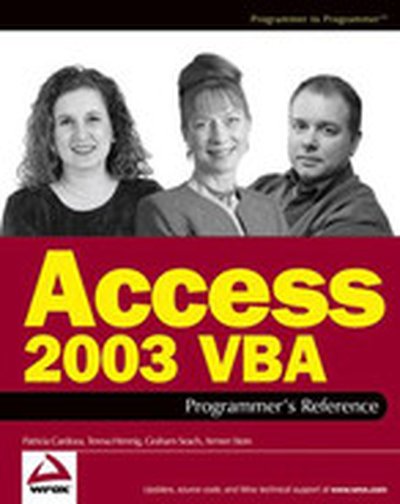
Access 2003 VBA Programmer's Reference

Covers all features of VBA programming for Access database applications Begins with an overview of VBA and highlights what's new in Microsoft Access 2003, the most popular database system in the world Real-world code examples demonstrate each programming topic, including using the Access Object Model, VBA execution and error handling, creating database objects with VBA, writing secure VBA code, and much more Shows how Access 2003 provides enhanced XML support, making it easier for programmers to publish data to the Web and exchange it with other organizations

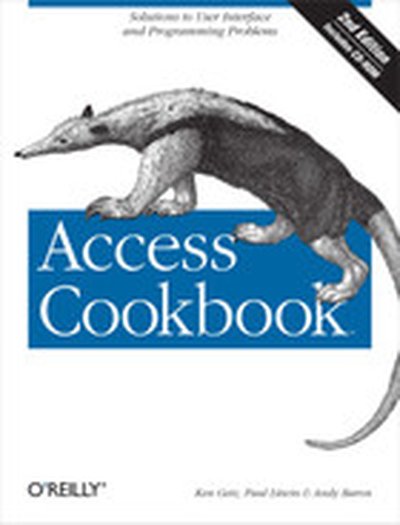
Access Cookbook, 2nd Edition

Not a reference book, and not a tutorial either, the new second edition of the highly regarded Access Cookbook is an uncommonly useful collection of solutions to problems that Access users and developers are likely to face as they attempt to build increasingly complex applications.Although using any single "recipe" in the book will more than pay back the cost of the book in terms of both hours saved and frustration thwarted, Access Cookbook, Second Edition is much more than a handy assortment of cut-and-paste code.Each of the "recipes" examine a particular problem--problems that commonly occur when you push the upper limits of Access, or ones that are likely to trip up a developer attempting to design a more elegant Access application--even some things you never knew Access could do. The authors then, in a clear, accessible, step-by-step style, present the problems' solution. Following each "recipe" are insights on how Access works, potential pitfalls, interesting programming techniques that are used in the solution, and how and why the solution works, so you can adapt the problem-solving techniques to other similar situations.Fully updated for Access 2003, Access Cookbook, Second Edition is also one of the first books to thoroughly explore new support for .NET managed code and XML. All of the practical, real-world examples have been tested for compatibility with Access 2003, Windows XP, and Windows Server 2003. This updated new edition also covers Access and SharePoint, Access and SmartTags, Access and .NET; and Access and XML.Access power users and programmers at all levels, from the relatively inexperienced to the most sophisticated, will rely on the Access Cookbook for quick solutions to gnarly problems. With a dog-eared copy of Access Cookbook at your side, you can spend your time and energy where it matters most: working on the interesting facets of your Access application, not just the time-consuming ones.

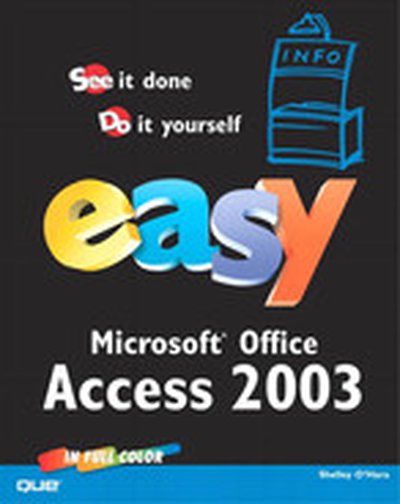
Easy Microsoft® Office Access 2003

Easy Microsoft Office Access 2003 takes the work out of learning this powerful database by using short, easy-to-follow lessons that show you how to accomplish basic tasks quickly and efficiently! It is the perfect book for beginners who want to learn Microsoft's database application through a visual, full-color approach. More than 100 hands-on lessons are designed to teach the easiest, fastest, or most direct way to accomplish common Access tasks. The book is suited for new Access users, as well as those upgrading from an earlier version.

Absolute Beginner’s Guide to Microsoft® Office Access 2003

Microsoft Access 11 is a powerful, relational database software package that makes it easier for you to create and manage complex databases. With Access, you can create a database quickly from scratch or by using and Access database Wizard. Once you¿ve created your database, Access provides all the tools you need to enter and manipulate data. Using Access, you can do the following: Quickly start a new database by using the Database Wizard. Create tables from scratch or by using a Wizard. Add and edit database information by using both tables and forms. Manipulate data in a number of tables by using queries and reports.

Sams Teach Yourself Microsoft® Office Access 2003 in 24 Hours

In just 24 sessions of one hour or less, the reader picks up all the skills needed to increase the effectiveness and reliability of Access applications. Using a straightforward, step-by-step approach, each lesson builds upon the previous one, allowing the reader to quickly learn the essentials of Access programming from the ground up. The book helps the reader to understand the fundamentals of the Access architecture, gain fast knowledge of the new features that Access offers, learn how to effectively use the latest tools and features of Access by following practical, real-world examples, and get expert tips from the best-selling author, Alison Balter. This book is designed for the way readers learn. They can go through each step-by-step chapter or just choose the lessons that interest them the most.

Special Edition Using Microsoft® Office Access 2003

Special Edition Using Microsoft Office Access 2003 is a comprehensive reference for all the features of Access 2003. This edition adds new chapters on collaboration with Microsoft SharePoint Team Server, and creating or consuming XML Web Services, both of which are hot topics. The XML chapter includes Access 2003¿s new XML export/import features. The book¿s organization follows the development process for typical Access database applications. Detailed, step-by-step instructions with icons guide those who are new to Access through table design, data addition, importing data from external sources, query design and execution, and designing data entry forms and printed reports. Chapters on advanced form and report design emphasize data-entry efficiency and presentation clarity.

Absolute Beginner’s Guide to Microsoft® Access 2002

Microsoft Access 2002 is a powerful, relational database software package that makes it easy to create and manage complex databases. With Access, users can create a database quickly from scratch or by using an Access database Wizard. Once the database is created, Access provides all the tools needed to enter and manipulate data. With the help of the Absolute Beginner's Guide, readers are able to quickly start a new database by using the Database Wizard, create tables from scratch or by using a Wizard, add and edit database information by using both tables and forms and manipulate data in a number of tables by using queries and reports. The book assumes absolutely no prior knowledge of the topic, and learning is easy because of the book's lighthearted but no-nonsense style. It serves as an excellent resource for users who are completely new to Access 2002 or who are upgrading from a previous version of the software.

iSeries Access for Web V5R2 and WebSphere Host Publisher V4.0

iSeries Access for Web (5722-XH2) - the latest offering in the iSeries Access Family (5722-XW1) product - offers Web browser-based access to IBM eServer iSeries servers. iSeries Access for Web helps leverage business information, applications, and resources across an enterprise by extending the iSeries resources to the client desktop through a Web browser. IBM WebSphere Host Publisher 4.0 (5724-B81) can modernize host applications or replace traditional character-based interfaces with a Web look and feel. These host applications can run directly from any standard Web browser. Host Publisher integrates multiple sources of data, including host and database applications, into a single Web page with no change to backend applications. Host Publisher and Host Publisher Studio have been bundled with the iSeries Access for Web product to provide a complete Web-to-host integration solution. This IBM Redbooks publication is designed for basic-level users who want to use iSeries Access for Web V5R2 or WebSphere Host Publisher V4.0. It shows you how to install and use iSeries Access for Web and WebSphere Host Publisher on the iSeries server through several example applications. It summarizes the Web-to-host products. Then it presents various circumstances to help you decide which product to choose when you consider integrating enterprise data into the Web.

Alison Balter's Mastering Access 2002 Enterprise Development

Developing applications for the enterprise introduces challenges quite different from those associated with developing applications for desktops or small departments. This book offers a no-nonsense approach to enterprise development using Access 2002 as a front-end. it is written in a practical style and easily transitions the client/server neophyte to the sophisticated world of enterprise development. Although the book focuses on client/server development, the text covers other enterprise topics such as replication, trasaction processing, and data access pages. This book goes behond the basics covered by the many introductory books, but offers an easier read than the expert books available.

Access Cookbook

Access Cookbook contains a comprehensive collection of problems, solutions,and practical examples for the Access power user or programmer who is running up against some of the apparent limits of the Access user interface or of Access application development. The diverse problems and solutions presented here are of interest to Access power users and programmers at all levels, from the relatively inexperienced to the most sophisticated. Each of the book?s 14 chapters focuses on a particular topic area related to the Access environment or Access programming. Within each chapter, individual items follow a standardized format. The authors first pose the problem, and then present its solution. Finally, a discussion follows, which consists of extended analysis of the solution, an insightful examination of how Access works, or interesting programming techniques that are used in the solution but that you can also apply elsewhere. The kinds of problems posed and solved in the book include the following: Specifying query criteria at runtime, rather than at design time Restricting the user to a single row of a form Preventing a report from printing if it has no records Making slow forms run faster Insuring that user interface objects present a uniform, consistent appearance Controlling a printer's paper source programmatically Referencing data from multiple SQL Server databases in a single Access Data Project page Using contact information from an Access database when sending email using Outlook The accompanying CD-ROM includes Access databases that contain the solutions for all problems presented in the text.

Access 2002 Programming by Example

This book addresses an unmet need in this topic area. It is a complete beginner's tutorial resource to tips, troubleshooting, techniques, and program development for Access 2002. The book covers fundamentals such as database normalization, query design, object manipulation, and optimization and custom programming for forms and reports. It makes the reader more efficient, productive, and knowledgeable in Access VBA. Speed techniques are mentioned. Shortcuts, tips, and techniques increase productivity. This book deals with getting data from outside sources and using VBA to ensure data integrity and consistency, which no other Access VBA book does. It also tackles problems in a variety of day-to-day situations that programmers often face. Bob Villareal is a contributor and a resident expert for the "Inside Microsoft Access" Web journal and an Access instructor at a Tulsa Community College. He also does freelance programming and instruction. Bob has been developing databases in a large insurance firm for more than 15 years. He has more than seven years' experience of VBA programming in both Access and Excel and has written many tracking and management applications.