
talk-data.com talk-data.com

Topic

MLOps

machine_learning devops ai

47

tagged

Activity Trend

26 peak/qtr
2020-Q1 2026-Q1

Activities

Showing filtered results

Filtering by: Databricks DATA + AI Summit 2023 ×
Designing Better MLOps Systems

Real-world data problems are becoming increasingly daunting to solve, as data volume grows and computing tools proliferate. Since 2018, Gartner has predicted that 85% of ML projects will fail and this trend will likely continue through 2022 as well. Nevertheless, in most cases, ML practitioners have the opportunity to avoid their projects from failing in the early phases.

In this talk, the speaker will borrow from her consultancy and hands-on implementation experience with cross-functional clients to share her takeaways in designing better ML systems. The talk will walk through common pitfalls to watch out for, relevant best practices in software engineering for ML, and technical anchors that make a robust system. This talk aims to empower the audience – beginner and experienced practitioners alike – with confidence in their ML project designs and help provide the big-picture design thinking framework for successful projects.

Connect with us: Website: https://databricks.com Facebook: https://www.facebook.com/databricksinc Twitter: https://twitter.com/databricks LinkedIn: https://www.linkedin.com/company/data... Instagram: https://www.instagram.com/databricksinc/
Emerging Data Architectures & Approaches for Real-Time AI using Redis

As more applications harness the power of real-time data, it’s important to architect and implement a data stack to meet the broad requirements of operational ML and be able to seamlessly integrate neural embeddings into applications.

Real-time ML requires more than just deploying ML models to production using MLOps tooling; it requires a fast and scalable operational database that easily integrates into the MLOps workflow. Milliseconds matter and can make the difference in delivering fast online predictions whether it’s personalized recommendations, detecting fraud, or figuring out the most optimal food delivery route.

Attend this session to explore how a modern data stack can be used for real-time operational ML and building AI-infused applications. The session will over the following topics:

Emerging architectural components for operational ML such as the online feature store for real-time serving.

Operational excellence in managing globally distributed ML data and feature pipelines

Foundational data types of Redis including the representation of data using vector embeddings.

Using Redis as a vector database to build vector similarity search applications.

Connect with us: Website: https://databricks.com Facebook: https://www.facebook.com/databricksinc Twitter: https://twitter.com/databricks LinkedIn: https://www.linkedin.com/company/data... Instagram: https://www.instagram.com/databricksinc/
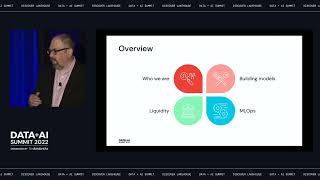
FutureMetrics: Using Deep Learning to Create a Multivariate Time Series Forecasting Platform

Liquidity forecasting is one of the most essential activities at any bank. TD bank, the largest of the big Five, has to provide liquidity for half a trillion dollars in products, and to forecast it to remain within a $5BN buffer.

The use case was to predict liquidity growth over short to moderate time horizons: 90 days to 18 months. Model must perform reliably in a strict regulatory framework, and as such validating such a model to the required standards is a key area of focus for this talk. While univariate models are widely used for this reason, their performance is capped preventing future improvements for these type problems.

The most challenging aspect of this problem is that the data is shallow (P N): the primary cadence is monthly, and chaotic nature of economic systems results in poor connectivity of behavior across transitions. Goal is to create an MLOps platform for these types of time series forecasting metrics across the enterprise.

Connect with us: Website: https://databricks.com Facebook: https://www.facebook.com/databricksinc Twitter: https://twitter.com/databricks LinkedIn: https://www.linkedin.com/company/data... Instagram: https://www.instagram.com/databricksinc/
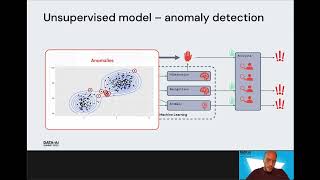
Detecting Financial Crime Using an Azure Advanced Analytics Platform and MLOps Approach

As gatekeepers of the financial system, banks play a crucial role in reporting possible instances of financial crime. At the same time, criminals continuously reinvent their approaches to hide their activities among dense transaction data. In this talk, we describe the challenges of detecting money laundering and outline why employing machine learning via MLOps is critically important to identify complex and ever-changing patterns.

In anti-money-laundering, machine learning answers to a dire need for vigilance and efficiency where previous-generation systems fall short. We will demonstrate how our open platform facilitates a gradual migration towards a model-driven landscape, using the example of transaction-monitoring to showcase applications of supervised and unsupervised learning, human explainability, and model monitoring. This environment enables us to drive change from the ground up in how the bank understands its clients to detect financial crime.

Connect with us: Website: https://databricks.com Facebook: https://www.facebook.com/databricksinc Twitter: https://twitter.com/databricks LinkedIn: https://www.linkedin.com/company/data... Instagram: https://www.instagram.com/databricksinc/
MLflow Pipelines: Accelerating MLOps from Development to Production

Despite being an emerging topic, MLOps is hard and there are no widely established approaches for MLOps. What makes it even harder is that in many companies the ownership of MLOps usually falls through the cracks between data science teams and production engineering teams. Data scientists are mostly focused on modeling the business problems and reasoning about data, features, and metrics, while the production engineers/ops are mostly focused on traditional DevOps for software development, ignoring ML-specific Ops like ML development cycles, experiment tracking, data/model validation, etc. In this talk, we will introduce MLflow Pipelines, an opinionated approach for MLOps. It provides predefined ML pipeline templates for common ML problems and opinionated development workflows to help data scientists bootstrap ML projects, accelerate model development, and ship production-grade code with little help from production engineers.

Connect with us: Website: https://databricks.com Facebook: https://www.facebook.com/databricksinc Twitter: https://twitter.com/databricks LinkedIn: https://www.linkedin.com/company/data... Instagram: https://www.instagram.com/databricksinc/
Financial Services Experience at Data + AI Summit 2022

The future of Financial Services is open with data and AI at its core. Welcome data teams and executives in Financial Services! This year’s Data + AI Summit is jam-packed with talks, demos and discussions on how Financial Services leaders are harnessing the power of data and analytics to digitally transform, minimize risk, accelerate time to market and drive sustainable value creation To help you take full advantage of the Financial Services industry experience at Summit, we’ve curated all the programs in one place.

Highlights at this year’s Summit:

Financial Services Industry Forum: Our flagship event for Financial Services attendees at Summit featuring keynotes and panel discussions with ADP, Northwestern Mutual, Point72 Asset Management, S&P Global and EY, followed by networking. More details in the agenda below. Financial Services Lounge: Stop by our lounge located outside the Expo floor to meet with Databricks’ industry experts and see solutions from our partners including Accenture, Avanade, Deloitte and others. Session Talks: Over 15 technical talks and demos on topics including hyper-personalization, AI-fueled forecasting, enterprise analytics in cloud, scaling privacy and cybersecurity, MLOps in cryptocurrency, ethical credit scoring and more.

Connect with us: Website: https://databricks.com Facebook: https://www.facebook.com/databricksinc Twitter: https://twitter.com/databricks LinkedIn: https://www.linkedin.com/company/data... Instagram: https://www.instagram.com/databricksinc/

Simplify Global DataOps and MLOps Using Okta’s FIG Automation Library

Think for a moment about an ML pipeline that you have created. Was it tedious to write? Did you have to familiarize yourself with technology outside your normal domain? Did you find many bugs? Did you give up with a “good enough” solution? Even simple ML pipelines are tedious. Complex ML pipelines make teams that include Data Engineers and ML Engineers still end up with delays and bugs. Okta’s FIG (Feature Infrastructure Generator) simplifies this with a configuration language for Data Scientists that produces scalable and correct ML pipelines, even highly complex ones. FIG is “just a library” in the sense that you can PIP install it. Once installed, FIG will configure your AWS account, creating ETL jobs, workflows, and ML training and scoring jobs. Data Scientists then use FIG’s configuration language to specify features and model integrations. With a single function call, FIG will run an ML pipeline to generate feature data, train models, and create scoring data. Feature generation is performed in a scalable, efficient, and temporally correct manner. Model training artifacts and scoring are automatically labeled and traced. This greatly simplifies the ML prototyping experience. Once it is time to productionize a model, FIG is able to use the same configuration to coordinate with Okta’s deployment infrastructure to configure production AWS accounts, register build and model artifacts, and setup monitoring. This talk will show a demo of using FIG in the development of Okta’s next generation security infrastructure. The demo includes a walkthrough of the configuration language and how that is translated into AWS during a prototyping session. The demo will also briefly cover how FIG interacts with Okta’s deployment system to make productionization seamless.

Connect with us: Website: https://databricks.com Facebook: https://www.facebook.com/databricksinc Twitter: https://twitter.com/databricks LinkedIn: https://www.linkedin.com/company/data... Instagram: https://www.instagram.com/databricksinc/