This week's episode explores the possibilities of extracting novel insights from the many great social web APIs available. Matthew Russell's Mining the Social Web is a fantastic exploration of the tools and methods, and we explore a few related topics. One helpful feature of the book is it's use of a Vagrant virtual machine. Using it, readers can easily reproduce the examples from the book, and there's a short video available that will walk you through setting up the Mining the Social Web virtual machine. The book also has an accompanying github repository which can be found here. A quote from Matthew that particularly reasonates for me was "The first commandment of Data Science is to 'Know thy data'." Take a listen for a little more context around this sage advice. In addition to the book, we also discuss some of the work done by Digital Reasoning where Matthew serves as CTO. One of their products we spend some time discussing is Synthesys, a service that processes unstructured data and delivers knowledge and insight extracted from the data. Some listeners might already be familiar with Digital Reasoning from recent coverage in Fortune Magazine on their cognitive computing efforts. For his benevolent recommendation, Matthew recommends the Hardcore History Podcast, and for his self-serving recommendation, Matthew mentioned that they are currently hiring for Data Science job opportunities at Digital Reasoning if any listeners are looking for new opportunities.
 talk-data.com
Speaker
Matthew Russell
3
talks
Filter by Event / Source
Talks & appearances
3 activities · Newest first

Popular social networks such as Facebook and Twitter generate a tremendous amount of valuable data on topics and use patterns. Who's talking to whom? What are they talking about? How often are they talking? This concise and practical book shows you how to answer these questions and more by harvesting and analyzing data using social web APIs, Python, and pragmatic storage technologies such as Redis, CouchDB, and NetworkX. With Mining the Social Web, intermediate to advanced programmers will learn how to harvest and analyze social data in way that lends itself to hacking as well as more industrial-strength analysis. Algorithms are designed with robustness and efficiency in mind so that the approaches scale well on an ordinary piece of commodity hardware. The book is highly readable from cover to cover as content progressively grows in complexity, but also lends itself to being read in an ad-hoc fashion. Use easily adaptable scripts to access popular social network APIs including Twitter, OpenSocial, and Facebook Learn approaches for slicing and dicing social data that's been harvested from social web APIs as well as other common formats such as email and markup formats Harvest data from other sources such as Freebase and other sites to enrich your analytic capabilities with additional context Visualize and analyze data in interactive ways with tools built upon rich UI JavaScript toolkits Get a concise and straightforward synopsis of some practical technologies from the semantic web landscape that you can incorporate into your analysis This book is still in progress, but you can get going on this technology through our Rough Cuts edition, which lets you read the manuscript as it's being written, either online or via PDF.
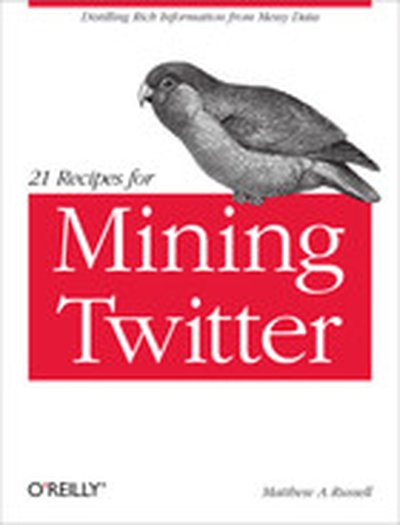
Millions of public Twitter streams harbor a wealth of data, and once you mine them, you can gain some valuable insights. This short and concise book offers a collection of recipes to help you extract nuggets of Twitter information using easy-to-learn Python tools. Each recipe offers a discussion of how and why the solution works, so you can quickly adapt it to fit your particular needs. The recipes include techniques to: Use OAuth to access Twitter data Create and analyze graphs of retweet relationships Use the streaming API to harvest tweets in realtime Harvest and analyze friends and followers Discover friendship cliques Summarize webpages from short URLs This book is a perfect companion to O’Reilly's Mining the Social Web.