Lindsay Murphy joins me to chat about whether companies are ready for AI in their data and analytics workflows. The verdict - listen and find out more :)
Lindsay's LinkedIn: https://www.linkedin.com/in/lindsaymurphy4/
 talk-data.com
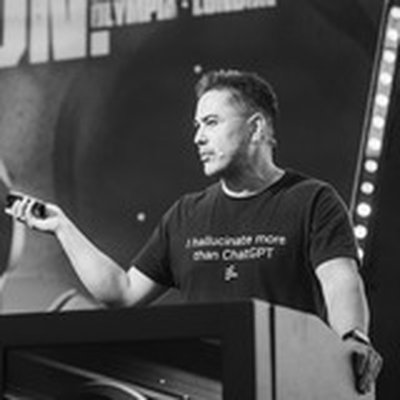
Speaker
25
talks
Joe Reis is a data professional with 20 years in the data industry, known as a "recovering data scientist" and a business-minded data nerd. His experience spans statistical modeling, forecasting, machine learning, data engineering, and data architecture. He is the co-author of Fundamentals of Data Engineering (O'Reilly, 2022).
Bio from: Small Data SF 2025
Talks & appearances
Showing 316 of 332 activities
Lindsay Murphy joins me to chat about whether companies are ready for AI in their data and analytics workflows. The verdict - listen and find out more :)
Lindsay's LinkedIn: https://www.linkedin.com/in/lindsaymurphy4/
It's not enough to know or peddle one data modeling technique these days. That's like fighting in the UFC knowing only thumb-wrestling. The world is very complicated with respect to data. To be a data practitioner, you need to be awesome in not just one, but MANY data modeling techniques. This is what I call Mixed Model Arts, which will be discussed further soon. Anyway, don't be 1-dimensional. Know a lot about a lot.
What's up with Finland and data? I think Finland might have among the strongest contingencies of data practitioners in the world. Pound for pound, Finland might rule the planet for data competencies.
I chat with the The Finnish Data Mafia, jokingly my friends who are responsible for the upcoming Helskini Data Week.
Just wrapped up a course with Sol Rashidi on transitioning your career from practitioner to leader. The notion of "success" kept recurring, so I spend this podcast unpacking it. What is success and why should you figure out what it means for you?
This wasn't the interview I expected to do. I thought I'd interview Nick Freund about his startup, Workstream. Between the time we scheduled our podcast and when we hit the record button, he shut down his company. That's a pretty major shift, to say the least.
What's it like to shut down a company? Nick discusses the various pivots of his startup, trying to raise capital in a brutal funding environment, the data tooling landscape, the process of shutting down a company, and much more.
This is an emotional episode, and I'm glad we got the opportunity to make it happen. I feel like stories like Nick's are all too common, yet rarely vocalized in the brutally honest way that Nick describes his story.
Nick's LinkedIn: https://www.linkedin.com/in/nick-from-workstream/
I've had plenty of discussions over the last couple of weeks about data teams - what are they, and how do I measure their success? I dive into a distinction I make about data teams - enterprise vs product - and some key ways to gauge them.
Doug Needham is an OG DBA and data architect who built DataOps workflows back in Desert Storm (!) and has managed to stay very current with data to today. We talk about data architecture war stories, the hard work to do generative AI in the enterprise, and much more. Enjoy!
Some things happened over the last day that I need to call out. Women and other underrepresented groups need to be treated better in tech and data. Whether it's all-male panels at conferences or mansplaining on social media, I'm pretty embarrassed and irritated by how women are treated in our industry. My message for this episode - stop being a d*ck.
Juha Korpela is a world-renowned expert in conceptual data modeling. He joins me to discuss the power of conceptual data modeling, why the data modeling world is broken today, data products, and much more.
LinkedIn: https://www.linkedin.com/in/jkorpela/
In this episode, I talk about why history matters for technology professionals. When you understand the history of technology, techniques, and approaches, you have the context to understand where they fit into your situation. Ignore history at your peril.
Yulia Pavlova (Director of Technical Innovation at Thomson Reuters) joins me to chat about the role of AI in disinformation/misinformation in the media, communicating complex topics to nontechnical people, and much more.
I personally consider the current state of the media as one of the central challenges today, and I learned a lot chatting with Yulia, who's innovating in this space.
LinkedIn: https://www.linkedin.com/in/yuliapavlovaphd/
Is data modeling a waste of time? I meet a number of people who say it is. In this episode, I dissect some of the arguments against data modeling, and give reasons why it matters more than ever today.
Safiyy Momen and I chat about the good and bad of the Modern Data Stack, controlling cloud costs, boring engineering, and much more.
LinkedIn: https://www.linkedin.com/in/safiyy-momen/
Gordon Wong and I chat about why most data teams aren't that valuable, and ways data teams can deliver more value.
Just got off the plane from Spain, and I'm quite jet lagged. Nonetheless, here's your Friday rant.
In this episode, I chat about an experience I had with someone telling me Python is a slow language. If you can't tell, I think programming language wars are dumb, and I give some reasons why.
Roman Yampolskiy is an AI safety researcher who's deeply concerned with the dangers of General Super Intelligence. We chat about why he doesn't think humanity has much time left, and what we can do about it.
Twitter: https://twitter.com/romanyam?lang=en
I'm sitting in the Amsterdam Airport (Schipol) and wrote some of my book on the flight over to Europe. In this episode, I'll talk briefly about my book writing process, and how it differs today from when I wrote Fundamentals of Data Engineering.
Jarod Santo and Adam Stacoviak from The Changelog join me for 1.5 hours of free-flowing chats about planned obscelescene, old school vs new school consumer tech, the XZ Backdoor incident, the job market doldrums (plus tips for finding work and starting a biz), and being unemployable.
Jarod and Adam are two of my favorite people to talk with, since we can literally chat about anything for hours. Enjoy!
Changelog: https://changelog.com/
In today's Practical Data Modeling group discussion, we chatted about how to get buy-in for data modeling. The question was intentionally vague, because context is key. I give some thoughts on this topic, and how you can generalize this to most situations where you need to get buy-in.
Practical Data Modeling: https://practicaldatamodeling.substack.com/
Vishnu Vasanth (e6Data) and I chat about what's next for analytical query engines, shifting left, the Indian tech scene, and much more.
Vishnu is very wise and has a very deep technical vision for where the industry needs to go. I very much agree with his vision. Enjoy!
e6Data: https://www.e6data.com/
LinkedIn: https://www.linkedin.com/in/vishnu-vasanth-5329233/
There's the interview you think you're going to have, then there's the interview you get. This is one of those, in the best way possible. I expected to chat about his time at Snowflake. We didn't even get past his early days building data warehouses because it was so fascinating. Did you know Kent is arguably one of the very first practitioners (probably an accidental inventor) of DataOps?
This is sort of a "prequel" episode. Kent Graziano and I chat about his early days as a data practitioner.
Sometimes I feel like the data world is stuck in a world of tabular data (rows and columns). This has been the data world for decades. Let's think bigger. We've moved beyond data fitting into lakes.
With the capability of AI to unlock the power of unstructured data (audio, images, video), it's time to start thinking about data oceans...
Keith Belanger is an OG data modeling practitioner, having been in the game for decades.
We chat about a wide range of data modeling topics.
What's changed and what's stayed the same? How to model data to fit the business's needs. Agile data modeling. When it works, when it doesn't. Data modeling for data mesh and decentralization. The art of data modeling How to teach conceptual data modeling to new practitioners
Keith brings a wealth of experience and a practical, no-nonsense perspective. If you're interested in data modeling, don't miss this!
LinkedIn: https://www.linkedin.com/in/krbelanger/
This morning, the Practical Data Modeling Community held its first group discussion (to be posted very soon). People from all sorts of organizations (biggest companies in the world, universities, small companies) discussed how the approach analytical data modeling.
My major takeaway - your mileage will vary. There's the ideal way of data modeling we're taught, and there's reality. Everyone's situation is different and there's no one-size-fits-all approach that will work for everyone.
The discussion was awesome, and we'll do it again soon. If you're not part of the Practical Data Modeling Community, please join here: https://practicaldatamodeling.substack.com/
Kishore Aradhya and I both teach, and we agree this is a very difficult landscape to determine what and how to teach. Against the backdrop of generative AI, we discuss the role of universities in teaching tech and data, the role of a teacher, how to teach data, and much more.
DSPY - https://github.com/stanfordnlp/dspy