talk-data.com talk-data.com

Topic

AI/ML

Artificial Intelligence/Machine Learning

data_science algorithms predictive_analytics

9014

tagged

Activity Trend

1532 peak/qtr
2020-Q1 2026-Q1

Activities

9014 activities · Newest first

As artificial intelligence reshapes the financial services landscape, modern data leaders are paving the way with empathy, innovation, and ethical clarity.  

Through personal stories, candid insights, and real-world strategies, this expert panel of Women in Data® leaders will unpack how diverse teams and inclusive leadership principles are essential to building responsible AI that reflects the customers it serves. Before leaving this session, you too will discover how passion and purpose can amplify impact in a sector too often dominated by numbers.  

Please note, this session will not be recorded so you must join us live to hear from this fantastic panel.

Powered by: Women in Data®

For years, data engineering was a story of predictable pipelines: move data from point A to point B. But AI just hit the reset button on our entire field. Now, we're all staring into the void, wondering what's next. While the fundamentals haven't changed, data remains challenging in the traditional areas of data governance, data management, and data modeling, which still present challenges. Everything else is up for grabs.

This talk will cut through the noise and explore the future of data engineering in an AI-driven world. We'll examine how team structures will evolve, why agentic workflows and real-time systems are becoming non-negotiable, and how our focus must shift from building dashboards and analytics to architecting for automated action. The reset button has been pushed. It's time for us to invent the future of our industry.

It sounds simple: “Hey AI, refresh my Salesforce data.” But what really happens when that request travels through your stack?

Using Airbyte’s architecture as a model, this talk explores the complexity behind natural language data triggers - from spinning up connectors and handling credentials, to enforcing access controls and orchestrating safe, purpose-driven movement. We’ll introduce a unified framework for thinking about all types of data movement, from bulk ingestion to fine-grained activation - a model we’ve developed to bring clarity to a space crowded with overlapping terms and toolchains.

We’ll also explore how this foundation—and any modern data movement platform—must evolve for an AI-native world, where speed, locality, and security are non-negotiable. That includes new risks: leaking credentials into LLMs, or triggering unintended downstream effects from a single prompt.

We’ll close with a live demo: spinning up a local data plane and moving data via Airbyte—simply by chatting with a bot.

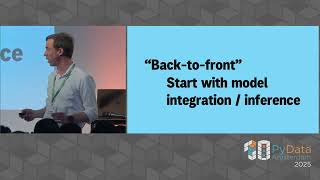
Flip the Plan: Fast-Track Your AI/ML Model Integration with a Back-to-Front Implementation Strategy

"How quickly will you be able to get this model into production?" is a common question in analytical projects. Often, this is the first time anyone considers the complexities of deploying models within enterprise systems.

This talk introduces an approach to enhance the success rate of complex AI/ML integration projects while reducing time-to-market. Using examples from global banks J.P. Morgan and ING, we will demonstrate team organisation and engineering patterns to achieve this.

This talk is ideal for data scientists, engineers, and product managers interested in adopting an efficient Model Development Lifecycle (MDLC).

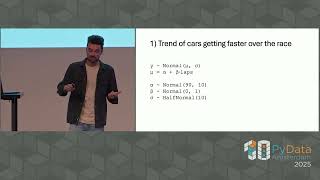
Formula 1 goes Bayesian: Time Series Decomposition with PyMC

Forecasting time series can be messy, data is often missing, noisy, or full of structural changes like holidays, outliers, or evolving patterns. This talk shows how to build interpretable time series decomposition models using PyMC, a modern probabilistic programming library.

We’ll break time series into trend, seasonality, and noise components using engineered time features (e.g., Fourier and Radial Basis Functions). You’ll also learn how to model correlated series using hierarchical priors, letting multiple time series "learn from each other." As a case study, we’ll analyze Formula 1 lap time data to compare drivers and explore performance consistency using Bayesian posteriors.

This is a hands-on, code-first talk for data scientists, ML engineers, and researchers curious about Bayesian modeling (or Formula 1). Familiarity with Python and basic statistics is helpful, but no deep knowledge of Bayes is required.

Governing generative AI systems presents unique challenges, particularly for teams dealing with diverse GenAI subdomains and rapidly changing technological landscapes. In this talk, Maarten de Ruiter, Data Scientist at Xomnia, shares practical insights drawn from real-world GenAI use-cases. He will highlight essential governance patterns, address common pitfalls, and provide actionable strategies for teams utilizing both open-source tools and commercial solutions. Attendees will gain concrete recommendations that work in practice, informed by successes (and failures!) across multiple industries

Data literacy and AI literacy are becoming essential skills in today's digital landscape. As organizations collect more data and deploy AI solutions, the ability to understand, interpret, and make decisions with these tools is increasingly valuable. But how do we develop these skills effectively across an organization? What does successful implementation of data and AI literacy programs look like in practice? The journey to becoming data literate doesn't require becoming a data scientist—it's about building confidence and comfort with data in your specific role. From change management strategies to measuring real value, understanding how to foster these skills can transform both individual careers and organizational outcomes. Jordan Morrow is known as the "Godfather of Data Literacy," having helped pioneer and invent the entire field. He is also the founder and CEO of Bodhi Data and currently is the Senior Vice President of Data & AI Transformation for AgileOne, helping to utilize data and AI in the total talent management space.

Jordan is a global trailblazer in the world of data literacy and enjoys his time traveling the world speaking and/or helping companies. He served as the Chair of the Advisory Board for The Data Literacy Project, has spoken at numerous conferences around the world, and is an active voice in the data and analytics community. He has also helped companies and organizations around the world, including the United Nations, build and/or understand data literacy.

In the episode, Richie and Jordan explore the progress and challenges in data literacy, the integration of AI literacy, the importance of storytelling and decision-making in data training, how organizations can foster a data-driven culture, practical tips for using AI in meetings and personal productivity, and much more.

Links Mentioned in the Show: Pre-order Jordan’s upcoming book - Data and AI Skills: Gain the Confidence You Need to SucceedJordan’s BooksConnect with JordanDataCamp Webinar Featuring the Godparents of Data Literacy - Jordan Morrow and Valerie LoganRelated Episode: Scaling Responsible AI Literacy with Uthman Ali, Global Head of Responsible AI at BPRewatch RADAR AI 

New to DataCamp? Learn on the go using the DataCamp mobile app Empower your business with world-class data and AI skills with DataCamp for business

According to MIT, 95% of organisations are seeing no return from their GenAI investments. Why? Because value doesn’t come from models alone. It comes from trust, governance, and people. Learn how organisations are breaking through the hype using Microsoft Fabric to unify data, Purview to govern it, and Copilot to empower every user. With a real-world customer story and a clear blueprint for action, this session will help you join the 5% who are turning AI ambition into impact.

The age of autonomous agents is here, and it’s moving fast. Gartner predicts that 70% of organizations will deploy AI agents this year to automate complex business processes. But as technology vendors promise exponential productivity, data leaders face a new reality: when every team member can command thousands of digital workers, who’s really in control?

Join Dael and Robin for a candid, entertaining fireside chat as they tackle the tough questions every CDO, CTO, and CIO should be asking. How do you keep oversight when agents are making split-second decisions at scale? What new risks (ethical, operational, and reputational) emerge when AI agents go rogue? And how do you build a data strategy that balances innovation with accountability?

Using real-world stories, surprising data points, and a dash of humour, this session will help you rethink how you buy, build, and govern technology in the age of agentic business. Whether you’re already deploying agents or just starting to explore, you’ll leave with practical insights to avoid the pitfalls, and harness the promise of this next frontier.