talk-data.com talk-data.com

Topic

AI/ML

Artificial Intelligence/Machine Learning

data_science algorithms predictive_analytics

9014

tagged

Activity Trend

1532 peak/qtr
2020-Q1 2026-Q1

Activities

9014 activities · Newest first

Legacy data tools weren’t built for the AI era. Agentic Data Management replaces static rules and siloed platforms with intelligent agents that monitor, reason, and act—automating quality, governance, and lineage at scale. Discover how data leaders are shifting from manual firefighting to autonomous control, powering faster, trusted, and scalable data for AI and analytics.

- See a live demo of an agentic system in action

- Learn how probabilistic and deterministic approaches work in concert

- Explore how to build intelligent data products using the MCP protocol

As enterprises scale their deployment of Generative AI (Gen AI), a central constraint has come into focus: the primary limitation is no longer model capability, but data infrastructure. Existing platforms, optimized for human interpretation and batch-oriented analytics, are misaligned with the operational realities of autonomous agents that consume, reason over, and act upon data continuously at machine scale. 

In this talk, Zhamak Dehghani — originator of the Data Mesh and a leading advocate for decentralized data architectures — presents a framework for data infrastructure designed explicitly for the AI-native era. She identifies the foundational capabilities required by Gen AI applications: embedded semantics, runtime computational policy enforcement, agent-centric, context-driven discovery.

The session contrasts the architectural demands of AI with the limitations of today’s fragmented, pipeline-driven systems—systems that rely heavily on human intervention and customized orchestration. Dehghani introduces autonomous data products as the next evolution: self-contained, self-governing services that continuously sense and respond to their environment. She offers an architectural deep dive and showcases their power with real-world use cases.  

Attendees will learn the architecture of “Data 3.0”, and how to both use GenAI to transform to this new architecture, and how this new architecture serves GenAI agents at scale.

Join Sami Hero and Tammie Coles, as they share how Ellie is reinventing data modeling with AI-native tools that empower both technical and non-technical users. With CData Embedded Cloud, Ellie brings live metadata and data models from systems like Snowflake, Databricks, and Oracle Financials into a unified modeling workspace. Their platform translates legacy structures into human-readable insights, letting users interact with a copilot-style assistant to discover, refine, and maintain data models faster—with less reliance on analysts.

You’ll see how Ellie uses generative AI to recommend new entities, reconcile differences between models and live systems, and continuously document evolving data environments. Learn how corporations are using Ellie and CData together to scale high-quality data modeling across teams. reducing rework, accelerating delivery of analytics-ready models, and making enterprise architecture accessible to the business.

The world of data is undergoing a seismic shift. From increasing scale & concurrency, to increasing technical complexity, increasing compliance scrutiny, and all this in the face of supporting the data-ravenous AI revolution.

So how do you deliver the right data to the right place at the right time whilst still maintaining control & accountability in increasingly regulated environments?

In this session, we’ll explore how the Starburst data platform delivers faster time to insights whilst breaking down data silos, serving data to & tightly integrating with GenAI & Agents at velocity, and achieving all this within the tight constraints of a well-governed architecture that meets regulatory compliance demands.

Data teams know the pain of moving from proof-of-concepts to production. We’ve all seen brittle scripts, one-off notebooks, and manual fixes turn into hidden risks. With large language models, the same story is playing out, unless we borrow the lessons of modern data engineering.

This talk introduces a declarative approach to LLM engineering using DSPy and Dagster. DSPy treats prompts, retrieval strategies, and evaluation metrics as first-class, composable building blocks. Instead of tweaking text by hand, you declare the behavior you want, and DSPy optimizes and tunes the pipeline for you. Dagster is built on a similar premise; with Dagster Components, you can build modular and declarative pipelines.

This approach means:

- Trust & auditability: Every LLM output can be traced back through a reproducible graph.

- Safety in production: Automated evaluation loops catch drift and regressions before they matter.

- Scalable experimentation: The same declarative spec can power quick tests or robust, HIPAA/GxP-grade pipelines.

By treating LLM workflows like data pipelines: declarative, observable, and orchestrate, we can avoid the prompt spaghetti trap and build AI systems that meet the same reliability bar as the rest of the stack.

AI is only as strong as the data beneath it. Yet most enterprises still rely on fragmented tools and reactive processes that undermine trust. The result: innovation that looks impressive in demos but collapses under real-world pressure. In this keynote, Salma Bakouk, CEO of Sifflet, argues that metadata, not models, is the true foundation for the AI era. By building a metadata control plane enriched with agentic observability, enterprises can move from reactive patchwork to proactive intelligence. In this keynote, she offers a provocative vision of where the market is heading, what traditional approaches are getting wrong, and why the winners of the AI economy will be those who treat trust not as insurance, but as infrastructure.

The Generative AI revolution is here, but so is the operational headache. For years, teams have matured their MLOps practices for traditional models, but the rapid adoption of LLMs has introduced a parallel, often chaotic, world of LLMOps. This results in fragmented toolchains, duplicated effort, and a state of "Ops Overload" that slows down innovation.

This session directly confronts this challenge. We will demonstrate how a unified platform like Google Cloud's Vertex AI can tame this complexity by providing a single control plane for the entire AI lifecycle.

We are entering the Era of Experience, where AI agents will transform customer journeys by learning directly from interactions. But most customer-facing agents today are “senseless,” lacking the real-time context needed to deliver relevant, empathetic, and valuable experiences. This session will explore how real-time streaming architectures and proprietary customer data can power the next generation of intelligent, perceptive agents.

Join Snowplow’s Jon Su as he unpacks:

  • Why brands risk commoditization if they rely on third-party agents
  • How real-time context enables smarter, more personalized customer interactions
  • The key ingredients for building agents that perceive, adapt, and self-optimize
  • How Snowplow Signals provides the real-time customer intelligence foundation for agentic applications

Discover how to shift from static personalization to adaptive, agent-driven experiences that improve customer satisfaction, loyalty, and business outcomes.

How do you prepare a global industrial business for AI? At Secil, the answer was data governance. In this session, Ricardo Carvalho shares how the team replaced siloed systems with a unified data platform using Domo, delivering enterprise-level analytics, smarter operations, and a foundation for scalable AI that drives real outcomes in just 18 months.

Millions has been poured into data and AI, but the returns often fall short of the promise. In this fireside chat, Jason Foster and Helen Louwrens will get under the skin of the ROI gap - why business cases can feel like guesswork, who should really own the number, and the messy politics of attributing value. We’ll also tackle the tough question: how to meaningfully measure ROI on data investments despite the challenges, and explore whether the gap can ever truly be closed, or if we need to rethink what “value” really means.

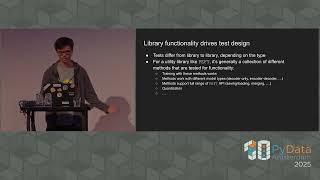
Designing tests for ML libraries – lessons from the wild

In this talk, we will cover how to write effective test cases for machine learning (ML) libraries that are used by hundreds of thousands of users on a regular basis. Tests, despite their well-established need for trust and foolproofing, often get less prioritized. Later, this can wreak havoc on massive codebases, with a high likelihood of introducing breaking changes and other unpleasant situations. This talk deals with our approach to testing our ML libraries, which serve a wide user base. We will cover a wide variety of topics, including the mindset and the necessity of minimal-yet-sufficient testing, all the way up to sharing some practical examples of end-to-end test suites.

AI innovation is accelerating, and your opportunity to lead is here. With the upcoming arrival of Dell Pro Max with GB10, powered by NVIDIA Grace Blackwell architecture, you no longer have to wait for the future of AI development; you can experience it first, right at your desk.

Join this session to discover how purpose-built, enterprise-class AI compute, compact enough for your workspace, yet powerful enough to drive breakthrough results, can transform your organisation’s AI productivity

Data is one of the most valuable assets in any organisation, but accessing and analysing it has been limited to technical experts. Business users often rely on predefined dashboards and data teams to extract insights, creating bottlenecks and slowing decision-making.

This is changing with the rise of Large Language Models (LLMs) and Retrieval-Augmented Generation (RAG). These technologies are redefining how organisations interact with data, allowing users to ask complex questions in natural language and receive accurate, real-time insights without needing deep technical expertise.

In this session, I’ll explore how LLMs and RAG are driving true data democratisation by making analytics accessible to everyone, enabling real-time insights with AI-powered search and retrieval and overcoming traditional barriers like SQL, BI tool complexity, and rigid reporting structures.

Buckle up for a bold ride into the future of performance intelligence. In this session, Keyloop - one of the world’s top digital innovators in automotive retail shares how it’s putting data in the driver’s seat to revolutionise decision-making.

Powered by ThoughtSpot and AWS first-party technologies, get an inside look at VEGA, their next-gen AI-powered performance intelligence platform. No dashboards. No bottlenecks. Just real-time, actionable insights that surface hidden issues, suggest smarter actions, and boost performance, profit, and customer experience.

If you're ready to see what happens when AI meets speed, scale, and simplicity, this is your green light.

Want to get your GenAI idea noticed? Databricks engineers share their hands-on experiences building interactive demos that actually made business leaders sit up and take notice.

We’ll walk through the journey from a single idea to a working prototype in under a month. Hear how we did it, what worked, what didn’t, including the unexpected hurdles that tripped us up, by taking a practical look at how to:

  • Translate technical impact into business value
  • Make your voice heard in large dev teams
  • Avoid common pitfalls, from permissions to procurement

If you’re a data scientist, engineer, or AI leader who wants to move fast and make your work impossible to ignore, join us to explore how you could create the Minimum Viable Product that makes you the Most Valuable Player.

As data’s changing landscape continually transforms how we work, the real challenge is preparing our people to keep pace. In this lively panel, Women in Data® leaders from Kingfisher and Travis Perkins, moderated by PA Consulting, share how they are building the skills, mindsets, and cultures needed for a data-led and AI-driven future.  

From practical upskilling to shifting behaviours, expect candid insights, lessons learned, and fresh ideas to help your teams stay ahead. 

Powered by: Women in Data®