
talk-data.com talk-data.com

Topic

Java

programming_language object_oriented enterprise

23

tagged

Activity Trend

25 peak/qtr
2020-Q1 2026-Q1

Activities

Showing filtered results

Filtering by: O'Reilly Data Science Books ×
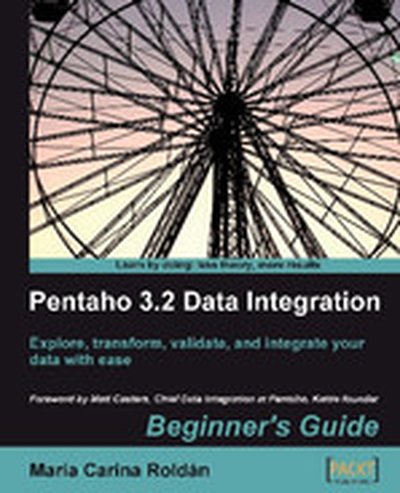
Pentaho 3.2 Data Integration Beginner's Guide

Explore, transform, validate, and integrate your data with ease Get started with Pentaho Data Integration from scratch. Enrich your data transformation operations by embedding Java and JavaScript code in PDI transformations. Create a simple but complete Datamart Project that will cover all key features of PDI. Part of Packt's Beginner's Guide series: Each task gradually develops from the previous task with an organized sequence of instructions accompanied with relevant explanation and a set of challenging tasks that the reader will be able to accomplish. In Detail Pentaho Data Integration (a.k.a. Kettle) is a full-featured open source ETL (Extract, Transform, and Load) solution. Although PDI is a feature-rich tool, effectively capturing, manipulating, cleansing, transferring, and loading data can get complicated. This book is full of practical examples that will help you to take advantage of Pentaho Data Integration's graphical, drag-and-drop design environment. You will quickly get started with Pentaho Data Integration by following the step-by-step guidance in this book. The useful tips in this book will encourage you to exploit powerful features of Pentaho Data Integration and perform ETL operations with ease. Starting with the installation of the PDI software, this book will teach you all the key PDI concepts. Each chapter introduces new features, allowing you to gradually get involved with the tool. First, you will learn to work with plain files, and to do all kinds of data manipulation. Then, the book gives you a primer on databases and teaches you how to work with databases inside PDI. Not only that, you'll be given an introduction to data warehouse concepts and you will learn to load data in a data warehouse. After that, you will learn to implement simple and complex processes. Once you've learned all the basics, you will build a simple datamart that will serve to reinforce all the concepts learned through the book. A practical, easy-to-read guide that gives you full understanding of the Pentaho Data Integration tool and shows you how to use it to your advantage to manipulate data

Integrating and Extending BIRT

A new edition of this title is available, ISBN-10: 0321580303 ISBN-13: 9780321580306 The second of a two-book series about business intelligence and reporting technology, introduces programmers to BIRT architecture and the reporting framework. Built on the Eclipse platform, this exciting technology makes it possible for programmers to build and deploy customized reports using scripting and BIRT APIs. In addition, programmers can extend the BIRT framework by building new plug-ins using the Eclipse Plug-in Development Environment. Integrating and Extending BIRT This book describes the key components of BIRT architecture, applications, and engines, including installing, deploying, and troubleshooting the Reporting and Charting engines in an Enterprise Java application-server environment.For developers who wish to incorporate custom business logic in their reports or access data from Java objects, the book describes BIRT's extensive scripting capabilities in JavaScript and Java. For developers who want to extend the BIRT framework, the book describes the key extension points to use in creating customized report items, rendering extensions for generating output other than HTML or PDF, and Open Data Access (ODA) drivers for new data sources. The book provides extensive examples of how to build plug-ins to extend the features of the BIRT framework. Topics discussed include Installing and deploying BIRT Deploying a BIRT report to an application server Understanding BIRT architecture Scripting in a BIRT report design Integrating BIRT functionality in applications Working with the BIRT extension framework

Fuzzy Modeling and Genetic Algorithms for Data Mining and Exploration

Fuzzy Modeling and Genetic Algorithms for Data Mining and Exploration is a handbook for analysts, engineers, and managers involved in developing data mining models in business and government. As you’ll discover, fuzzy systems are extraordinarily valuable tools for representing and manipulating all kinds of data, and genetic algorithms and evolutionary programming techniques drawn from biology provide the most effective means for designing and tuning these systems. You don’t need a background in fuzzy modeling or genetic algorithms to benefit, for this book provides it, along with detailed instruction in methods that you can immediately put to work in your own projects. The author provides many diverse examples and also an extended example in which evolutionary strategies are used to create a complex scheduling system. Written to provide analysts, engineers, and managers with the background and specific instruction needed to develop and implement more effective data mining systems Helps you to understand the trade-offs implicit in various models and model architectures Provides extensive coverage of fuzzy SQL querying, fuzzy clustering, and fuzzy rule induction Lays out a roadmap for exploring data, selecting model system measures, organizing adaptive feedback loops, selecting a model configuration, implementing a working model, and validating the final model In an extended example, applies evolutionary programming techniques to solve a complicated scheduling problem Presents examples in C, C++, Java, and easy-to-understand pseudo-code Extensive online component, including sample code and a complete data mining workbench