talk-data.com talk-data.com

Event

O'Reilly SQL Books

2002-09-10 – 2026-08-25 Oreilly Visit website ↗

Activities tracked

32

Collection of O'Reilly books on SQL.

Filtering by: Oracle ×

Sessions & talks

Showing 26–32 of 32 · Newest first

Search within this event →
SQL Injection Attacks and Defense, 2nd Edition

SQL Injection Attacks and Defense, First Edition: Winner of the Best Book Bejtlich Read Award "SQL injection is probably the number one problem for any server-side application, and this book unequaled in its coverage." –Richard Bejtlich, Tao Security blog SQL injection represents one of the most dangerous and well-known, yet misunderstood, security vulnerabilities on the Internet, largely because there is no central repository of information available for penetration testers, IT security consultants and practitioners, and web/software developers to turn to for help. SQL Injection Attacks and Defense, Second Edition is the only book devoted exclusively to this long-established but recently growing threat. This is the definitive resource for understanding, finding, exploiting, and defending against this increasingly popular and particularly destructive type of Internet-based attack. SQL Injection Attacks and Defense, Second Edition includes all the currently known information about these attacks and significant insight from its team of SQL injection experts, who tell you about: Understanding SQL Injection – Understand what it is and how it works Find, confirm and automate SQL injection discovery Tips and tricks for finding SQL injection within code Create exploits for using SQL injection Design apps to avoid the dangers these attacks SQL injection on different databases SQL injection on different technologies SQL injection testing techniques Case Studies Securing SQL Server, Second Edition is the only book to provide a complete understanding of SQL injection, from the basics of vulnerability to discovery, exploitation, prevention, and mitigation measures Covers unique, publicly unavailable information, by technical experts in such areas as Oracle, Microsoft SQL Server, and MySQL---including new developments for Microsoft SQL Server 2012 (Denali) Written by an established expert, author, and speaker in the field, with contributions from a team of equally renowned creators of SQL injection tools, applications, and educational materials
Learning SQL, 2nd Edition

Updated for the latest database management systems -- including MySQL 6.0, Oracle 11g, and Microsoft's SQL Server 2008 -- this introductory guide will get you up and running with SQL quickly. Whether you need to write database applications, perform administrative tasks, or generate reports, Learning SQL, Second Edition, will help you easily master all the SQL fundamentals. Each chapter presents a self-contained lesson on a key SQL concept or technique, with numerous illustrations and annotated examples. Exercises at the end of each chapter let you practice the skills you learn. With this book, you will: Move quickly through SQL basics and learn several advanced features Use SQL data statements to generate, manipulate, and retrieve data Create database objects, such as tables, indexes, and constraints, using SQL schema statements Learn how data sets interact with queries, and understand the importance of subqueries Convert and manipulate data with SQL's built-in functions, and use conditional logic in data statements Knowledge of SQL is a must for interacting with data. With Learning SQL, you'll quickly learn how to put the power and flexibility of this language to work.

SQL in a Nutshell, 3rd Edition

For programmers, analysts, and database administrators, SQL in a Nutshell is the essential reference for the SQL language used in today's most popular database products. This new edition clearly documents every SQL command according to the latest ANSI standard, and details how those commands are implemented in Microsoft SQL Server 2008, Oracle 11g, and the MySQL 5.1 and PostgreSQL 8.3 open source database products. You'll also get a concise overview of the Relational Database Management System (RDBMS) model, and a clear-cut explanation of foundational RDBMS concepts -- all packed into a succinct, comprehensive, and easy-to-use format. This book provides: Background on the Relational Database Model, including current and previous SQL standards Fundamental concepts necessary for understanding relational databases and SQL commands An alphabetical command reference to SQL statements, according to the SQL2003 ANSI standard The implementation of each command by MySQL, Oracle, PostgreSQL, and SQL Server An alphabetical reference of the ANSI SQL2003 functions, as well as the vendor implementations Platform-specific functions unique to each implementation Beginning where vendor documentation ends, SQL in a Nutshell distills the experiences of professional database administrators and developers who have used SQL variants to support complex enterprise applications. Whether SQL is new to you, or you've been using SQL since its earliest days, you'll get lots of new tips and techniques in this book.

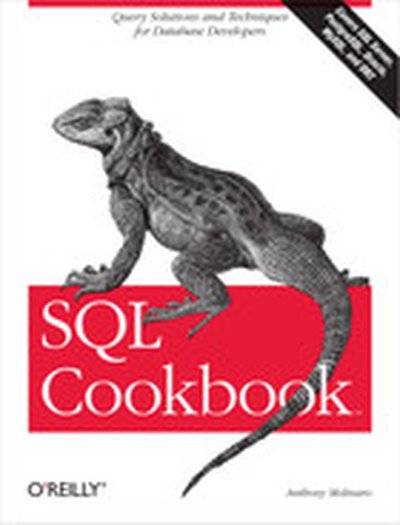
SQL Cookbook

You know the rudiments of the SQL query language, yet you feel you aren't taking full advantage of SQL's expressive power. You'd like to learn how to do more work with SQL inside the database before pushing data across the network to your applications. You'd like to take your SQL skills to the next level. Let's face it, SQL is a deceptively simple language to learn, and many database developers never go far beyond the simple statement: SELECT columns FROM table WHERE conditions. But there is so much more you can do with the language. In the SQL Cookbook, experienced SQL developer Anthony Molinaro shares his favorite SQL techniques and features. You'll learn about: Window functions, arguably the most significant enhancement to SQL in the past decade. If you're not using these, you're missing out Powerful, database-specific features such as SQL Server's PIVOT and UNPIVOT operators, Oracle's MODEL clause, and PostgreSQL's very useful GENERATE_SERIES function Pivoting rows into columns, reverse-pivoting columns into rows, using pivoting to facilitate inter-row calculations, and double-pivoting a result set Bucketization, and why you should never use that term in Brooklyn. How to create histograms, summarize data into buckets, perform aggregations over a moving range of values, generate running-totals and subtotals, and other advanced, data warehousing techniques The technique of walking a string, which allows you to use SQL to parse through the characters, words, or delimited elements of a string Written in O'Reilly's popular Problem/Solution/Discussion style, the SQL Cookbook is sure to please. Anthony's credo is: "When it comes down to it, we all go to work, we all have bills to pay, and we all want to go home at a reasonable time and enjoy what's still available of our days." The SQL Cookbook moves quickly from problem to solution, saving you time each step of the way.

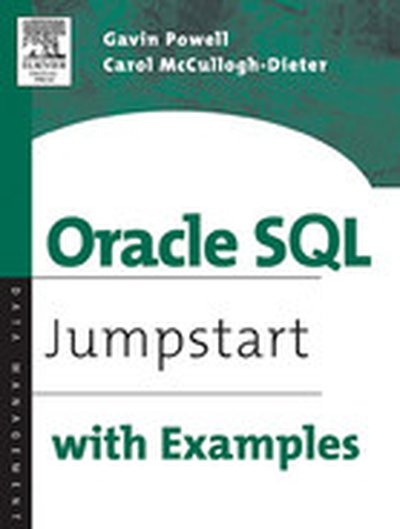
Oracle SQL

Developers and DBAs use Oracle SQL coding on a daily basis, whether for application development, finding problems, fine-tuning solutions to those problems, or other critical DBA tasks. Oracle SQL: Jumpstart with Examples is the fastest way to get started and to quickly locate answers to common (and uncommon) questions. It includes all the basic queries: filtering, sorting, operators, conditionals, pseudocolumns, single row functions, joins, grouping and summarizing, grouping functions, subqueries, composite queries, hierarchies, flashback queries, parallel queries, expressions and regular expressions, DML, datatypes (including collections), XML in Oracle, DDL for basic database objects such as tales, views and indexes, Oracle Partitioning, security, and finally PL/SQL. * Each of the hundreds of SQL code examples was tested on a working Oracle 10g database * Invaluable everyday tool that provides an absolute plethora of properly tested examples of Oracle SQL code * Authors have four decades of commercial experience between them as developers and database administrators

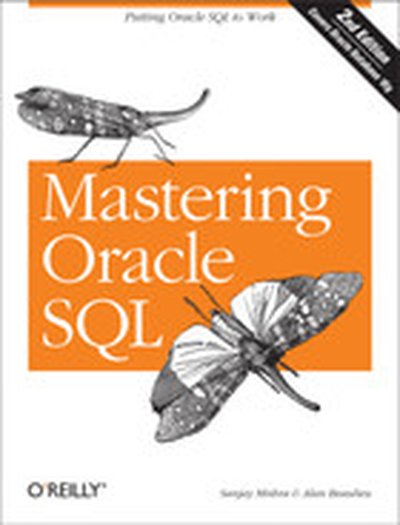
Mastering Oracle SQL, 2nd Edition

The vast majority of Oracle SQL books discuss some syntax, provide the barest rudiments of using Oracle SQL, and perhaps include a few simple examples. It might be enough to pass a survey course, or give you some buzz words to drop in conversation with real Oracle DBAs. But if you use Oracle SQL on a regular basis, you want much more. You want to access the full power of SQL to write queries in an Oracle environment. You want a solid understanding of what's possible with Oracle SQL, creative techniques for writing effective and accurate queries, and the practical, hands-on information that leads to true mastery of the language. Simply put, you want useful, expert best practices that can be put to work immediately, not just non-vendor specific overview or theory.Updated to cover the latest version of Oracle, Oracle 10g, this edition of the highly regarded Mastering Oracle SQL has a stronger focus on technique and on Oracle's implementation of SQL than any other book on the market. It covers Oracle s vast library of built-in functions, the full range of Oracle SQL query-writing features, regular expression support, new aggregate and analytic functions, subqueries in the SELECT and WITH clauses, multiset union operators, enhanced support for hierarchical queries: leaf and loop detection, and the CONNECT_BY_ROOT operator, new partitioning methods (some introduced in Oracle9i Release 2), and the native XML datatype, XMLType. Mastering Oracle SQL, 2nd Edition fills the gap between the sometimes spotty vendor documentation, and other books on SQL that just don't explore the full depth of what is possible with Oracle-specific SQL. For those who want to harness the untapped (and often overlooked) power of Oracle SQL, this essential guide for putting Oracle SQL to work will prove invaluable.

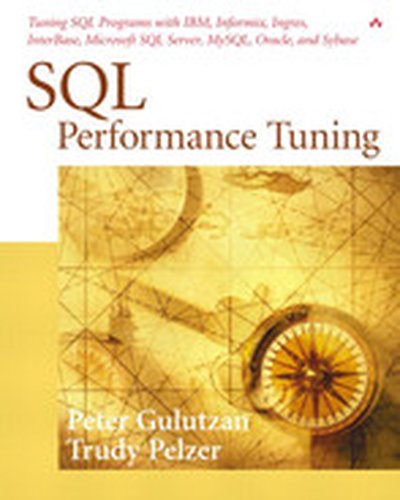
SQL Performance Tuning

is a handbook of practical solutions for busy database professionals charged with managing an organization's critically important data. Covering today's most popular and widely installed database environments, this book is an indispensable resource for managing and tuning SQL across multiple platforms. SQL Performance Tuning Packed with tips, techniques, and best practices, this hands-on guide covers SQL commands and queries over a wide range of conditions and environments. Every facet of the SQL environment is covered, from concurrency control to optimization—and every issue in between. The book includes an overview of each of the most widely used database management systems (DBMS) and provides tuning tips for common day-to-day situations. Topics covered include: General and specific tuning General sort considerations and options Joins and subqueries Columns and tables Indexes, including B-trees and bitmaps Constraints and stored procedures ODBC and JDBC Data changes and concurrency control (locking) Clients, servers, and middleware Whether you are a programmer, consultant, or user, you will find SQL Performance Tuning an indispensable guide to optimizing SQL performance across today's popular database environments. Throughout , ideas and techniques are tested on a variety of popular SQL environments, including IBM DB2, Informix, Ingres, InterBase, Microsoft SQL Server, MySQL, Oracle, and Sybase ASE. The book's practical examples are written in ANSI/ISO Standard SQL: 1999. SQL Performance Tuning