
talk-data.com talk-data.com

Event

PyData Boston 2025

2025-12-08 – 2025-12-10 PyData

Activities tracked

3

Filtering by: Data Science ×

Sessions & talks

Showing 1–3 of 3 · Newest first

Search within this event →
How AI Is Transforming Data Careers — A Panel Discussion

How AI Is Transforming Data Careers — A Panel Discussion

2025-12-10 Watch
talk

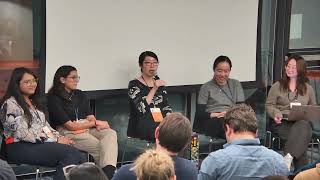
AI is transforming data careers. Roles once centered on modeling and feature engineering are evolving into positions that involve building AI products, crafting prompts, and managing workflows shaped by automation and augmentation. In this panel discussion, ambassadors from Women in Data Science (WiDS) share how they have adapted through this shift—turning personal experiments into company practices, navigating uncertainty, and redefining their professional identities. They’ll also discuss how to future-proof your career by integrating AI into your daily work and career growth strategy. Attendees will leave with a clearer view of how AI is reshaping data careers and practical ideas for how to evolve their own skills, direction, and confidence in an era where AI is not replacing, but redefining, human expertise.
Accelerating Geospatial Analysis with GPUs

Accelerating Geospatial Analysis with GPUs

2025-12-10 Watch
talk

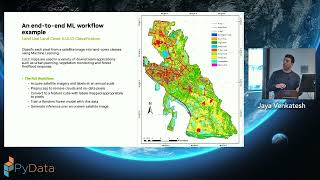
Geospatial analysis often relies on raster data, n‑dimensional arrays where each cell holds a spatial measurement. Many raster operations, such as computing indices, statistical analysis, and classification, are naturally parallelizable and ideal for GPU acceleration.

This talk demonstrates an end‑to‑end GPU‑accelerated semantic segmentation pipeline for classifying satellite imagery into multiple land cover types. Starting with cloud-hosted imagery, we will process data in chunks, compute features, train a machine learning model, and run large-scale predictions. This process is accelerated with the open-source RAPIDS ecosystem, including Xarray, cuML, and Dask, often requiring only minor changes to familiar data science workflows.

Attendees who work with raster data or other parallelizable, computationally intensive workflows will benefit most from this talk, which focuses on GPU acceleration techniques. While the talk draws from geospatial analysis, key geospatial concepts will be introduced for beginners. The methods demonstrated can be applied broadly across domains to accelerate large-scale data processing.

The Lifecycle of a Jupyter Environment: From Exploration to Production-Grade Pipelines

2025-12-09
talk

Most data science projects start with a simple notebook—a spark of curiosity, some exploration, and a handful of promising results. But what happens when that experiment needs to grow up and go into production?

This talk follows the story of a single machine learning exploration that matures into a full-fledged ETL pipeline. We’ll walk through the practical steps and real-world challenges that come up when moving from a Jupyter notebook to something robust enough for daily use.

We’ll cover how to:

  • Set clear objectives and document the process from the beginning
  • Break messy notebook logic into modular, reusable components
  • Choose the right tools (Papermill, nbconvert, shell scripts) based on your workflow—not just the hype
  • Track environments and dependencies to make sure your project runs tomorrow the way it did today
  • Handle data integrity, schema changes, and even evolving labels as your datasets shift over time

And as a bonus: bring your results to life with interactive visualizations using tools like PyScript, Voila, and Panel + HoloViz