
talk-data.com talk-data.com

Event

PyData Boston 2025

2025-12-08 – 2025-12-10 PyData

Activities tracked

3

Filtering by: Data Engineering ×

Sessions & talks

Showing 1–3 of 3 · Newest first

Search within this event →

Data engineering with Python the right way: introducing the composable, Python-native data stack

2025-12-10
talk

For the past decade, SQL has reigned king of the data transformation world, and tools like dbt have formed a cornerstone of the modern data stack. Until recently, Python-first alternatives couldn't compete with the scale and performance of modern SQL. Now Ibis can provide the same benefits of SQL execution with a flexible Python dataframe API.

In this talk, you will learn how Ibis supercharges open-source libraries like Kedro, Pandera, and the Boring Semantic Layer and how you can combine these technologies (and a few more) to build and orchestrate scalable data engineering pipelines without sacrificing the comfort (and other advantages) of Python.
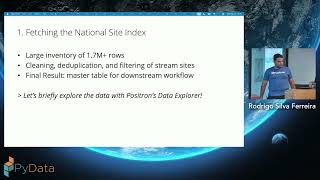
When Rivers Speak: Analyzing Massive Water Quality Datasets using USGS API and Remote SSH in Positron

When Rivers Speak: Analyzing Massive Water Quality Datasets using USGS API and Remote SSH in Positron

2025-12-10 Watch
talk

Rivers have long been storytellers of human history. From the Nile to the Yangtze, they have shaped trade, migration, settlement, and the rise of civilizations. They reveal the traces of human ambition... and the costs of it. Today, from the Charles to the Golden Gate, US rivers continue to tell stories, especially through data.

Over the past decades, extensive water quality monitoring efforts have generated vast public datasets: millions of measurements of pH, dissolved oxygen, temperature, and conductivity collected across the country. These records are more than environmental snapshots; they are archives of political priorities, regulatory choices, and ecological disruptions. Ultimately, they are evidence of how societies interact with their environments, often unevenly.

In this talk, I’ll explore how Python and modern data workflows can help us "listen" to these stories at scale. Using the United States Geological Survey (USGS) Water Data APIs and Remote SSH in Positron, I’ll process terabytes of sensor data spanning several years and regions. I’ll demonstrate that, while Parquet and DuckDB enable scalable exploration of historical records, using Remote SSH is paramount in order to enable large-scale data analysis. By doing so, I hope to answer some analytical questions that can surface patterns linked to industrial growth, regulatory shifts, and climate change.

By treating rivers as both ecological systems and social mirrors, we can begin to see how environmental data encodes histories of inequality, resilience, and transformation.

Whether your interest lies in data engineering, environmental analytics, or the human dimensions of climate and infrastructure, this talk will explore topics at the intersection of environmental science, will offer both technical methods and sociological lenses to understand the stories rivers continue to tell.

From Notebook to Pipeline: Hands-On Data Engineering with Python

From Notebook to Pipeline: Hands-On Data Engineering with Python

2025-12-08 Watch
talk

In this hands-on tutorial, you'll go from a blank notebook to a fully orchestrated data pipeline built entirely in Python, all in under 90 minutes. You'll learn how to design and deploy end-to-end data pipelines using familiar notebook environments, using Python for your data loading, data transformations, and insights delivery.

We'll dive into the Ingestion-Tranformation-Delivery (ITD) framework for building data pipelines: ingest raw data from cloud object storage, transform the data using Python DataFrames, and deliver insights via a Streamlit application.

Basic familiarity with Python (and/or SQL) is helpful, but not required. By the end of the session, you'll understand practical data engineering patterns and leave with reusable code templates to help you build, orchestrate, and deploy data pipelines from notebook environments.