talk-data.com talk-data.com

G

Speaker

Guy Harrison

7

talks

author

Frequent Collaborators

Filter by Event / Source

Talks & appearances

7 activities · Newest first

Search activities →
CockroachDB: The Definitive Guide, 2nd Edition

CockroachDB is the distributed SQL database that handles the demands of today's data-driven applications. The second edition of this popular hands-on guide shows software developers, architects, and DevOps/SRE teams how to use CockroachDB for applications that scale elastically and provide seamless delivery for end users while remaining indestructible. Data professionals will learn how to migrate existing applications to CockroachDB's performant, cloud-native data architecture. You'll also quickly discover the benefits of strong data correctness and consistency guarantees, plus optimizations for delivering ultra-low latencies to globally distributed end users. Uncover the power of distributed SQL Learn how to start, manage, and optimize projects in CockroachDB Explore best practices for data modeling, schema design, and distributed infrastructure Discover strategies for migrating data into CockroachDB See how to read, write, and run ACID transactions across distributed systems Maximize resiliency in multiregion clusters Secure, monitor, and fine-tune your CockroachDB deployment for peak performance

CockroachDB: The Definitive Guide

Get the lowdown on CockroachDB, the distributed SQL database built to handle the demands of today's data-driven cloud applications. In this hands-on guide, software developers, architects, and DevOps/SRE teams will learn how to use CockroachDB to create applications that scale elastically and provide seamless delivery for end users while remaining indestructible. Teams will also learn how to migrate existing applications to CockroachDB's performant, cloud native data architecture. If you're familiar with distributed systems, you'll quickly discover the benefits of strong data correctness and consistency guarantees as well as optimizations for delivering ultra low latencies to globally distributed end users. You'll learn how to: Design and build applications for distributed infrastructure, including data modeling and schema design Migrate data into CockroachDB Read and write data and run ACID transactions across distributed infrastructure Plan a CockroachDB deployment for resiliency across single region and multi-region clusters Secure, monitor, and optimize your CockroachDB deployment

MongoDB Performance Tuning: Optimizing MongoDB Databases and their Applications

Use this fast and complete guide to optimize the performance of MongoDB databases and the applications that depend on them. You will be able to turbo-charge the performance of your MongoDB applications to provide a better experience for your users, reduce your running costs, and avoid application growing pains. MongoDB is the world’s most popular document database and the foundation for thousands of mission-critical applications. This book helps you get the best possible performance from MongoDB. MongoDB Performance Tuning takes a methodical and comprehensive approach to performance tuning that begins with application and schema design and goes on to cover optimization of code at all levels of an application. The book also explains how to configure MongoDB hardware and cluster configuration for optimal performance. The systematic approach in the book helps you treat the true causes of performance issues and get the best return on your tuninginvestment. Even when you’re under pressure and don’t know where to begin, simply follow the method in this book to set things right and get your MongoDB performance back on track. What You Will Learn Apply a methodical approach to MongoDB performance tuning Understand how to design an efficient MongoDB application Optimize MongoDB document design and indexing strategies Tune MongoDB queries, aggregation pipelines, and transactions Optimize MongoDB server resources: CPU, memory, disk Configure MongoDB Replica sets and Sharded clusters for optimal performance Who This Book Is For Developers and administrators of high-performance MongoDB applications who want to be sure they are getting the best possible performance from their MongoDB system. For developers who wish to create applications that are fast, scalable,and cost-effective. For administrators who want to optimize their MongoDB server and hardware configuration.

Oracle Database Problem Solving and Troubleshooting Handbook

An Expert Guide for Solving Complex Oracle Database Problems delivers comprehensive, practical, and up-to-date advice for running the Oracle Database reliably and efficiently in complex production environments. Seven leading Oracle experts have brought together an unmatched collection of proven solutions, hands-on examples, and step-by-step tips for Oracle Database 12 Oracle Database Problem Solving and Troubleshooting Handbook c, 11 g, and other recent versions of Oracle Database. Every solution is crafted to help experienced Oracle DBAs and DMAs understand and fix serious problems as rapidly as possible. The authors cover LOB segments, UNDO tablespaces, high GC buffer wait events, poor query response times, latch contention, indexing, XA distributed transactions, RMAN backup/recovery, and much more. They also offer in-depth coverage of a wide range of topics, including DDL optimization, VLDB tuning, database forensics, adaptive cursor sharing, data pumps, data migration, SSDs, indexes, and how to go about fixing Oracle RAC problems. Learn how to Choose the quickest path to solve high-impact problems Use modern best practices to make your day more efficient and predictable Construct your “Call 9-1-1 plan” for future database emergencies Proactively perform maintenance to improve your environment’s stability Save time with industry-standard tools and scripts Register your product at informit.com/register for convenient access to downloads, updates, and corrections as they become available.

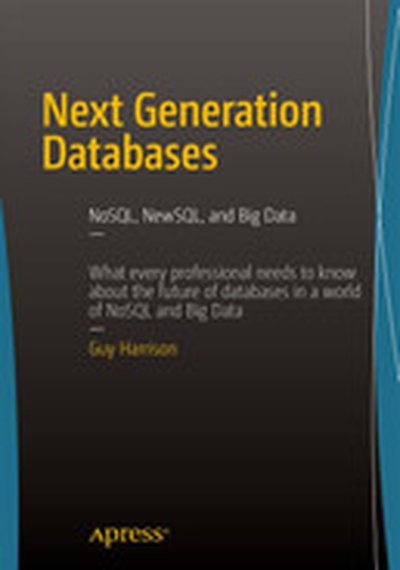
Next Generation Databases: NoSQL, NewSQL, and Big Data

This is a book for enterprise architects, database administrators, and developers who need to understand the latest developments in database technologies. It is the book to help you choose the correct database technology at a time when concepts such as Big Data, NoSQL and NewSQL are making what used to be an easy choice into a complex decision with significant implications. The relational database (RDBMS) model completely dominated database technology for over 20 years. Today this "one size fits all" stability has been disrupted by a relatively recent explosion of new database technologies. These paradigm-busting technologies are powering the "Big Data" and "NoSQL" revolutions, as well as forcing fundamental changes in databases across the board. Deciding to use a relational database was once truly a no-brainer, and the various commercial relational databases competed on price, performance, reliability, and ease of use rather than on fundamental architectures. Today we are faced with choices between radically different database technologies. Choosing the right database today is a complex undertaking, with serious economic and technological consequences. Next Generation Databases demystifies today’s new database technologies. The book describes what each technology was designed to solve. It shows how each technology can be used to solve real word application and business problems. Most importantly, this book highlights the architectural differences between technologies that are the critical factors to consider when choosing a database platform for new and upcoming projects. Introduces the new technologies that have revolutionized the database landscape Describes how each technology can be used to solve specific application or business challenges Reviews the most popular new wave databases and how they use these new database technologies

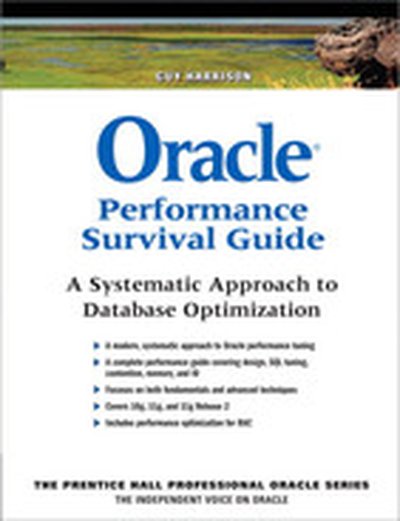
Oracle

Oracle Performance Survival Guide A Systematic Approach to Database Optimization The fast, complete, start-to-finish guide to optimizing Oracle performance Oracle Performance Survival Guide offers a structured, systematic, start-to-finish methodology for optimizing Oracle performance as efficiently as possible. Leading Oracle expert Guy Harrison shows how to maximize your tuning investment by focusing on causes rather than symptoms, and by quickly identifying the areas that deliver the greatest “bang for the buck.” Writing for DBAs and developers with all levels of experience, Harrison covers every area of Oracle performance management, from application design through SQL tuning, contention management through memory and physical IO management. He also presents up-to-the-minute guidance for optimizing the performance of the Oracle 11g Release 2. You’ll start by mastering Oracle structured performance tuning principles and tools, including techniques for tracing and monitoring Oracle execution. Harrison illuminates the interaction between applications and databases, guides you through choosing tuning tools, and introduces upfront design techniques that lead to higher-performance applications. He also presents a collection of downloadable scripts for reporting on all aspects of database performance. Coverage includes • “Tuning by layers,” the most effective, highest-value approach to Oracle performance optimization • Making the most of Oracle’s core tools for tracing, monitoring, and diagnosing performance • Highly efficient database logical and physical design, indexing, transaction design, and API use • SQL and PL/SQL tuning, including the use of parallel SQL techniques • Minimizing contention for locks, latches, shared memory, and other database resources • Optimizing memory and physical disk IO • Tuning Real Application Cluster (RAC) databases guyharrison.net informit.com/ph

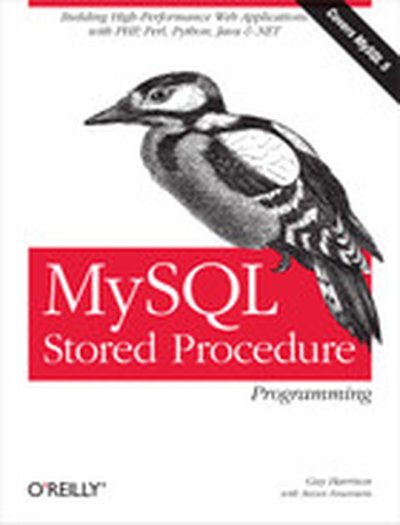
MySQL Stored Procedure Programming

The implementation of stored procedures in MySQL 5.0 a hugemilestone -- one that is expected to lead to widespread enterprise adoption ofthe already extremely popular MySQL database. If you are serious aboutbuilding the web-based database applications of the future, you need toget up to speed quickly on how stored procedures work -- and how tobuild them the right way. This book, destined to be the bible of storedprocedure development, is a resource that no real MySQL programmer canafford to do without. In the decade since MySQL burst on the scene, it has become thedominant open source database, with capabilities and performancerivaling those of commercial RDBMS offerings like Oracle and SQLServer. Along with Linux and PHP, MySQL is at the heart of millions ofapplications. And now, with support for stored procedures, functions,and triggers in MySQL 5.0, MySQL offers the programming power neededfor true enterprise use. MySQL's new procedural language has a straightforward syntax, making iteasy to write simple programs. But it's not so easy to write secure,easily maintained, high-performance, and bug-free programs. Few in theMySQL world have substantial experience yet with stored procedures, butGuy Harrison and Steven Feuerstein have decades of combined expertise. In MySQL Stored Procedure Programming, they putthat hard-won experience to good use. Packed with code examples and coveringeverything from language basics to application building to advancedtuning and best practices, this highly readable book is the one-stopguide to MySQL development. It consists of four major sections: MySQL stored programming fundamentals -- tutorial, basicstatements, SQL in stored programs, and error handling Building MySQL stored programs -- transaction handling,built-in functions, stored functions, and triggers MySQL stored programs in applications -- using storedprograms with PHP, Java, Perl, Python, and .NET (C# and VB.NET) Optimizing MySQL stored programs -- security, basic andadvanced SQL tuning, optimizing stored program code, and programmingbest practices A companion web site contains many thousands of lines of code, that youcan put to use immediately. Guy Harrison is Chief Architect of Database Solutions at Quest Softwareand a frequent speaker and writer on MySQL topics. Steven Feuerstein isthe author of Oracle PL/SQL Programming, the classic reference for Oracle stored programming for more than ten years. Both have decades of experience as database developers, and between them they have authored a dozen books.