
talk-data.com talk-data.com

G

Speaker

Gunnar Morling

6

talks

Software Engineer and open-source enthusiast Decodable

Gunnar Morling is a Software Engineer at Decodable, focusing on stream processing with Apache Flink. Formerly at Red Hat, he led the Debezium project for change data capture. He is a Java Champion and has founded open source projects such as JfrUnit, kcctl, and MapStruct. He blogs at morling.dev and speaks at conferences including QCon, JavaOne, and Devoxx.

Bio from: Data Council 2023

Filter by Event / Source

Talks & appearances

6 activities · Newest first

Search activities →
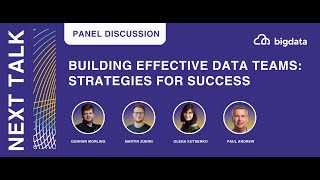
Panel Discussion | Building Effective Data Teams: Strategies for Success

🌟 Session Overview 🌟

Session Name: Building Effective Data Teams: Strategies for Success Speaker: Gunnar Morling, Martin Zuern, Olena Kutsenko, Paul Andrew Session Description: Panel Discussion will explore the key strategies for assembling and nurturing high-performing data teams. Expert panelists will discuss best practices for recruiting top talent, fostering collaboration, and creating a culture of innovation within data teams. The session will also address common challenges such as skill gaps, team dynamics, and aligning data initiatives with business goals.

🚀 About Big Data and RPA 2024 🚀

Unlock the future of innovation and automation at Big Data & RPA Conference Europe 2024! 🌟 This unique event brings together the brightest minds in big data, machine learning, AI, and robotic process automation to explore cutting-edge solutions and trends shaping the tech landscape. Perfect for data engineers, analysts, RPA developers, and business leaders, the conference offers dual insights into the power of data-driven strategies and intelligent automation. 🚀 Gain practical knowledge on topics like hyperautomation, AI integration, advanced analytics, and workflow optimization while networking with global experts. Don’t miss this exclusive opportunity to expand your expertise and revolutionize your processes—all from the comfort of your home! 📊🤖✨

📅 Yearly Conferences: Curious about the evolution of QA? Check out our archive of past Big Data & RPA sessions. Watch the strategies and technologies evolve in our videos! 🚀 🔗 Find Other Years' Videos: 2023 Big Data Conference Europe https://www.youtube.com/playlist?list=PLqYhGsQ9iSEpb_oyAsg67PhpbrkCC59_g 2022 Big Data Conference Europe Online https://www.youtube.com/playlist?list=PLqYhGsQ9iSEryAOjmvdiaXTfjCg5j3HhT 2021 Big Data Conference Europe Online https://www.youtube.com/playlist?list=PLqYhGsQ9iSEqHwbQoWEXEJALFLKVDRXiP

💡 Stay Connected & Updated 💡

Don’t miss out on any updates or upcoming event information from Big Data & RPA Conference Europe. Follow us on our social media channels and visit our website to stay in the loop!

🌐 Website: https://bigdataconference.eu/, https://rpaconference.eu/ 👤 Facebook: https://www.facebook.com/bigdataconf, https://www.facebook.com/rpaeurope/ 🐦 Twitter: @BigDataConfEU, @europe_rpa 🔗 LinkedIn: https://www.linkedin.com/company/73234449/admin/dashboard/, https://www.linkedin.com/company/75464753/admin/dashboard/ 🎥 YouTube: http://www.youtube.com/@DATAMINERLT
Gunnar Morling: Data Contracts In Practice With Debezium and Apache Flink

🌟 Session Overview 🌟

Session Name: Data Contracts In Practice With Debezium and Apache Flink Speaker: Gunnar Morling Session Description: Log-based change data capture (CDC) is an invaluable part of the data engineering toolbox: it enables a variety of use cases such as real-time analytics, full-text search, or cache invalidation by publishing data change events from your database. But when publishing change event streams across context or team boundaries, aren’t you tying external consumers to your application’s data model, thus limiting yourself in evolving the same?

Enter data contracts—consciously designed abstractions between your internal data model and the outside world. Come and join us for this session to learn about:

Challenges you may encounter when exposing table-level change event streams and how data contracts can mitigate them Implementation strategies for data contracts, such as the outbox pattern and stream processing Evolving your data model and the corresponding data contracts without breaking any existing consumers We’ll also touch on some advanced topics at the intersection of CDC and stream processing, such as hydrating partial change events, using the popular change stream processing duo of Debezium and Apache Flink.

🚀 About Big Data and RPA 2024 🚀

Unlock the future of innovation and automation at Big Data & RPA Conference Europe 2024! 🌟 This unique event brings together the brightest minds in big data, machine learning, AI, and robotic process automation to explore cutting-edge solutions and trends shaping the tech landscape. Perfect for data engineers, analysts, RPA developers, and business leaders, the conference offers dual insights into the power of data-driven strategies and intelligent automation. 🚀 Gain practical knowledge on topics like hyperautomation, AI integration, advanced analytics, and workflow optimization while networking with global experts. Don’t miss this exclusive opportunity to expand your expertise and revolutionize your processes—all from the comfort of your home! 📊🤖✨

📅 Yearly Conferences: Curious about the evolution of QA? Check out our archive of past Big Data & RPA sessions. Watch the strategies and technologies evolve in our videos! 🚀 🔗 Find Other Years' Videos: 2023 Big Data Conference Europe https://www.youtube.com/playlist?list=PLqYhGsQ9iSEpb_oyAsg67PhpbrkCC59_g 2022 Big Data Conference Europe Online https://www.youtube.com/playlist?list=PLqYhGsQ9iSEryAOjmvdiaXTfjCg5j3HhT 2021 Big Data Conference Europe Online https://www.youtube.com/playlist?list=PLqYhGsQ9iSEqHwbQoWEXEJALFLKVDRXiP

💡 Stay Connected & Updated 💡

Don’t miss out on any updates or upcoming event information from Big Data & RPA Conference Europe. Follow us on our social media channels and visit our website to stay in the loop!

🌐 Website: https://bigdataconference.eu/, https://rpaconference.eu/ 👤 Facebook: https://www.facebook.com/bigdataconf, https://www.facebook.com/rpaeurope/ 🐦 Twitter: @BigDataConfEU, @europe_rpa 🔗 LinkedIn: https://www.linkedin.com/company/73234449/admin/dashboard/, https://www.linkedin.com/company/75464753/admin/dashboard/ 🎥 YouTube: http://www.youtube.com/@DATAMINERLT

Abstract: You've been tasked with implementing a data streaming pipeline for propagating data changes from your operational Postgres database to a search index in OpenSearch. Data views in OS should be denormalized for fast querying, and of course there should be no noticeable impact on the production database. In this session we'll discuss how to build this data pipeline using two popular open-source projects: Debezium for log-based change data capture (CDC) and Apache Flink for stream processing. Join us for this talk and learn about: * Setting up change data streams with Debezium * Efficiently building nested data structures from 1:n joins * Deployment options: Kafka Connect vs. Flink CDC

Change Data Streaming Patterns With Debezium & Apache Flink | Decodable

ABOUT THE TALK: Microservices are one of the big trends in software engineering of the last few years.

In this session we'll discuss and showcase how open-source change data capture (CDC) with Debezium can help developers with typical challenges they often face when working on microservices.

Learn how to:

  • Employ the outbox pattern for reliable, eventually consistent data exchange between microservices, without incurring unsafe dual writes or tight coupling
  • Gradually extract microservices from existing monolithic applications, using CDC, the strangler fig pattern and Apache Flink
  • Coordinate long-running business transactions across multiple services using CDC-based saga orchestration, ensuring such activity gets consistently applied or aborted by all participating services.

ABOUT THE SPEAKER: Gunnar Morling is a software engineer and open-source enthusiast by heart, currently working at Decodable on stream processing based on Apache Flink. In his prior role as a software engineer at Red Hat, he led the Debezium project, a distributed platform for change data capture. He is a Java Champion and has founded multiple open source projects such as JfrUnit, kcctl, and MapStruct. Gunnar is an avid blogger (morling.dev) and has spoken at a wide range of conferences like QCon, Java One, and Devoxx. He lives in Hamburg, Germany.

ABOUT DATA COUNCIL: Data Council (https://www.datacouncil.ai/) is a community and conference series that provides data professionals with the learning and networking opportunities they need to grow their careers.

Make sure to subscribe to our channel for the most up-to-date talks from technical professionals on data related topics including data infrastructure, data engineering, ML systems, analytics and AI from top startups and tech companies.

FOLLOW DATA COUNCIL: Twitter: https://twitter.com/DataCouncilAI LinkedIn: https://www.linkedin.com/company/datacouncil-ai/

Summary Databases are useful for inspecting the current state of your application, but inspecting the history of that data can get messy without a way to track changes as they happen. Debezium is an open source platform for reliable change data capture that you can use to build supplemental systems for everything from maintaining audit trails to real-time updates of your data warehouse. In this episode Gunnar Morling and Randall Hauch explain why it got started, how it works, and some of the myriad ways that you can use it. If you have ever struggled with implementing your own change data capture pipeline, or understanding when it would be useful then this episode is for you.

Announcements

Hello and welcome to the Data Engineering Podcast, the show about modern data management When you’re ready to build your next pipeline, or want to test out the projects you hear about on the show, you’ll need somewhere to deploy it, so check out our friends at Linode. With 200Gbit private networking, scalable shared block storage, and a 40Gbit public network, you’ve got everything you need to run a fast, reliable, and bullet-proof data platform. If you need global distribution, they’ve got that covered too with world-wide datacenters including new ones in Toronto and Mumbai. And for your machine learning workloads, they just announced dedicated CPU instances. Go to dataengineeringpodcast.com/linode today to get a $20 credit and launch a new server in under a minute. And don’t forget to thank them for their continued support of this show! You listen to this show to learn and stay up to date with what’s happening in databases, streaming platforms, big data, and everything else you need to know about modern data management. For even more opportunities to meet, listen, and learn from your peers you don’t want to miss out on this year’s conference season. We have partnered with organizations such as O’Reilly Media, Corinium Global Intelligence, ODSC, and Data Council. Upcoming events include the Software Architecture Conference in NYC, Strata Data in San Jose, and PyCon US in Pittsburgh. Go to dataengineeringpodcast.com/conferences to learn more about these and other events, and take advantage of our partner discounts to save money when you register today. Your host is Tobias Macey and today I’m interviewing Randall Hauch and Gunnar Morling about Debezium, an open source distributed platform for change data capture

Interview

Introduction How did you get involved in the area of data management? Can you start by describing what Change Data Capture is and some of the ways that it can be used? What is Debezium and what problems does it solve?

What was your motivation for creating it? What are some of the use cases that it enables? What are some of the other options on the market for handling change data capture?

Can you describe the systems architecture of Debezium and how it has evolved since it was first created?

How has the tight coupling with Kafka impacted the direction and capabilities of Debezium? What, if any, other substrates does Debezium support (e.g. Pulsar, Bookkeeper, Pravega)?

What are the data sources that are supported by Debezium?

Given that you have branched into non-relational stores, how have you approached organization of the code to allow for handling the specifics of those engines while retaining a common core set of functionality?

What is involved in deploying, integrating, and maintaining an installation of Debezium?

What are the scaling factors? What are some of the edge cases that users and operators should be aware of?

Debezium handles the ingestion and distribution of database changesets. What are the downstream challenges or complications that application designers or systems architects have to deal with to make use of that information?

What are some of the design tensions that exist in the Debezium community between acting as a simple pipe vs. adding functionality for interpreting/a