talk-data.com talk-data.com

Topic

AI/ML

Artificial Intelligence/Machine Learning

data_science algorithms predictive_analytics

9014

tagged

Activity Trend

1532 peak/qtr
2020-Q1 2026-Q1

Activities

9014 activities · Newest first

Transfer Learning: Leveraging Pretrained Models with Limited Data

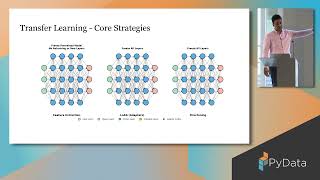
Transfer learning has revolutionised machine learning by enabling models trained on large datasets to generalise effectively to tasks with limited data. This talk explores strategies for adapting pretrained models to new domains, focusing on audio processing as a case study. Using YAMNet, Whisper, and wav2vec2 for laughter detection, we demonstrate how to extract meaningful representations, fine-tune models efficiently, and handle severe class imbalances. The session covers feature extraction, model fusion techniques, and best practices for optimising performance in data-scarce environments. Attendees will gain practical insights into applying transfer learning across various modalities beyond audio, maximising model effectiveness when labelled data is scarce.
Agentic Cyber Defense with External Threat Intelligence

This talk will detail how to integrate external threat intelligence data into an autonomous agentic AI system for proactive cybersecurity. Using real world datasets—including open-source threat feeds, security logs, or OSINT—you will learn how to build a data ingestion pipeline, train models with Python, and deploy agents that autonomously detect and mitigate cyber threats. This case study will provide practical insights into data preprocessing, feature engineering, and the challenges of adversarial conditions.

AI for Everyone - Building Inclusive Machine Learning Models

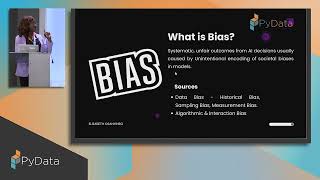
Artificial Intelligence (AI) and Machine Learning (ML) are transforming industries such as healthcare, finance, education, and entertainment. However, these advancements are not benefiting everyone equally. Biases in datasets, algorithms, and design processes often lead to AI systems that unintentionally exclude or misrepresent underrepresented communities, reinforcing societal inequalities.

This talk, "AI for Everyone: Building Inclusive Machine Learning Models," explores the critical importance of developing AI systems that are ethical, fair, and accessible to all. We will examine real-world examples of AI bias, discuss techniques for identifying and mitigating bias in data and models, and explore frameworks for responsible AI development. Attendees will leave with actionable insights to design AI solutions that promote fairness, inclusivity, and social impact.

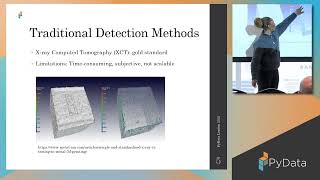
Automating Porosity Detection in Additive Manufacturing with Deep Learning

Additive Manufacturing (AM) enables complex, high-performance components, but porosity defects can compromise structural integrity. Traditional porosity analysis in X-ray CT scans is manual, slow, and inconsistent. This talk introduces a deep learning-based approach using CNNs and segmentation models to automate porosity detection, enhancing accuracy and efficiency. Attendees will gain insights into pre-processing 3D CT scans, training AI models, and solving industry challenges.

In this decades-spanning episode, Tristan Handy sits down with Lonne Jaffe, Managing Director at Insight Partners and former CEO of Syncsort (now Precisely), to trace the history of the data ecosystem—from its mainframe origins to its AI-infused future. Lonne reflects on the evolution of ETL, the unexpected staying power of legacy tech, and why AI may finally erode the switching costs that have long protected incumbents. For full show notes and to read 6+ years of back issues of the podcast's companion newsletter, head to https://roundup.getdbt.com. The Analytics Engineering Podcast is sponsored by dbt Labs.

Not Another LLM Talk… Practical Lessons from Building a Real-World Adverse Media Pipeline

LLMs are magical—until they aren’t. Extracting adverse media entities might sound straightforward, but throw in hallucinations, inconsistent outputs, and skyrocketing API costs, and suddenly, that sleek prototype turns into a production nightmare.

Our adverse media pipeline monitors over 1 million articles a day, sifting through vast amounts of news to identify reports of crimes linked to financial bad actors, money laundering, and other risks. Thanks to GenAI and LLMs, we can tackle this problem in new ways—but deploying these models at scale comes with its own set of challenges: ensuring accuracy, controlling costs, and staying compliant in highly regulated industries.

In this talk, we’ll take you inside our journey to production, exploring the real-world challenges we faced through the lens of key personas: Cautious Claire, the compliance officer who doesn’t trust black-box AI; Magic Mike, the sales lead who thinks LLMs can do anything; Just-Fine-Tune Jenny, the PM convinced fine-tuning will solve everything; Reinventing Ryan, the engineer reinventing the wheel; and Paranoid Pete, the security lead fearing data leaks.

Expect practical insights, cautionary tales, and real-world lessons on making LLMs reliable, scalable, and production-ready. If you've ever wondered why your pipeline works perfectly in a Jupyter notebook but falls apart in production, this talk is for you.

Platforms for valuable AI Products: Iteration, iteration, iteration

In data science experimentation is vital, the more we can experiment, the more we can learn. However quick iteration isn't sufficient we also need to be able to easily promote these experiments to production to deliver value. This requires all the stability and reliability of any production system. John will discuss building platforms that treat iteration as a first class consideration, the role of open source libraries, and balancing trade-offs.

Sovereign Data for AI with Python

The only certainty in life is that the pendulum will always swing. Recently, the pendulum has been swinging towards repatriation. However, the infrastructure needed to build and operate AI systems using Python in a sovereign (even air-gapped) environment has changed since the shift towards the cloud. This talk will introduce the infrastructure you need to build and deploy Python applications for AI - from data processing, to model training and LLM fine-tuning at scale to inference at scale. We will focus on open-source infrastructure including: a Python library server (Pypi, Conda, etc) and avoiding supply chain attacks a container registry that works at scale a S3 storage layer a database server with a vector index

Since the end of 2022, the AI space has reached unprecedented velocity, scale and proliferation. When it seems like everyone (and their dog) is talking about AI, how should those of us who've been working in Machine Learning, Data Science (and AI) as domain experts look to navigate the conversation? In this talk, Leanne will aim to shine a light on the impact the AI arms race is having on our field, the reality of what it means to be a practitioner and some principles to stick by to help traverse what may appear to be a time of panic.

The global economy looks to be posting trend-like growth in 1H25. How much of this is underlying resilience in a healthy expansion and how much is transitory front-loading set to reverse in 2H25 is central to the outlook. The data show resilience, notably in job growth, but cracks are growing in global industry. We maintain a baseline of no recession while also seeing risks elevated at 40%.

Speakers:

Bruce Kasman

Joseph Lupton

This podcast was recorded on 6 June 2025.

This communication is provided for information purposes only. Institutional clients please visit www.jpmm.com/research/disclosures for important disclosures. © 2025 JPMorgan Chase & Co. All rights reserved. This material or any portion hereof may not be reprinted, sold or redistributed without the written consent of J.P. Morgan. It is strictly prohibited to use or share without prior written consent from J.P. Morgan any research material received from J.P. Morgan or an authorized third-party (“J.P. Morgan Data”) in any third-party artificial intelligence (“AI”) systems or models when such J.P. Morgan Data is accessible by a third-party. It is permissible to use J.P. Morgan Data for internal business purposes only in an AI system or model that protects the confidentiality of J.P. Morgan Data so as to prevent any and all access to or use of such J.P. Morgan Data by any third-party.

Graph Theory for Multi-Agent Integration: Showcase Clinical Use Cases

Graph theory is a well-known concept for algorithms and can be used to orchestrate the building of multi-model pipelines. By translating tasks and dependencies into a Directed Acyclic Graph, we can orchestrate diverse AI models, including NLP, vision, and recommendation capabilities. This tutorial provides a step-by-step approach to designing graph-based AI model pipelines, focusing on clinical use cases from the field.

Reinforcement Learning (RL) has emerged as a transformative sub-field in AI/ML, driving breakthroughs in areas ranging from autonomous robotics to personalized recommendation systems. This workshop is designed to serve a broad audience—from beginners eager to grasp foundational RL concepts to practitioners seeking to deepen their technical expertise through applied projects. These projects will range from developing simple classical RL game environments to practical financial domain use cases such as using RL sequential decision making for stock trading and asset portfolio optimization scenarios.

Most companies are diving into AI without a clue where to start. In this must-hear conversation, Jordan Morrow reveals the hidden costs of poor AI adoption, how to assess your real use cases, and what every organization should be doing now to prepare for the AI-powered future. Whether you're a CEO, a marketer, or an engineer, this episode unpacks the four essential 'rights' to using AI effectively and the shocking truth about data privacy in generative models.

DataUnchained #AItools #EnterpriseAI #DataGovernance #DigitalTransformation #AIadoption #CXOinsights

Cyberpunk by jiglr | https://soundcloud.com/jiglrmusic Music promoted by https://www.free-stock-music.com Creative Commons Attribution 3.0 Unported License https://creativecommons.org/licenses/by/3.0/deed.en_US Hosted on Acast. See acast.com/privacy for more information.