talk-data.com talk-data.com

Topic

analytics-platforms

402

tagged

Activity Trend

1 peak/qtr
2020-Q1 2026-Q1

Activities

402 activities · Newest first

JMP 13 Design of Experiments Guide, Second Edition, 2nd Edition

The JMP 13 Design of Experiments Guide covers classic DOE designs (for example, full factorial, response surface, and mixture designs). Read about more flexible custom designs, which you generate to fit your particular experimental situation. And discover JMP’s definitive screening designs, an efficient way to identify important factor interactions using fewer runs than required by traditional designs. The book also provides guidance on determining an appropriate sample size for your study.

JMP 13 Fitting Linear Models, Second Edition, 2nd Edition

JMP 13 Fitting Linear Models focuses on the Fit Model platform and many of its personalities. Linear and logistic regression, analysis of variance and covariance, and stepwise procedures are covered. Also included are multivariate analysis of variance, mixed models, generalized models, and models based on penalized regression techniques.

JMP 13 Multivariate Methods, Second Edition, 2nd Edition

JMP 13 Multivariate Methods describes techniques for analyzing several variables simultaneously. The book covers descriptive measures, such as correlations. It also describes methods that give insight into the structure of the multivariate data, such as clustering, latent class analysis, principal components, discriminant analysis, and partial least squares.

JMP 13 Predictive and Specialized Modeling, Second Edition, 2nd Edition

JMP 13 Predictive and Specialized Modeling provides details about modeling techniques such as partitioning, neural networks, nonlinear regression, and time series analysis. Topics include the Gaussian platform, which is useful in analyzing computer simulation experiments. The book also covers the Response Screening platform, which is useful in testing the effect of a predictor when you have many responses.

JMP Start Statistics, 6th Edition

This book provides hands-on tutorials with just the right amount of conceptual and motivational material to illustrate how to use the intuitive interface for data analysis in JMP. Each chapter features concept-specific tutorials,

examples, brief reviews of concepts, step-by-step illustrations, and exercises.

Updated for JMP 13, JMP Start Statistics, Sixth Edition includes many new features, including:

The redesigned Formula Editor.

New and improved ways to create formulas in JMP directly from the data table or dialogs.

Interface updates, including improved menu layout.

Updates and enhancements in many analysis platforms.

New ways to get data into JMP and to save and share JMP results.

Many new features that make it easier to use JMP.

SAS 9.4 SQL Procedure User's Guide, Fourth Edition, 4th Edition

Describes the basics of using the SQL procedure and provides comprehensive reference information. The usage information includes retrieving data from single and multiple tables; selecting specific data from tables; subsetting, ordering, and summarizing data; updating tables; combining tables to create new tables and useful reports; performing queries on database management system (DBMS) tables; using PROC SQL with the SAS macro facility; and debugging and optimizing PROC SQL code. The reference information includes statements, dictionary components, and system options.

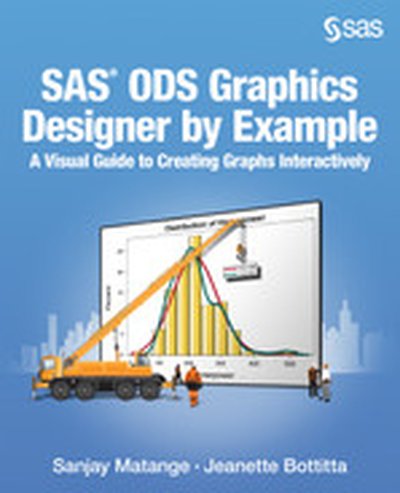
SAS ODS Graphics Designer by Example

You just got the results from your study, and need to get some quick graphical views of your data before you begin the analysis. Do you need a crash course in the SG procedures (also known as ODS Graphics procedures) just to get a simple histogram? What should you do? The ODS Graphics Designer is the answer. With this application, you can use the interactive drag-and-drop feature to create many graphs, including histograms, box plots, scatter plot matrices, classification panels, and more. You can render your graph in batch with new data and output the results to any open ODS destination, or view the generated Graph Template Language (GTL) code as a leg-up to GTL programming. You can do all this with ease!

SAS(R) ODS Graphics Designer by Example: A Visual Guide to Creating Graphs Interactively describes in detail the features of the ODS Graphics Designer. The designer application lets you, the analyst, create graphs interactively so that you can focus on the analysis, and not on learning graph syntax. This book will take you step-by-step through the features of the designer, providing you with examples of graphs that are commonly used for the analysis of data in the health care, life sciences, and finance industries. The examples in this book will help you create just the right graph with ease!

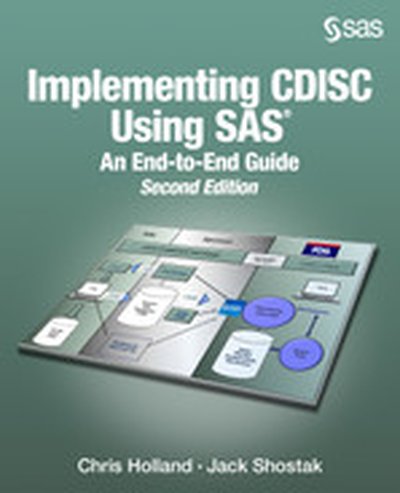
Implementing CDISC Using SAS

For decades researchers and programmers have used SAS to analyze, summarize, and report clinical trial data. Now Chris Holland and Jack Shostak have updated their popular Implementing CDISC Using SAS, the first comprehensive book on applying clinical research data and metadata to the Clinical Data Interchange Standards Consortium (CDISC) standards.

Implementing CDISC Using SAS: An End-to-End Guide, Second Edition, is an all-inclusive guide on how to implement and analyze the Study Data Tabulation Model (SDTM) and the Analysis Data Model (ADaM) data and prepare clinical trial data for regulatory submission. Updated to reflect the 2017 FDA mandate for adherence to CDISC standards, this new edition covers creating and using metadata, developing conversion specifications, implementing and validating SDTM and ADaM data, determining solutions for legacy data conversions, and preparing data for regulatory submission. The book covers products such as Base SAS, SAS Clinical Data Integration, and the SAS Clinical Standards Toolkit, as well as JMP Clinical. Topics included in this new edition include an implementation of the Define-XML 2.0 standard, new SDTM domains, validation with Pinnacle 21 software, event narratives in JMP Clinical, and of course new versions of SAS and JMP software.

Any manager or user of clinical trial data in this day and age is likely to benefit from knowing how to either put data into a CDISC standard or analyzing and finding data once it is in a CDISC format. If you are one such person--a data manager, clinical and/or statistical programmer, biostatistician, or even a clinician--then this book is for you.

Biostatistics by Example Using SAS Studio

Learn how to solve basic statistical problems with Ron Cody's easy-to-follow style using the point-and-click SAS Studio tasks. Aimed specifically at the health sciences, Biostatistics by Example Using SAS Studio, provides an introduction to SAS Studio tasks. The book includes many biological and health-related problem sets and is fully compatible with SAS University Edition. After reading this book you will be able to understand temporary and permanent SAS data sets, and you will learn how to create them from various data sources. You will also be able to use SAS Studio statistics tasks to generate descriptive statistics for continuous and categorical data. The inferential statistics portion of the book covers the following topics: paired and unpaired t tests one-way analysis of variance N-way ANOVA correlation simple and multiple regression logistic regression categorical data analysis power and sample size calculations Besides describing each of these statistical tests, the book also discusses the assumptions that need to be met before running and interpreting these tests. For two-sample tests and N-way tests, nonparametric tests are also described. This book leads you step-by-step through each of the statistical tests with numerous screen shots, and you will see how to read and interpret all of the output generated by these tests. Experience with some basic statistical tests used to analyze medical data or classroom experience in biostatistics or statistics is required. Although the examples are related to the medical and biology fields, researchers in other fields such as psychology or education will find this book helpful. No programming experience is required. Loading data files into SAS University Edition? Click here for more information.

Strategic Analytics and SAS

Use aggregate data to answer high-level business questions!

Data miners, data scientists, analytic managers, and analysts who work in all industries will find the insights in Randy Collica's Strategic Analytics and SAS: Using Aggregate Data to Drive Organizational Initiatives invaluable in their work. This book shows you how to use your existing data at aggregate levels to answer high-level business questions. Written in a detailed, step-by-step format, the multi-industry use cases begin with a high-level question that a C-level executive might ask. Collica then progresses through the steps to perform the analysis, including many tables and screenshots to guide you along the way. He then ends each use case with the solution to the high-level question. Topics covered include logistic analysis, models developed from surveys, survival analysis, confidence intervals, text mining and analysis, visual analytics, hypothesis tests, and size and magnitude of analytic effects. Connect the dots between detailed data on your customers and the high-level business goals of your organization with Strategic Analytics and SAS!

Mobile App Analytics

User experience monitoring is essential for enhancing the usability and performance of your mobile native app. How are your customers using your product? Which features do they prefer? How can you spot trouble before it adversely affects your product? This O’Reilly report provides an overview of several metrics you can apply, based on different use-cases. Author Wolfgang Beer explains the typical instrumentation and publishing process of mobile apps, and takes you through different instrumentation approaches. With screenshots from popular tools such as Google Analytics, Ruxit, Fabric, and Flurry Analytics, this report helps you choose the metrics that will help you improve your product’s performance. Monitor performance to understand your app’s stability and usability Measure app user engagement by identifying active and new users, and determining median session length Determine your app’s current retention and churn rates Gather business intelligence by defining users according to personas and lifetime value Oversee the service and infrastructure dependencies of your app in real time Visually track user behavior with heat maps and navigational paths Add automated or manual instrumentation before you publish your app

The Analytical Marketer

How to lead the change Analytics are driving big changes, not only in what marketing departments do but in how they are organized, staffed, led, and run. Leaders are grappling with issues that range from building an analytically driven marketing organization and determining the kinds of structure and talent that are needed to leading interactions with IT, finance, and sales and creating a unified view of the customer. The Analytical Marketer provides critical insight into the changing marketing organization—digital, agile, and analytical—and the tools for reinventing it. Written by the head of global marketing for SAS, The Analytical Marketer is based on the author’s firsthand experience of transforming a marketing organization from “art” to “art and science.” Challenged and inspired by their company’s own analytics products, the SAS marketing team was forced to rethink itself in order to take advantage of the new capabilities that those tools offer the modern marketer. Key marketers and managers at SAS tell their stories alongside the author’s candid lessons learned as she led the marketing organization’s transformation. With additional examples from other leading companies, this book is a practical guide and set of best practices for creating a new marketing culture that thrives on and adds value through data and analytics.

JMP 13 Basic Analysis

JMP 13 Basic Analysis covers the initial types of analyses that you often perform in JMP, such as univariate, bivariate, and oneway analyses. Creating tables of summary statistics with the Tabulate platform is included along with approximating sampling distributions using bootstrapping. Find information about how to clean up your data before performing analyses. Read about performing powerful parametric and nonparametric simulation capability using Simulation.

JMP 13 Consumer Research

JMP 13 Consumer Research focuses on analyses that help users observe and predict subject's behavior, particularly those in the market research field. The Uplift platform predicts consumer behavior based on shifts in marketing efforts. Learn how to tabulate and summarize categorical responses with the Categorical platform. Factor Analysis rotates principal components to help identify which directions have the most variation among the variables. The book also covers Item Analysis, a method for identifying latent traits that might affect an individual's choices. And read about the Choice platform, which market researchers use to estimate probability in consumer spending.

JMP 13 Design of Experiments Guide

The JMP 13 Design of Experiments Guide covers classic DOE designs (for example, full factorial, response surface, and mixture designs). Read about more flexible custom designs, which you generate to fit your particular experimental situation. And discover JMP’s definitive screening designs, an efficient way to identify important factor interactions using fewer runs than required by traditional designs. The book also provides guidance on determining an appropriate sample size for your study.

JMP 13 Essential Graphing

Start with JMP 13 Essential Graphing to find the ideal graph for your data. The book begins with Graph Builder, a quick way to create graphs in a drag-and-drop window. Line charts, ellipses, box plots, and maps are just a few of the graphs available in Graph Builder. Find information about creating other types of plots: bubble plots, scatterplots, parallel plots, and more.