talk-data.com talk-data.com

Topic

C#/.NET

programming_language microsoft software_development

71

tagged

Activity Trend

4 peak/qtr
2020-Q1 2026-Q1

Activities

71 activities · Newest first

SQL Server 2005 Distilled

Need to get your arms around Microsoft SQL Server 2005 fast, without getting buried in the details? Need to make fundamental decisions about deploying, using, or administering Microsoft’s latest enterprise database? Need to understand what’s new in SQL Server 2005, and how it fits with your existing IT and business infrastructure? SQL Server 2005 Distilled delivers the answers you need–quickly, clearly, and objectively. Former SQL Server team member Eric L. Brown offers realistic insight into every significant aspect of SQL Server 2005: its new features, architecture, administrative tools, security model, data management capabilities, development environment, and much more. Brown draws on his extensive experience consulting with enterprise users, outlining realistic usage scenarios that leverage SQL Server 2005’s strengths and minimize its limitations. Coverage includes Architectural overview: how SQL Server 2005’s features work together and what it means to you Security management, policies, and permissions: gaining tighter control over your data SQL Server Management Studio: Microsoft’s new, unified tool suite for authoring, management, and operations Availability enhancements: online restoration, improved replication, shorter maintenance/recovery windows, and more Scalability improvements, including a practical explanation of SQL Server 2005’s complex table partitioning feature Data access enhancements, from ADO.NET 2.0 to XML SQL Server 2005’s built-in .NET CLR: how to use it, when to use it, and when to stay with T-SQL Business Intelligence Development Studio: leveraging major improvements in reporting and analytics Visual Studio integration: improving efficiency throughout the coding and debugging process Simple code examples demonstrating SQL Server 2005’s most significant new features

Hands-On Microsoft Access: A Practical Guide to Improving Your Access Skills

Praise for Hands-On Microsoft Access “Bob has distilled the essence of database design and Access development into a highly valuable and easily understandable resource that I wish was available when I first started out.” —Graham R. Seach, Microsoft Access MVP “If you’ve been using Access with that typical uncertainty, asking yourself 'Just how could I do that?' or 'Why isn’t this working?', if you’d like to know what you’re doing before you hit the wall, this book is probably perfect for you.” —Olaf Rabbachin, CEO, IntuiDev IT-solutions “Life at the cutting edge of Access development is exciting and very challenging. The knowledge and experience gained over many years of research and trial-and-error has been hard won. But Bob's new book encapsulates the knowledge we now take for granted, and for the first time the beginner is afforded the opportunity to bypass all that hard work. In this his latest work, Bob has distilled the essence of database design and Access development into a highly valuable and easily understandable resource that I wish was available when I first started out.” —Graham R Seach, MCP, MCAD, MCSD, Microsoft Access MVP, author “This is an excellent book for beginners, with an easy reading style. It is now on my recommended list of books that I hand out in every Access class that I teach.” —M.L. “Sco” Scofield, Microsoft Access MVP, MCSD, Senior Instructor, Scofield Business Services “If you've been using Access with that typical uncertainty, asking yourself 'Just how could I do that?' or 'Why isn't this working?', or if you'd like to know what you're doing before you hit the wall, this book is perfect for you. Access is a tremendous product and a database is created using a few clicks; but without at least some theoretical background you're bound to encounter problems soon. I wish a book like this one would've been available when I started getting deeper into working with Access some ten years ago.” —Olaf Rabbachin, CEO, IntuiDev IT-solutions “This book is for any level DB developer/user. It is packed full of real-world examples and solutions that are not the normal Northwind database that most Access books use. The examples and the technical content surrounding them are the real strength of the book. Schneider uses real-world scenarios that make for excellent reading. It made me want to go and redo a lot of my older Access DBs that were not written as well as they could have been. This book taught me different approaches to doing some routine tasks.” —Ron Crumbaker, Microsoft MVP – SMS “While a very powerful application (or perhaps because of its power), Microsoft Access does have a steep learning curve and can be intimidating to new users. Bob Schneider has managed to write a book that's both understandable and enjoyable to read. His examples should be understandable to all readers, and he extends them in a logical manner. This book should leave the reader well equipped to make use of what many consider to be the best desktop database product available.” —Doug Steele, Microsoft Access MVP “The author takes what is potentially a very dry subject and adds fantastic color through entertaining analogies and metaphors. For instance, his examples using the NBA, the Beatles, and Donald Rumsfeld help us 'get it' without realizing we have just traversed what could be very stale database theory. Brilliant!” —Kel Good, MCT, MCSD for Microsoft.NET, Custom Software Development Inc. (www.customsoftware.ca) Go from Access “beginner” to Access “master”! Millions of people use Microsoft Access, but only a small fraction of them are really comfortable with it. If you're ready to go “beyond the wizards”—and become a confident, highly effective Access user— Hands-On Microsoft Access was written for you. In plain English, Bob Schneider helps you master crucial principles for building flexible, powerful databases. Discover how to enter data more easily, retrieve it more freely, manipulate it more successfully, analyze it with greater sophistication, and share it more effectively. Schneider's dozens of hands-on examples thoroughly demystify Access, and his friendly, conversational style makes it more approachable than ever before. Hands-On Microsoft Access presents solutions for the challenges you're most likely to encounter, including How do Access objects and interfaces fit together, and when should I use each one? What's the best way for me to organize my fields into tables? How can I modify the tables, forms, and reports an Access wizard created for me? How can I design forms and reports for people to use more effectively? How do primary keys and relationships work, and why are they so important? How do I make sure my data stays consistent and accurate? How do I build queries that give me the right information—quickly, efficiently, and reliably? How do I use data from other sources, or deliver Access data to other people or programs? What are PivotTables and PivotCharts, what can I do with them, and how do I use them? Written for Access 2003, this book also contains special instructions for Access 2002 users and extensive coverage of issues relevant to Access 95, 97, and 2000.

DB2 UDB V8.2 on the Windows Environment

IBM DB2 Universal Database Version 8.2 is another significant jump in DBRM technology. It delivers new features to address the ever-increasing demands and requirements of information management customers. This IBM Redbooks publication is an update of DB2 UDB Exploitation of the Windows Environment (SG24-6893), with a focus on DB2 UDB Version 8.2 functions and features. We illustrate, step-by-step, the installation and migration processes. The new autonomic computing technology that makes the DBA’s job easier is described in detail. The new security features and their integration with the Windows environment are discussed intensively. This book covers the new performance and monitoring enhancements of Version 8.2. New, exciting high availability functions are described in detail. Further, we discuss aspects of DB2 application development with .NET 2003 and Java and provide programming details using ADO.NET, CLR, and Java.

Special Edition Using® Crystal Reports® 10

Special Edition Using Crystal Reports 10 is a reference guide designed to provide hands-on experience with the latest release of the product suite. The latest version of the Crystal Reporting Suite, delivers vast enhancements that drive upgrades from licensees who'll seek a reference to help them migrate. As Crystal Decisions insiders, the authors bring unique and valuable real-world perspectives on implementations and use of the Crystal Reports product. The book includes content, tutorials and samples for reporting within the Microsoft Visual Studio.NET environment and on the SAP Business Information Warehouse. New content on report distribution, and integration into the secured managed reporting solution known as Crystal Enterprise, is also now included in this definitive user guide.

Supply Chains: A Manager's Guide

“An excellent summary of the state of supply chain management going into the twenty-first century. Explains the essential concepts clearly and offers practical, down-to-earth advice for making supply chains more efficient and adaptive. Truly a survival guide for executives as they struggle to cope with the increasing competition between supply chains.” — Christian Knoll, Vice President of Global Supply Chain Management, SAP AG “Through real-world case studies and graphic illustrations, David Taylor clearly demonstrates the bottom-line benefits of managing the supply chain effectively. Although the book is written for managers, I recommend it for everyone from the executive suite to the shipping floor because they all have to work together to master the supply chain. But beware—you can expect many passionate employees demanding improvements in your company’s supply chain after reading this book!” — David Myers, President, WinfoSoft Inc., Former Board Member of Supply Chain Council “A comprehensive, thoroughly researched, and well-designed book that gives managers the information they need in a highly readable form. I am already starting to use the techniques in this book to improve our international distribution system.” — Jim Muller, Vice President of Produce Sales, SoFresh Produce “Supply chain management is a deceptively deep subject. Simple business practices combine to form complex systems that seem to defy rational analysis: Companies that form trading partnerships continue to compete despite their best efforts to cooperate; small variations in consumer buying create devastating swings in upstream demand, and so on. In his trademark fashion, Taylor clearly reveals the hidden logic at work in your supply chain and gives you the practical tools you need to make better management decisions. A must-read for every manager who affects a supply chain, and in today's marketplace there are few managers who are exempt from this requirement.” — Adrian J. Bowles, Ph.D., President, CoSource.net “David Taylor has done it again. With his new book, David makes supply chain management easy to grasp for the working manager, just as he did with his earlier guides to business technology. If you work for a company that is part of a supply chain, you need this book.” — Dirk Riehle, Ph.D. “David Taylor has done a masterful job of defining the core issues in supply chain management without getting trapped in the quicksand of jargon. This concise book is well written, highly informative, and easy to read.” — Marcia Robinson, President, E-Business Strategies, author of Services Blueprint: Roadmap “Taylor has done a tremendous job of giving readers an intuitive grasp of a complicated subject. If you’re new to supply chains, this book will give you an invaluable map of the territory. If you're already among the initiated, it will crystallize your insights and help you make better decisions. In either case, you can only come out ahead by reading this book.” — Kevin Dick, Founder of Kevin Dick Associates, author of XML: A Manager’s Guide “My motto for compressing data is ‘squeeze it til it gags.’ In the current business climate, that’s what you have to do to costs, and Taylor shows you many ways to squeeze costs out of your supply chain. He also writes with the same economy: This book contains exactly what you need to manage your supply chain effectively. Nothing is missing, and nothing is extra.” — Charles Ashbacher, President, Charles Ashbacher Technologies Today's fiercest business battles are taking place between competitors' supply chains, with victory dependent on finding a way to deliver products to customers more quickly and efficiently than the competition. For proof, just look to Dell and Amazon.com, both of which revolutionized their industries by changing how companies produce, distribute, and sell physical goods. But they're hardly alone. By revamping their supply chains, Siemens CT improved lead time from six months to two weeks, Gillette slashed $400 million of inventory, and Chrysler saved $1.7 billion a year. It's a high-stakes game, and you don't have a lot of choice about playing: If your company touches a physical product, it's part of a supply chain--and your success ultimately hangs on the weakest link in that chain. In , best-selling author David Taylor explains how to assemble a killer supply chain using the knowledge, technology, and tools employed in supply-chain success stories. Using his signature fast-track summaries and informative graphics, Taylor offers a clear roadmap to understanding and solving the complex problems of supply-chain management. Supply Chains: A Manager's Guide Modern manufacturing has driven down the time and cost of the production process, leaving supply chains as the final frontier for cost reduction and competitive advantage. will quickly give managers the foundation they need to contribute effectively to their company's supply-chain success. Supply Chains: A Manager's Guide

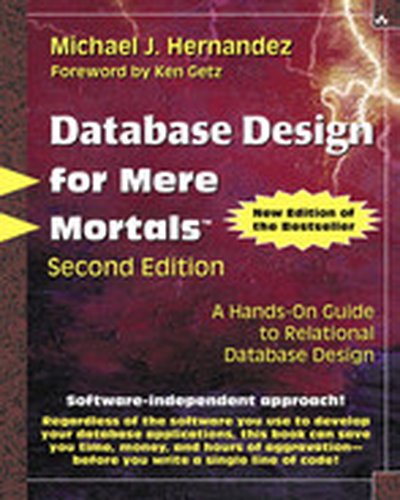
Database Design for Mere Mortals™: A Hands-On Guide to Relational Database Design, Second Edition

“This book takes the somewhat daunting process of database design and breaks it into completely manageable and understandable components. Mike’s approach whilst simple is completely professional, and I can recommend this book to any novice database designer.” – Sandra Barker, Lecturer, University of South Australia, Australia “Databases are a critical infrastructure technology for information systems and today’s business. Mike Hernandez has written a literate explanation of database technology–a topic that is intricate and often obscure. If you design databases yourself, this book will educate you about pitfalls and show you what to do. If you purchase products that use a database, the book explains the technology so that you can understand what the vendor is doing and assess their products better.” – Michael Blaha, consultant and trainer, author of A Manager’s Guide to Database Technology “If you told me that Mike Hernandez could improve on the first edition of Database Design for Mere Mortals I wouldn’t have believed you, but he did! The second edition is packed with more real-world examples, detailed explanations, and even includes database-design tools on the CD-ROM! This is a must-read for anyone who is even remotely interested in relational database design, from the individual who is called upon occasionally to create a useful tool at work, to the seasoned professional who wants to brush up on the fundamentals. Simply put, if you want to do it right, read this book!” – Matt Greer, Process Control Development, The Dow Chemical Company “Mike’s approach to database design is totally common-sense based, yet he’s adhered to all the rules of good relational database design. I use Mike’s books in my starter database-design class, and I recommend his books to anyone who’s interested in learning how to design databases or how to write SQL queries.” – Michelle Poolet, President, MVDS, Inc. “Slapping together sophisticated applications with poorly designed data will hurt you just as much now as when Mike wrote his first edition, perhaps even more. Whether you’re just getting started developing with data or are a seasoned pro; whether you've read Mike’s previous book or this is your first; whether you're happier letting someone else design your data or you love doing it yourself–this is the book for you. Mike’s ability to explain these concepts in a way that’s not only clear, but fun, continues to amaze me.” –From the Foreword by Ken Getz, MCW Technologies, coauthor ASP.NET Developer's JumpStart “The first edition of Mike Hernandez’s book Database Design for Mere Mortals was one of the few books that survived the cut when I moved my office to smaller quarters. The second edition expands and improves on the original in so many ways. It is not only a good, clear read, but contains a remarkable quantity of clear, concise thinking on a very complex subject. It’s a must for anyone interested in the subject of database design.” – Malcolm C. Rubel, Performance Dynamics Associates “Mike’s excellent guide to relational database design deserves a second edition. His book is an essential tool for fledgling Microsoft Access and other desktop database developers, as well as for client/server pros. I recommend it highly to all my readers.” – Roger Jennings, author of Special Edition Using Access 2002 “There are no silver bullets! Database technology has advanced dramatically, the newest crop of database servers perform operations faster than anyone could have imagined six years ago, but none of these technological advances will help fix a bad database design, or capture data that you forgot to include! Database Design for Mere Mortals™, Second Edition, helps you design your database right in the first place!” – Matt Nunn, Product Manager, SQL Server, Microsoft Corporation “When my brother started his professional career as a developer, I gave him Mike’s book to help him understand database concepts and make real-world application of database technology. When I need a refresher on the finer points of database design, this is the book I pick up. I do not think that there is a better testimony to the value of a book than that it gets used. For this reason I have wholeheartedly recommended to my peers and students that they utilize this book in their day-to-day development tasks.” – Chris Kunicki, Senior Consultant, OfficeZealot.com “Mike has always had an incredible knack for taking the most complex topics, breaking them down, and explaining them so that anyone can ‘get it.’ He has honed and polished his first very, very good edition and made it even better. If you're just starting out building database applications, this book is a must-read cover to cover. Expert designers will find Mike’s approach fresh and enlightening and a source of great material for training others.” – John Viescas, President, Viescas Consulting, Inc., author of Running Microsoft Access 2000 and coauthor of SQL Queries for Mere Mortals “Whether you need to learn about relational database design in general, design a relational database, understand relational database terminology, or learn best practices for implementing a relational database, Database Design for Mere Mortals™, Second Edition, is an indispensable book that you’ll refer to often. With his many years of real-world experience designing relational databases, Michael shows you how to analyze and improve existing databases, implement keys, define table relationships and business rules, and create data views, resulting in data integrity, uniform access to data, and reduced data-entry errors.” – Paul Cornell, Site Editor, MSDN Office Developer Center Sound database design can save hours of development time and ensure functionality and reliability. is a straightforward, platform-independent tutorial on the basic principles of relational database design. It provides a commonsense design methodology for developing databases that work. Database Design for Mere Mortals™, Second Edition, Database design expert Michael J. Hernandez has expanded his best-selling first edition, maintaining its hands-on approach and accessibility while updating its coverage and including even more examples and illustrations. This edition features a CD-ROM that includes diagrams of sample databases, as well as design guidelines, documentation forms, and examples of the database design process. This book will give you the knowledge and tools you need to create efficient and effective relational databases.

Applied XML Programming for Microsoft® .NET

Get the expert advice you need to succeed in building .NET-connected applications with XML! XML is everywhere in the Microsoft .NET Framework, from Remoting to Web services, and from data access to configuration. Learn about the extensive XML core classes in .NET and find out how to program against its parser in this in-depth guide—written by an expert programming author and consultant on cutting-edge technologies such as Microsoft ASP.NET and Microsoft ADO.NET. You'll find authoritative explanations of technologies such as schemas, transformations, and XPath, plus extensive discussion of data access issues such as synchronization and serialization, the DiffGram format, and the XML extensions in Microsoft SQL Server™ 2000. Along the way, you'll learn exactly how to get the best performance out of XML in the .NET world. You'll also get answers to common questions such as, "When should I use XML Web services instead of Remoting?".

Special Edition Using SOAP

This book will introduce the reader to SOAP and serve as a comprehensive reference to both experienced and new developers in the area. Only one other book completely dedicated to SOAP is currently on the market, and it has strong sales because no other information is available. SE Using SOAP will capture more readers than the competition because it provides real-world examples and troubleshooting with complete data conversion information. The emphasis will be on getting started fast instead of reading through white paper-style theory in hopes of finding applicable information. By reading this book and working through the examples, the reader will be well versed in SOAP and its applications immediately. SE Using SOAP includes difficult to find information on how SOAP works with different languages and protocols including Visual Basic.NET, Visual Basic 6, C#, XML, HTTP, SDL, DISCO, COM, SQL Server, plus much more. Also covers how to work with PDAs, an ever-growing need in the data transfer market.

Dan will cover his Python-driven services for high-performance AI applications used in the pharmaceutical industry. Neural Networks and drug-like molecule databases of billions of compounds will be covered. How do you query a billion objects in Python quickly? Dan will show how to cheat with custom C code to extend Python to enable new tricks. Demo site - https://do.dotmatics.net/