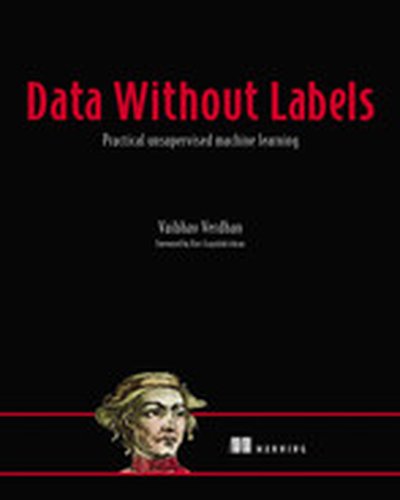
Discover all-practical implementations of the key algorithms and models for handling unlabeled data. Full of case studies demonstrating how to apply each technique to real-world problems. In Data Without Labels you’ll learn: Fundamental building blocks and concepts of machine learning and unsupervised learning Data cleaning for structured and unstructured data like text and images Clustering algorithms like K-means, hierarchical clustering, DBSCAN, Gaussian Mixture Models, and Spectral clustering Dimensionality reduction methods like Principal Component Analysis (PCA), SVD, Multidimensional scaling, and t-SNE Association rule algorithms like aPriori, ECLAT, SPADE Unsupervised time series clustering, Gaussian Mixture models, and statistical methods Building neural networks such as GANs and autoencoders Dimensionality reduction methods like Principal Component Analysis and multidimensional scaling Association rule algorithms like aPriori, ECLAT, and SPADE Working with Python tools and libraries like sci-kit learn, numpy, Pandas, matplotlib, Seaborn, Keras, TensorFlow, and Flask How to interpret the results of unsupervised learning Choosing the right algorithm for your problem Deploying unsupervised learning to production Maintenance and refresh of an ML solution Data Without Labels introduces mathematical techniques, key algorithms, and Python implementations that will help you build machine learning models for unannotated data. You’ll discover hands-off and unsupervised machine learning approaches that can still untangle raw, real-world datasets and support sound strategic decisions for your business. Don’t get bogged down in theory—the book bridges the gap between complex math and practical Python implementations, covering end-to-end model development all the way through to production deployment. You’ll discover the business use cases for machine learning and unsupervised learning, and access insightful research papers to complete your knowledge. About the Technology Generative AI, predictive algorithms, fraud detection, and many other analysis tasks rely on cheap and plentiful unlabeled data. Machine learning on data without labels—or unsupervised learning—turns raw text, images, and numbers into insights about your customers, accurate computer vision, and high-quality datasets for training AI models. This book will show you how. About the Book Data Without Labels is a comprehensive guide to unsupervised learning, offering a deep dive into its mathematical foundations, algorithms, and practical applications. It presents practical examples from retail, aviation, and banking using fully annotated Python code. You’ll explore core techniques like clustering and dimensionality reduction along with advanced topics like autoencoders and GANs. As you go, you’ll learn where to apply unsupervised learning in business applications and discover how to develop your own machine learning models end-to-end. What's Inside Master unsupervised learning algorithms Real-world business applications Curate AI training datasets Explore autoencoders and GANs applications About the Reader Intended for data science professionals. Assumes knowledge of Python and basic machine learning. About the Author Vaibhav Verdhan is a seasoned data science professional with extensive experience working on data science projects in a large pharmaceutical company. Quotes An invaluable resource for anyone navigating the complexities of unsupervised learning. A must-have. - Ganna Pogrebna, The Alan Turing Institute Empowers the reader to unlock the hidden potential within their data. - Sonny Shergill, Astra Zeneca A must-have for teams working with unstructured data. Cuts through the fog of theory ili Explains the theory and delivers practical solutions. - Leonardo Gomes da Silva, onGRID Sports Technology The Bible for unsupervised learning! Full of real-world applications, clear explanations, and excellent Python implementations. - Gary Bake, Falconhurst Technologies