talk-data.com talk-data.com

Topic

Microsoft

technology software cloud

407

tagged

Activity Trend

556 peak/qtr
2020-Q1 2026-Q1

Activities

Showing filtered results

Filtering by: O'Reilly Data Engineering Books ×
MDX Solutions: With Microsoft® SQL Server™ Analysis Services 2005 and Hyperion® Essbase, Second Edition

Serving as both a tutorial and a reference guide to the MDX (Multidimensional Expressions) query language, this book shows data warehouse developers what they need to know to build effective multidimensional data warehouses After a brief overview of the MDX language and a look at how it is used to access data in sophisticated, multidimensional databases and data warehousing, the authors move directly to providing practical examples of MDX in use New material covers changes in the MDX language itself as well as major changes in its implementation with the latest software releases of Microsoft SQL Server Analysis Services 2005 and Hyperion Essbase Also covers more advanced techniques, like aggregation, query templates, and MDX optimization, and shows users what they need to know to access and analyze data to make better business decisions Note: CD-ROM/DVD and other supplementary materials are not included as part of eBook file.

Fixing Access Annoyances

When an application is part of the Microsoft Office suite, it's sure to be a leader in its field. In the realm of desktop database management, Access is top dog with millions of users. But this is one dog that can bite. Although Access is a powerful, relational tool with the fetching talents of a Labrador, it's not an easy beast to train. Still, millions of users count on Access for everything from managing parts databases to running Web catalogs to working as a front end to mondo SQL databases. But Access is chockablock with annoyances---report hassles, query conundrums, VBA bugs, arcane error messages, and more. O'Reilly's Annoyances series offer real-world help, right now, and Fixing Access Annoyances continues tradition. You'll not only squash bugs and workaround Access' limits, but you'll learn how to use Access to the max, whether you're a newbie or a seasoned pro. Coverage includes install/configuration annoyances, building better tables and queries, creating forms that work right, generating reliable and sophisticated reports, pulling in data from a variety of sources, crafting macros and VBA code to customize Access, and much more. You could grab those other books for help, but do they solve problems from page one? Meet a book of a different stripe. The authors come armed with knowledge of the program's quirks, design hurdles and interface snags. They provide you with battle plans in Fixing Access Annoyances to save you time and bouts of hair pulling. Stop information from spiraling out of control when working with Access and trying to make this #$@@#$ thing work! Don't let its quirks, bugs, and troublemaking features beat you. Who you gonna call for help? Instead of waiting on the line for tech support or searching for the answer on the Internet with its too many resources to find exactly what you need, take control of databases with Fixing Access Annoyances, your partner on database adventures.

Programming SQL Server 2005

SQL Server 2005, Microsoft's next-generation data management and analysis solution, represents a huge leap forward. It comes with a myriad of changes that deliver increased security, scalability, and power--making it the complete data package. Used properly, SQL Server 2005 can help organizations of all sizes meet their data challenges head on. Programming SQL Server 2005 from O'Reilly provides a practical look at this updated version of Microsoft's premier database product. It guides you through all the new features, explaining how they work and how to use them. The first half of the book examines the changes and new features of the SQL Server Engine itself. The second addresses the enhanced features and tools of the platform, including the new services blended into this popular version. Each chapter contains numerous code samples-written in C# and compiled using the Visual Studio 2005 development environment-that show you exactly how to program SQL Server 2005. Programming SQL Server 2005 can help you: Build, deploy, and manage enterprise applications that are more secure, scalable, and reliable Maximize IT productivity by reducing the complexity of building, deploying, and managing database applications Share data across multiple platforms, applications, and devices to make it easier to connect internal and external systems Because the goal of Programming SQL Server 2005 is to introduce all facets of Programming SQL Server 2005, it's beneficial to programmers of all levels. The book can be used as a primer by developers with little experience with SQL Server, as a ramp up to the new programming models for SQL Server 2005 for more experienced programmers, or as background and primer to specific concepts. Any IT professional who wants to learn about SQL Server 2005's comprehensive feature set, interoperability with existing systems, and automation of routine tasks will find the answers in this authoritative guide.

Microsoft SQL Server 2005 Notification Services

Microsoft SQL Server 2005 Notification Services covers the basic problems of notification applications, describes the SQL Notification Services platform and describes how to use it to build rich, scalable notification applications. Written by Shyam Pather, the Technical Lead for the SQL Notification Services Team, this book is based on his three years of experience teaching SQL Notification Services to new customers. This book is your complete resource for learning SQL Notification Services application development and the underlying architectural concepts.

Business Process Execution Language for Web Services - Second Edition

Key Features Architecture, syntax, development and composition of Business Processes and Services using BPEL Advanced BPEL features such as compensation, concurrency, links, scopes, events, dynamic partner links, and correlations Oracle BPEL Process Manager and BPEL Designer Microsoft BizTalk Server as a BPEL server Book Description Web services provide the basic technical platform required for application interoperability. They do not, however, provide higher level control, such as which web services need to be invoked, which operations should be called and in what sequence. Nor do they provide ways to describe the semantics of interfaces, the workflows, or e-business processes. BPEL is the missing link to assemble and integrate web services into a real business process BPEL4WS standardizes process automation between web services. This applies both within the enterprise, where BPEL4WS is used to integrate previously isolated systems, and between enterprises, where BPEL4WS enables easier and more effective integration with business partners. In providing a standard descriptive structure BPEL4WS enables enterprises to define their business processes during the design phase. Wider business benefits can flow from this through business process optimization, reengineering, and the selection of most appropriate processes . Supported by major vendors - including BEA, Hewlett-Packard, IBM, Microsoft, Novell, Oracle, SAP, Sun, and others - BPEL4WS is becoming the accepted standard for business process management. This book provides detailed coverage of BPEL4WS, its syntax, and where, and how, it is used. It begins with an overview of web services, showing both the foundation of, and need for, BPEL. The web services orchestration stack is explained, including standards such as WS-Security, WS-Coordination, WS-Transaction, WS-Addressing, and others. The BPEL language itself is explained in detail, with Code snippets and complete examples illustrating both its syntax and typical construction. Having covered BPEL itself, the book then goes on to show BPEL is used in context. by providing an overview of major BPEL4WS servers. It covers the Oracle BPEL Process Manager and Microsoft BizTalk Server 2004 in detail, and shows how to write BPEL4WS solutions using these servers. What you will learn Chapter 1 provides a detailed introduction to BPEL and Service Oriented Architecture (SOA). It discusses business processes and their automation, explains the role of BPEL, web services, and Enterprise Service Buses (ESB) in SOA, provides insight into business process composition with BPEL, explains the most important features, compares BPEL to other specifications, provides an overview of BPEL servers, and discusses the future of BPEL. Chapter 2 provides a detailed introduction to the Web Services Technology Stack. It discusses the important standards and specifications for using BPEL and implementing SOA with web services, such as WS-Security, WS-Addressing, WS-Coordination, WS-AtomicTransaction, WS-BusinessActivity, WS-Reliable Messaging, etc. Chapter 3 discusses the composition of web services with BPEL. The chapter introduces the core concepts of BPEL and explains how to define synchronous and asynchronous business processes with BPEL. The reader gets familiar with BPEL process structure, partner links, sequential and parallel service invocation, variables, conditions, etc. Chapter 4 goes deeper into the BPEL specification and covers advanced features for modeling complex business processes. Advanced activities, scopes, serialization, fault handing, compensations, event handling, correlation sets, concurrent activities and links, process lifecycle, and dynamic partner links are covered in detail. Chapter 5 explains how to use the Oracle BPEL Process Manager for deploying and executing business processes defined in BPEL. It describes the server architecture, tools, features, and common approaches for managing and debugging BPEL processes. The chapter also looks at graphical development of BPEL processes using Oracle BPEL Designer for JDeveloper and for Eclipse. Chapter 6 takes a detailed look at the advanced features of the Oracle BPEL Process Manager including extension functions, dynamic parallel flows, Web Services Invocation Framework, Java embedding, Notification service, Workflow service, Identity service, and Oracle BPEL Server APIs. Chapter 7 discusses MS BizTalk Server 2004 and its support for BPEL. It explains how to develop business processes in BizTalk and export them to BPEL. It also explains how to import BPEL processes into BizTalk and how to use the Orchestration Designer tool to define processes graphically, and compares BizTalk and BPEL constructs. Appendix A provides a syntax reference for BPEL version 1.1. The appendix covers standard BPEL activities and elements, functions, attributes, and faults. Who this book is for This book is aimed at architects and developers in the design, implementation, and integration phases of advanced information systems and e-business solutions, developing business processes and dealing with the issues of composition, orchestration, transactions, coordination, and security. The book presumes knowledge of XML and web services, web services development (either on J2EE or .NET), and multi-tier architecture

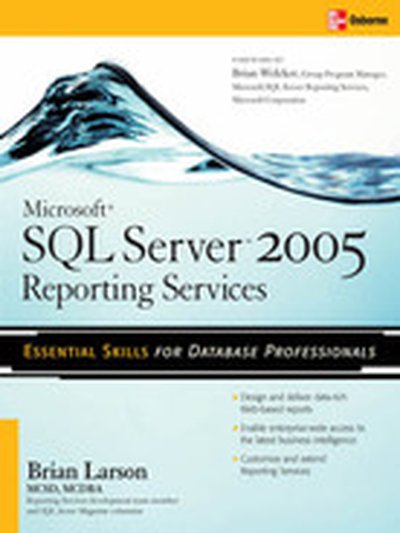
Microsoft SQL Server 2005 Reporting Services, 2nd Edition

Microsoft's Reporting Services product is a vital part of the SQL Server 2005 business intelligence platform, but it works with virtually any data source. This hands-on guide explains how to transform data into insightful and interactive Web-based reports using Microsoft SQL Server 2005 Reporting Services. With coverage of everything from installation to administration, the book demonstrates how to use this powerful server-based reporting solution to improve business decision-making and facilitate company-wide -- even worldwide -- communication.

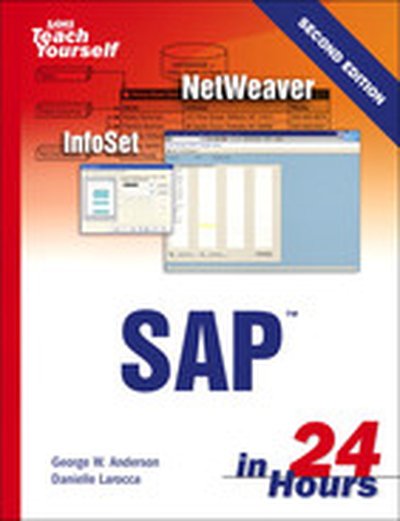
Sams Teach Yourself SAP™ in 24 Hours, Second Edition

A new edition of this book is now available, ISBN-10: 0137142846 ISBN:13 9780137142842 Sams Teach Yourself SAP in 24 Hours, Second Edition is the perfect tool for learning one of the most sophisticated enterprise solutions available today. Designed to being with the basics, you will become acquainted with the entire SAP system, from navigation to creating your own reports. You'll also cover: Implementation tools and methodologies NetWeaver ECC 5.0 Designing Screens and menus Reporting Integration with Microsoft Office And more Written by leading SAP consultants with over 20 years of combined experience, this easy-to-understand tutorial is ideal for getting up and running with SAP quickly and efficiently.

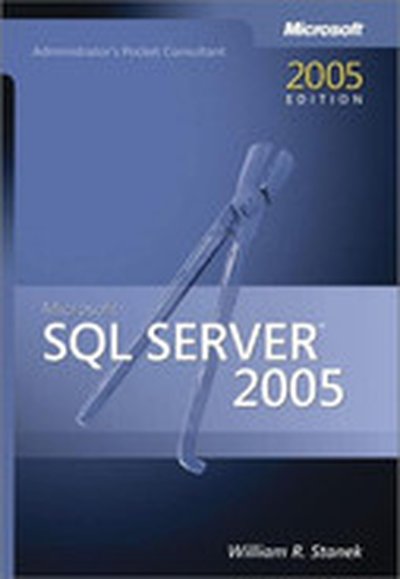
Microsoft® SQL Server™ 2005 Administrator's Pocket Consultant

Here’s the utterly practical, pocket-sized reference for IT professionals who need to administer, optimize, and maintain Microsoft SQL Server 2005 in their organization. This unique guide provides essential details for using Microsoft SQL Server 2005 to help protect and manage your company’s data—whether automating tasks; creating indexes and views; performing backups and recovery; replicating transactions; tuning performance; managing server activity; importing and exporting data; or performing other key tasks. Featuring quick-reference tables, lists, and step-by-step instructions, this handy, one-stop guide provides fast, accurate answers on the spot—whether you’re at your desk or in the field!

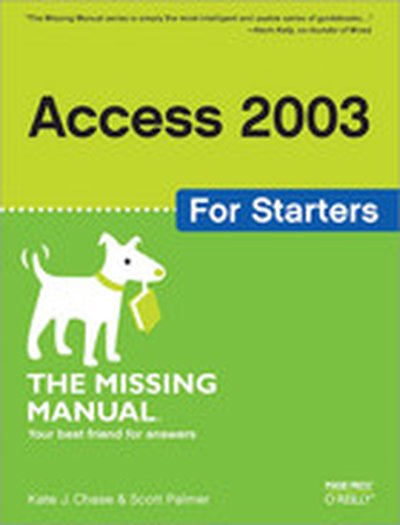
Access 2003 for Starters: The Missing Manual

Maybe you got Access as part of Microsoft Office and wonder what it can do for you and your household; maybe you're a small business manager and don't have a techie on staff to train the office in Microsoft Access. Regardless, you want to quickly get your feet wet--but not get in over your head--and Access 2003 for Starters: The Missing Manual is the book to make it happen. Far more than a skimpy introduction but much less daunting than a weighty tech book, Access 2003 for Starters: The Missing Manual demystifies databases and explains how to design and create them with ease. It delivers everything you need--and nothing you don't--to use Access right away. It's your expert guide to the Access features that are most vital and most useful, and it's your trusted advisor on the more in-depth features that are best saved for developers and programmers. Access is sophisticated and powerful enough for professional developers but easy and practical enough for everyday users like you. This Missing Manual explains all the major features of Access 2003, including designing and creating databases, organizing and filtering information, and generating effective forms and reports. Bestselling authors, database designers, and programmers Scott Palmer, Ph.D., and Kate Chase are your guides for putting the world's most popular desktop data management program to work. Their clear explanations, step-by-step instructions, plenty of illustrations, and timesaving advice help you get up to speed quickly and painlessly. Whether you're just starting out or you know you've been avoiding aspects of the program and missing out on much of what it can do, this friendly, witty book will gently immerse you in Microsoft Access. Keep it handy, as you'll undoubtedly refer to it again and again.

IBM Workplace Collaboration Services: Release 2.5 Deployment Guide

IBM, a leader in collaboration, has created IBM Workplace Collaboration Services--a new completely, integrated collaborative environment based on open standards. IBM Workplace Collaboration Services provides a wide range of integrated, ready-to-use communication and collaboration capabilities as services for the IBM Workplace environment. This includes capabilities such e-mail, calendaring and scheduling, presence and awareness, instant messaging, learning, team spaces, Web conferencing, and document and Web content management. This IBM Redbooks publication is an installation and deployment guide for IBM Workplace Collaboration Services Release 2.5. We provide detailed installation procedures for Microsoft Windows and Novell SUSE Linux and highlight clustered deployment.

Deployment Guide Series: IBM Tivoli Configuration Manager

IBM Tivoli Configuration Manager controls software distribution and asset management inventory in a multiplatform environment. It is designed for configuration, distribution, change, version, and asset management in a distributed computing environment. Working on top of IBM Tivoli Management Framework, IBM Tivoli Configuration Manager provides an integrated solution for managing complex, distributed enterprise environments. This IBM Redbooks publication introduces the IBM Tivoli Configuration Manager logical and physical components and covers detailed planning and implementation steps to deploy IBM Tivoli Configuration Manager in small-to-medium and large-sized environments, including IBM AIX 5L, Microsoft Windows, Linux, and IBM OS/400 systems. In addition, we talk about best practices, advanced customization, and tuning topics for IBM Tivoli Configuration Manager. This book will be useful for IT specialists responsible for implementing IBM Tivoli Configuration Manager V4.2.x in customer environments. Please note that the additional material referenced in the text is not available from IBM.

Microsoft® SQL Server 2005: Changing the Paradigm (SQL Server 2005 Public Beta Edition)

Microsoft SQL Server 2005: Changing the Paradigm (SQL Server 2005 Public Beta Edition) will prepare database administrators for upcoming changes in SQL Server 2005. Obtain the skills necessary to run SQL Server 2005 from the experts at Microsoft Gold Partner. Get a head-start to understanding the new concepts and features of SQL Server 2005 from the database administrator's perspective, including: SQL Server 2005 Architecture Tool Sets Scalability, Reliability and High Availability Chapter Performance Tuning Replication .NET CLR Integration DTS and Business Intelligence Minimize the surprises in SQL Server 2005 with the help of Microsoft SQL Server 2005: Changing the Paradigm (SQL Server 2005 Public Beta Edition).

Hands-On Microsoft Access: A Practical Guide to Improving Your Access Skills

Praise for Hands-On Microsoft Access “Bob has distilled the essence of database design and Access development into a highly valuable and easily understandable resource that I wish was available when I first started out.” —Graham R. Seach, Microsoft Access MVP “If you’ve been using Access with that typical uncertainty, asking yourself 'Just how could I do that?' or 'Why isn’t this working?', if you’d like to know what you’re doing before you hit the wall, this book is probably perfect for you.” —Olaf Rabbachin, CEO, IntuiDev IT-solutions “Life at the cutting edge of Access development is exciting and very challenging. The knowledge and experience gained over many years of research and trial-and-error has been hard won. But Bob's new book encapsulates the knowledge we now take for granted, and for the first time the beginner is afforded the opportunity to bypass all that hard work. In this his latest work, Bob has distilled the essence of database design and Access development into a highly valuable and easily understandable resource that I wish was available when I first started out.” —Graham R Seach, MCP, MCAD, MCSD, Microsoft Access MVP, author “This is an excellent book for beginners, with an easy reading style. It is now on my recommended list of books that I hand out in every Access class that I teach.” —M.L. “Sco” Scofield, Microsoft Access MVP, MCSD, Senior Instructor, Scofield Business Services “If you've been using Access with that typical uncertainty, asking yourself 'Just how could I do that?' or 'Why isn't this working?', or if you'd like to know what you're doing before you hit the wall, this book is perfect for you. Access is a tremendous product and a database is created using a few clicks; but without at least some theoretical background you're bound to encounter problems soon. I wish a book like this one would've been available when I started getting deeper into working with Access some ten years ago.” —Olaf Rabbachin, CEO, IntuiDev IT-solutions “This book is for any level DB developer/user. It is packed full of real-world examples and solutions that are not the normal Northwind database that most Access books use. The examples and the technical content surrounding them are the real strength of the book. Schneider uses real-world scenarios that make for excellent reading. It made me want to go and redo a lot of my older Access DBs that were not written as well as they could have been. This book taught me different approaches to doing some routine tasks.” —Ron Crumbaker, Microsoft MVP – SMS “While a very powerful application (or perhaps because of its power), Microsoft Access does have a steep learning curve and can be intimidating to new users. Bob Schneider has managed to write a book that's both understandable and enjoyable to read. His examples should be understandable to all readers, and he extends them in a logical manner. This book should leave the reader well equipped to make use of what many consider to be the best desktop database product available.” —Doug Steele, Microsoft Access MVP “The author takes what is potentially a very dry subject and adds fantastic color through entertaining analogies and metaphors. For instance, his examples using the NBA, the Beatles, and Donald Rumsfeld help us 'get it' without realizing we have just traversed what could be very stale database theory. Brilliant!” —Kel Good, MCT, MCSD for Microsoft.NET, Custom Software Development Inc. (www.customsoftware.ca) Go from Access “beginner” to Access “master”! Millions of people use Microsoft Access, but only a small fraction of them are really comfortable with it. If you're ready to go “beyond the wizards”—and become a confident, highly effective Access user— Hands-On Microsoft Access was written for you. In plain English, Bob Schneider helps you master crucial principles for building flexible, powerful databases. Discover how to enter data more easily, retrieve it more freely, manipulate it more successfully, analyze it with greater sophistication, and share it more effectively. Schneider's dozens of hands-on examples thoroughly demystify Access, and his friendly, conversational style makes it more approachable than ever before. Hands-On Microsoft Access presents solutions for the challenges you're most likely to encounter, including How do Access objects and interfaces fit together, and when should I use each one? What's the best way for me to organize my fields into tables? How can I modify the tables, forms, and reports an Access wizard created for me? How can I design forms and reports for people to use more effectively? How do primary keys and relationships work, and why are they so important? How do I make sure my data stays consistent and accurate? How do I build queries that give me the right information—quickly, efficiently, and reliably? How do I use data from other sources, or deliver Access data to other people or programs? What are PivotTables and PivotCharts, what can I do with them, and how do I use them? Written for Access 2003, this book also contains special instructions for Access 2002 users and extensive coverage of issues relevant to Access 95, 97, and 2000.

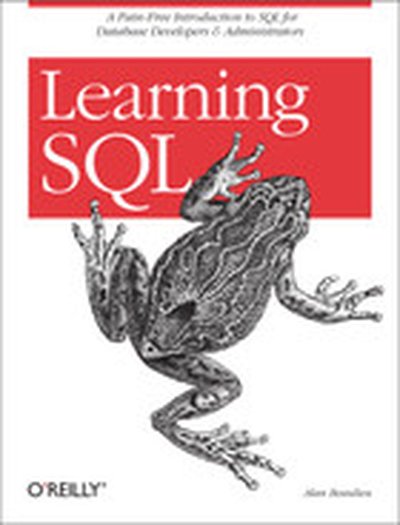
Learning SQL

SQL (Structured Query Language) is a standard programming language for generating, manipulating, and retrieving information from a relational database. If you're working with a relational database--whether you're writing applications, performing administrative tasks, or generating reports--you need to know how to interact with your data. Even if you are using a tool that generates SQL for you, such as a reporting tool, there may still be cases where you need to bypass the automatic generation feature and write your own SQL statements. To help you attain this fundamental SQL knowledge, look to Learning SQL, an introductory guide to SQL, designed primarily for developers just cutting their teeth on the language. Learning SQL moves you quickly through the basics and then on to some of the more commonly used advanced features. Among the topics discussed: The history of the computerized database SQL Data Statements--those used to create, manipulate, and retrieve data stored in your database; example statements include select, update, insert, and delete SQL Schema Statements--those used to create database objects, such as tables, indexes, and constraints How data sets can interact with queries The importance of subqueries Data conversion and manipulation via SQL's built-in functions How conditional logic can be used in Data StatementsBest of all, Learning SQL talks to you in a real-world manner, discussing various platform differences that you're likely to encounter and offering a series of chapter exercises that walk you through the learning process. Whenever possible, the book sticks to the features included in the ANSI SQL standards. This means you'll be able to apply what you learn to any of several different databases; the book covers MySQL, Microsoft SQL Server, and Oracle Database, but the features and syntax should apply just as well (perhaps with some tweaking) to IBM DB2, Sybase Adaptive Server, and PostgreSQL. Put the power and flexibility of SQL to work. With Learning SQL you can master this important skill and know that the SQL statements you write are indeed correct.

XSLT 1.0 Pocket Reference

XSLT is an essential tool for converting XML into other kinds of documents: HTML, PDF file, and many others. It's a critical technology for XML-based platforms such as Microsoft .NET, Sun Microsystems' Sun One, as well as for most web browsers and authoring tools. As useful as XSLT is, however, most people have a difficult time getting used to its peculiar characteristics. The ability to use advanced techniques depends on a clear and exact understanding of how XSLT templates work and interact. The XSLT 1.0 Pocket Reference from O'Reilly wants to make sure you achieve that level of understanding. With its concise approach, this handy pocket guide quickly gets you up to speed on XSLT 1.0 so you can covert XML like a seasoned pro. In addition to covering the basics of stylesheet structure, it also explains how to: use template rules create a result tree apply conditional processing transform multiple source documents employ number formatting Thanks to their convenient, quick-reference format, O'Reilly's Pocket References spare you from having to hunt through larger books for answers. They deliver just what you need to get the job done in a timely fashion. And the XSLT 1.0 Pocket Reference is no different--it's the ideal companion to have at your desk when you need an answer fast.

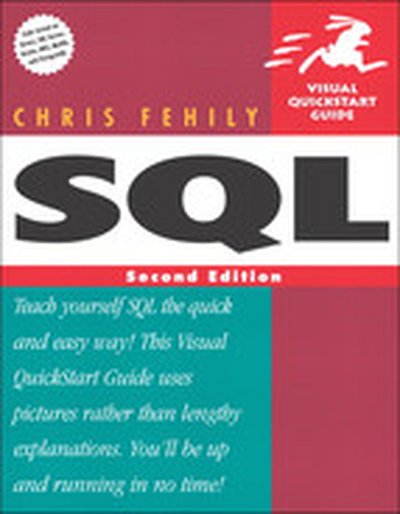
SQL: Visual Quickstart Guide, Second Edition

As dynamic, database-driven Web sites become the standard, more and more nonprogrammers just like yourself are being forced to work with database information and create and edit database objects. With SQL and this task-based guide to it, you can do it too-- no programming experience required! After going over the relational database model and SQL syntax in the first few chapters, veteran author Chris Fehily launches into the tasks that will get you comfortable with SQL fast. In addition to explaining SQL basics, this updated reference covers the ANSI SQL:2003 standard and contains a wealth of brand-new information, including a new chapter on set operations and common tasks, well-placed optimization tips to make your queries run fast, sidebars on advanced topics, and added IBM DB2 coverage. Best of all, the book's examples were tested on the latest versions of Microsoft Access, Microsoft SQL Server, Oracle, IBM DB2, MySQL, and PostgreSQL. On the companion Web site, you can download the SQL scripts and sample database for all these systems and put your knowledge to work immediately on a real database..

Access Hacks

As part of the Microsoft Office suite, Access has become the industry's leading desktop database management program for organizing, accessing, and sharing information. But taking advantage of this product to build increasingly complex Access applications requires something more than your typical how-to book. What it calls for is Access Hacks from O'Reilly.This valuable guide provides direct, hands-on solutions that can help relieve the frustrations felt by users struggling to master the program's various complexities. For experienced users, Access Hacks offers a unique collection of proven techniques and tools that enable them to take their database skills and productivity to the next level. For Access beginners, it helps them acquire a firm grasp of the program's most productive features.A smart collection of insider tips and tricks, Access Hacks covers all of the program's finer points. Among the multitude of topics addressed, it shows users how to: work with Access in multi-user environments utilize SQL queries work with external data and programs integrate Access with third-party productsJust imagine: a learning process without the angst. Well, Access Hacks delivers it with ease, thanks to these down-and-dirty techniques not collected together anywhere else.Part of O'Reilly's best-selling Hacks series, Access Hacks is based on author Ken Bluttman's two decades of real-world experience in database programming and business application building. It's because of his vast experiences that the book is able to offer such a deep understanding of the program's expanding possibilities.

Access 2003 Programming by Example with VBA, XML, and ASP

This book is designed to take Microsoft Access users to the next step in programming. Its five parts cover an intro-duction to VBA programming, manipulating databases with ADO, using DDL, event programming, and using ASP and XML. With more than 300 hands-on examples and 11 custom projects, users can quickly build the toolset required for developing their own database solutions. Learn how to write and debug your programming code with the Visual Basic Editor, and understand and use common VBA programming structures such as conditions, loops, arrays, and collections. Learn how to create and manage databases with ActiveX Data Objects (ADO), and perform database tasks with Jet/Access Structured Query Language (SQL) and its Data Definition Language (DDL) component. Learn how to query and manipulate your database from a web browser with Active Server Pages (ASP) and export and import Access data to and from XML both manually and programmatically.

Beginning SQL

Taking readers through the basics of the language, right up to some more advanced topics, this book is a practical, hands-on resource and aims to keep the reader involved at all times Focuses on the SQL standard and is loaded with detailed examples and code; each chapter includes practice exercises that readers can challenge themselves with before looking at the sample solutions in the appendix Paul Wilton is a successful Wrox "Beginning" book author and is an ideal author to write for those who want a firm grasp of standard SQL before learning the details specific to a particular database product SQL is an international standard for manipulating data in databases and is used by database programmers in all major database systems: Microsoft, IBM, Oracle, MySQL, and many others

Lotus Workplace 2.0.1 Products: Deployment Guide

IBM Lotus software has created IBM Lotus Workplace, an integrated family of products based on open standards. Lotus Workplace combines market-leading collaborative components that can be used with a variety of security-rich clients for simplified access and interaction with other people and a host of collaborative applications such as e-mail, calendaring and scheduling, instant messaging, Web conferencing, team spaces, document and Web content management, and e-learning. IBM Lotus Workplace products include: This IBM Redbooks publication is an installation and deployment guide for the Lotus Workplace 2.0.1 platform. We provide detailed installation procedures for installing the Lotus Workplace products on both a Microsoft Windows 2000 server and a Linux server running SUSE LINUX Enterprise Server 8.1. We also discuss important deployment and planning scenarios, as well as tips, best practices, and techniques for troubleshooting errors during installation.