
talk-data.com talk-data.com

Topic

Polars

data_manipulation data_analysis rust

2

tagged

Activity Trend

13 peak/qtr
2020-Q1 2026-Q1

Activities

Showing filtered results

Filtering by: PyData Paris 2025 ×
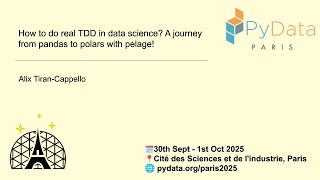
How to do real TDD in data science? A journey from pandas to polars with pelage!

In the world of data, inconsistencies or inaccuracies often presents a major challenge to extract valuable insights. Yet the number of robust tools and practices to address those issues remain limited. Particularly, the practice of TDD remains quite difficult in data science, while it is a standard among classic software development, also because of poorly adapted tools and frameworks.

To address this issue we released Pelage, an open-source Python package to facilitate data exploration and testing, which relies on Polars intuitive syntax and speed. Pelage empowers data scientists and analysts to facilitate data transformation, enhance data quality and improve code clarity.

We will demonstrate, in a test-first approach, how you can use this library in a meaningful data science workflow to gain greater confidence for your data transformations.

See website: https://alixtc.github.io/pelage/
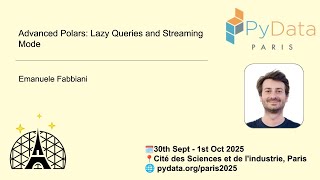
Advanced Polars: Lazy Queries and Streaming Mode

Do you find yourself struggling with Pandas' limitations when handling massive datasets or real-time data streams?

Discover Polars, the lightning-fast DataFrame library built in Rust. This talk presents two advanced features of the next-generation dataframe library: lazy queries and streaming mode.

Lazy evaluation in Polars allows you to build complex data pipelines without the performance bottlenecks of eager execution. By deferring computation, Polars optimises your queries using techniques like predicate and projection pushdown, reducing unnecessary computations and memory overhead. This leads to significant performance improvements, particularly with datasets larger than your system’s physical memory.

Polars' LazyFrames form the foundation of the library’s streaming mode, enabling efficient streaming pipelines, real-time transformations, and seamless integration with various data sinks.

This session will explore use cases and technical implementations of both lazy queries and streaming mode. We’ll also include live-coding demonstrations to introduce the tool, showcase best practices, and highlight common pitfalls.

Attendees will walk away with practical knowledge of lazy queries and streaming mode, ready to apply these tools in their daily work as data engineers or data scientists.