talk-data.com talk-data.com

Topic

relational-databases

507

tagged

Activity Trend

1 peak/qtr
2020-Q1 2026-Q1

Activities

507 activities · Newest first

SQL Server Integration Services

SQL Server 2005 Integration Services (SSIS) lets you build high-performance data integration solutions. SSIS solutions wrap sophisticated workflows around tasks that extract, transform, and load (ETL) data from and to a wide variety of data sources. This Short Cut begins with an overview of key SSIS concepts, capabilities, standard workflow and ETL elements, the development environment, execution, deployment, and migration from Data Transformation Services (DTS). Next, you'll see how to apply the concepts you've learned through hands-on examples of common integration scenarios. Once you've finished this Short Cut, you'll have the background and understanding you need to start building your own SSIS integration solutions.

OnDemand SQL Performance Analysis Simplified on DB2 for i5/OS in V5R4

The goal of database performance tuning is to minimize the response time of your queries. It is also to optimize your server’s resources by minimizing network traffic, disk I/O, and CPU time. This IBM IBM Redbooks publication helps you to understand the basics of identifying and tuning the performance of Structured Query Language (SQL) statements using IBM DB2 for i5/OS . DB2 for i5/OS provides a comprehensive set of tools that help technical analysts tune SQL queries. The SQL Performance Monitors are part of the set of tools that IBM i5/OS provides for assisting in SQL performance analysis since Version 3 Release 6. These monitors help to analyze database performance problems after SQL requests are run. In V5R4 of i5/OS iSeries Navigator provides a series of new tools to do SQL Performance analysis that we cover in this book. Among the new tools that we will covering are:

Expert MySQL

Since the enormous number of features made available with MySQL release 5.0, MySQL has been gaining steam as a viable alternative to database behemoths like Oracle and IBM DB2. MySQL users now have the ability to extend MySQL with new SQL commands, optimize query execution, and embed MySQL within low-resource environments like embedded devices and kiosks. Expert MySQL, by Dr. Charles A. Bell, is the first book to examine these opportunities in detail, showing you how to wield maximum control over this powerful open source database. You'll learn how to create your own custom storage handlers, ensuring maximum flexibility and speed within your specialized applications. You'll also gain valuable insight into MySQLs architecture and learn how to tweak its behavior through custom changes to the source code.

Beginning Database Design

Beginning Database Design: From Novice to Professional provides short, easy-to-read explanations of how to get database design right the first time. This book offers numerous examples to help you avoid the many pitfalls that entrap new and not-so-new database designers. Through the help of use cases and class diagrams modeled in the UML, youll learn how to discover and represent the details and scope of the problem in question. Database design is not an exact science, and solid database design principles and examples help demonstrate the consequences of simplifications and pragmatic decisions. The rationale is to try to keep it simple, but allow room for development as situations change or resources permit. The book also features an introduction for implementing the final design in a relational database.

Using IBM DB2 UDB with IBM System Storage N series

Database cloning is the process by which you create an exact copy of a DB2 database, either by physically copying the data or by performing what is known as a redirected restore. Database cloning is performed frequently by database administrators to provide near-production data for various business needs such as application development, QA testing, and report generation. Traditional methods of cloning a database pose various challenges, including system downtime and degraded system performance during the cloning process. Additionally, a large amount of storage space is required to store each clone. Furthermore, the maintenance overhead can be enormous if each cloned database requires a frequent data refresh. This IBM Redbooks publication describes the process used to create a clone of an IBM DB2 UDB database using FlexClone technology. This book also covers creating a database clone on a disaster recovery site that has replicated data using Data ONTAP SnapMirror technology.

Microsoft SQL Server 2005 Analysis Services

Microsoft SQL Server Analysis Services provides fast access to data by means of multidimensional data structures and the multidimensional query languag MDX. Analysis Services provides the capability to design, create, and manage multidimensional cubes based on data warehouse tables, and it serves as the foundation for the Microsoft Business Intelligence strategy. Microsoft SQL Server 2005 Analysis Services gives the reader insight into the way Analysis Services functions. It not only explains ways to design and create multidimensional objects, databases, dimensions, and cubes, but also provides invaluable information about the reasons behind design decisions made by the development team. Here's what you will find inside: Understand the key concepts of multidimensional modeling Explore the multidimensional object model and its definition language Learn the main concepts of the MDX language and gain an in-depth understanding of advanced MDX concepts Understand the mechanisms of integrating multidimensional and relational databases Learn how to build client applications to access data in Analysis Services Examine server architecture, including main data structures, data processing, and query resolution algorithms Gain a deep understanding of the internal and external protocols for data transfer, including the XML/A protocol Explore how Analysis Services manages memory Explore the security model, including role-based security, code-access security, and data security Discover how to monitor and manage Analysis Services All the code for the sample database used in the book can be found at www.informit.com/title/0672327821.

DB2 Recovery Expert for z/OS User Scenarios

This IBM Redbooks publication describes the procedures for using IBM DB2 Recovery Expert for z/OS to manage the recovery of DB2 for z/OS objects in a data sharing and non-data sharing environment. IBM DB2 Recovery Expert for z/OS is an easy-to-use, automated recovery solution that enables database recovery operations with minimal disruption. Its graphical user interface (GUI) provides powerful reporting and automated recovery capabilities for productive database maintenance and high availability. This book is written for an audience of DB2 for z/OS database administrators (DBA). This book gives you an overview of DB2 Recovery Expert for z/OS, its main features, architecture, recovery semantics, and processing flow. It also describes some of the key considerations in choosing a particular topology to address a business requirement. We provide user scenarios with step-by-step approaches to recover single DB2 for z/OS objects, multiple DB2 for z/OS objects, dropped DB2 for z/OS tables, and DB2 for z/OS subsystems using the IBM Recovery Expert for z/OS tool. We discuss backup and recovery in a DB2 for z/OS environment, the types of failures that might occur, the types of recovery that are supported, the types of objects that can be recovered, the elements and tools of recovery, and the recovery flow. We also provide a brief tutorial of the DB2 Recovery Expert for z/OS GUI client and an overview of the schema level repository (SLR) with recommendations for its maintenance. Please note that the additional material referenced in the text is not available from IBM.

MySQL Cookbook, 2nd Edition

Along with MySQL's popularity has come a flood of questions about solving specific problems, and that's where this Cookbook is essential. Designed as a handy resource when you need quick solutions or techniques, the book offers dozens of short, focused pieces of code and hundreds of worked-out examples for programmers of all levels who don't have the time (or expertise) to solve MySQL problems from scratch. The new edition covers MySQL 5.0 and its powerful new features, as well as the older but still widespread MySQL 4.1. One major emphasis of this book is how to use SQL to formulate queries for particular kinds of questions, using the mysql client program included in MySQL distributions. The other major emphasis is how to write programs that interact with the MySQL server through an API. You'll find plenty of examples using several language APIs in multiple scenarios and situations, including the use of Ruby to retrieve and format data. There are also many new examples for using Perl, PHP, Python, and Java as well. Other recipes in the book teach you to: Access data from multiple tables at the same time Use SQL to select, sort, and summarize rows Find matches or mismatches between rows in two tables Determine intervals between dates or times, including age calculations Store images into MySQL and retrieve them for display in web pages Get LOAD DATA to read your data files properly or find which values in the file are invalid Use strict mode to prevent entry of bad data into your database Copy a table or a database to another server Generate sequence numbers to use as unique row identifiers Create database events that execute according to a schedule And a lot more MySQL Cookbook doesn't attempt to develop full-fledged, complex applications. Instead, it's intended to assist you in developing applications yourself by helping you get past problems that have you stumped.

Creating your MySQL Database: Practical Design Tips and Techniques

This book is your guide to efficiently designing and structuring databases using MySQL. Through practical insights, you will learn how to organize data effectively and design with an emphasis on future growth and performance. By following this book's tips, you'll be able to streamline the backend of your applications and improve their robustness and scalability. What this Book will help me do Understand how to collect and organize data for a MySQL database. Master structuring database schemas for optimal performance. Learn about data security and applying privileges and views. Gain techniques to document and visualize data effectively. Develop and validate relational database structure with SQL queries. Author(s) Marc Delisle is an experienced database practitioner and an advocate for practical database design. With years of expertise in MySQL, Marc has helped numerous organizations optimize their data handling strategies. His writing simplifies complex concepts and focuses on empowering readers to apply lessons directly to real projects. Who is it for? This book is intended for software developers or IT professionals who handle applications with MySQL databases. It suits those with beginner to intermediate SQL and MySQL knowledge aiming to enhance their database design skills. Readers seeking practical, hands-on techniques for efficient database structuring will find this book invaluable. By learning the provided methods, readers can ensure their databases perform reliably in production environments.

Learning MySQL

Whether you're running a business, keeping track of members andmeetings for a club, or just trying to organize a large and diversecollection of information, you'll find the MySQL database engineuseful for answering questions such as: Which are my top ten fastest-selling products? How frequently does this person come to our facility? What was the highest, lowest, and average score of the team last season? MySQL, the most popular open-source database, offers the power ofa relational database in a package that's easy to set up andadminister, and Learning MySQL provides all the tools you need toget started. This densely packed tutorial includes detailedinstructions to help you set up and design an effective database,create powerful queries using SQL, configure MySQL for improvedsecurity, and squeeze information out of your data. After covering the basics, the book travels far into MySQL'ssubtleties, including complex queries and joins, how to interact withthe database over the Web using PHP or Perl, and importanthouse-keeping such as backups and security. Topic include: Installation on Linux, Windows, and Mac OS X Basic and advanced querying using SQL User management and security Backups and recovery Tuning for improved efficiency Developing command-line and web database applications using thePHP and Perl programming languages The authors, Saied Tahaghoghi and Hugh E. Williams, have careers inacademia and business, and share a keen interest in research intosearch technologies. Whether you've never touched a database or have already completedsome MySQL projects, you'll find insights in Learning MySQLthat will last a career.

Negus Live Linux Series Practical PHP and MySQL

"Practical PHP and MySQL reflects Jono's commitment to the spirit of making open source subjects accessible to everyone. The book carefully walks you through the code for eight useful, dynamic Web applications. Projects are presented in a playful way, like the forum project that touts horror movies that make you 'hide behind the couch.'" -From the Foreword by Christopher Negus, Series Editor, Negus Live Linux Series Build Dynamic Web Sites Fast, with PHP and MySQL... Learn from Eight Ready-to-Run Applications! Suddenly, it’s easy to build commercial-quality Web applications using free and open source software. With this book, you’ll learn from eight ready-to-run, real-world applications—all backed by clear diagrams and screenshots, well-documented code, and simple, practical explanations. Leading open source author Jono Bacon teaches the core skills you’ll need to build virtually any application. You’ll discover how to connect with databases, upload content, perform cascading deletes, edit records, validate registrations, specify user security, create reusable components, use PEAR extensions, and even build Ajax applications. Working from complete examples on the CD-ROM, you’ll create Generic dynamic Web sites Blogs Discussion forums Shopping carts Auction sites Calendars FAQ systems Reusable components Content management systems News sites JONO BACON is Ubuntu community manager for Canonical, Ubuntu’s sponsor. He is an established speaker, author, and contributor to the open source community. Bacon co-authored Linux Desktop Hacks and The Official Ubuntu Book; has served as a columnist for Linux Format, Linux User & Developer, and PC Plus; and is an O’Reilly Networkweblog author. He is a lead developer onthe Jokosher (www.jokosher.org) project,and co-founder of LUGRadio—a podcastwith more than 15,000 listeners, andan annual event that attracts visitorsfrom around the world. CD-ROM Includes XAMPP for Linux: easy-to-install, preconfigured Apache distributions containing MySQL, PHP, Perl, and more Source code for all eight fully-working applications discussed in the book A remastered Ubuntu live CD, set to run all eight applications live System Requirements CPU: Pentium III, 650 MHz. RAM: 256MB (recommended 512MB). Hard disk: No space required to run live CD; 250MB of space needed to put XAMPP server and projects on installed system.

Introduction to SQL: Mastering the Relational Database Language, Fourth Edition/20th Anniversary Edition

The Classic SQL Tutorial: Fully Updated for Today’s Standards and Today’s Top Databases For twenty years, van der Lans’ Introduction to SQL has been the definitive SQL tutorial for database professionals everywhere, regardless of experience or platform. Now van der Lans has systematically updated this classic guide to reflect the latest SQL standards and the newest versions of today’s leading RDBMSs: Oracle, Microsoft SQL Server, DB2, and MySQL. Using case study examples and hands-on exercises, van der Lans illuminates every key SQL concept, technique, and statement. Drawing on decades of experience as an SQL standards team member and enterprise consultant, he reveals exactly why SQL works as it does–and how to get the most out of it. You’ll gain powerful insight into everything from basic queries to stored procedures, transactions to data security. Whether you’re a programmer or DBA, a student or veteran, this book will take you from “apprentice” to true SQL master. Writing queries and updating data: all you need to know about SELECT Working with joins, functions, and subqueries Creating database objects: tables, indexes, views, and more Specifying keys and other integrity constraints Using indexes to improve efficiency Enforcing security via passwords and privileges Building stored procedures and triggers Developing with embedded SQL and ODBC Working with transactions, including rollbacks, savepoints, isolation levels, and more Optimizing performance by reformulating SQL statements Using object-relational features: subtables, references, sets, and user-defined data types Reference section: SQL statement definitions and SQL function lists

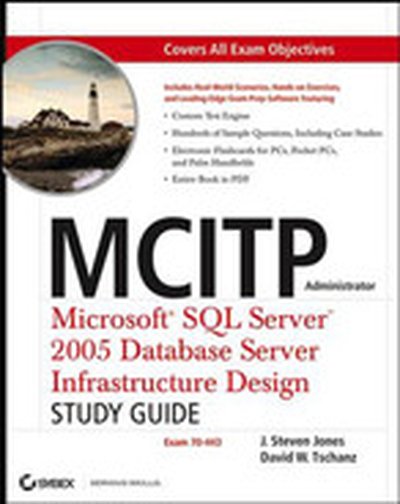
MCITP Administrator: Microsoft® SQL Server™ 2005 Database Server Infrastructure Design Study Guide

This comprehensive book guides readers through Microsoft's brand-new SQL 2005 administrator exam: Designing a Database Server Infrastructure by Using Microsoft SQL Server 2005 (Exam 70443) Addresses the database tasks that the MCITP exam focuses on such as design, development, deployment, optimization, maintenance, and support Reviews key topics, including defining high availability solutions, automating administrative tasks, defining security solutions, monitoring and troubleshooting the database server, and much more The CD-ROM features leading-edge exam prep software with test engine plus hundreds of practice questions and electronic flashcards Note: CD-ROM/DVD and other supplementary materials are not included as part of eBook file.

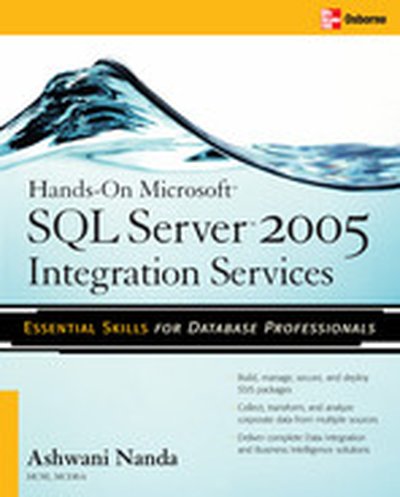
Hands-On Microsoft SQL Server™ 2005 Integration Services

In-depth coverage of Microsoft’s powerful new data integration tool Learn to maximize the features of SQL Server 2005 Integration Services from this essential guide. Hands-On Microsoft SQL Server 2005 Integration Services makes learning SSIS easy through the use of extensive real-world exercises structured around every component within the tool. You will learn to collect corporate data from various sources and transform that data for analysis, mining, and reporting.

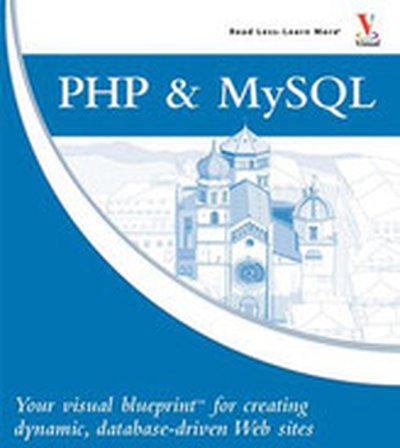
PHP & MySQL®: Your visual blueprint™ for creating dynamic, database-driven Web sites

"The expertise, thought, and effort that go into each book are obvious, and I sincerely appreciate your efforts. Keep up the wonderful work!" --Tracey Moore (Memphis, TN) Welcome to the only guidebook series that takes a visual approach to professional-level computer topics. Open the book and you will discover step-by-step screen shots that demonstrate over 140 key techniques using PHP amd MySQL, including: Configuring Apache to process PHP code Working with character strings Creating, sorting, and comparing arrays Defining and using functions Finding and replacing substrings Querying databases and retrieving data Stopping and starting the MySQL server Adding dynamic check boxes Sending new Web pages to a browser Extra / Apply It High-resolution screen shots demonstrate each task Succinct explanations walk you through step-by-step Two-page lessons break big topics into bite-sized modules "Apply It" and "Extra" sidebars highlight useful tips

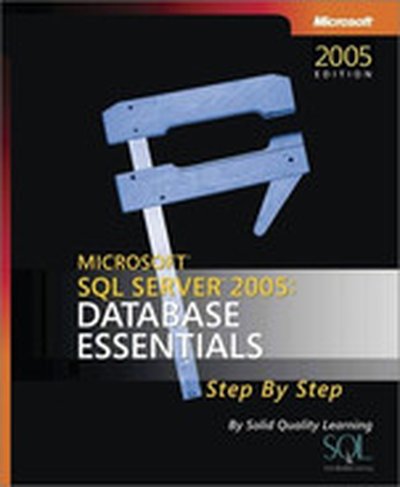
Microsoft® SQL Server™ 2005: Database Essentials Step by Step

SQL Server 2005 is Microsoft’s next-generation data management and analysis solution that delivers enhanced scalability, availability, and security features to enterprise data and analytical applications while making them easier to create, deploy, and manage. Now you can teach yourself how to design, build, test, deploy, and maintain SQL Server databases—one step at a time. With STEP BY STEP, you work at your own pace through hands-on, learn-by-doing exercises. Instead of merely focusing on describing new features, this book shows new database programmers and administrators how to use specific features within typical business scenarios. Each chapter puts you to work, providing a highly practical learning experience that demonstrates how to build database solutions to solve common business problems.

The Relational Database Dictionary

Avoid misunderstandings that can affect the design, programming, and use of database systems. Whether you're using Oracle, DB2, SQL Server, MySQL, or PostgreSQL, The Relational Database Dictionary will prevent confusion about the precise meaning of database-related terms (e.g., attribute, 3NF, one-to-many correspondence, predicate, repeating group, join dependency), helping to ensure the success of your database projects. Carefully reviewed for clarity, accuracy, and completeness, this authoritative and comprehensive quick-reference contains more than 600 terms, many with examples, covering issues and concepts arising from the relational model of data. This one-of-a-kind dictionary provides a single, compact source where DBAs, database designers, DBMS implementers, application developers, and database professors and students can find the accurate definitions they need on a daily basis, information that isn't readily available anywhere else. If you're working with or learning about relational databases, you need this pocket-sized quick-reference.