talk-data.com talk-data.com

Topic

SAS

statistical_software analytics data_management

245

tagged

Activity Trend

8 peak/qtr
2020-Q1 2026-Q1

Activities

Showing filtered results

Filtering by: O'Reilly Data Science Books ×
JMP® Start Statistics: A Guide to Statistics and Data Analysis Using JMP®, 4th Edition

JMP Start Statistics: A Guide to Statistics and Data Analysis Using JMP, Fourth Edition, is a complete and orderly introduction to analyzing data using JMP statistical discovery software from SAS. A mix of software manual and statistics text, this book provides hands-on tutorials with just the right amount of conceptual and motivational material to illustrate how to use JMP's intuitive interface for data analysis. Each chapter features concept-specific tutorials, examples, brief reviews of concepts, step-by-step illustrations, and exercises. Written by John Sall, Lee Creighton, and Ann Lehman, this book is a great tool for statistics students or practitioners needing a software-related statistics review.
SAS® Programming for Enterprise Guide® Users

In this pragmatic, example-driven book, author Neil Constable demonstrates how you can use SAS code to enhance the capabilities of SAS Enterprise Guide. Designed to help you gain extra value from the products you already have, SAS Programming for Enterprise Guide Users contains tips and techniques that show you a variety of features that cannot be accessed directly through the task interfaces. In all cases, techniques are shown with examples that you can try and test, plus additional exercises are included to give you more practice. The end result is more efficient and resilient use of SAS Enterprise Guide in a wider variety of business areas. Included is a discussion of the following subject areas: the Output Delivery System advanced formatting macro variables and macros advanced reporting using PROC REPORT highlighting in reports hyperlinking between reports and graphs data manipulation using SQL data manipulation using the DATA step extended graphics By adding small amounts of code in key areas, SAS Enterprise Guide users can get more out of the product than the tasks reveal. Users should be familiar with the SAS Enterprise Guide user interface and tasks. No programming experience is necessary.

SAS for Mixed Models, Second Edition, 2nd Edition
The indispensable, up-to-date guide to mixed models using SAS. Discover the latest capabilities available for a variety of applications featuring the MIXED, GLIMMIX, and NLMIXED procedures in SAS for Mixed Models, Second Edition, the comprehensive mixed models guide for data analysis, completely revised and updated for SAS 9 by authors Ramon Littell, George Milliken, Walter Stroup, Russell Wolfinger, and Oliver Schabenberger. The theory underlying the models, the forms of the models for various applications, and a wealth of examples from different fields of study are integrated in the discussions of these models: random effect only and random coefficients models; split-plot, multilocation, and repeated measures models; hierarchical models with nested random effects; analysis of covariance models; spatial correlation models; generalized linear mixed models; and nonlinear mixed models.

Professionals and students with a background in two-way ANOVA and regression and a basic knowledge of linear models and matrix algebra will benefit from the topics covered.

This book is part of the SAS Press program.

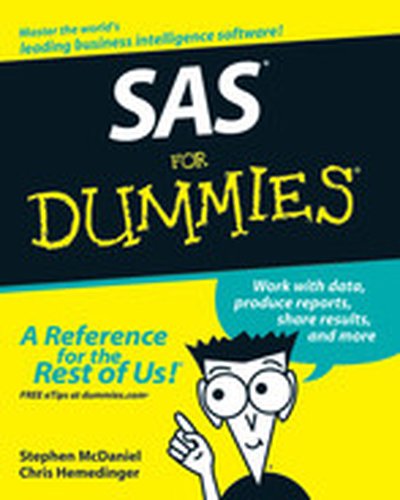
SAS For Dummies

Created in partnership with SAS, this book explores SAS, a business intelligence software that can be used in any business setting or enterprise for data delivery, reporting, data mining, forecasting, statistical analysis, and more. SAS employee and technologist Stephen McDaniel combines real-world expertise and a friendly writing style to introduce readers to SAS basics. It covers crucial topics such as getting various types of data into the software, producing reports, working with the data, basic SAS programming, macros, and working with SAS and databases.

SAS® Macro Programming Made Easy, Second Edition

Need help understanding the SAS macro facility? You will find all the answers that you need in this easy-to-follow book! Michele Burlew puts her decades of macro programming experience to work for you as she guides you through the basics, as well as the more complex features of the SAS macro facility. Updated extensively for SAS 9, this book includes plenty of examples and step-by-step instructions. You will learn the elements of the macro facility (macro variables, macro programs, macro language), how to write a macro program, macro programming techniques, tips on using the macro facility, how the macro facility fits into SAS, and about the interfaces between the macro facility and other components of SAS. New topics for the second edition include using SAS 9 macro and SAS language features, debugging macro programs, adding error checking to macro programs, and building a library of utility macro programs. Beginning macro programmers will learn to write SAS macro programs quickly and efficiently. More experienced macro programmers will find this book useful to refresh their conceptual knowledge and expand on their macro programming skills. It is also important to note that the macro facility is a highly popular part of SAS and found in the job requirements for many SAS programming jobs. In addition, macro facility concepts are tested on the SAS Advanced Programming Exam. The book assumes some SAS programming experience, including knowledge of how to write a DATA step and how to use SAS procedures.

Learning SAS by Example
Learn to program SAS by example!

If you like learning by example, then Learning SAS by Example: A Programmer's Guide makes it easy to learn SAS programming. In an instructive and conversational tone, author Ron Cody clearly explains each programming technique and then illustrates it with one or more real-life examples, followed by a detailed description of how the program works. The text is divided into four major sections: Getting Started; DATA Step Processing; Presenting and Summarizing Your Data; and Advanced Topics. Subjects addressed include: Reading data from external sources Learning details of DATA step programming Subsetting and combining SAS data sets Understanding SAS functions and working with arrays Creating reports with PROC REPORT and PROC TABULATE Learning to use the SAS Output Delivery System Getting started with the SAS macro language Introducing PROC SQL

You can test your knowledge and hone your skills by solving the problems at the end of each chapter. (Solutions to odd-numbered problems are located at the back of this book. Solutions to all problems are available to instructors by visiting Ron Cody's author page for details.) This book is intended for beginners and intermediate users. Readers should know how to enter and submit a SAS program from their operating system.

This book is part of the SAS Press program.

Pharmaceutical Statistics Using SAS

Pharmaceutical Statistics Using SAS: A Practical Guide offers extensive coverage of cutting-edge biostatistical methodology used in drug development and the practical problems facing today's drug developers. Written by well-known experts in the pharmaceutical industry Alex Dmitrienko, Christy Chuang-Stein, and Ralph D'Agostino, it provides relevant tutorial material and SAS examples to help readers new to a certain area of drug development quickly understand and learn popular data analysis methods and apply them to real-life problems. Step-by-step, the book introduces a wide range of data analysis problems encountered in drug development and illustrates them using a wealth of case studies from actual pre-clinical experiments and clinical studies. The book also provides SAS code for solving the problems. Among the topics addressed are these:

drug discovery experiments to identify promising chemical compounds animal studies to assess the toxicological profile of these compounds clinical pharmacology studies to examine the properties of new drugs in healthy human subjects Phase II and Phase III clinical trials to establish therapeutic benefits of experimental drugs.

Additional features include a discussion of methodological issues, practical advice from subject-matter experts, and review of relevant regulatory guidelines. Most chapters are self-contained and include a fair amount of high-level introductory material to make them accessible to a broad audience of pharmaceutical scientists. This book will also serve as a useful reference for regulatory scientists as well as academic researchers and graduate students.

This book is part of the SAS Press program.

Data Preparation for Analytics Using SAS

Written for anyone involved in the data preparation process for analytics, Gerhard Svolba's Data Preparation for Analytics Using SAS offers practical advice in the form of SAS coding tips and tricks, and provides the reader with a conceptual background on data structures and considerations from a business point of view. The tasks addressed include viewing analytic data preparation in the context of its business environment, identifying the specifics of predictive modeling for data mart creation, understanding the concepts and considerations of data preparation for time series analysis, using various SAS procedures and SAS Enterprise Miner for scoring, creating meaningful derived variables for all data mart types, using powerful SAS macros to make changes among the various data mart structures, and more!

In the Know...SAS(R) Tips and Techniques From Around the Globe, Second Edition

You'll gain a world of knowledge through Phil Mason's inventive tips and techniques. Updated and expanded to cover the breadth of functionality offered in SAS 8 and SAS 9, In the Know...SAS Tips and Techniques From Around the Globe, Second Edition, is packed with timeless classics and plenty of new material addressing such popular topics as the DATA step, SQL, macros, functions, ODS, and much more. Each tip is presented in a self-contained format that is both informative and easy to use. Every chapter contains a collection of related tips with frequent use of code and log examples to help improve productivity. Users of all levels will discover how to save time and effort by incorporating the wisdom found in these practical tips.

The Little SAS® Book for Enterprise Guide® 4.1

Learning to use SAS Enterprise Guide has never been easier! With The Little SAS Book for Enterprise Guide 4.1, Susan Slaughter and Lora Delwiche help you quickly become familiar with the SAS Enterprise Guide point-and-click environment. A series of carefully designed tutorials help you master the basics of the tasks you will want to do most frequently. The reference section of the book expands on the tutorial topics, focusing on specific features. If you are new to SAS or new to SAS Enterprise Guide, this book will be an invaluable tool on your way to becoming an expert.

SAS® Certification Prep Guide: Base Programming for SAS®9

Prepare for the SAS Base Programming for SAS®9 certification exam with the official guide by the SAS® Certified Professional Program. New and experienced SAS users who want to prepare for the SAS Base Programming for SAS®9 certification exam will find this guide an invaluable, convenient and comprehensive resource that covers all of the objectives tested on the exam. Major topics include importing and exporting raw data files, creating and modifying SAS data sets, and identifying and correcting data syntax and programming logic errors.You will also become familiar with the enhancements and new functionality that are available in SAS®9. Includes a free CD-ROM with tutorials, practice data, and sample programs to further reinforce and test your SAS skills.

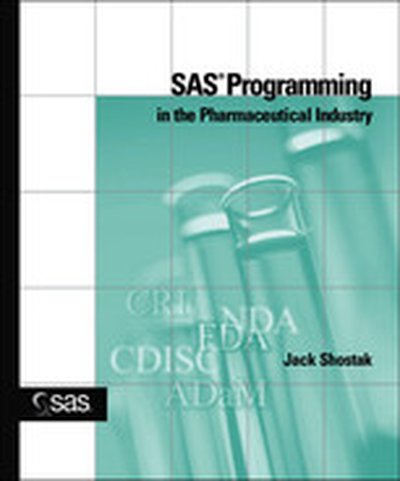
SAS® Programming in the Pharmaceutical Industry

At last! A real-world reference guide for clinical trial SAS programming, packed with solutions that programmers can apply to their day-to-day problems. Discover key techniques and tools available within Base SAS (including the macro language and PROC SQL), SAS/GRAPH, and SAS/STAT that can be used to resolve many common issues in working with clinical trial data. Organized to reflect the statistical programmer's work flow, this user-friendly text begins with an introduction to the working environment, then presents chapters on importing and massaging data into analysis data sets, producing clinical trial output, and exporting data. Valuable plug-and-play programming examples are provided throughout. Whether you're a novice seeking an introduction to SAS programming for the pharmaceutical industry or a junior-level programmer exploring new approaches to problem solving, you'll find a wealth of practical suggestions to help you sharpen your skills.

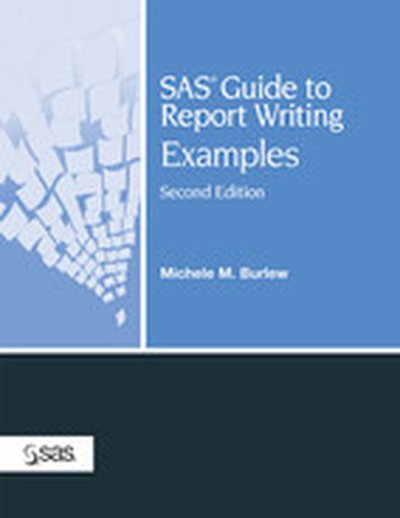
SAS® Guide to Report Writing: Examples, Second Edition

Jump-start your report-writing skills! Report writing has never been easier. Learn how you can easily avoid common report-writing pitfalls with SAS Guide to Report Writing: Examples, Second Edition. Updated for SAS®9, this task-oriented book guides you through the steps that you need to produce professional reports. Using a wealth of easy-to-follow examples, this time-saving book demonstrates the many different styles of reports that are available and the SAS tools used to generate them. The examples enable more experienced programmers to quickly grasp new techniques, while margin notes and additional discussions provide novice users with the details that they need for effective learning. You can save programming hours by using the SAS programs as they are or as models for developing your own reports. Whether you are a beginner or an expert, this must-have guide will strengthen your report-writing expertise and give you the tools that you need to enhance the power of your reports!

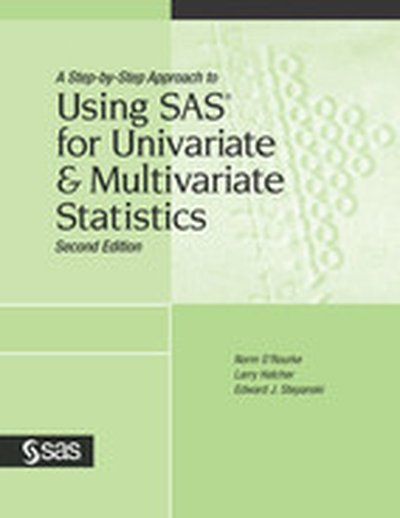
A Step-by-Step Approach to Using SAS® for Univariate & Multivariate Statistics, Second Edition

Updated for SA®9, this second edition is an easy-to-understand introduction to SAS as well as to univariate and multivariate statistics. Clear explanations and simple language guide you through the research terminology, data input, data manipulation, and types of statistical analysis that are most commonly used in the social and behavioral sciences. Providing practice data inspired by actual studies, this book teaches you how to choose the right statistic, understand the assumptions underlying the procedure, prepare the SAS program for the analysis, interpret the output, and summarize the analysis and results according to the format prescribed in the Publication Manual of the American Psychological Association. Step by step you will learn how to perform the following types of analysis: simple descriptive statistics, measures of bivariate association, t tests: independent samples and paired samples, NOVA and MANOVA, multiple regression, principal component analysis, and assessing scale reliability with coefficient alpha. This text is ideally suited to students who are beginning their study of data analysis, and to professors and researchers who want a handy reference on their bookshelf.

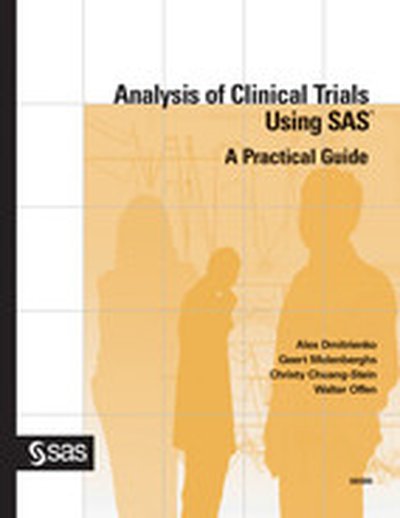
Analysis of Clinical Trials Using SAS

In Analysis of Clinical Trials Using SAS: A Practical Guide, Alex Dmitrienko, Geert Molenberghs, Christy Chuang-Stein, and Walter Offen bridge the gap between modern statistical methodology and real-world clinical trial applications. Step-by-step instructions illustrated with examples from actual trials and case studies serve to define a statistical method and its relevance in a clinical trials setting and to illustrate how to implement the method rapidly and efficiently using the power of SAS software. Topics reflect the International Conference on Harmonization (ICH) guidelines for the pharmaceutical industry and address important statistical problems encountered in clinical trials, including analysis of stratified data, incomplete data, multiple inferences, issues arising in safety and efficacy monitoring, and reference intervals for extreme safety and diagnostic measurements. Clinical statisticians, research scientists, and graduate students in biostatistics will greatly benefit from the decades of clinical research experience compiled in this book. Numerous ready-to-use SAS macros and example code are included.

This book is part of the SAS Press program.

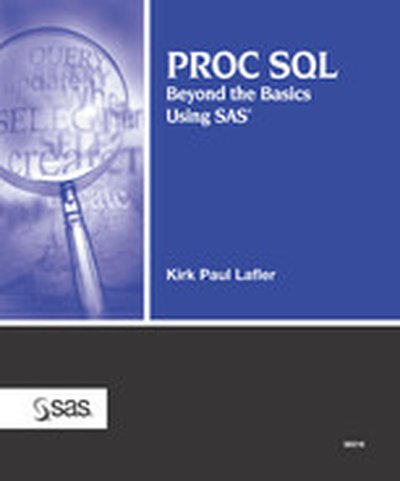
PROC SQL: Beyond the Basics Using SAS®

Master the language of PROC SQL! Get faster and better results when you use the SQL procedure with this step-by-step, example-driven guide in your hands. You will find information about implementing both American National Standards Institute (ANSI) guidelines and non-ANSI features. A broad range of SAS users, including applications programmers, database designers and administrators, statisticians, and systems analysts, will find techniques in Kirk Lafler's PROC SQL: Beyond the Basics Using SAS to enhance their data access, manipulation, and presentation prowess. Topics examined include database design; an introduction to SQL, dictionary tables, and tables; coding PROC SQL logic as well as complex queries; working with views; troubleshooting and debugging SQL code; and tuning for performance. With the growing popularity of databases, PROC SQL is becoming the language of choice for SAS users around the world. Intermediate and advanced users will appreciate the straightforward explanations and numerous examples.

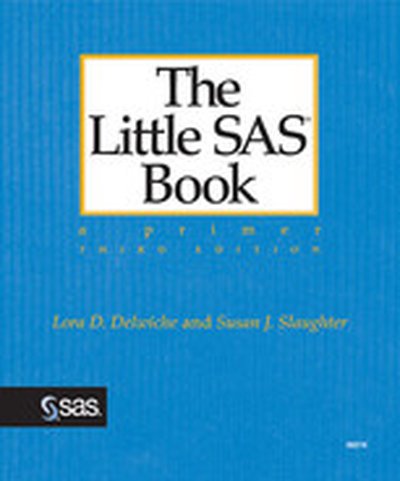
The Little SAS® Book: A Primer, Third Edition

Getting started with SAS is easy with The Little SAS Book. This friendly, easy-to-read guide gently introduces you to the most commonly used features of SAS software plus a whole lot more! The book has been revised to include concepts of the Output Delivery System; the STYLE= option in the PRINT, REPORT, and TABULATE procedures; ODS HTML, RTF, PRINTER, and OUTPUT destinations; PROC REPORT; more on PROC TABULATE; exporting data; and the colon modifier for informats. You'll find clear and concise explanations of basic SAS concepts (such as DATA and PROC steps), inputting data, modifying and combining data sets, summarizing and presenting data, basic statistical procedures, and debugging SAS programs. Each topic is presented in a self-contained, two-page layout complete with examples and graphics. This format enables new users to get up and running quickly, while the examples allow you to type in the program and see it work!

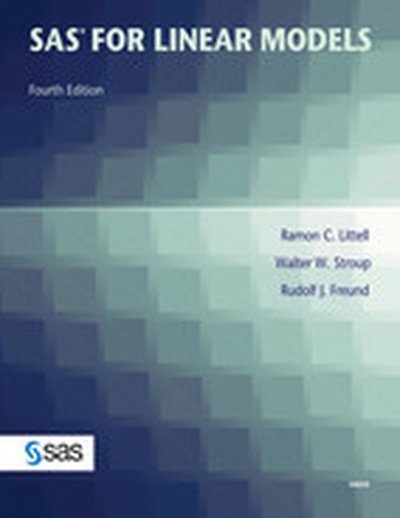
SAS for Linear Models, Fourth Edition

This clear and comprehensive guide provides everything you need for powerful linear model analysis. Using a tutorial approach and plenty of examples, authors Ramon Littell, Walter Stroup, and Rudolf Freund lead you through methods related to analysis of variance with fixed and random effects. You will learn to use the appropriate SAS procedure for most experiment designs (including completely random, randomized blocks, and split plot) as well as factorial treatment designs and repeated measures. SAS for Linear Models, Fourth Edition, also includes analysis of covariance, multivariate linear models, and generalized linear models for non-normal data. Find inside: regression models; balanced ANOVA with both fixed- and random-effects models; unbalanced data with both fixed- and random-effects models; covariance models; generalized linear models; multivariate models; and repeated measures. New in this edition: MIXED and GENMOD procedures, updated examples, new software-related features, and other new material.

This book is part of the SAS Press program.

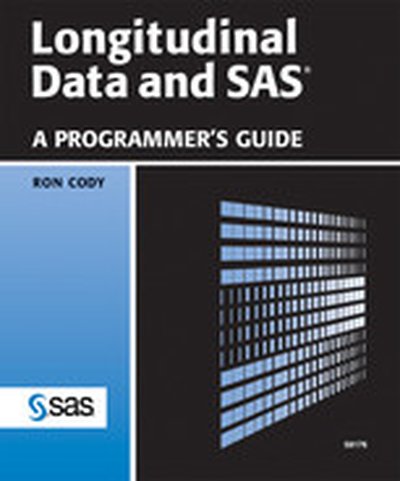
Longitudinal Data and SAS
Working with longitudinal data introduces a unique set of challenges. Once you've mastered the art of performing calculations within a single observation of a data set, you're faced with the task of performing calculations or making comparisons between observations. It's easy to look backward in data sets, but how do you look forward and across observations? Ron Cody provides straightforward answers to these and other questions. Longitudinal Data and SAS details useful techniques for conducting operations between observations in a SAS data set. For quick reference, the book is conveniently organized to cover tools, including an introduction to powerful SAS programming techniques for longitudinal data; case studies, including a variety of illuminating examples that use Ron's techniques; and macros, including detailed descriptions of helpful longitudinal data macros. Beginning to intermediate SAS users will appreciate this book's informative, easy-to-comprehend style. And users who frequently process longitudinal data will learn to make the most of their analyses by following Ron's methodologies.

This book is part of the SAS Press program.

Cody’s Data Cleaning Techniques Using SAS® Software

The key to ensuring accurate data is having clean data. This book develops and describes data cleaning programs and macros. You can use many of the programs and macros that are provided, as is, or you can modify them for your own special data cleaning tasks. Ron has carefully explained and documented each of the programs and macros, thus providing you with SAS programming instruction on an intermediate-to-advanced level. Topics presented include validation checks on character data, numeric data, missing values, and date values; searching for duplicate records; working with multiple files; double entry and verification using the COMPARE procedure; and SQL solutions and using validation data sets. Written in Ron's signature informal, tutorial style, this book gives anyone who manages data thoroughly documented, step-by-step instructions for the development of data cleaning programs and macros. Supports releases 6.12 and higher of SAS software.