talk-data.com talk-data.com

Topic

Scikit-learn

machine_learning data_science data_analysis

5

tagged

Activity Trend

6 peak/qtr
2020-Q1 2026-Q1

Activities

Showing filtered results

Filtering by: PyData Paris 2025 ×

Most common machine learning models (linear, tree-based or neural network-based), optimize for the least squares loss when trained for regression tasks. As a result, they output a point estimate of the conditional expected value of the target: E[y|X].

In this presentation, we will explore several ways to train and evaluate probabilistic regression models as a richer alternative to point estimates. Those models predict a richer description of the full distribution of y|X and allow us to quantify the predictive uncertainty for individual predictions.

On the model training part, we will introduce the following options:

  • ensemble of quantile regressors for a grid of quantile levels (using linear models or gradient boosted trees in scikit-learn, XGBoost and PyTorch),
  • how to reduce probabilistic regression to multi-class classification + a cumulative sum of the predict_proba output to recover a continuous conditional CDF.
  • how to implement this approach as a generic scikit-learn meta-estimator;
  • how this approach is used to pretrain foundational tabular models (e.g. TabPFNv2).
  • simple Bayesian models (e.g. Bayesian Ridge and Gaussian Processes);
  • more specialized approaches as implemented in XGBoostLSS.

We will also discuss how to evaluate probabilistic predictions via:

  • the pinball loss of quantile regressors,
  • other strictly proper scoring rules such as Continuous Ranked Probability Score (CRPS),
  • coverage measures and width of prediction intervals,
  • reliability diagrams for different quantile levels.

We will illustrate of those concepts with concrete examples and running code.

Finally, we will illustrate why some applications need such calibrated probabilistic predictions:

  • estimating uncertainty in trip times depending on traffic conditions to help a human decision make choose among various travel plan options.
  • modeling value at risk for investment decisions,
  • assessing the impact of missing variables for an ML model trained to work in degraded mode,
  • Bayesian optimization for operational parameters of industrial machines from little/costly observations.

If time allows, will also discuss usage and limitations of Conformal Quantile Regressors as implemented in MAPIE and contrast aleatoric vs epistemic uncertainty captured by those models.
PyPI in the face: running jokes that PyPI download stats can play on you

We all love to tell stories with data and we all love to listen to them. Wouldn't it be great if we could also draw actionable insights from these nice stories?

As scikit-learn maintainers, we would love to use PyPI download stats and other proxy metrics (website analytics, github repository statistics, etc ...) to help inform some of our decisions like: - how do we increase user awareness of best practices (please use Pipeline and cross-validation)? - how do we advertise our recent improvements (use HistGradientBoosting rather than GradientBoosting, TunedThresholdClassifier, PCA and a few other models can run on GPU) ? - do users care more about new features from recent releases or consolidation of what already exists? - how long should we support older versions of Python, numpy or scipy ?

In this talk we will highlight a number of lessons learned while trying to understand the complex reality behind these seemingly simple metrics.

Telling nice stories is not always hard, trying to grasp the reality behind these metrics is often tricky.

Skrub: machine learning for dataframes

Skrub is an open source package that simplifies machine-learning with dataframes by providing a variety of tools to explore, prepare and feature-engineer dataframes so they can be integrated into scikit-learn pipelines. Skrub DataOps allow to build extensive, multi-table wrangling plans, explore hyperparameter spaces, and export the resulting objects for deployment. The talk showcases various use cases where skrub can simplify the job of a data scientist from data preparation to deployment, through code examples and demonstrations.

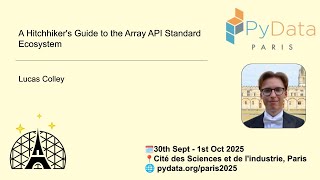
A Hitchhiker's Guide to the Array API Standard Ecosystem

The array API standard is unifying the ecosystem of Python array computing, facilitating greater interoperability between code written for different array libraries, including NumPy, CuPy, PyTorch, JAX, and Dask.

But what are all of these "array-api-" libraries for? How can you use these libraries to 'future-proof' your libraries, and provide support for GPU and distributed arrays to your users? Find out in this talk, where I'll guide you through every corner of the array API standard ecosystem, explaining how SciPy and scikit-learn are using all of these tools to adopt the standard. I'll also be sharing progress updates from the past year, to give you a clear picture of where we are now, and what the future holds.

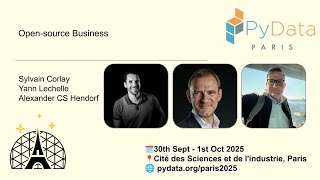
Open-source Business

Challenges in economics and governance models for open-source scientific projects

In this presentation, the CEOs of two companies at the forefront of open-source scientific software development - Sylvain Corlay of QuantStack and Yann Lechelle of Probabl - examine the intricate challenges of open-source funding and governance and reflect on how these two aspects interconnect.

We start by reflecting on the origins of the open-source movement within the scientific community, and delve into the contemporary challenges of operating businesses and identifying sustainable economic models that both leverage and contribute to open-source software.

In particular, we highlight the unique approaches and experiences of QuantStack and Probabl, which primarily contribute to multi-stakeholder scientific projects such as scikit-learn, Jupyter, Apache Arrow, or conda-forge.