talk-data.com talk-data.com

Topic

SQL Server

Microsoft SQL Server

relational_database microsoft enterprise

4

tagged

Activity Trend

1 peak/qtr
2020-Q1 2026-Q1

Activities

Showing filtered results

Filtering by: Jonathan Gennick ×
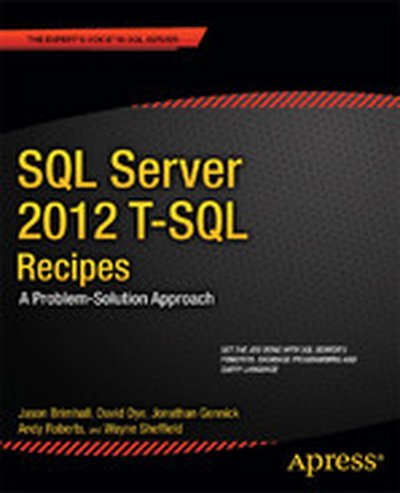
SQL Server 2012 T-SQL Recipes: A Problem-Solution Approach

SQL Server 2012 T-SQL Recipes is an example-based guide to the Transact-SQL language that is at the core of SQL Server 2012. It provides ready-to-implement solutions to common programming and database administration tasks. Learn to create databases, insert and update data, generate reports, secure your data, and more. Tasks and their solutions are broken down into a problem/solution format that is quick and easy to read so that you can get the job done fast when the pressure is on. Solutions in this book are divided into chapters by problem domain. Each chapter is a collection of solutions around a single facet of the language such as writing queries, developing triggers, and applying aggregate functions. Each solution is presented code-first, giving you a working code example to copy from and implement immediately in your own environment. Following each example is an in-depth description of how and why the given solution works. Tradeoffs and alternative approaches are also discussed. Focused on solutions: Look up what you need to do. Learn how to do it. Do it. Current: Newly updated for SQL Server 2012 Comprehensive: Covers all common T-SQL problem domains What you'll learn Create databases, tables, and indexes Query and manipulate data Store and manage XML inside the database Move business logic into the database Resolve common performance problems. Build reports that matter to your business. Perform common backup and recovery tasks. Who this book is for SQL Server 2012 T-SQL Recipes is aimed at technically-oriented users of SQL Server desiring to extract the full power of the platform through it's powerful, built-in programming and scripting language. Target readers include developers who use Microsoft SQL Server 2012 as their back-end database, and the database administrators who create, manage, and secure those databases.
SQL Pocket Guide, 3rd Edition

If you're a programmer or database administrator who uses SQL in your day-to-day work, this popular pocket guide is the ideal on-the-job reference. You'll find many examples that address the language's complexity, along with key aspects of SQL used in IBM DB2 Release 9.7, MySQL 5.1, Oracle Database 11g Release 2, PostgreSQL 9.0, and Microsoft SQL Server 2008 Release 2. SQL Pocket Guide describes how these database systems implement SQL syntax for querying, managing transactions, and making changes to data. It also shows how the systems use SQL functions, regular expression syntax, and type conversion functions and formats. All example SQL statements in this book execute against a set of tables, with data that you can quickly download. The third edition covers important database changes, including: Oracle's support of the recursive WITH syntax, and addition of PIVOT and UNPIVOT operators Functions new to Oracle, such as LISTAGG, NTH_VALUE, and more PostgreSQL’s support of recursive WITH and some window functions DB2 syntax and datatypes, some compatible with Oracle MySQL features such as the TIMESTAMP type and the TO_SECONDS function

SQL Pocket Guide, 2nd Edition

SQL is the language of databases. It's used to create and maintain database objects, place data into those objects, query the data, modify the data, and, finally, delete data that is no longer needed. Databases lie at the heart of many, if not most business applications. Chances are very good that if you're involved with software development, you're using SQL to some degree. And if you're using SQL, you should own a good reference or two. Now available in an updated second edition, our very popular SQL Pocket Guide is a major help to programmers, database administrators, and everyone who uses SQL in their day-to-day work. The SQL Pocket Guide is a concise reference to frequently used SQL statements and commonly used SQL functions. Not just an endless collection of syntax diagrams, this portable guide addresses the language's complexity head on and leads by example. The information in this edition has been updated to reflect the latest versions of the most commonly used SQL variants including: Oracle Database 10g, Release 2 (includingthe free Oracle Database 10g Express Edition (XE)) Microsoft SQL Server 2005 MySQL 5 IBM DB2 8.2 PostreSQL 8.1 database

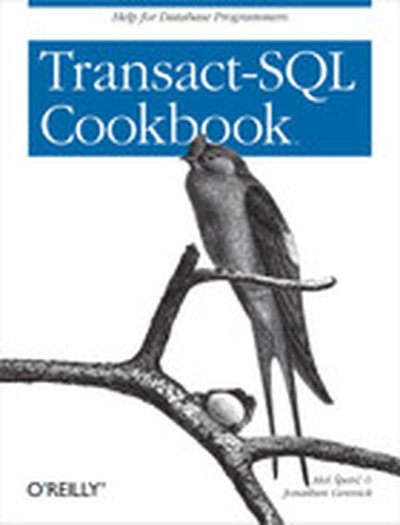
Transact-SQL Cookbook

This unique cookbook contains a wealth of solutions to problems that SQL programmers face all the time. The recipes inside range from how to perform simple tasks, like importing external data, to ways of handling issues that are more complicated, like set algebra. Authors Ales Spetic and Jonathan Gennick, two authorities with extensive database and SQL programming experience, include a discussion with each recipe to explain the logic and concepts underlying the solution.SQL (Structured Query Language) is the closest thing to a standard query language that currently exists, and Transact-SQL -- a full-featured programming language that dramatically extends the power of SQL -- is the procedural language of choice for both Microsoft SQL Server and Sybase SQL Server systems. The Transact-SQL Cookbook is designed so you can use the recipes directly, as a source of ideas, or as a way to learn a little more about SQL and what you can do with it. Topics covered include: With an abundance of recipes to help you get your job done more efficiently, the Audit logging. In addition to recipes for implementing an audit log, this chapter also includes recipes for: improving performance where large log tables are involved; supporting multiple-languages; and simulating server push. Hierarchies. Recipes show you how to manipulate hierarchical data using Transact-SQL. Importing data. This chapter introduces concepts like normalization and recipes useful for working with imported data tables. Sets. Recipes demonstrate different operations, such as how to find common elements, summarize the data in a set, and find the element in a set that represents an extreme. Statistics. This chapter?s recipes show you how to effectively use SQL for common statistical operations from means and standard deviations to weighted moving averages. Temporal data. Recipes demonstrate how to construct queries against time-based data. Data Structures. This chapter shows how to manipulate data structures like stacks, queues, matrices, and arrays. Transact-SQL Cookbook is sure to become an essential part of your library.