talk-data.com talk-data.com

Topic

statistics

512

tagged

Activity Trend

1 peak/qtr
2020-Q1 2026-Q1

Activities

512 activities · Newest first

Statistics Hacks

Want to calculate the probability that an event will happen? Be able to spot fake data? Prove beyond doubt whether one thing causes another? Or learn to be a better gambler? You can do that and much more with 75 practical and fun hacks packed into Statistics Hacks. These cool tips, tricks, and mind-boggling solutions from the world of statistics, measurement, and research methods will not only amaze and entertain you, but will give you an advantage in several real-world situations-including business. This book is ideal for anyone who likes puzzles, brainteasers, games, gambling, magic tricks, and those who want to apply math and science to everyday circumstances. Several hacks in the first chapter alone-such as the "central limit theorem,", which allows you to know everything by knowing just a little-serve as sound approaches for marketing and other business objectives. Using the tools of inferential statistics, you can understand the way probability works, discover relationships, predict events with uncanny accuracy, and even make a little money with a well-placed wager here and there. Statistics Hacks presents useful techniques from statistics, educational and psychological measurement, and experimental research to help you solve a variety of problems in business, games, and life. You'll learn how to: Play smart when you play Texas Hold 'Em, blackjack, roulette, dice games, or even the lottery Design your own winnable bar bets to make money and amaze your friends Predict the outcomes of baseball games, know when to "go for two" in football, and anticipate the winners of other sporting events with surprising accuracy Demystify amazing coincidences and distinguish the truly random from the only seemingly random--even keep your iPod's "random" shuffle honest Spot fraudulent data, detect plagiarism, and break codes How to isolate the effects of observation on the thing observed Whether you're a statistics enthusiast who does calculations in your sleep or a civilian who is entertained by clever solutions to interesting problems, Statistics Hacks has tools to give you an edge over the world's slim odds.
Stochastic Simulation

WILEY-INTERSCIENCE PAPERBACK SERIES The Wiley-Interscience Paperback Series consists of selected books that have been made more accessible to consumers in an effort to increase global appeal and general circulation. With these new unabridged softcover volumes, Wiley hopes to extend the lives of these works by making them available to future generations of statisticians, mathematicians, and scientists. ". . .this is a very competently written and useful addition to the statistical literature; a book every statistician should look at and that many should study!" -Short Book Reviews, International Statistical Institute ". . .reading this book was an enjoyable learning experience. The suggestions and recommendations on the methods [make] this book an excellent reference for anyone interested in simulation. With its compact structure and good coverage of material, it [is] an excellent textbook for a simulation course." -Technometrics ". . .this work is an excellent comprehensive guide to simulation methods, written by a very competent author. It is especially recommended for those users of simulation methods who want more than a 'cook book'. " -Mathematics Abstracts This book is a comprehensive guide to simulation methods with explicit recommendations of methods and algorithms. It covers both the technical aspects of the subject, such as the generation of random numbers, non-uniform random variates and stochastic processes, and the use of simulation. Supported by the relevant mathematical theory, the text contains a great deal of unpublished research material, including coverage of the analysis of shift-register generators, sensitivity analysis of normal variate generators, analysis of simulation output, and more.

Cash Flow Forecasting

Budgets are like road maps -- they provide a direction for a corporates financial management. Balance sheets and statements of revenues also provide insights into how well a company is following that direction. But cash flow and cash flow forecasts are what guide the day-to-day itinerary for an organization. Budgets and cash flow are dynamic -- adjustments and changes can and should occur. If you understand what you are looking at, you can use cash flow to create better budgets and thus more accurate cash flow forecasting. Cash Flow Forecasting outlines the techniques required to undertake a detailed analysis of the cash flow dynamics of the business from both a historical and forward looking perspective. Cash Flow Forecasting explains how to: * Determine appropriate cash flow figures from pro forma financial statements * Interpret detailed cash flow forecasts and understand the difference between profit and cash flow * Conserve or generate cash in the short term * Evaluate different methods of project evaluation * Recognize the limitations of accounting information in valuing companies *Inspired by basic entry level training courses that have been developed by major international banks worldwide * Will enable students and those already in the finance profession to gain an understanding of the basic information and principles of cash flow forecasting * Includes questions with answers, study topics, practical "real world" examples and extensive bibliography

THE POWER OF THE PURSE: HOW SMART BUSINESSES ARE ADAPTING TO THE WORLD'S MOST IMPORTANT CONSUMERS—WOMEN

Women now drive some 80% of all buying decisions. By 2010, they'll account for half of America's private wealth: $13 trillion dollars. A few remarkable companies have learned how to refocus on women -- and, in so doing, have achieved truly stunning results. In The Power of the Purse, top journalist Fara Warner takes you behind the scenes at those companies, revealing how they did it -- and how you can, too. Unlike previous books on marketing to women, this one doesn't settle for generalities: it offers in-depth, start-to-finish case studies. Discover how McDonald's turned around its business by recognizing women as full-fledged consumers, not just 'Moms.' Learn how Kodak's digital camera business soared from fourth to first by recognizing women's importance as family 'memory makers'. See how P G built Swiffer into a cultural revolution, and how the diamond industry did the same for right-hand rings. Watch Bratz topple Barbie, Torrid create its enormously successful plus-size stores for teenagers, and Avon connect with a radically new generation of women. From Nike to Home Depot, each story is unique -- but in every case, these companies put women at the center of their strategies, and listened intently to what real women consumers were telling them. It's not about 'painting your products pink': it's about transforming the way you think about women. Do that, and you'll create products that sell better to everyone.

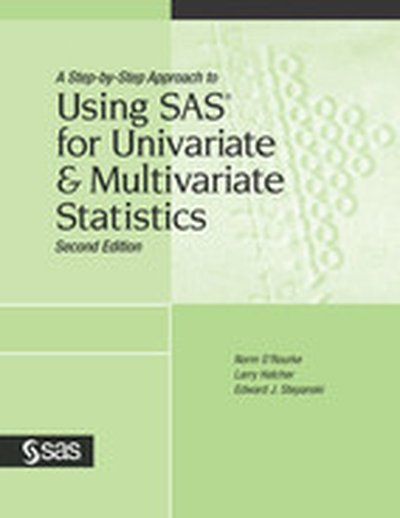
A Step-by-Step Approach to Using SAS® for Univariate & Multivariate Statistics, Second Edition

Updated for SA®9, this second edition is an easy-to-understand introduction to SAS as well as to univariate and multivariate statistics. Clear explanations and simple language guide you through the research terminology, data input, data manipulation, and types of statistical analysis that are most commonly used in the social and behavioral sciences. Providing practice data inspired by actual studies, this book teaches you how to choose the right statistic, understand the assumptions underlying the procedure, prepare the SAS program for the analysis, interpret the output, and summarize the analysis and results according to the format prescribed in the Publication Manual of the American Psychological Association. Step by step you will learn how to perform the following types of analysis: simple descriptive statistics, measures of bivariate association, t tests: independent samples and paired samples, NOVA and MANOVA, multiple regression, principal component analysis, and assessing scale reliability with coefficient alpha. This text is ideally suited to students who are beginning their study of data analysis, and to professors and researchers who want a handy reference on their bookshelf.

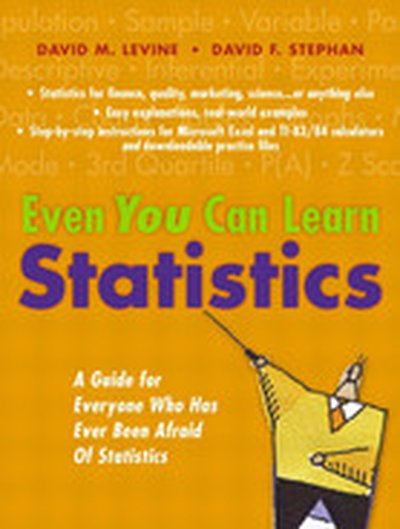
Even You Can Learn Statistics A Guide for Everyone Who Has Ever Been Afraid of Statistics

Even You Can Learn Statistics A Guide for Everyone Who Has Ever Been Afraid Of Statistics One easy step at a time, this book will teach you the key statistical techniques you'll need for finance, quality, marketing, the social sciences, or just about any other field. Each technique is introduced with a simple, jargon-free explanation, practical examples, and hands-on guidance for solving real problems with Excel or a TI-83/84 series calculator, including Plus models. Hate math? No sweat. You'll be amazed how little you need! For those who do have an interest in mathematics, optional "Equation Blackboard" sections review the equations that provide the foundations for important concepts. David M. Levine is a much-honored innovator in statistics education. He is Professor Emeritus of Statistics and Computer Information Systems at Bernard M. Baruch College (CUNY), and co-author of several best-selling books, including Statistics for Managers using Microsoft Excel, Basic Business Statistics, Quality Management, and Six Sigma for Green Belts and Champions. Instructional designer David F. Stephan pioneered the classroom use of personal computers, and is a leader in making Excel more accessible to statistics students. He has co-authored several textbooks with David M. Levine. Here's just some of what you'll learn how to do... Use statistics in your everyday work or study Perform common statistical tasks using a Texas Instruments statistical calculator or Microsoft Excel Build and interpret statistical charts and tables "Test Yourself" at the end of each chapter to review the concepts and methods that you learned in the chapter Work with mean, median, mode, standard deviation, Z scores, skewness, and other descriptive statistics Use probability and probability distributions Work with sampling distributions and confidence intervals Test hypotheses and decision-making risks with Z, t, Chi-Square, ANOVA, and other techniques Perform regression analysis and modeling The easy, practical introduction to statistics–for everyone! Thought you couldn't learn statistics? Think again. You can–and you will! Complementary Web site Downloadable practice files at http://www.ftpress.com/youcanlearnstatistics

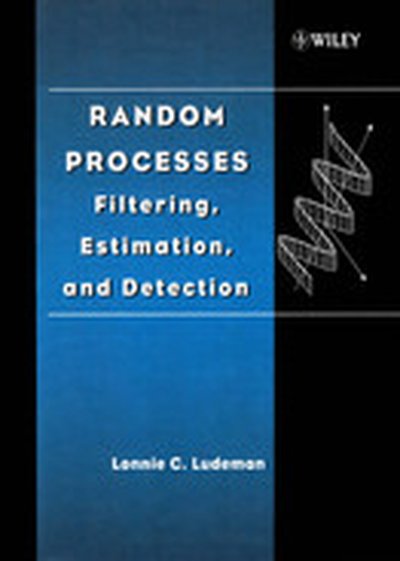
Random Processes: Filtering, Estimation, and Detection

An understanding of random processes is crucial to many engineering fields-including communication theory, computer vision, and digital signal processing in electrical and computer engineering, and vibrational theory and stress analysis in mechanical engineering. The filtering, estimation, and detection of random processes in noisy environments are critical tasks necessary in the analysis and design of new communications systems and useful signal processing algorithms. Random Processes: Filtering, Estimation, and Detection clearly explains the basics of probability and random processes and details modern detection and estimation theory to accomplish these tasks. In this book, Lonnie Ludeman, an award-winning authority in digital signal processing, joins the fundamentals of random processes with the standard techniques of linear and nonlinear systems analysis and hypothesis testing to give signal estimation techniques, specify optimum estimation procedures, provide optimum decision rules for classification purposes, and describe performance evaluation definitions and procedures for the resulting methods. The text covers four main, interrelated topics: Probability and characterizations of random variables and random processes Linear and nonlinear systems with random excitations Optimum estimation theory including both the Wiener and Kalman Filters Detection theory for both discrete and continuous time measurements Lucid, thorough, and well-stocked with numerous examples and practice problems that emphasize the concepts discussed, Random Processes: Filtering, Estimation, and Detection is an understandable and useful text ideal as both a self-study guide for professionals in the field and as a core text for graduate students.

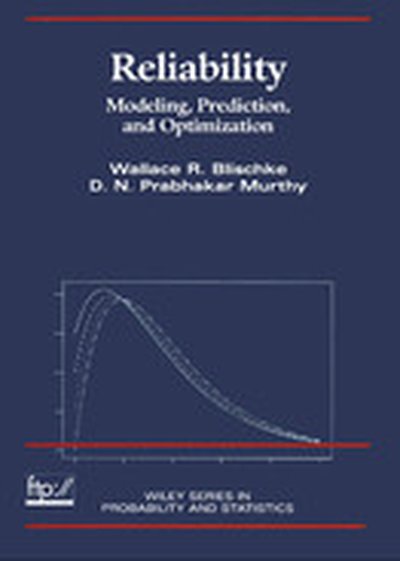
Reliability: Modeling, Prediction, and Optimization

Bringing together business and engineering to reliability analysis With manufactured products exploding in numbers and complexity, reliability studies play an increasingly critical role throughout a product's entire life cycle-from design to post-sale support. Reliability: Modeling, Prediction, and Optimization presents a remarkably broad framework for the analysis of the technical and commercial aspects of product reliability, integrating concepts and methodologies from such diverse areas as engineering, materials science, statistics, probability, operations research, and management. Written in plain language by two highly respected experts in the field, this practical work provides engineers, operations managers, and applied statisticians with both qualitative and quantitative tools for solving a variety of complex, real-world reliability problems. A wealth of examples and case studies accompanies: Comprehensive coverage of assessment, prediction, and improvement at each stage of a product's life cycle Clear explanations of modeling and analysis for hardware ranging from a single part to whole systems Thorough coverage of test design and statistical analysis of reliability data A special chapter on software reliability Coverage of effective management of reliability, product support, testing, pricing, and related topics Lists of sources for technical information, data, and computer programs Hundreds of graphs, charts, and tables, as well as over 500 references PowerPoint slides are available from the Wiley editorial department.

APPLIED MULTIVARIATE STATISTICS: WITH SAS® SOFTWARE

Real-world problems and data sets are the backbone of Ravindra Khattree and Dayanand Naik's Applied Multivariate Statistics with SAS Software, Second Edition, which provides a unique approach to the topic, integrating statistical methods, data analysis, and applications. Now extensively revised, the book includes new information about mixed effects models, applications of the MIXED procedure, regression diagnostics with the corresponding IML procedure code, and covariance structures. The authors' approach to the information will aid professors, researchers, and students in a variety of disciplines and industries. Extensive SAS code and the corresponding high-resolution output accompany sample problems, and clear explanations of SAS procedures are included. Emphasis is on correct interpretation of the output to draw meaningful conclusions. Featuring both the theoretical and the practical, topics covered include multivariate analysis of experimental data and repeated measures data, graphical representation of data including biplots, and multivariate regression. In addition, a quick introduction to the IML procedure with special reference to multivariate data is available in an appendix. SAS programs and output integrated with the text make it easy to read and follow the examples.

System Identification: Theory for the User, 2nd Edition

65669-4 The field’s leading text, now completely updated. Modeling dynamical systems — theory, methodology, and applications. Lennart Ljung’s System Identification: Theory for the User is a complete, coherent description of the theory, methodology, and practice of System Identification. This completely revised Second Edition introduces subspace methods, methods that utilize frequency domain data, and general non-linear black box methods, including neural networks and neuro-fuzzy modeling. The book contains many new computer-based examples designed for Ljung’s market-leading software, System Identification Toolbox for MATLAB. Ljung combines careful mathematics, a practical understanding of real-world applications, and extensive exercises. He introduces both black-box and tailor-made models of linear as well as non-linear systems, and he describes principles, properties, and algorithms for a variety of identification techniques: Nonparametric time-domain and frequency-domain methods. Parameter estimation methods in a general prediction error setting. Frequency domain data and frequency domain interpretations. Asymptotic analysis of parameter estimates. Linear regressions, iterative search methods, and other ways to compute estimates. Recursive (adaptive) estimation techniques. Ljung also presents detailed coverage of the key issues that can make or break system identification projects, such as defining objectives, designing experiments, controlling the bias distribution of transfer-function estimates, and carefully validating the resulting models. The first edition of System Identification has been the field’s most widely cited reference for over a decade. This new edition will be the new text of choice for anyone concerned with system identification theory and practice.

Modelling Stock Market Volatility

This essay collection focuses on the relationship between continuous time models and Autoregressive Conditionally Heteroskedastic (ARCH) models and applications. For the first time, Modelling Stock Market Volatility provides new insights about the links between these two models and new work on practical estimation methods for continuous time models. Featuring the pioneering scholarship of Daniel Nelson, the text presents research about the discrete time model, continuous time limits and optimal filtering of ARCH models, and the specification and estimation of continuous time processes. This work will lead to a rapid growth in their empirical application as they are increasingly subjected to routine specification testing. Key Features * Provides for the first time new insights on the links between continuous time and ARCH models * Collects seminal scholarship by some of the most renowned researchers in finance and econometrics * Captures complex arguments underlying the approximation and proper statistical modelling of continuous time volatility dynamics

Interviewing for a Data Science position can feel daunting. This workshop will cover everything you need to know to prepare yourself for interviewing and succeed in landing your preferred Data Science job. I will break down the complete, start-to-finish components of the process—from job applications to offer negotiations—to help you feel confident and maximize your interview experience. Topics covered include: understanding the different flavors of Data Science positions and what best suits you; tailoring your resume to land the interview; technical skills: what to expect and how to prepare your skills in statistics, Python, ML, SQL, and more; communication skills: how to communicate your experiences and stand out; general tips for acing your interviews and negotiating your offers.