talk-data.com talk-data.com

Event

O'Reilly Data Engineering Books

2001-10-19 – 2027-05-25 Oreilly Visit website ↗

Activities tracked

3406

Collection of O'Reilly books on Data Engineering.

Filtering by: data ×

Sessions & talks

Showing 2651–2675 of 3406 · Newest first

Search within this event →
Joe Celko's Thinking in Sets: Auxiliary, Temporal, and Virtual Tables in SQL

Perfectly intelligent programmers often struggle when forced to work with SQL. Why? Joe Celko believes the problem lies with their procedural programming mindset, which keeps them from taking full advantage of the power of declarative languages. The result is overly complex and inefficient code, not to mention lost productivity.This book will change the way you think about the problems you solve with SQL programs.. Focusing on three key table-based techniques, Celko reveals their power through detailed examples and clear explanations. As you master these techniques, you’ll find you are able to conceptualize problems as rooted in sets and solvable through declarative programming. Before long, you’ll be coding more quickly, writing more efficient code, and applying the full power of SQL Filled with the insights of one of the world’s leading SQL authorities - noted for his knowledge and his ability to teach what he knows Focuses on auxiliary tables (for computing functions and other values by joins), temporal tables (for temporal queries, historical data, and audit information), and virtual tables (for improved performance) Presents clear guidance for selecting and correctly applying the right table technique

Deployment Guide Series: IBM Tivoli Composite Application Manager for Web Resources V6.2

This book is written as part of the deployment guide series. It provides a step-by-step guide for deploying IBM® Tivoli® Composite Application Manager (ITCAM) for Web Resources V6.2. This deployment guide will help an IBM Business Partner or service person plan and perform the deployment of the product. The discussion on ITCAM for Web Resources describes product architecture and components, planning and sizing considerations, and guidelines on setting up service engagements. Although the information is highly relevant for larger deployment engagements, it is also suitable for a small deployment system. The extensive deployment and usage scenarios can also help you demonstrate the product.

The Data Warehouse Lifecycle Toolkit

The world of data warehousing has changed remarkably since the first edition of The Data Warehouse Lifecycle Toolkit was published in 1998. With this new edition, Ralph Kimball and his colleagues have refined the original set of Lifecycle methods and techniques based on their consulting and training experience. They walk you through the detailed steps of designing, developing, and deploying a data warehousing/business intelligence system. With substantial new and updated content, this second edition again sets the standard in data warehousing for the next decade.

Oracle Database 11g DBA Handbook

The Essential Resource for Oracle DBAs--Fully Updated and Expanded Manage a flexible, highly available Oracle database with help from the expert information contained in this exclusive Oracle Press guide. Fully revised to cover every new feature and utility, Oracle Database 11g DBA Handbook shows how to perform a new installation, upgrade from previous versions, configure hardware and software for maximum efficiency, and employ bulletproof security. You will learn to automate the backup and recovery process, provide transparent failover capability, audit and tune performance, and distribute your enterprise databases with Oracle Net. Plan and deploy permanent, temporary, and bigfile tablespaces Optimize disk allocation, CPU usage, I/O throughput, and SQL queries Develop powerful database management applications Guard against human errors using Oracle Flashback and Oracle Automatic Undo Management Diagnose and tune system performance using Oracle Automatic Workload Repository and SQL Tuning Sets Implement robust security using authentication, authorization, fine-grained auditing, and fine-grained access control Maintain high availability using Oracle Real Application Clusters and Oracle Active Data Guard Respond more efficiently to failure scenarios by leveraging the Oracle Automatic Diagnostic Repository and the Oracle Repair Advisor Back up and restore tables, tablespaces, and databases with Oracle Recovery Manager and Oracle Data Pump Export and Import Work with networked databases, data warehouses, and VLDBs Put the latest Oracle Database 11 g tools to work--Oracle Total Recall, Oracle Flashback Data Archive, and more

Tagging: People-powered Metadata for the Social Web

Tagging is fast becoming one of the primary ways people organize and manage digital information. Tagging complements traditional organizational tools like folders and search on users desktops as well as on the web. These developments mean that tagging has broad implications for information management, information architecture and interface design. And its reach extends beyond these technical domains to our culture at large. We can imagine, for example, the scrapbookers of the future curating their digital photos, emails, ticket stubs and other mementos with tags. This book explains the value of tagging, explores why people tag, how tagging works and when it can be used to improve the user experience. It exposes tagging's superficial simplicity to reveal interesting issues related to usability, information architecture, online community and collective intelligence.

Oracle Enterprise Manager 10g Grid Control Implementation Guide

Install and Configure Grid Control to Manage Your Oracle Landscape Build a robust grid computing infrastructure with guidance from an Oracle expert who developed and taught the Grid Control Deep Dive class to Oracle Consulting. Featuring real-world examples and best practices, Oracle Enterprise Manager 10g Grid Control Implementation Guide explains how to reliably and cost-effectively deploy a dynamic Grid Control environment. Learn how to lay the preinstallation groundwork, configure targets for monitoring, create services, implement security, and fine-tune performance. You'll also get full coverage of backup and recovery strategies and high-availability techniques. Prepare infrastructure hosts for Grid Control rollout Install the Oracle management repository, service, and agents Select the Grid Control installation options that fit your needs Discover and manage host, database, and application server targets Set target metrics and policies according to best practices Optimize performance and availability of your Grid Control framework Secure the Grid Control framework to protect data transmitted between components

IBM IMS Version 10 Implementation Guide: A Technical Overview

This IBM Redbooks publication provides an overview of the new functions and enhancements in IBM Information Management System (IMS) Version 10. IBM continues to enhance IMS integration, manageability, and scalability. IMS helps you with On Demand Business enablement, growth, availability, and systems management that current and newer environments and cost measures require. IMS Version 10 helps in addressing your On Demand Business needs through integration/openness, manageability, and scalability, providing: - Integration with other products and platforms across the Internet, supporting open standards that benefit you, and taking best advantage of the latest industry tooling for application development and connectivity - Scalability with virtualization in assuring flexibility for growth and expansion in a heterogeneous environment while utilizing the latest hardware and software facilities to optimize performance, capacity, availability, and recovery

Requirements Management Using IBM Rational RequisitePro

Optimize Your Entire Requirements Process–and Use Requirements to Build More Successful Software Using IBM® Rational® RequisitePro®, you can systematically improve the way you create and maintain requirements–and use those requirements to build more effective, higher-quality software. Now, for the first time, there’s a comprehensive, hands-on guide to optimally using RequisitePro in real-world development environments. Utilizing a start-to-finish sample project, requirements expert Peter Zielczynski introduces an organized, best-practice approach to managing requirements and shows how to implement every step with RequisitePro. You’ll walk through planning, eliciting, and clarifying stakeholder requirements; building use cases and other key project documents; managing changing requirements; transforming requirements into designs; and much more. Every stage of the process is illuminated with examples, realistic artifacts, and practical solutions. This book is an invaluable resource for everyone who creates requirements, and everyone who relies on them: business analysts, systems analysts, project managers, architects, designers, developers, and testers alike. Coverage includes Overcoming the three leading causes of project failure: lack of user input, incomplete requirements and specifications, and poorly managed change Understanding each type of software requirement–how they interrelate, and what makes a good requirement Establishing a Requirements Management Plan that describes how requirements are created and handled throughout the project lifecycle Developing a Vision document that can drive your project from beginning to end Creating high-quality use cases Using requirements as the basis for system design Leveraging RequisitePro features for improved project management Integrating requirements management with the IBM Rational Unified Process® Foreword xvii Preface xix Acknowledgments xxiii About the Author xxv Part I: Overview 1 Chapter 1: Requirements Management 3 Chapter 2: Overview of RequisitePro 23 Part II: Requirements Management Activities 33 Chapter 3: Establishing a Requirements Management Plan 35 Chapter 4: Setting up the Project 45 Chapter 5: Requirements Elicitation 63 Chapter 6: Developing a Vision Document 99 Chapter 7: Creating Use Cases 129 Chapter 8: Supplementary Specification 157 Chapter 9: Creating Test Cases from Use Cases 191 Chapter 10: Creating Test Cases from Supplementary Requirements 221 Chapter 11: Object-Oriented Design 243 Chapter 12: Documentation 273 Part III: Other Topics 285 Chapter 13: Managing Projects 287 Chapter 14: Requirements Management in the Rational Unified Process 295 Part IV: Review 311 Chapter 15: Summary 313 Appendix: Sample Requirements Management Plan 319 Index 327

IBM DB2 9 for z/OS: New Tools for Query Optimization

The cost-based optimizer of IBM DB2 for z/OS has continually evolved since its initial inception. Support has included new optimization algorithms, join methods, complex relational data structures, such as star schemas. DB2 for z/OS V8 has provided access path visualization and a Statistics Advisor function through a new Visual Explain. DB2 9 for z/OS starts addressing the challenge of reducing cost of ownership by extending query optimization through expert-based query and workload analysis, server enhancements, and an Index Advisory function. These functions are delivered with two tools: DB2 Optimization Service Center and DB2 Optimization Expert. This book helps you understand the installation, customization, and usage aspects of the tools. You are guided through scenarios of gradually increasing complexity where the functions of the tools are exploited for query optimization.

Getting Started with IBM Tivoli Performance Analyzer Version 6.1

Capacity management is the discipline that ensures that IT infrastructure is provided at the right time in the right volume at the right price. IBM® Tivoli® Performance Analyzer is a strategic capacity management solution from IBM that adds value to IBM Tivoli Monitoring, IBM Tivoli Service Management, and OMEGAMON® products. This IBM Redbooks® publication provides a practical guide to implementing, using, and optimizing IBM Tivoli Performance Analyzer Version 6.1, which includes planning and deployment scenarios, troubleshooting, and so forth. We position IBM Tivoli Performance Analyzer against two other IBM capacity management solutions, IBM Tivoli Capacity Process Manager and HyPerformix IPS Capacity Manager. We also provide some best practice guidelines on when to use each solution. To better explain the product functionality, we included several case studies that will help you understand the capabilities of IBM Tivoli Performance Analyzer. This book is a reference for IT professionals who implement and use IBM Tivoli Performance Analyzer in small, medium, and large-scale environments.

Access 2007 Programming by Example with VBA, XML, and ASP

Access 2007 Programming by Example with VBA, XML, and ASP shows non-programmers how Access databases can be created, managed, and customized with Visual Basic for Applications (VBA) — a powerful programming language built into Access. Hundreds of hands-on examples and projects throughout the book show users how to take charge of their Access databases with programming. Learn how to Write and debug your programming code with the Visual Basic Editor; access and manipulate databases with Data Access Objects (DAO) and ActiveX Data Objects (ADO); use the Data Definition Language (DDL) to enforce data integrity and manage database security; modify the behavior of forms, reports, and controls by writing event procedures; publish dynamic Access data to the web using Active Server Pages (ASP) and Extensible Markup Language (XML); and work with the new features for tables, forms, reports, macros, and templates that are available in the Access 2007 user interface.

A Designer’s Guide to Adobe InDesign and XML: Harness the Power of XML to Automate your Print and Web Workflows

Is this book for programmers? Written specifically for graphic designers and production artists already comfortable working with Adobe InDesign, this book teaches you how to automate publishing without learning a lot of scary code. XML simplifies the process of moving content in and out of your layouts and can speed up any print or Web assignment. Why should I care about XML? If you’re managing data-intensive layout projects, and you want to keep that data consistent, accurate, and up-to-date, then incorporating XML can help. You can also use XML to automate processes like importing text and large numbers of graphics into a layout, or repurposing content from one application to another. Do I need additional plug-ins or special software? You need only the powerful features built into InDesign CS2, CS3 or CS4 to use this book. This guide includes nine easy-to-follow projects with downloadable support files. With these hands-on tutorials, you will learn XML in context. By the final project, XML will no longer be a mystery, but a powerful tool you can use to support your company or clients. How will I learn XML? These real-world projects will teach you: l Business cards: Create a structured layout in InDesign and then import XML. Format text automatically and flow the text into multiple examples. l Product catalog: Learn how to import XML data into a structured layout using nested styles and cloned text. l Direct mail and variable data printing: Use XML and InDesign to create sophisticated direct mail pieces without costly plug-ins or third-party software. l Magazine and newspaper: Build and export magazine-style publications for online distribution. l Web: Transform XML into XHTML to incorporate directly into your Web pages, or use Cascading Style Sheets to instantly format your exported XML.

Microsoft® Office Access 2007 VBA

Business Solutions Microsoft® Office Access 2007 VBA Develop your Access 2007 VBA expertise instantly with proven techniques Microsoft Office Access 2007 VBA builds on the skills you’ve already developed in creating database applications and helps you take them to the next level—using Visual Basic for Applications (VBA) to accomplish things you once performed manually. To facilitate this lofty goal, Access includes the VBA programming language. Even if you’ve never programmed, this book will help you learn how to leverage the power of VBA to make your work with Access more efficient than ever before. Microsoft Office Access 2007 VBA is for professionals who use Microsoft Access frequently in their daily work. You have serious work to get done and you can’t spend all day reading a computer book. This book teaches you the essential skills you need to automate your databases as quickly as possible. Although written for Access 2007, the techniques and concepts covered will work in most versions of Microsoft Access. Highlights of This Book Include • Navigating within the Visual Basic Editor • Using variables, constants, and data types • Employing built-in functions • Creating procedures • Understanding object-and event-driven coding • Working with arrays • Understanding scope • Working with forms • Using selection controls • Creating reports • Exploring menus, navigation, and ribbons • Using object models • Working with data • Defining database schema • Using the Windows API • Working with XML files • Exploring Access SQL On the Website Download database files used in the book at www.quepublishing.com. Category Office Applications Covers Visual Basic for Applications User Level Intermediate - Advanced Scott B. Diamond is a seasoned database designer and Microsoft Access 2007 MVP. During the last 20+ years, he has designed databases on a wide range of platforms, including dBASE, FoxPro, SQL/DS, Lotus Approach, Lotus Notes, and, for the past 10 years, Microsoft Access. Scott has worked as a consultant, both in-house and freelance, and as a support professional at firms that are among the leaders in their industries. Scott spends some of his free time answering questions at the premier site for Access support: http://www.utteraccess.com. Brent Spaulding started writing applications about 20 years ago and has utilized Microsoft Access since version 2.0. He looks forward to using Access well into the future. In July 2007, he received the Microsoft MVP award for Access, which recognizes his talent and contributions to the Access community. Front cover bullets: Edit and debug your code Use looping and conditional statements Understand the Access object- and event-driven architecture Automate data entry Learn how to use variables for dynamic automation Create user-friendly applications for others Create custom functions and objects Customize the user interface Manipulate data and objects with code

Oracle Automatic Storage Management: Under-the-Hood & Practical Deployment Guide

Streamline data management and provisioning Build and manage a storage infrastructure with Oracle scalable Automatic Storage Management using Oracle Automatic Storage Management (Oracle ASM) and the detailed information contained in this exclusive Oracle Press resource. Written by a team of database experts, maintain a dynamic, highly available Oracle database Oracle Automatic Storage Management: Under-the-Hood & Practical Deployment Guide explains how to build and storage environment . Inside, you'll learn how to configure storage for Oracle ASM, build disk groups, use data striping and mirroring, and optimize performance. You'll also learn how to ensure consistency across server and storage platforms, maximize data redundancy, and administer Oracle ASM from the command line. Manage Oracle ASM Instances and configure Oracle RDBMS instances to leverage Oracle ASM Define, discover, and manage disk storage under Oracle ASM Create external, normal-redundancy, and high-redundancy disk groups Add and remove Oracle ASM storage without affecting RDMS instance availability Learn how Oracle ASM provides even I/O distribution Work with Oracle ASM directories, files, templates, and aliases Improve storage performance and integrity using the ASMLIB API Simplify system administration with the Oracle ASM command line interface Understand key internal Oracle ASM structures and algorithms

Oracle Database 11g New Features

FOREWORD by Tom Kyte Your Must-Have Guide to Everything New in Oracle Database 11 g Realize the full potential of Oracle Database 11 g with help from the experts. Written by Robert G. Freeman, and with insightful commentary throughout from Arup Nanda, this Oracle Press guide offers full details on the architectural changes, database administration upgrades, availability and recovery revisions, security enhancements, and programming innovations. Every new and updated feature is covered and presented with screenshots, code samples, tables, and charts. Find out how to take full advantage of all the new and improved capabilities of Oracle Database 11 g, including: New Oracle Automatic Storage Management features, such as Fast Disk Resync, Compatibility Attributes, P referred Mirror Read, and Rolling Upgrade components Improved Automated Memory Management capabilities New database design features, such as virtual columns, tablespace encryption, and true table-level data compression New Database Advisors for data recovery and repair, partitioning, and streams performance New tuning features, such as Automatic SQL Tuning and SQL Performance Analyzer Enhancements to Oracle RMAN, including active database duplication and UNDO backup optimization Improved auditing and security capabilities Advanced BI, data warehousing, and partitioning features New SQL and PL/SQL enhancements

Oracle Database 11g SQL

Write powerful SQL statements and PL/SQL programs Learn to access Oracle databases through SQL statements and construct PL/SQL programs with guidance from Oracle expert, Jason Price. Published by Oracle Press, Oracle Database 11g SQL explains how to retrieve and modify database information, use SQL Plus and SQL Developer, work with database objects, write PL/SQL programs, and much more. Inside, you'll find in-depth coverage of the very latest SQL features and tools, performance optimization techniques, advanced queries, Java support, and XML. This book contains everything you need to master SQL. Explore SQL Plus and SQL Developer Use SQL SELECT, INSERT, UPDATE, and DELETE statements Write PL/SQL programs Create tables, sequences, indexes, views, and triggers Write advanced queries containing complex analytical functions Create database objects and collections to handle abstract data Use large objects to handle multimedia files containing music and movies Write Java programs to access an Oracle Database using JDBC Tune your SQL statements to make them execute faster Explore the XML capabilities of the Oracle Database Master the very latest Oracle Database 11 g features, such as PIVOT and UNPIVOT, flashback archives, and much more

DB2® 9 for Linux®, UNIX®, and Windows®: DBA Guide, Reference, and Exam Prep, Sixth Edition

DB2 ® 9 builds on the world's number one enterprise database to simplify the delivery of information as a service, accelerate development, and dramatically improve operational efficiency, security, and resiliency. Now, this new edition offers complete, start-to-finish coverage of DB2 9 administration and development for Linux ®, UNIX ®, and Windows ® platforms, as well as authoritative preparation for the latest IBM DB2 certification exam. Written for both DBAs and developers, this definitive reference and self-study guide covers all aspects of deploying and managing DB2 9, including DB2 database design and development; day-to-day administration and backup; deployment of networked, Internet-centered, and SOA-based applications; migration; and much more. You'll also find an unparalleled collection of expert tips for optimizing performance, availability, and value. Coverage includes: Important security and resiliency enhancements, including advanced access control; fine-grained, label-based security; and the new security administrator role Breakthrough pureXML ™ features that make it easier to succeed with service-oriented architecture Operational improvements that enhance DBA efficiency--including self-tuning memory allocation, automated storage management, and storage optimization Table-partitioning features that improve scalability and manageability Powerful improvements for more agile and rapid development, including the new Eclipse-based Developer Workbench and simple SQL or XQuery access to all data Whatever your role in working with DB2 or preparing for certification, is the one book you can't afford to be without. DB2 9 for Linux, UNIX, and Windows, Sixth Edition Download Complete DB2 V9 Trial Version Visit ibm.com/db2/9/download.html to download a complete trial version of DB2, which enables you to try out dozens of the most powerful features of DB2 for yourself: everything from pureXML support to automated administration and optimization. Straight from IBM, the ultimate guide to running DB2 9 and preparing for the latest IBM DB2 certification exam! Covers powerful DB2 9 enhancements ranging from automated management to improved compression Covers the full spectrum of DBA responsibilities, including server management, data placement, XML concepts, activity analysis, high availability, and security Presents expert tips and best practices from the DB2 customer support organization

IBM Tivoli Configuration Manager and Tivoli Provisioning Manager for Software Coexistence and Migration Considerations

This IBM® Redbooks® publication focuses on migration of a data center from a Tivoli® Framework environment and a Tivoli Configuration Manager-based management model to the new Service-Oriented Architecture (SOA), provided by Tivoli Provisioning Manager for Software V 5.1. In addition to migration, we also discuss the coexistence environment, where Tivoli Provisioning Manager for Software drives the Tivoli Management Framework environment. Because Tivoli Provisioning Manager for Software shares its roots with Tivoli Provisioning Manager 5.1, all of the migration scenarios we describe in this book apply to Tivoli Provisioning Manager 5.1, as well. To give you ideas for various migration possibilities, we describe several customer environments and then describe the suggested approach for moving to a Tivoli Provisioning Manager environment. We also tell you how the two environments can coexist during the migration process. We provide a feature-by-feature comparison between common Frameworks, Tivoli Configuration Manager operations, and their equivalent in Tivoli Provisioning Manager. This book is a reference for IT Specialists who implement data center migration from a Tivoli Management Framework and Tivoli Configuration Manager-based management model to Tivoli Provisioning Manager for Software V 5.1 or Tivoli Provisioning Manager V 5.1.

Special Edition Using FileMaker 9

Special Edition Using FileMaker 9 The only FILEMAKER 9 book you need We crafted this book to grow with you, providing the reference material you need as you move toward FileMaker® 9 proficiency and the use of more advanced features. If you buy only one book on FileMaker® 9, Special Edition Using FileMaker® 9 is the only book you need. Make the most of FileMaker 9: • Integrate the Web with FileMaker using the new Web Viewer • Use the new external data sources techniques with SQL and ODBC • Discover how to add supplemental fields in FileMaker to external SQL data sources • See how the major changes in script editing and debugging can help you • Learn new layout techniques, including conditional formatting and auto-resizing layout objects • Find out how to use the new FileMaker Server Admin Console to administer databases • Publish FileMaker databases on the Web using Instant Web Publishing, and use Custom Web Publishing with PHP or XML/XSLT “The new FileMaker 9 product line is the most dramatic new offering in years with over 30 ease-of-use breakthroughs; and Special Edition Using FileMaker 9 is an excellent desk reference and companion resource for all FileMaker professionals!” –Rick Kalman, Senior Product Manager, FileMaker, Inc. Jesse Feiler is a member of the FileMaker Business Alliance. He regularly consults on FileMaker and develops FileMaker solutions for small businesses, non-profits, art, retail point-of-sale, publishing, marketing, and other markets. He has created a number of video training courses, including one on FileMaker 7 and appears regularly on WAMC Northeast Public Radio’s Roundtable and Vox Pop shows. ON THE WEB Download modified FileMaker Starter solutions with added fields, scripts, and layouts to illustrate techniques in the book, along with other materials, from www.quepublishing.com and www.northcountryconsulting.com. Category Database Covers FileMaker 9 User Level Intermediate–Advanced

Oracle Database 11g: New Features for DBAs and Developers

Oracle Database 11g : New Features for DBAs and Developers is a comprehensive, example-laden review of the most significant new features and improvements offered by the latest release of Oracle Corporation's flagship database product. Learn what's new in Oracle that really counts See actual examples and test run output Make sound decisions on new feature adoption Sift the gold from the silt and discover which new features of the latest release of Oracle's flagship database product are really worth adopting. Years of database administration experience from authors Sam Alapati and Charles Kim are combined with sound, step-by-step testing and a heart-felt emphasis on what matters in the real-world to help you get the most out of Oracle Database 11 g.

Availability Management: Planning and Implementing Cross-Site Mirroring on IBM System i5

In this IBM® Redbooks® publication, we introduce the concept of cross-site mirroring (XSM) as implemented in IBM OS/400® or i5/OS® at V5R3M0 and later. XSM describes the replication of data at multiple sites. It involves the use of clustering, cluster resource groups (CRGs), independent auxiliary storage pools (IASPs), and other components. In this updated version, we include the new i5/OS V5R4 functions of Administrative Domain and Source Site Tracking. We also include preview information of the Target Site Tracking function. An additional component of this highly available technology is that XSM keeps two identical copies of an independent disk pool at two sites to provide high availability and disaster recovery. These sites can be geographically close to one another or far apart, depending on the needs of the business. This book is written for IBM technical professionals, Business Partners, and customers who are considering, planning, and implementing a highly available solution on the IBM System i5™ platform.

Expert Access™ 2007 Programming

Expert Access 2007 Programming shows experienced developers how to create professional-level Access database applications. The authors—software engineers on the Access development team at Microsoft—show how to apply software engineering methodologies to Access application development. The book is organized to cover all phases of Access development. The authors demonstrate techniques for creating Access controls, forms, and reports that help streamline development and produce more user-friendly applications. They also cover such overlooked areas as custom deployment and documentation. The book contains many useful code examples designed so they can be used with minimal modification.

Create Amazing Custom User Interfaces with WPF, C#, and XAML in .NET 3.0

This Wrox Blox presents WPF along with the Extensible Application Markup Language (XAML), showing developers how to customize existing user interface controls such as the Button, Progress Bar, CheckBox, Radio Button, and Label along with creating two new custom controls. The Windows Presentation Foundation (WPF) released with the .NET 3.0 SDK provides a rich foundation for developing and customizing user interfaces. Unlike existing user interface development tools like GDI and GDI+, WPF is entirely vector-based, offering the developer enhanced two-dimensional and even three-dimensional rendering in the presentation layer. The author customizes these existing controls using XAML to: Create control templates to define their appearance and behaviors. Create two new custom controls, one derived from System.Windows.UserControl and the second from System.Windows.Control. Illustrate the interoperability of WPF content in Windows Forms and Win32 applications. Create the code samples using Microsoft Visual Studio 2005 with extensions for .NET 3.0 and the .NET 3.0 SDK. These code samples contain four projects: A C# WPF control library that contains the control templates and a User Control containing the customized Windows controls and the two new custom controls; a C# WPF application to host the WPF User Control; a C# Windows Forms application to host the WPF User Control; and a C++ Win32 application to host the WPF User Control. Usage Rights for Wiley Wrox Blox Any Wrox Blox you purchase from this site will come with certain restrictions that allow Wiley to protect the copyrights of its products. After you purchase and download this title, you: Are entitled to three downloads Are entitled to make a backup copy of the file for your own use Are entitled to print the Wrox Blox for your own use Are entitled to make annotations and comments in the Wrox Blox file for your own use May not lend, sell or give the Wrox Blox to another user May not place the Wrox Blox file on a network or any file sharing service for use by anyone other than yourself or allow anyone other than yourself to access it May not copy the Wrox Blox file other than as allowed above May not copy, redistribute, or modify any portion of the Wrox Blox contents in any way without prior permission from Wiley If you have any questions about these restrictions, you may contact Customer Care at (877) 762-2974 (8 a.m. - 5 p.m. EST, Monday - Friday). If you have any issues related to Technical Support, please contact us at 800-762-2974 (United States only) or 317-572-3994 (International) 8 a.m. - 8 p.m. EST, Monday - Friday).

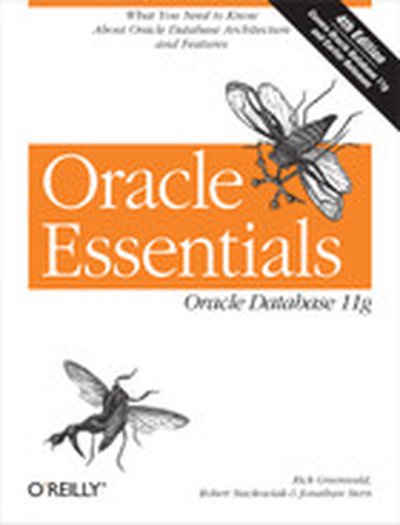
Oracle Essentials, 4th Edition

Oracle is an enormous system, with myriad technologies, options, and releases. Most users--even experienced developers and database administrators--find it difficult to get a handle on the full scope of the Oracle database. And, as each new Oracle version is released, users find themselves under increasing pressure to learn about a whole range of new technologies. The latest challenge is Oracle Database 11g. This book distills an enormous amount of information about Oracle into a compact, easy-to-read volume filled with focused text, illustrations, and helpful hints. It contains chapters on: The latest Oracle Database 11g features: query result set caching, Automatic Memory Management, the Real Application Testing, Advanced Compression, Total Recall, and Active Data Guard Option Options, changes to the OLAP Option (transparently accessed and managed as materialized views), the Flashback transaction command, transparent data encryption, the Support Workbench (and diagnosability infrastructure), and partitioning enhancements (including interval and new composite types) Oracle products, options, data structures, and overall architecture for Oracle Database 11g, as well as earlier releases (Oracle Database 10g, Oracle9i, and Oracle8i) Installing, running, managing, monitoring, networking, and tuning Oracle, including Enterprise Manager (EM) and Oracle's self-tuning and management capabilities; and using Oracle security, auditing, and compliance (a new chapter in this edition) Multiuser concurrency, data warehouses, distributed databases, online transaction processing (OLTP), high availability, and hardware architectures (e.g., SMP, clusters, NUMA, and grid computing) Features beyond the Oracle database: Oracle Application Express, Fusion Middleware (including Oracle Application Server), and database SOA support as a Web services provider For new Oracle users, DBAs, developers, and managers, Oracle Essentials provides an invaluable, all-in-one introduction to the full range of Oracle features and technologies, including the just-released Oracle Database 11g features. But even if you already have a library full of Oracle documentation, you'll find that this compact book is the one you turn to, again and again, as your one-stop, truly essential reference. " Oracle Essentials gives a clear explanation of the key database concepts and architecture underlying the Oracle database. It's a great reference for anyone doing development or management of Oracle databases." --Andrew Mendelsohn, Senior Vice President, Database Server Technologies, Oracle Corporation