talk-data.com talk-data.com

Event

O'Reilly Data Engineering Books

2001-10-19 – 2027-05-25 Oreilly Visit website ↗

Activities tracked

3406

Collection of O'Reilly books on Data Engineering.

Filtering by: data ×

Sessions & talks

Showing 3076–3100 of 3406 · Newest first

Search within this event →
XML in Data Management

XML in Data Management is for IT managers and technical staff involved in the creation, administration, or maintenance of a data management infrastructure that includes XML. For most IT staff, XML is either just a buzzword that is ignored or a silver bullet to be used in every nook and cranny of their organization. The truth is in between the two. This book provides the guidance necessary for data managers to make measured decisions about XML within their organizations. Readers will understand the uses of XML, its component architecture, its strategic implications, and how these apply to data management. Takes a data-centric view of XML Explains how, when, and why to apply XML to data management systems Covers XML component architecture, data engineering, frameworks, metadata, legacy systems, and more Discusses the various strengths and weaknesses of XML technologies in the context of organizational data management and integration

Understanding the IBM TotalStorage Open Software Family

This IBM Redbooks publication describes and explains the features and functions of the IBM TotalStorage Open Software Family, which is designed to help you simplify your storage infrastructure, optimize storage utilization, and adapt quickly and dynamically to the on demand world. The book introduces storage virtualization, on-demand solutions, and storage management software by explaining the concepts, architecture, and systems management features of the IBM TotalStorage Open Software Family and showing available complementary products. It will help you design solutions to protect data holdings from losses ranging from those caused by user error to complete site disasters. This easy-to-follow guide gives a broad understanding of the IBM TotalStorage Open Software Family software, the key technologies to know, and the solutions available to protect your business. It offers understanding of how the IBM TotalStorage Open Software Family solutions will work in heterogeneous environments including Windows, UNIX/AIX/Linux, OS/400, and z/OS platforms, and with such mission-critical applications as DB/2, Oracle, Lotus Domino, Exchange, mySAP.com, and many more.

Building and Scaling SAP Business Information Warehouse on DB2 UDB ESE

SAP is a leading ERP vendor, with a large install base. A key element in their product set is the SAP Business Information Warehouse (BW). The primary objective of this IBM Redbooks publication is to provide guidelines to help you implement your SAP Business Information Warehouse on DB2 UDB ESE. Two major considerations when building a business information warehouse are scalability and performance. In this book, we have demonstrated the wide range of scalability of BW when implemented on DB2, while maintaining the performance requirements that are so critical. The parallelism and data partitioning capabilities of DB2 Universal Database ESE, enables a robust, highly scalable, and high performance business information warehouse. For a common understanding, we first discuss the concepts of data warehousing and then describe the SAP architecture and robust component capabilities of the SAP business information warehouse. To help in your implementation, we provide guidelines for how to configure SAP BW when it is built on DB2. We also describe and discuss the key capabilities and parameters to help you get the best from DB2. Key topics such as sizing, partitioning, performance tuning, and systems administration, are discussed to assist in the implementation and maintenance of your system. This book will help enable you to more quickly and easily implement a robust SAP BW on DB2 UDB ESE.

IBM TotalStorage Tape Selection and Differentiation Guide

This IBM Redbooks publication will help users to select the appropriate tape solution for various backup scenarios found in open systems environments. This book is a tape product selection and differentiation guide that is designed to assist users in finding all the information needed to select the best tape solution for the designated backup environment. This guide describes the information gathering process and product selection criteria to differentiate among the available IBM tape offerings. It provides a basis for tape differentiation. It is not, however, intended as a tape system sizing guide. For this purpose, users should use the sizing tools provided by each product family. This guide focuses primarily on identifying backup environments for the IBM 358x Ultrium product family (LTO) and the environments for the IBM TotalStorage Enterprise Tape System 3590 and 3592. Single user or departmental type backup environments are also addressed through providing information on the entry level tape product lines such as 4mm or This edition of the book has been updated with information about the following: IBM 3592-J1A tape drive; WORM and Economy cartridge support for the IBM 3592; new models of the IBM TotalStorage UltraScalable Tape Library 3584; and new models of the IBM TotalStorage Ultrium Tape 2U Autoloader 3581.

Enterprise Service Bus

Large IT organizations increasingly face the challenge of integrating various web services, applications, and other technologies into a single network. The solution to finding a meaningful large-scale architecture that is capable of spanning a global enterprise appears to have been met in ESB, or Enterprise Service Bus. Rather than conform to the hub-and-spoke architecture of traditional enterprise application integration products, ESB provides a highly distributed approach to integration, with unique capabilities that allow individual departments or business units to build out their integration projects in incremental, digestible chunks, maintaining their own local control and autonomy, while still being able to connect together each integration project into a larger, more global integration fabric, or grid.Enterprise Service Bus offers a thorough introduction and overview for systems architects, system integrators, technical project leads, and CTO/CIO level managers who need to understand, assess, and evaluate this new approach. Written by Dave Chappell, one of the best known and authoritative voices in the field of enterprise middleware and standards-based integration, the book drills down into the technical details of the major components of ESB, showing how it can utilize an event-driven SOA to bring a variety of enterprise applications and services built on J2EE, .NET, C/C++, and other legacy environments into the reach of the everyday IT professional.With Enterprise Service Bus, readers become well versed in the problems faced by IT organizations today, gaining an understanding of how current technology deficiencies impact business issues. Through the study of real-world use cases and integration patterns drawn from several industries using ESB--including Telcos, financial services, retail, B2B exchanges, energy, manufacturing, and more--the book clearly and coherently outlines the benefits of moving toward this integration strategy. The book also compares ESB to other integration architectures, contrasting their inherent strengths and limitations.If you are charged with understanding, assessing, or implementing an integration architecture, Enterprise Service Bus will provide the straightforward information you need to draw your conclusions about this important disruptive technology.

mySAP Toolbag for Performance Tuning and Stress Testing

“A good book for people who deal with SAP systems for a living. I haven’t read another book like this. It’s technical but it’s also an entertaining read. A pleasant departure from the norm.” —David C. Gilliland, Senior Consultant, SAP America, Inc. “Clearly, this book could be used as an excellent development tool and could help a company like mine perfect performance tuning steps and standards.” —Dennis Prince, SAP Development/Support Specialist, Hewlett-Packard “SAP optimization is one of those subjects that developers struggle to find time for and managers don’t know is necessary. Presenting the value of the process up front serves to give the developer ammunition to win time for optimization and the manager an education in the value and necessity of optimization. Even if the manager types don’t read past chapter 3, George’s job is done. They should be convinced that someone technical in their IT department needs to be reading this book. Anderson explains the value, then the core technology, and then when we’re all on the same page, the process. To me, that was very helpful.” —Crew Reynolds, Software Development Manager, Daydots “This book features good discussion on performance tuning the mySAP suite that no other books have so far. This is the perfect book for SAP Stress Test Project Managers, SAP Stress Test Project Teams, SAP Basis Administrators, Oracle DBAs, Unix Administrators managing SAP systems, and project implementation teams. Those who stress test their systems well with the help of this book will have significant returns.” —Sanjoy Rath, SAP Consultant Drive maximum performance and value from your SAP investment! In this book, a leading expert on SAP performance walks through every facet of tuning and optimizing mySAP Solutions, and the technology layers underpinning these solutions, to maximize performance and value. George W. Anderson covers the entire testing and tuning process: planning, staffing, developing, testing, executing, validating, evaluating... and acting on what you’ve learned. Anderson offers unparalleled guidance with regard to predicting the impact of system changes—from new hardware to updated NetWeaver-enabled business processes. Along the way, he shows how to make the most of countless optimization and monitoring tools—from free and low-cost technology stack-based utilities to comprehensive, automated SAP testing suites. His vendor-neutral, unbiased coverage includes: Quantifying concrete performance requirements—even for complex, cross-application business processes Testing and monitoring daily system loads, month-end or seasonal business peaks, key transactions, and complex multi-system business processes Conducting comprehensive server, SAN/disk subsystem, and database testing Managing the testing process, leveraging proven best practices and techniques Analyzing, verifying, and quantifying SAP availability, scalability, and TCO Regardless of the technology infrastructure underpinning your SAP solutions, if you’re responsible for deploying, managing, maintaining, refreshing, upgrading, or supporting SAP technologies, you need this book— now.

Event Management and Best Practices

This IBM Redbooks publication presents a deep and broad understanding about event management with a focus on best practices. It examines event filtering, duplicate detection, correlation, notification, escalation, and synchronization. Plus it discusses trouble-ticket integration, maintenance modes, and automation in regard to event management. Throughout this book, you learn to apply and use these concepts with IBM Tivoli Enterprise Console 3.9, NetView 7.1.4, and IBM Tivoli Switch Analyzer 1.2.1. Plus you learn about the latest features of these tools and how they fit into an event management system. This book is intended for system and network administrators who are responsible for delivering and managing IT-related events through the use of systems and network management tools. Prior to reading this book, you should have a thorough understanding of the event management system in which you plan to implement these concepts. Please note that the additional material referenced in the text is not available from IBM.

Implementing Tivoli Data Warehouse V 1.2

With Tivoli Data Warehouse, you can analyze historical trends from various Tivoli and customer applications. The Tivoli Data Warehouse infrastructure enables a set of extract, transform, and load (ETL) utilities to extract and move data from Tivoli application data stores to a central repository. The open architecture of Tivoli Data Warehouse also enables data from non-Tivoli applications to be integrated into its central repository. Data from the central repository can be extracted into data marts that pertain to the reporting needs of selected groups. These data marts can also be used to produce cross application reports. This IBM Redbooks publication focuses on planning, installation, customization, use, maintenance, and troubleshooting topics related to the new features of the Tivoli Data Warehouse version 1.2. This is done using a number of case study scenarios and several warehouse enablement packs. The instructions given in this book are very detailed and explicit. These instructions are not the only way to install the products and related prerequisites. They are meant to be followed by anyone to successfully install, configure, and set up Tivoli Data Warehouse environments of any size.

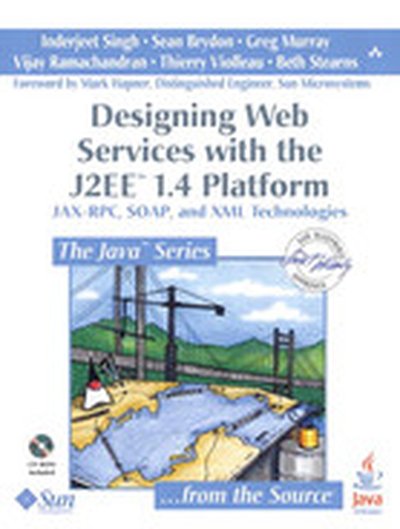
Designing Web Services with the J2EE™ 1.4 Platform JAX-RPC, SOAP, and XML Technologies

Written by Sun Microsystems' Java™ BluePrints team, is the authoritative guide to the best practices for designing and integrating enterprise-level Web services using the Java 2 Platform, Enterprise Edition (J2EE) 1.4. This book provides the guidelines, patterns, and real-world examples architects and developers need in order to shorten the learning curve and start building robust, scalable, and portable solutions. Designing Web Services with the J2EE™ 1.4 Platform The authors use the Java Adventure Builder application to bring the design process to life and help illustrate the use of Java APIs for XML Processing (JAXP), Java APIs for XML-Based RPC (JAX-RPC), and other Web service and Java-XML technologies. Key topic coverage includes: Web service requirements and design issues Support for Web services provided by the J2EE 1.4 platform Designing and implementing Web service end points Writing efficient Web service client applications Designing and developing XML-based applications Integrating applications and data using Web services The J2EE platform security model as it applies to Web services A coherent programming model for designing and developing Web service endpoints and clients provides the insight, advice, and detail that make it easier to create effective Web service applications using the J2EE 1.4 platform. Designing Web Services with the J2EE™ 1.4 Platform

XML Publishing with AxKit

Web developers rely on XML to separate data from presentation and create a consistent templating system for a web site. Although limited XML-to-HTML conversion is possible within some browsers, web developers creating dynamic or complex sites will find server-side XML transformation a necessity. Unfortunately, until recently, there have been few XML tools available for server-side XML transformation or authoring. AxKit, a mod_perl and Apache-based XML content delivery solution, was designed to meet that need with a cost-effective and efficient plugin architecture. AxKit allows the developer to quickly design modules to create faster web sites, and deliver them in a wide variety of media formats. AxKit also takes care of caching so the developer doesn't have to worry about it. AxKit meets the demands of the web developer nicely, but, as with any new toolkit, there is a learning curve. For developers who want to flatten that learning curve and get right to work with AxKit, XML Publishing with AxKit provides detailed information on how to install, configure, and deploy AxKit effectively. The first book solely devoted to AxKit, XML Publishing with AxKit also offers a concise and focused look at how to create XSLT and XPathScript-based pipelines for XML data transfer. This solidly useful new book presents web programmers with the hands-on knowledge they need to get really creative with AxKit. It features a thorough introduction to XSP (extensible Server Pages), which applies the concepts of Server Pages technologies (embedded code, tag libraries, etc) to the XML world, and covers integrating AxKit with other tools such as Template Toolkit, Apache:: Mason, Apache::ASP, and plain CGI. The book also includes invaluable reference sections on configuration directives, XPathScript, and XSP. With XML Publishing with AxKit, web developers will have all the tools they need to deliver complex XML-based systems quickly, the power to develop their own systems for style sheet negotiation, and the flexibility to design completely new style sheet languages. XML Publishing with AxKit gives those new to XML all the background and the courage they need to jump right in and deploy AxKit. And it gives XML-savvy professionals everything they need to hit the ground running.

Joe Celko's Trees and Hierarchies in SQL for Smarties

Joe Celko's Trees and Hierarchies in SQL is an intermediate to advanced-level practitioner’s guide to mastering the two most challenging aspects of developing database applications in SQL. In this book, Celko illustrates several major approaches to representing trees and hierarchies and related topics that should be of interest to the working database programmer. These topics include hierarchical encoding schemes, graphs, IMS, binary trees, and more. This book covers SQL-92 and SQL:1999. · Includes graph theory and programming techniques. · Running examples throughout the book help illustrate and tie concepts together. · Loads of code, available for download from www.mkp.com.

Office 2003 XML

In Microsoft's Office 2003, users experience the merger of the power of the classic Office suite of applications with the fluidity of data exchange inherent in XML. With XML at its heart, the new version of Microsoft's desktop suite liberates the information stored in millions of documents created with Office software over the past fifteen years, making it available to a wide variety of programs. Office 2003 XML offers an in-depth exploration of the relationship between XML and Office 2003, examining how the various products in the Office suite both produce and consume XML. Developers will learn how they can connect Microsoft Office to others systems, while power users will learn to create and analyze XML documents using familiar Office tools. The book begins with an overview of the XML features included in the various Office 2003 components, and explores in detail how Word, Excel, and Access interact with XML. This book covers both the user interface side, creating interfaces so that users can comfortably (and even unknowingly) work with XML, and the back end, exposing Office information to other processes. It also looks at Microsoft's new InfoPath application and how it fits with the rest of Office. Finally, the book's appendices introduce various XML technologies that may be useful in working with Office, including XSLT, W3C XML Schema, RELAX NG, and SOAP. Office 2003 XML provides quick and clear guidance to a anyone who needs to import or export information from Office documents into other systems. Both XML programmers and Office power will learn how to get the most from this powerful new intersection between Office 2003 and XML.

Grid Computing with the IBM Grid Toolbox

The IBM Grid Toolbox can assist enterprises that deploy, manage, and control grid computing, as well as developers who create products that assist in managing and deploying grids. This grid-enabling toolkit contains standardized development code, much of which was harvested from the open source community, plus an added database and run-time environment. This IBM Redbooks publication is designed to give the reader a comprehensive view of the IBM Grid Toolbox. As the IBM Grid Toolbox is designed in a layered approach, we describe the product by introducing each underlying layer until the whole ecosystem is revealed. The product significantly leverages open standards in the grid computing world, so we show how the IBM Grid Toolbox complements and enhances these standards for the development and deployment of grid services and applications.

IBM eServer zSeries 990 Technical Guide

The IBM Eserver zSeries® 990 scalable server provides major extensions to the existing zSeries architecture and capabilities. The concept of Logical Channel Subsystems is added, and the maximum number of Processor Units and logical partitions is increased. These extensions provide the base for much larger zSeries servers. This IBM® IBM Redbooks publication is intended for IBM systems engineers, consultants, and customers who need to understand the zSeries 990 features, functions, availability, and services. IBM Eserver zSeries 990 Technical Introduction, SG24-6863 Note that the information in this book includes features and functions announced on April 7, 2004, and that certain functionality is not available until hardware Driver Level 55 is installed on the z990 server.

IBM eServer zSeries 890 Technical Introduction

This IBM Redbooks publication introduces the IBM eServer zSeries 890, which represents the continuation of the scalable servers featured with the IBM eServer zSeries 990. The z890 is based on z/Architecture, the zSeries building blocks of the z990, and the virtualization technology of passed sever families. It is designed to be resilient in the unpredictable on demand world. The z890 is a single model server with a wide range of capacity settings, delivering significantly improved granularity and enriched functions over its predecessor. At the same time, the z890 is also introducing the new eServer zSeries Application Assist Processor (zAAP), which provides a Java execution environment. This publication provides information on the hardware and software features available with the z890. It also includes planning and migration considerations. This technical introduction is intended for hardware planners, system engineers, and consultants who need to understand the capabilities of the z890.

Microsoft® SQL Server™ 2005 Reporting Services Step by Step

Your hands-on guide to learning Microsoft SQL Server Reporting Services, Microsoft’s customizable reporting solution for business data analysis. Reporting Services is a powerful tool for business intelligence, so an understanding of the essentials—how to architect a report, as well as how to install and program Reporting Services—is key to harnessing the full benefits of SQL Server. This step-by-step tutorial shows you how to get started, how to use the report project wizard, how to think about and access data, and how to build queries. It also walks you through the creation of charts and visual layouts to enable maximum visual understanding of the data analysis. Interactivity features (enhanced in SQL Server 2005) and security are also covered in detail. With STEP BY STEP, you work at your own pace through hands-on, learn-by-doing exercises. Whether you’re a beginning programmer or new to this version of the technology, you’ll understand the fundamental techniques for using Reporting Services. A companion CD includes data sets and sample code.

Hibernate: A Developer's Notebook

Do you enjoy writing software, except for the database code? Hibernate:A Developer's Notebook is for you. Database experts may enjoy fiddling with SQL, but you don't have to--the rest of the application is the fun part. And even database experts dread the tedious plumbing and typographical spaghetti needed to put their SQL into a Java program. Hibernate: A Developers Notebook shows you how to use Hibernate to automate persistence: you write natural Java objects and some simple configuration files, and Hibernate automates all the interaction between your objects and the database. You don't even need to know the database is there, and you can change from one database to another simply by changing a few statements in a configuration file. Hibernate: A Developer's Notebook walks you through the ins and outs of using Hibernate, from installation and configuration, to complex associations and composite types. Two chapters explore ways to write sophisticated queries, which you can express either through a pure Java API, or with an SQL-inspired, but object-oriented, query language. Don't let that intimidate you though: one of the biggest surprises in working with Hibernate is that for many of the common real-world application scenarios, you don't need an explicit query at all. If you've needed to add a database backend to your application, don't put it off. It's much more fun than it used to be, and Hibernate: A Developer's Notebook shows you why. Here's what a few reviewers had to say: "I'm sitting on an airplane after finishing Hibernate: A Developer's Notebook. It's rare to find a book on a new Java technology that you can get through on a domestic flight. That this notebook effectively and succinctly tackles object-relational mapping makes it, and Hibernate, even more impressive. Many books in this category would need to be checked luggage. With this book, you travel first class." --Mike Clark "A simple persistence framework deserves a simple book, and this one delivers. The examples are well described and easy to understand, yet sophisticated enough to demonstrate Hibernate in a real-world context. Jim, I'm a new fan." --Bruce Tate About the new Developer's Notebook Series from O'Reilly: Developer's Notebooks are a new book series covering important new tools for software developers. Developer's Notebooks stress example over explanation and practice over theory. They are about learning by doing; by experimenting with tools and discovering what works. "All lab, no lecture," with a thoughtful lab partner to guide the way.

A Practical Guide to the IBM Autonomic Computing Toolkit

This IBM Redbooks publication provides practical information related to using the IBM Autonomic Computing Toolkit. Using this toolkit, software developers can provide facilities to enable applications or other system components to participate in an autonomic environment. IBM provides the Autonomic Computing Toolkit to assist software developers in enabling components, products, and solutions to become autonomic. The toolkit also provides the base for developers of management software to be able to manage entities that have been properly enabled. As with the technologies themselves, this toolkit will evolve as new capabilities and tools become available. This book provides a view of the Autonomic Computing Toolkit as it exists today and describes how it can be used to enable autonomic capabilities. This book primarily focuses on the problem determination capabilities provided by the Autonomic Computing Toolkit. Other facilities, such as Solution Installation and Integrated Console support, to name two, will be covered in future books. Please note that the additional material referenced in the text is not available from IBM.

DB2 for Linux on iSeries: Implementation Guide

This IBM Redbooks publication discusses DB2 UDB for Linux on iSeries. We provide the installation and configuration steps for DB2 UDB for Linux on iSeries. We also present connectivity scenarios between OS/400 resources and Linux resources. With V8.1, DB2 UDB for Linux is available for running in a Linux partition on an IBM eServer iSeries system. Linux is one of the fastest growing operating systems in the industry today. Linux is quickly becoming a key enabler for e-business applications that are demanding more robust local database capabilities. Applications running in the Linux partition can certainly leverage DB2 UDB for iSeries through a variety of interfaces (DB2 Connect, JDBC, ODBC), and this is an excellent choice to leverage the low administration overhead, autonomic computing, and security benefits provided by DB2’s tight integration with OS/400. DB2 for Linux is an excellent choice to support Linux (or other client/server) applications when there is a need to have local data storage within the Linux application environment or to leverage specific features of DB2 UDB V8 such as Federated Database or Microsoft .NET Framework support.

Oracle Database 10g: A Beginner's Guide

Provides beginning DBAs and developers with a solid foundation in the database administration and programming basics needed to embark on an Oracle career. The focus is on Oracle Database 10g, but you’ll get the fundamentals applicable to all Oracle database releases.

DB2 UDB ESE V8 non-DPF Performance Guide for High Performance OLTP and BI

This IBM Redbooks publication provides detailed information on implementing high performance OLTP and BI applications in DB2 UDB ESE V8 environments involving AIX and Windows 2000 platforms. It is aimed at a target audience of DB2 application developers and database administrators (DBAs). We provide an overview of the architecture of a DB2 UDB V8 non-DPF environment from a performance perspective, and describe key performance drivers in OLTP, BI, and mixed workload environments. This book’s primary focus is a single partition (non-DPF) environment, and we provide best practices to achieve optimal application and system performance in OLTP, BI, and mixed workload environments. Finally, we discuss some of the commonly encountered problems faced by a DBA when managing a DB2 environment, and describe techniques for problem diagnosis using typical problem scenarios.

Oracle® DBA Automation Quick Reference

Fast, easy automation for every Oracle 9 i and 10 g DBA! Quick access to real-world examples Installation, database creation, management, monitoring, tuning, and backup/recovery Oracle Universal Installer (OUI), Oracle Net Configuration Assistant (NetCA), and Oracle Database Configuration Assistant (DBCA) The fast, practical Oracle 9 i/10 g automation reference for every DBA! Automate Oracle—and save your time for more important tasks! This is the Oracle automation reference every working Oracle DBA needs... concise, straightforward, and incredibly easy to use. Discover proven solutions for automating installation, database creation, management, monitoring, tuning, backup/recovery, and more. Keep this book by your desk, near your server...wherever you need fast, reliable automation solutions right now! Master scripting for both Oracle 9 i and Oracle 10 g! Use Oracle Universal Installer to create response files for automating any installation Use Oracle Network Configuration Assistant (NetCA) to configure network components during installation Use Oracle Database Configuration Assistant (DBCA) to create and clone databases, and to reverse engineer them into templates and scripts Manage files and tablespaces, tune memory, perform backup/recovery, schedule automated administration tasks, and more Extend and customize any script to your own needs Includes concise reference to Perl DBI and its Oracle-specific components—with real-world examples and syntax

Access 2003 VBA Programmer's Reference

Covers all features of VBA programming for Access database applications Begins with an overview of VBA and highlights what's new in Microsoft Access 2003, the most popular database system in the world Real-world code examples demonstrate each programming topic, including using the Access Object Model, VBA execution and error handling, creating database objects with VBA, writing secure VBA code, and much more Shows how Access 2003 provides enhanced XML support, making it easier for programmers to publish data to the Web and exchange it with other organizations

High Performance MySQL

As users come to depend on MySQL, they find that they have to deal with issues of reliability, scalability, and performance--issues that are not well documented but are critical to a smoothly functioning site. This book is an insider's guide to these little understood topics.Author Jeremy Zawodny has managed large numbers of MySQL servers for mission-critical work at Yahoo!, maintained years of contacts with the MySQL AB team, and presents regularly at conferences. Jeremy and Derek have spent months experimenting, interviewing major users of MySQL, talking to MySQL AB, benchmarking, and writing some of their own tools in order to produce the information in this book.In High Performance MySQL you will learn about MySQL indexing and optimization in depth so you can make better use of these key features. You will learn practical replication, backup, and load-balancing strategies with information that goes beyond available tools to discuss their effects in real-life environments. And you'll learn the supporting techniques you need to carry out these tasks, including advanced configuration, benchmarking, and investigating logs.Topics include: A review of configuration and setup options Storage engines and table types Benchmarking Indexes Query Optimization Application Design Server Performance Replication Load-balancing Backup and Recovery Security