talk-data.com talk-data.com

Event

PyData Eindhoven 2025

2025-12-09 – 2025-12-09 PyData

Activities tracked

6

Filtering by: Python ×

Sessions & talks

Showing 1–6 of 6 · Newest first

Search within this event →

Optimizing fantasy basketball decisions with Python: linear & integer programming for roster management

2025-12-09
talk
Pawel Kapuscinski (Analytics Pros)

Fantasy basketball involves daily decisions: which players to start, who to pick up from free agency, and how to balance competing objectives across multiple statistical categories. This talk demonstrates how linear programming and integer programming can help solving those problems.

Using Python library PuLP we'll explore when to use linear programming versus integer programming, how to formulate constraints for roster decisions, and how to handle different league formats. Through practical examples, we'll build optimizers for start/sit decisions and free agency streaming.
Planning Hockey Careers With Python

Planning Hockey Careers With Python

2025-12-09 Watch
talk

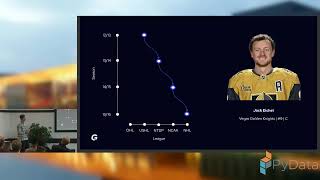
How can data science help young athletes navigate their careers? In this talk, I’ll share my experience building a career path planner for aspiring ice hockey players. The project combines player performance data, career path patterns, and predictive modeling to suggest possible development paths and milestones. Along the way, I’ll discuss the challenges of messy sports data and communicating insights in a way that resonates with non-technical users like coaches, parents, and players.

Extending SQL Databases with Python

Extending SQL Databases with Python

2025-12-09 Watch
talk

What if your database could run Python code inside SQL? In this talk, we’ll explore how to extend popular databases using Python, without needing to write a line of C.

We’ll cover three systems—SQLite, DuckDB, and PostgreSQL—and show how Python can be used in each to build custom SQL functions, accelerate data workflows, and prototype analytical logic. Each database offers a unique integration path: - SQLite and DuckDB allow you to register Python functions directly into SQL via sqlite3.create_function, making it easy to inject business logic or custom transformations. - PostgreSQL offers PL/Python, a full-featured procedural language for writing SQL functions in Python. We’ll also touch on advanced use cases, including embedding the Python interpreter directly into a PostgreSQL extension for deeper integration.

By the end of this talk, you’ll understand the capabilities, limitations, and gotchas of Python-powered extensions in each system—and how to choose the right tool depending on your use case, whether you’re analyzing data, building pipelines, or hacking on your own database.

Football is complex, but your code doesn’t have to be — meet DataBallPy and a practical deep dive into pressing

2025-12-09
talk

DataBallPy is an open-source Python package that quickly starts your analysis of a football-related question. In the current talk, we will introduce the core features and functionalities of DataBallPy using code examples with compelling visualisations. The second part of the talk will showcase a practical example of how the Royal Belgian Football Association (RBFA) has used components of DataBallPy to analyse the effectiveness and efficiency of pressuring the opponent in over 200 games. Taken together, this talk will give you a clear starting point of how to start answering your football-related questions.

Scaling Python to thousands of nodes with Ray

Scaling Python to thousands of nodes with Ray

2025-12-09 Watch
talk

Python is the language of choice for anything to do with AI and ML. While that has made it easy to write code for one machine, it's much more difficult to run workloads across clusters of thousands of nodes. Ray allows you to do just that. I'll demonstrate how to implement this open source tool with a few lines of code. As a demo project, I'll show how I built a RAG for the Wheel of Time series.

AI-Powered Web Scraping: From Data Collection to Strategic Insights

2025-12-09
talk

Companies today are hungry for external data to stay competitive, but actually getting and making sense of that data isn’t easy. Standard web scraping often produces messy or incomplete results, and modern anti-bot systems make reliable collection even tougher.

In this talk, I’ll share how pairing Python’s scraping frameworks (like Scrapy, Playwright, and Selenium) with AI/ML can turn raw, unstructured data into clear, actionable insights.

We’ll look at:

1) How to build scrapers that still work in 2025.

2) Ways to use AI to automatically clean, enrich, and classify data.

3) Real-world applications of sentiment analysis for reviews and social media.

4) Case studies showing how SMEs have used these pipelines to sharpen marketing and product strategies.

By the end, you’ll see how to design pipelines that don’t just gather data, but deliver real strategic value. The session will focus on practical Python tools, scalable deployment (Airflow, Kubernetes, cloud platforms), and key lessons learned from hands-on projects at the intersection of scraping and AI.