In this talk, we will go through everything open-source AI: the state of open-source AI, why it matters, the future of it and how you can get started with it.
 talk-data.com
Topic
AI/ML
Artificial Intelligence/Machine Learning
data_science
algorithms
predictive_analytics
9014
tagged
Activity Trend
1532
peak/qtr
2020-Q1
2026-Q1
Top Events
Google Cloud Next '25
761
Microsoft Ignite 2025
699
Google Cloud Next '24
553
Data + AI Summit 2025
425
O'Reilly Data Science Books
333
Databricks DATA + AI Summit 2023
287
Data Engineering Podcast
271
O'Reilly Data Engineering Books
240
DataFramed
239
Making Data Simple
223
AWS re:Invent 2024
223
DATA MINER Big Data Europe Conference 2020
215
Help us become the #1 Data Podcast by leaving a rating & review! We are 67 reviews away! Thomas Gresco shares his journey from being a high school math teacher to landing a role as a Reimbursement Analyst in less than 70 days. He discusses the struggles of job hunting, the importance of a strong portfolio and network, and how following the SPN method transformed his career. 💌 Join 30k+ aspiring data analysts & get my tips in your inbox weekly 👉 https://www.datacareerjumpstart.com/newsletter 🆘 Feeling stuck in your data journey? Come to my next free "How to Land Your First Data Job" training 👉 https://www.datacareerjumpstart.com/training 👩💻 Want to land a data job in less than 90 days? 👉 https://www.datacareerjumpstart.com/daa 👔 Ace The Interview with Confidence 👉 https://www.datacareerjumpstart.com//interviewsimulator ⌚ TIMESTAMPS ⌚ TIMESTAMPS 04:10 - The Job Hunt 14:00 - The Interview Experience 20:18 - Life as an Analyst 🔗 CONNECT WITH THOMAS https://www.linkedin.com/in/thomas-gresco/ 🔗 CONNECT WITH AVERY 🎥 YouTube Channel 🤝 LinkedIn 📸 Instagram 🎵 TikTok 💻 Website Mentioned in this episode: Join the last cohort of 2025! The LAST cohort of The Data Analytics Accelerator for 2025 kicks off on Monday, December 8th and enrollment is officially open!
To celebrate the end of the year, we’re running a special End-of-Year Sale, where you’ll get: ✅ A discount on your enrollment 🎁 6 bonus gifts, including job listings, interview prep, AI tools + more
If your goal is to land a data job in 2026, this is your chance to get ahead of the competition and start strong.
👉 Join the December Cohort & Claim Your Bonuses: https://DataCareerJumpstart.com/daa https://www.datacareerjumpstart.com/daa
Está no ar, o Data Hackers News !! Os assuntos mais quentes da semana, com as principais notícias da área de Dados, IA e Tecnologia, que você também encontra na nossa Newsletter semanal, agora no Podcast do Data Hackers !!
Aperte o play e ouça agora, o Data Hackers News dessa semana !
Para saber tudo sobre o que está acontecendo na área de dados, se inscreva na Newsletter semanal:
https://www.datahackers.news/
Conheça nossos comentaristas do Data Hackers News:
Monique Femme
Paulo Vasconcellos
Matérias/assuntos comentados:
Inscreva-se no XConf América Latina 2024 (pagina em português);
Klarna planeja "cancelar provedores de SaaS' e substituí-los por IA própria;
YouTube libera dublagem automática para canais.
Episódio dublado por AI
Baixe o relatório completo do State of Data Brazil e os highlights da pesquisa :
Demais canais do Data Hackers:
Site
Linkedin
Instagram
Tik Tok
You Tube
The Data Product Management In Action podcast, brought to you by Soda and executive producer Scott Hirleman, is a platform for data product management practitioners to share insights and experiences.
In Season 01, Episode 16, we introduce another one of our amazing hosts, Nick Zervoudis. Nick is the head of Products for Data and AI at CKDelta. He shares his journey into product management and discusses his dual roles, managing data monetization products and consulting for sister companies. We will discuss Nick’s career highlights, key successes, and challenges. Get to know Nick and learn about journey into the field of Data Product management!
About our host Nick Zervoudis: Nick is Head of Product at CKDelta, an AI software business within the CK Hutchison Holdings group. Nick oversees a portfolio of data products and works with sister companies to uncover new opportunities to innovate using data, analytics, and machine learning. Nick's career has revolved around data and advanced analytics from day one, having worked as an analyst, consultant, product manager, and instructor for startups, SMEs, and enterprises including PepsiCo, Sainsbury's, Lloyds Banking Group, IKEA, Capgemini Invent, BrainStation, QuantSpark, and Hg Capital. Nick is also the co-host of London's Data Product Management meetup, and speaks & writes regularly about data & AI product management. Connect with Nick on LinkedIn.
All views and opinions expressed are those of the individuals and do not necessarily reflect their employers or anyone else.
Join the conversation on LinkedIn. Apply to be a guest or nominate someone that you know.
Do you love what you're listening to? Please rate and review the podcast, and share it with fellow practitioners you know. Your support helps us reach more listeners and continue providing valuable insights!
The Data Product Management In Action podcast, brought to you by Soda and executive producer Scott Hirleman, is a platform for data product management practitioners to share insights and experiences.
In Season 01, Episode 17, host Nick Zervoudis ( Head of Product at CKDelta) talks to Grace Halim (Product Manager with Power Digital Marketing). In this episode Grace shares her career journey and highlights the importance of diverse experiences in shaping a successful product manager. She discusses the value of empathy, strong relationships with engineering and data teams, and the role of curiosity in asking the right questions. Listen to Grace as she shares her plans for a career break to explore new projects!
About our host Nick Zervoudis: Nick is Head of Product at CKDelta, an AI software business within the CK Hutchison Holdings group. Nick oversees a portfolio of data products and works with sister companies to uncover new opportunities to innovate using data, analytics, and machine learning. Nick's career has revolved around data and advanced analytics from day one, having worked as an analyst, consultant, product manager, and instructor for startups, SMEs, and enterprises including PepsiCo, Sainsbury's, Lloyds Banking Group, IKEA, Capgemini Invent, BrainStation, QuantSpark, and Hg Capital. Nick is also the co-host of London's Data Product Management meetup, and speaks & writes regularly about data & AI product management. Connect with Nick on LinkedIn.
About our guest Grace Halim: Grace is a seasoned product leader with a passion for building innovative products. With over 12 years of product management experience, Grace has honed her skills in leading high-performing product teams and delivering exceptional customer experiences. From crafting engaging data products to optimizing complex enterprise systems, Grace has a proven track record of success in the product management field. Grace is currently on a career break traveling around Australia in a caravan with her young family. Having been a product leader in the last two roles she held, Grace excelled in building and scaling product teams, fostering a culture of innovation, and driving business growth. Her teams' focus on customer focus and strategic thinking have been instrumental in delivering successful products that resonate with customers and drive bottom-line results. Beyond her corporate experience, Grace is an entrepreneur at heart. As co-founder of a data platform, she demonstrated her ability to turn a vision into a paying customer. Stay up to date with Grace’s adventure on LinkedIn.
All views and opinions expressed are those of the individuals and do not necessarily reflect their employers or anyone else.
Join the conversation on LinkedIn.
Apply to be a guest or nominate someone that you know.
Do you love what you're listening to? Please rate and review the podcast, and share it with fellow practitioners you know. Your support helps us reach more listeners and continue providing valuable insights!
Jupyter based environments are getting a lot of traction for teaching computing, programming, and data sciences. The narrative structure of notebooks has indeed proven its value for guiding each student at it's own pace to the discovery and understanding of new concepts or new idioms (e.g. how do I extract a column in pandas?). But then these new pieces of knowledge tend to quickly fade out and be forgotten. Indeed long term acquisition of knowledge and skills takes reinforcement by repetition. This is the foundation of many online learning platforms like Webwork or WIMS that offer exercises with randomization and automatic feedback. And of popular "AI-powered" apps -- e.g. to learn foreign languages -- that use spaced repetition algorithms designed by educational and neuro sciences to deliver just the right amount of repetition.
What if you could author such exercizes as notebooks, to benefit from everything that Jupyter can offer (think rich narratives, computations, visualization, interactions)? What if you could integrate such exercises right into your Jupyter based course? What if a learner could get personalized exercise recommandations based on their past learning records, without having to give away these sensitive pieces of information away?
That's Jupylates (work in progress). And thanks to the open source scientific stack, it's just a small Jupyter extension.
The Jupyter stack has undergone a significant transformation in recent years with the integration of collaborative editing features: users can now modify a shared document and see each other's changes in real time, with a user experience akin to that of Google Docs. The underlying technology uses a special data structure called Conflict-free Replicated Data Types (CRDTs), that automatically resolves conflicts when concurrent changes are made. This allows data to be distributed rather than centralized in a server, letting clients work as if data was local rather than remote. In this talk, we look at new possibilities that CRDTs can unlock, and how they are redefining Jupyter's architecture. Different use cases are presented: a suggestion system similar to Google Doc's, a chat system allowing collaboration with an AI agent, an execution model allowing full notebook state recovery, a collaborative widget model. We also look at the benefits of using CRDTs in JupyterLite, where users can interact without a server. This may be a great example of a distributed system where every user owns their data and shares them with their peers.
In the last year there hasn’t been a day that passed without us hearing about a new generative AI innovation that will enhance some aspect of our lives. On a number of tasks large probabilistic systems are now outperforming humans, or at least they do so “on average”. “On average” means most of the time, but in many real life scenarios “average” performance is not enough: we need correctness ALL of the time, for example when you ask the system to dial 911.
In this talk we will explore the synergy between deterministic and probabilistic models to enhance the robustness and controllability of machine learning systems. Tailored for ML engineers, data scientists, and researchers, the presentation delves into the necessity of using both deterministic algorithms and probabilistic model types across various ML systems, from straightforward classification to advanced Generative AI models.
You will learn about the unique advantages each paradigm offers and gain insights into how to most effectively combine them for optimal performance in real-world applications. I will walk you through my past and current experiences in working with simple and complex NLP models, and show you what kind of pitfalls, shortcuts, and tricks are possible to deliver models that are both competent and reliable.
The session will be structured into a brief introduction to both model types, followed by case studies in classification and generative AI, concluding with a Q&A segment.
With increased ease of smaller "AI" models, better chips and on-device learning, is it possible now to build and train your own models for your own use? In this keynote, we'll explore learnings of small, medium and large-sized model personalization, but driven by yourself and for yourself. A walk through what's possible, what's not and what we should prioritize if we'd like AI & ML to be made for everyone.
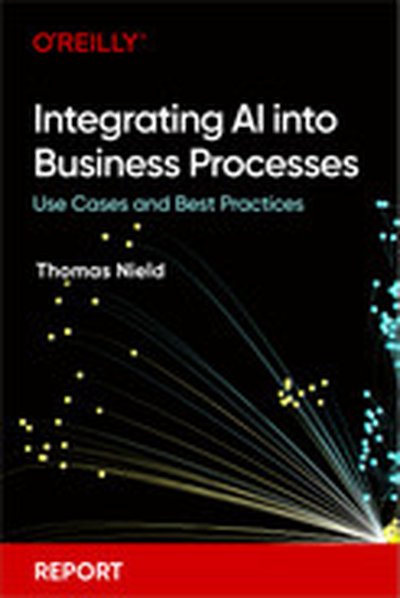
Are you grappling with increasing productivity and enhancing creativity within your business processes? As businesses evolve in this digital age, the demand for swift, efficient, and innovative solutions is more pressing than ever. Traditional methods often fall short in keeping pace with the rapid changes and challenges that professionals face daily. Enter this report by Thomas Nield. This curated guide outlines the transformative power of generative AI in various business functions and serves as a much-needed solution to overcoming modern business hurdles. Discover how AI can be your ally in not just meeting but exceeding your productivity and creativity goals. You'll learn how to: Quickly find and use relevant images for presentations, blogs, and articles Save valuable time and refine your communications with AI-assisted email rewriting Easily distill large volumes of information into essential summaries Leverage AI for efficient data-gathering from the web, perfectly suited for analysis Utilize AI-generated text and visuals to craft compelling basic marketing materials
Nora Szentivanyi and Greg Fuzesi discuss their takeaways from the August CPI reports and how the incoming data are shaping the outlook for global inflation and monetary policy. Global headline inflation stepped down to 2.9%oya, helped by lower energy prices, while core inflation moved sideways at 3.1%. The monthly pace of core CPI gains firmed marginally to 0.3%, but remains on track to ease in line with our forecasts for a moderation to 2.8%ar this quarter from a 3.4%ar pace in the first half of the year. While the recent slide in US core inflation stands out, there has been some encouraging progress with respect to services disinflation in a number of other countries too. In this episode we discuss the Euro area’s inflation dynamics in more detail and what it means for the ECB.
This podcast was recorded on Sept 24, 2024.
This communication is provided for information purposes only. Institutional clients can view the related reports at
https://www.jpmm.com/research/content/GPS-4801321-0
https://www.jpmm.com/research/content/GPS-4799070-0
https://www.jpmm.com/research/content/GPS-4794311-0
for more information; please visit www.jpmm.com/research/disclosures for important disclosures.
© 2024 JPMorgan Chase & Co. All rights reserved. This material or any portion hereof may not be reprinted, sold or redistributed without the written consent of J.P. Morgan. It is strictly prohibited to use or share without prior written consent from J.P. Morgan any research material received from J.P. Morgan or an authorized third-party (“J.P. Morgan Data”) in any third-party artificial intelligence (“AI”) systems or models when such J.P. Morgan Data is accessible by a third-party. It is permissible to use J.P. Morgan Data for internal business purposes only in an AI system or model that protects the confidentiality of J.P. Morgan Data so as to prevent any and all access to or use of such J.P. Morgan Data by any third-party.
This talk explores the disconnect between MLOps fundamental principles and their practical application in designing ML pipelines
Summary Airbyte is one of the most prominent platforms for data movement. Over the past 4 years they have invested heavily in solutions for scaling the self-hosted and cloud operations, as well as the quality and stability of their connectors. As a result of that hard work, they have declared their commitment to the future of the platform with a 1.0 release. In this episode Michel Tricot shares the highlights of their journey and the exciting new capabilities that are coming next. Announcements Hello and welcome to the Data Engineering Podcast, the show about modern data managementYour host is Tobias Macey and today I'm interviewing Michel Tricot about the journey to the 1.0 launch of Airbyte and what that means for the projectInterview IntroductionHow did you get involved in the area of data management?Can you describe what Airbyte is and the story behind it?What are some of the notable milestones that you have traversed on your path to the 1.0 release?The ecosystem has gone through some significant shifts since you first launched Airbyte. How have trends such as generative AI, the rise and fall of the "modern data stack", and the shifts in investment impacted your overall product and business strategies?What are some of the hard-won lessons that you have learned about the realities of data movement and integration?What are some of the most interesting/challenging/surprising edge cases or performance bottlenecks that you have had to address?What are the core architectural decisions that have proven to be effective?How has the architecture had to change as you progressed to the 1.0 release?A 1.0 version signals a degree of stability and commitment. Can you describe the decision process that you went through in committing to a 1.0 version?What are the most interesting, innovative, or unexpected ways that you have seen Airbyte used?What are the most interesting, unexpected, or challenging lessons that you have learned while working on Airbyte?When is Airbyte the wrong choice?What do you have planned for the future of Airbyte after the 1.0 launch?Contact Info LinkedInParting Question From your perspective, what is the biggest gap in the tooling or technology for data management today?Closing Announcements Thank you for listening! Don't forget to check out our other shows. Podcast.init covers the Python language, its community, and the innovative ways it is being used. The AI Engineering Podcast is your guide to the fast-moving world of building AI systems.Visit the site to subscribe to the show, sign up for the mailing list, and read the show notes.If you've learned something or tried out a project from the show then tell us about it! Email [email protected] with your story.Links AirbytePodcast EpisodeAirbyte CloudAirbyte Connector BuilderSinger ProtocolAirbyte ProtocolAirbyte CDKModern Data StackELTVector DatabasedbtFivetranPodcast EpisodeMeltanoPodcast EpisodedltReverse ETLGraphRAGAI Engineering Podcast EpisodeThe intro and outro music is from The Hug by The Freak Fandango Orchestra / CC BY-SA
Today, we’re joined by Rob Wenger, Chief Executive Officer and Co-Founder of Higher Logic, a leading provider of engagement platforms for associations and nonprofits. We talk about: The challenge of knowing when to innovate & at what paceUsing Gen AI to generate revenue & deliver value to users (without going off the rails)Integrating technologies post-acquisitionHow to remediate technical debtAlternatives to real-time integration
AI has rapidly emerged as an incredibly transformative technology, and nowhere has its impact been felt more unexpectedly than in the creative arts. Just a decade ago, few would have predicted that AI would evolve from automating routine tasks to generating paintings, music, and even poetry. Yet today, the role of AI in the arts has entered mainstream conversations, even contributing to the debates seen in last year’s Hollywood strikes. Kent Kersey is a creative technologist who has served as a Product and Business leader in startups across B2B, B2C, and Enterprise SaaS. He is the founder and CEO of Invoke, an open-source Enterprise platform built to empower creatives to co-create with custom/fine-tuned AI products. In the episode, Adel and Kent explore intellectual property and AI, the legal landscape surrounding AI models, open vs closed-source models, the future of creative teams and GenAI, innovations in GenAI, the role of artists in an AI-world, GenAI’s impact on the future of entertainment and much more. Links Mentioned in the Show: InvokeHow to Use Midjourney: A Comprehensive Guide to AI-Generated Artwork CreationCourse: Generative AI ConceptsRelated Episode: Seeing the Data Layer Through Spatial Computing with Cathy Hackl and Irena CroninRewatch sessions from RADAR: AI Edition New to DataCamp? Learn on the go using the DataCamp mobile appEmpower your business with world-class data and AI skills with DataCamp for business
Nisha Paliwal, who leads enterprise data tech at Capital One, joins Tristan to discuss building a strong data culture for in the world of AI. She is the co-author of the book Secrets of AI Value Creation. For full show notes and to read 6+ years of back issues of the podcast's companion newsletter, head to https://roundup.getdbt.com. The Analytics Engineering Podcast is sponsored by dbt Labs.
Bruce Kasman and Jay Barry discuss how the Fed met their expectations for a 50bp rate cut as it shifted its assessment of risk while not materially adjusting its growth or inflation forecasts. Markets showed a continued steepening in the US curve but the rise in longer-term yields suggests that this is aligned with greater confidence in the Fed engineering a sustained expansion.
This podcast was recorded on 9/20/2024.
This communication is provided for information purposes only. Institutional clients please visit www.jpmm.com/research/disclosures for important disclosures. © 2024 JPMorgan Chase & Co. All rights reserved. This material or any portion hereof may not be reprinted, sold or redistributed without the written consent of J.P. Morgan. It is strictly prohibited to use or share without prior written consent from J.P. Morgan any research material received from J.P. Morgan or an authorized third-party (“J.P. Morgan Data”) in any third-party artificial intelligence (“AI”) systems or models when such J.P. Morgan Data is accessible by a third-party. It is permissible to use J.P. Morgan Data for internal business purposes only in an AI system or model that protects the confidentiality of J.P. Morgan Data so as to prevent any and all access to or use of such J.P. Morgan Data by any third-party.
All of the product innovation and open source project updates Databricks announced at Data + AI Summit–in less than 5 min.