With increased ease of smaller "AI" models, better chips and on-device learning, is it possible now to build and train your own models for your own use? In this keynote, we'll explore learnings of small, medium and large-sized model personalization, but driven by yourself and for yourself. A walk through what's possible, what's not and what we should prioritize if we'd like AI & ML to be made for everyone.
 talk-data.com

Speaker
Katharine Jarmul
8
talks
Head of Product
Cape Privacy
Frequent Collaborators
Filter by Event / Source
Talks & appearances
8 activities · Newest first
Katharine Jarmul and I chat about the Biden AI Executive Order. Enjoy!
We talked about:
Katharine's background Katharine's ML privacy startup GDPR, CCPA, and the “opt-in as the default” approach What is data privacy? Finding Katharine's book – Practical Data Privacy The various definitions of data privacy and “user profiles” Privacy engineering and privacy-enhancing technologies Why data privacy is important What is differential privacy? The importance of keeping privacy in mind when designing systems Data privacy on the example of ChatGPT Katharine's resource suggestions for learning about data privacy
Links:
LinkedIn: https://www.linkedin.com/in/katharinejarmul/
Twitter: https://twitter.com/kjam
Free data engineering course: https://github.com/DataTalksClub/data-engineering-zoomcamp Join DataTalks.Club: https://datatalks.club/slack.html Our events: https://datatalks.club/events.html
Katharine Jarmul (Principal data scientist at Thoughtworks and author of Practical Data Privacy (O’Reilly, 2023)) and I chat about all things data privacy. She brings battle-tested experience and unique perspectives in the areas of ML/AI privacy, AI risk, regulation, and much more. I learned a ton, and I hope you do too!
LinkedIn: https://www.linkedin.com/in/katharinejarmul/
Twitter: https://twitter.com/kjam
Probably Private newsletter: https://probablyprivate.com/
If you like this show, give it a 5-star rating on your favorite podcast platform.
Purchase Fundamentals of Data Engineering at your favorite bookseller.
Check out my substack: https://joereis.substack.com/
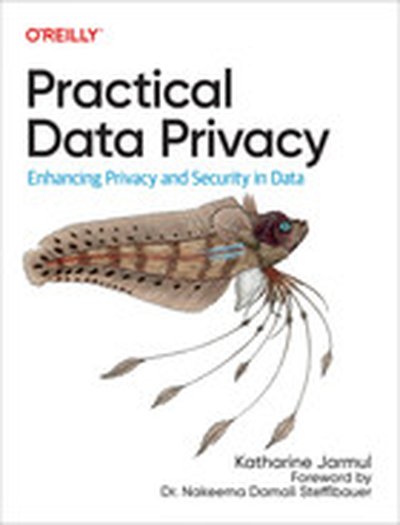
Between major privacy regulations like the GDPR and CCPA and expensive and notorious data breaches, there has never been so much pressure to ensure data privacy. Unfortunately, integrating privacy into data systems is still complicated. This essential guide will give you a fundamental understanding of modern privacy building blocks, like differential privacy, federated learning, and encrypted computation. Based on hard-won lessons, this book provides solid advice and best practices for integrating breakthrough privacy-enhancing technologies into production systems. Practical Data Privacy answers important questions such as: What do privacy regulations like GDPR and CCPA mean for my data workflows and data science use cases? What does "anonymized data" really mean? How do I actually anonymize data? How does federated learning and analysis work? Homomorphic encryption sounds great, but is it ready for use? How do I compare and choose the best privacy-preserving technologies and methods? Are there open-source libraries that can help? How do I ensure that my data science projects are secure by default and private by design? How do I work with governance and infosec teams to implement internal policies appropriately?
Before the COVID-19 crisis, we were already acutely aware of the need for a broader conversation around data privacy: look no further than the Snowden revelations, Cambridge Analytica, the New York Times Privacy Project, the General Data Protection Regulation (GDPR) in Europe, and the California Consumer Privacy Act (CCPA). In the age of COVID-19, these issues are far more acute. We also know that governments and businesses exploit crises to consolidate and rearrange power, claiming that citizens need to give up privacy for the sake of security. But is this tradeoff a false dichotomy? And what type of tools are being developed to help us through this crisis? In this episode, Katharine Jarmul, Head of Product at Cape Privacy, a company building systems to leverage secure, privacy-preserving machine learning and collaborative data science, will discuss all this and more, in conversation with Dr. Hugo Bowne-Anderson, data scientist and educator at DataCamp.Links from the show
FROM THE INTERVIEW
Katharine on TwitterKatharine on LinkedInContact Tracing in the Real World (By Ross Anderson)The Price of the Coronavirus Pandemic (By Nick Paumgarten)Do We Need to Give Up Privacy to Fight the Coronavirus? (By Julia Angwin)Introducing the Principles of Equitable Disaster Response (By Greg Bloom)Cybersecurity During COVID-19 ( By Bruce Schneier)
"Python Web Scraping" is a practical guide to extracting and processing online data using the Python programming language. With this book, you'll learn step-by-step how to build web scrapers and crawlers that can handle a range of data sources and structures. After reading this, you will be equipped to tackle real-world web scraping challenges effectively. What this Book will help me do Learn how to extract structured data from standard webpages using Python. Gain proficiency with libraries such as Selenium and PyQt for handling dynamic and JavaScript-dependent content. Build concurrent scrapers to efficiently process large volumes of web pages in parallel. Understand and implement form interaction automation for data extraction from complex websites. Develop advanced scrapers using Scrapy to handle sophisticated web crawling tasks. Author(s) None Jarmul is an experienced data scientist and programmer with extensive knowledge in Python. They bring practical expertise from working on real-world web scraping projects. In their work, they focus on creating content that empowers readers by demystifying complex technical topics. Who is it for? This book is perfect for software developers eager to dive into web scraping using Python, even if they're new to the subject. If you have basic to intermediate Python skills and want to automate data collection and processing, this is the book for you. The techniques here are valuable for tackling diverse data extraction scenarios.
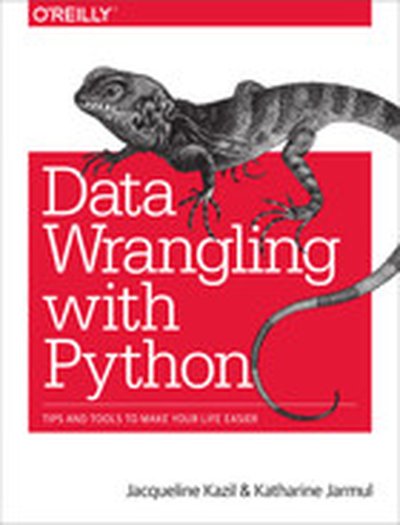
How do you take your data analysis skills beyond Excel to the next level? By learning just enough Python to get stuff done. This hands-on guide shows non-programmers like you how to process information that’s initially too messy or difficult to access. You don't need to know a thing about the Python programming language to get started. Through various step-by-step exercises, you’ll learn how to acquire, clean, analyze, and present data efficiently. You’ll also discover how to automate your data process, schedule file- editing and clean-up tasks, process larger datasets, and create compelling stories with data you obtain. Quickly learn basic Python syntax, data types, and language concepts Work with both machine-readable and human-consumable data Scrape websites and APIs to find a bounty of useful information Clean and format data to eliminate duplicates and errors in your datasets Learn when to standardize data and when to test and script data cleanup Explore and analyze your datasets with new Python libraries and techniques Use Python solutions to automate your entire data-wrangling process