
talk-data.com talk-data.com

Topic

Amazon EMR

big_data hadoop aws

6

tagged

Activity Trend

6 peak/qtr
2020-Q1 2026-Q1

Activities

Showing filtered results

Filtering by: Databricks DATA + AI Summit 2023 ×
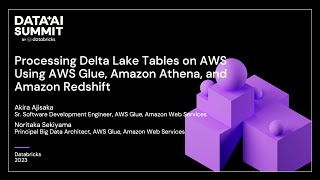
Processing Delta Lake Tables on AWS Using AWS Glue, Amazon Athena, and Amazon Redshift

Delta Lake is an open source project that helps implement modern data lake architectures commonly built on cloud storages. With Delta Lake, you can achieve ACID transactions, time travel queries, CDC, and other common use cases on the cloud.

There are a lot of use cases of Delta tables on AWS. AWS has invested a lot in this technology, and now Delta Lake is available with multiple AWS services, such as AWS Glue Spark jobs, Amazon EMR, Amazon Athena, and Amazon Redshift Spectrum. AWS Glue is a serverless, scalable data integration service that makes it easier to discover, prepare, move, and integrate data from multiple sources. With AWS Glue, you can easily ingest data from multiple data sources such as on-prem databases, Amazon RDS, DynamoDB, MongoDB into Delta Lake on Amazon S3 even without expertise in coding.

This session will demonstrate how to get started with processing Delta Lake tables on Amazon S3 using AWS Glue, and querying from Amazon Athena, and Amazon Redshift. The session also covers recent AWS service updates related to Delta Lake.

Talk by: Noritaka Sekiyama and Akira Ajisaka

Here’s more to explore: Why the Data Lakehouse Is Your next Data Warehouse: https://dbricks.co/3Pt5unq Lakehouse Fundamentals Training: https://dbricks.co/44ancQs

Connect with us: Website: https://databricks.com Twitter: https://twitter.com/databricks LinkedIn: https://www.linkedin.com/company/databricks Instagram: https://www.instagram.com/databricksinc Facebook: https://www.facebook.com/databricksinc
Deep Dive Into Grammarly's Data Platform

Grammarly helps 30 million people and 50,000 teams to communicate more effectively. Using the Databricks Lakehouse Platform, we can rapidly ingest, transform, aggregate, and query complex data sets from an ecosystem of sources, all governed by Unity Catalog. This session will overview Grammarly’s data platform and the decisions that shaped the implementation. We will dive deep into some architectural challenges the Grammarly Data Platform team overcame as we developed a self-service framework for incremental event processing.

Our investment in the lakehouse and Unity Catalog has dramatically improved the speed of our data value chain: making 5 billion events (ingested, aggregated, de-identified, and governed) available to stakeholders (data scientists, business analysts, sales, marketing) and downstream services (feature store, reporting/dashboards, customer support, operations) available within 15. As a result, we have improved our query cost performance (110% faster at 10% the cost) compared to our legacy system on AWS EMR.

I will share architecture diagrams, their implications at scale, code samples, and problems solved and to be solved in a technology-focused discussion about Grammarly’s iterative lakehouse data platform.

Talk by: Faraz Yasrobi and Christopher Locklin

Connect with us: Website: https://databricks.com Twitter: https://twitter.com/databricks LinkedIn: https://www.linkedin.com/company/databricks Instagram: https://www.instagram.com/databricksinc Facebook: https://www.facebook.com/databricksinc
Lessons Learned from Deidentifying 700 Million Patient Notes

Providence embarked on an ambitious journey to de-identify all our clinical electronic medical record (EMR) data to support medical research and the development of novel treatments. This talk shares how this was done for patient notes and how you can achieve the same.

First, we built a deidentification pipeline using pre-trained deep learning models, fine-tuned to our own data. We then developed an innovative methodology to evaluate reidentification risk, as American healthcare laws (HIPAA) require that de-identified data have a “very low” risk of reidentification, but do not specify a standard. Our next challenge was to annotate a dataset large enough to produce meaningful statistics and improve the fine-tuning of our model. Finally, through experimentation and iteration, we achieved a level of level of performance that would safeguard patient privacy while minimizing information loss. Our technology partner provided the computing power to efficiently process hundreds of millions of records of historical data and incremental daily loads.

Through this endeavor, we have learned many lessons that we will share:

• Evaluating risk of reidentification to meet HIPAA requirements
• Annotating samples of data to create labeled datasets • Performing experiments and evaluating performance • Fine-tuning pre-trained models with your own data • Augmenting models with rules and other tricks • Optimizing clusters to process very large volumes of text data

We will also present speed and throughput metrics from running our pipeline, which you can use to benchmark similar projects.

Connect with us: Website: https://databricks.com Facebook: https://www.facebook.com/databricksinc Twitter: https://twitter.com/databricks LinkedIn: https://www.linkedin.com/company/data... Instagram: https://www.instagram.com/databricksinc/
Running a Low Cost, Versatile Data Management Ecosystem with Apache Spark at Core

Data is the key component of Analytics, AI or ML platform. Organizations may not be successful without having a Platform that can Source, Transform, Quality check and present data in a reportable format that can drive actionable insights.

This session will focus on how Capital One HR Team built a Low Cost Data movement Ecosystem that can source data, transform at scale and build the data storage (Redshift) at a level that can be easily consumed by AI/ML programs - by using AWS Services with combination of Open source software(Spark) and Enterprise Edition Hydrograph (UI Based ETL tool with Spark as backend) This presentation is mainly to demonstrate the flexibility that Apache Spark provides for various types ETL Data Pipelines when we code in Spark.

We have been running 3 types of pipelines over 6+ years , over 400+ nightly batch jobs for $1000/mo. (1) Spark on EC2 (2) UI Based ETL tool with Spark backend (on the same EC2) (3) Spark on EMR. We have a CI/CD pipeline that supports easy integration and code deployment in all non-prod and prod regions ( even supports automated unit testing). We will also demonstrate how this ecosystem can failover to a different region in less than 15 minutes , making our application highly resilient.

Connect with us: Website: https://databricks.com Facebook: https://www.facebook.com/databricksinc Twitter: https://twitter.com/databricks LinkedIn: https://www.linkedin.com/company/data... Instagram: https://www.instagram.com/databricksinc/
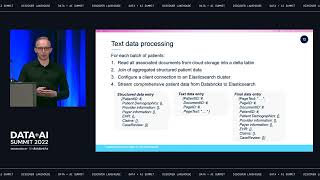
Comprehensive Patient Data Self-Serve Environment and Executive Dashboards Leveraging Databricks

In this talk, we will outline our data pipelines and demo dashboards developed on top of the resulting elasticsearch index. This tool enables queries for terms or phrases in the raw documents to be executed together with any associated EMR patient data filters within 1-2 second for a data set containing millions of records/documents. Finally, the dashboards are simple to use and enable Real World Evidence data stakeholders to gain real-time statistical insight into the comprehensive patient information available.

Connect with us: Website: https://databricks.com Facebook: https://www.facebook.com/databricksinc Twitter: https://twitter.com/databricks LinkedIn: https://www.linkedin.com/company/data... Instagram: https://www.instagram.com/databricksinc/

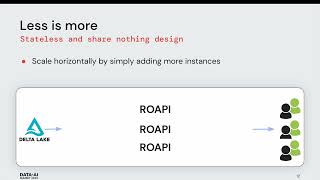
ROAPI: Serve Not So Big Data Pipeline Outputs Online with Modern APIs

Data is the key component of Analytics, AI or ML platform. Organizations may not be successful without having a Platform that can Source, Transform, Quality check and present data in a reportable format that can drive actionable insights.

This session will focus on how Capital One HR Team built a Low Cost Data movement Ecosystem that can source data, transform at scale and build the data storage (Redshift) at a level that can be easily consumed by AI/ML programs - by using AWS Services with combination of Open source software(Spark) and Enterprise Edition Hydrograph (UI Based ETL tool with Spark as backend) This presentation is mainly to demonstrate the flexibility that Apache Spark provides for various types ETL Data Pipelines when we code in Spark.

We have been running 3 types of pipelines over 6+ years , over 400+ nightly batch jobs for $1000/mo. (1) Spark on EC2 (2) UI Based ETL tool with Spark backend (on the same EC2) (3) Spark on EMR. We have a CI/CD pipeline that supports easy integration and code deployment in all non-prod and prod regions ( even supports automated unit testing). We will also demonstrate how this ecosystem can failover to a different region in less than 15 minutes , making our application highly resilient.

Connect with us: Website: https://databricks.com Facebook: https://www.facebook.com/databricksinc Twitter: https://twitter.com/databricks LinkedIn: https://www.linkedin.com/company/data... Instagram: https://www.instagram.com/databricksinc/