talk-data.com talk-data.com

Topic

data-science-tools

333

tagged

Activity Trend

1 peak/qtr
2020-Q1 2026-Q1

Activities

333 activities · Newest first

Mastering Predictive Analytics with R

Dive into the realm of predictive analytics with this R-focused guide. Whether you're building your first model or refining complex analytics strategies, this book equips you with fundamental techniques and in-depth understanding of predictive modeling using R. What this Book will help me do Master the end-to-end predictive modeling process. Classify and select suitable predictive models for specific use cases. Understand the mechanics and assumptions of various predictive models. Evaluate predictive model performance with appropriate metrics. Enhance your R programming skills for analytical tasks. Author(s) The authors of this book combine strong technical expertise in data science and predictive analytics with extensive hands-on experience in applying them to real-world challenges. They excel at distilling complex topics into approachable, actionable steps for readers at varying levels of familiarity with R and data analysis. Their commitment to empowering learners defines their work. Who is it for? This book is perfect for budding data scientists and quantitative analysts with basic R knowledge who aspire to master predictive analytics. Even experienced professionals will find valuable model-specific insights. If you're familiar with basic statistics and eager to bridge the gap to robust machine learning applications, this book is for you.
Spatio-Temporal Methods in Environmental Epidemiology

This is the first book of its kind to specifically address the interface between environmental epidemiology and spatio-temporal modeling. The book links recent developments in spatio-temporal methodology with epidemiological applications. Drawing on real-life problems, it provides the tools required to exploit recent advances in methodology when assessing the health risks associated with environmental hazards. The text includes practical examples together with embedded R code, details of specific R packages, and other software, including WinBUGS/OpenBUGS and INLA.

Mastering Pandas for Finance

"Mastering Pandas for Finance" takes a deep dive into applying Python and the pandas library to solve real-world financial data analysis problems. With a focus on financial modeling, backtesting trading strategies, and analyzing large datasets, this book equips you with the skills to leverage pandas effectively. What this Book will help me do Utilize pandas DataFrame for efficient financial data handling and manipulation. Develop robust time-series models and perform statistical analysis on financial data. Backtest algorithmic trading strategies including momentum and mean reversion. Price complex financial options and calculate Value at Risk for portfolio management. Optimize portfolio allocation and model financial performance using industry techniques. Author(s) Michael Heydt is an experienced software engineer and data scientist with a strong background in quantitative finance. He specializes in using Python for data analysis and has spent years teaching and writing about technical subjects. His detailed yet approachable writing style makes complex topics accessible to all. Who is it for? "Mastering Pandas for Finance" is perfect for finance professionals seeking to integrate Python into their workflows, data analysts exploring quantitative finance applications, and programmers aiming to specialize in financial analytics. Some baseline Python and pandas knowledge is recommended, but the book is structured to guide you effectively through advanced concepts too.

R in Action, Second Edition

R in Action, Second Edition presents both the R language and the examples that make it so useful for business developers. Focusing on practical solutions, the book offers a crash course in statistics and covers elegant methods for dealing with messy and incomplete data that are difficult to analyze using traditional methods. You'll also master R's extensive graphical capabilities for exploring and presenting data visually. And this expanded second edition includes new chapters on time series analysis, cluster analysis, and classification methodologies, including decision trees, random forests, and support vector machines. About the Technology Business pros and researchers thrive on data, and R speaks the language of data analysis. R is a powerful programming language for statistical computing. Unlike general-purpose tools, R provides thousands of modules for solving just about any data-crunching or presentation challenge you're likely to face. R runs on all important platforms and is used by thousands of major corporations and institutions worldwide. About the Book R in Action, Second Edition teaches you how to use the R language by presenting examples relevant to scientific, technical, and business developers. Focusing on practical solutions, the book offers a crash course in statistics, including elegant methods for dealing with messy and incomplete data. You'll also master R's extensive graphical capabilities for exploring and presenting data visually. And this expanded second edition includes new chapters on forecasting, data mining, and dynamic report writing. What's Inside Complete R language tutorial Using R to manage, analyze, and visualize data Techniques for debugging programs and creating packages OOP in R Over 160 graphs About the Reader This book is designed for readers who need to solve practical data analysis problems using the R language and tools. Some background in mathematics and statistics is helpful, but no prior experience with R or computer programming is required. About the Author Dr. Rob Kabacoff is a seasoned researcher who specializes in data analysis. He has taught graduate courses in statistical programming and manages the Quick-R website at statmethods.net. Quotes Essential to anyone doing data analysis with R, whether in industry or academia. - Cristofer Weber, NeoGrid A go-to reference for general R and many statistics questions. - George Gaines, KYOS Systems Inc. Accessible language, realistic examples, and clear code. - Samuel D. McQuillin, University of Houston Offers a gentle learning curve to those starting out with R for the first time. - Indrajit Sen Gupta, Mu Sigma Business Solutions

Learning Pandas

"Learning Pandas" is your comprehensive guide to mastering pandas, the powerful Python library for data manipulation and analysis. In this book, you'll explore pandas' capabilities and learn to apply them to real-world data challenges. With clear explanations and hands-on examples, you'll enhance your ability to analyze, clean, and visualize data effectively. What this Book will help me do Understand the core concepts of pandas and how it integrates with Python. Learn to efficiently manipulate and transform datasets using pandas. Gain skills in analyzing and cleaning data to prepare for insights. Explore techniques for working with time-series data and financial datasets. Discover how to create compelling visualizations with pandas to communicate findings. Author(s) Michael Heydt is an experienced Python developer and data scientist with expertise in teaching technical concepts to others. With a deep understanding of the pandas library, Michael has authored several guides on data analysis and is passionate about making complex information accessible. His practical approach ensures readers can directly apply lessons to their own projects. Who is it for? This book is ideal for Python programmers who want to harness the power of pandas for data analysis. Whether you're a beginner in data science or looking to refine your skills, you'll find clear, actionable guidance here. Basic programming knowledge is assumed, but no prior pandas experience is necessary. If you're eager to turn data into impactful insights, this book is for you.
R Packages

Turn your R code into packages that others can easily download and use. This practical book shows you how to bundle reusable R functions, sample data, and documentation together by applying author Hadley Wickham’s package development philosophy. In the process, you’ll work with devtools, roxygen, and testthat, a set of R packages that automate common development tasks. Devtools encapsulates best practices that Hadley has learned from years of working with this programming language. Ideal for developers, data scientists, and programmers with various backgrounds, this book starts you with the basics and shows you how to improve your package writing over time. You’ll learn to focus on what you want your package to do, rather than think about package structure. Learn about the most useful components of an R package, including vignettes and unit tests Automate anything you can, taking advantage of the years of development experience embodied in devtools Get tips on good style, such as organizing functions into files Streamline your development process with devtools Learn the best way to submit your package to the Comprehensive R Archive Network (CRAN) Learn from a well-respected member of the R community who created 30 R packages, including ggplot2, dplyr, and tidyr

Mastering R for Quantitative Finance

Dive deeply into the quantitative finance domain using R with 'Mastering R for Quantitative Finance.' Through this book, you'll explore advanced R programming techniques tailored to financial modeling, risk assessment, and trading strategy optimization. This comprehensive guide aims to equip you with the tools to build practical quantitative finance solutions. What this Book will help me do Analyze detailed financial data using R and quantitative techniques. Develop predictive models for time series and risk management. Implement advanced trading strategies tailored to current market conditions. Master simulation techniques for scenarios without analytical solutions. Evaluate portfolio risks and potential returns with advanced methods. Author(s) None Gabler is a seasoned expert in quantitative finance and R programming, bringing years of practical experience to this book. Her approach combines theoretical depth with practical examples to ensure readers can apply the learned concepts in real-world financial contexts. Her passion for teaching and clear writing style make complex topics accessible to both practitioners and learners. Who is it for? This book is for financial professionals and data scientists seeking to delve into quantitative finance using R. Ideal readers are familiar with the basics of economics and statistics and are looking to apply advanced analytics in finance. If you are aiming to refine your modeling skills or develop precise strategies, this book is tailored for you. It's perfect for those eager to bridge the gap between theory and practical application.

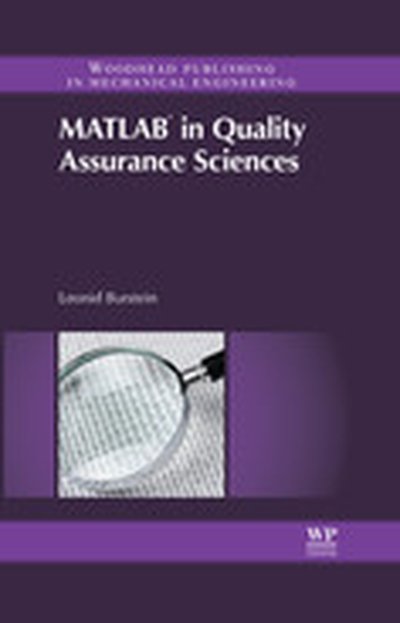
Matlab® in Quality Assurance Sciences

MATLAB® in Quality Assurance Sciences fills a gap in the highly topical field of quality assurance (QA). It is a compact guide for students, engineers, and scientists in this field. It concentrates on MATLAB® fundamentals with examples of application to a wide range of current problems from general, nano and bio-technology, and statistical control, to medicine and industrial management. Examples cover both the school and advanced level; comprising calculations of total quality management, six sigma, time series, process improvement, metrology, quality control, human factors in quality assurance, measurement and testing techniques, quality project and function management, and customer satisfaction. This book covers key topics, including: the basics of software with examples; graphics and representations; numerical computation, scripts and functions for QA calculations; ODE and PDEPE solvers applied to QA problems; curve fitting and time series tool interfaces in calculations of quality; and statistics calculations applied to quality testing. Includes MATLAB® fundamentals, matrices, arrays, general graphics and specialized plots in quality assurance problems, script files, ordinary and partial differential equations Gives calculation of six sigma, total quality management, time series forecasting, reliability, process improvement, metrology, quality control and assurance, measurement and testing techniques Provides tools for graphical presentation, basic and special statistics and testing, ordinary and partial differential solvers, and fitting tools

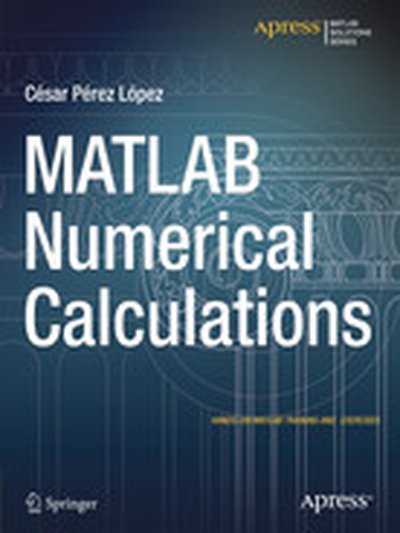
MATLAB Numerical Calculations

MATLAB is a high-level language and environment for numerical computation, visualization, and programming. Using MATLAB, you can analyze data, develop algorithms, and create models and applications. The language, tools, and built-in math functions enable you to explore multiple approaches and reach a solution faster than with spreadsheets or traditional programming languages, such as C/C++ or Java. This book is designed for use as a scientific/business calculator so that you can get numerical solutions to problems involving a wide array of mathematics using MATLAB. Just look up the function you want in the book and you are ready to use it in MATLAB or use the book to learn about the enormous range of options that MATLAB offers. MATLAB Numerical Calculations focuses on MATLAB capabilities to give you numerical solutions to problems you are likely to encounter in your professional or scholastic life. It introduces you to the MATLAB language with practical hands-on instructions and results, allowing you to quickly achieve your goals. Starting with a look at basic MATLAB functionality with integers, rational numbers and real and complex numbers, and MATLAB's relationship with Maple, you will learn how to solve equations in MATLAB, and how to simplify the results. You will see how MATLAB incorporates vector, matrix and character variables, and functions thereof. MATLAB is a powerful tool used to defined, manipulate and simplify complex algebraic expressions. With MATLAB you can also work with ease in matrix algebra, making use of commands which allow you to find eigenvalues, eigenvectors, determinants, norms and various matrix decompositions, among many other features. Lastly, you will see how you can write scripts and use MATLAB to explore numerical analysis, finding approximations of integrals, derivatives and numerical solutions of differential equations.

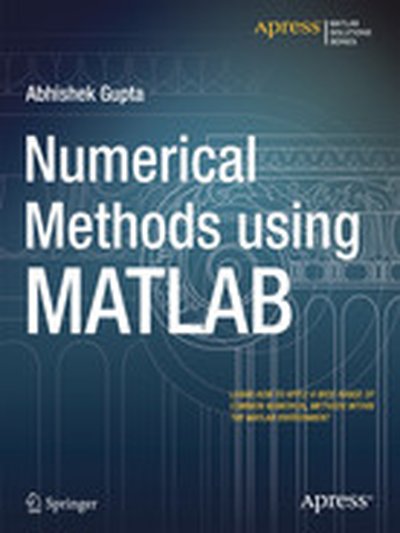
Numerical Methods using MATLAB

Numerical Methods with MATLAB provides a highly-practical reference work to assist anyone working with numerical methods. A wide range of techniques are introduced, their merits discussed and fully working MATLAB code samples supplied to demonstrate how they can be coded and applied. Numerical methods have wide applicability across many scientific, mathematical, and engineering disciplines and are most often employed in situations where working out an exact answer to the problem by another method is impractical. Numerical Methods with MATLAB presents each topic in a concise and readable format to help you learn fast and effectively. It is not intended to be a reference work to the conceptual theory that underpins the numerical methods themselves. A wide range of reference works are readily available to supply this information. If, however, you want assistance in applying numerical methods then this is the book for you.

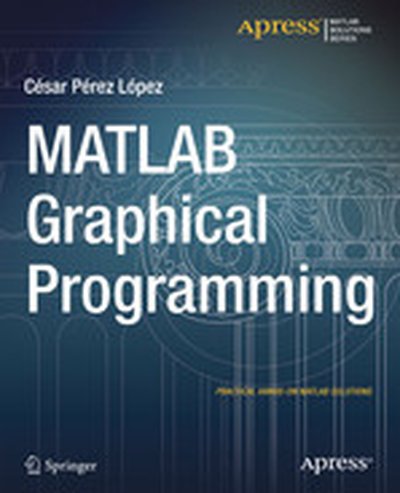
MATLAB Graphical Programming

MATLAB enables you to work with its graphics capabilities in almost all areas of the experimental sciences and engineering. The commands that MATLAB implements in job related graphics are quite useful and are very efficient. MATLAB has functions for working with two-dimensional and three-dimensional graphics, statistical graphs, curves and surfaces in explicit, implicit, parametric and polar coordinates. It also works perfectly with twisted curves, surfaces, volumes and graphical interpolation. MATLAB Graphical Programming addresses all these issues by developing the following topics:This book is a reference designed to give you a simple syntax example of the commands and to graph it so that you can see the result for: Two dimensional graphics Statistical graphics Curves in explicit coordinates Curves in parametric coordinates Curves in polar coordinates Logarithmic and semi-logarithmic plots Bar graphs and histograms sectors Three-dimensional graphics Twisted curves and surfaces Graphs of surfaces, meshes and contours Graphs of surfaces in explicit coordinates parametric surfaces Viewing volumes and specialized graphics Special commands for graphics

Learning R for Geospatial Analysis

Learn how to leverage the power of R for geospatial analysis in this comprehensive guide. Whether you're processing spatial datasets, creating publication-quality maps, or performing GIS operations, this book covers the necessary tools and techniques for effective analysis, without requiring prior programming knowledge. What this Book will help me do Discover how to manipulate and analyze geospatial data effectively using R. Gain proficiency in loading, reshaping, and visualizing spatial data. Master key concepts like spatial queries and overlays for GIS tasks. Learn to automate spatial data workflows using reproducible R scripts. Create high-quality visualizations and maps tailored to your datasets. Author(s) None Dorman, the author of this book, is an experienced data science educator and practitioner with a particular focus on geospatial data analysis in R. With years of teaching and applied geospatial research, Dorman brings expertise in making advanced topics approachable. Their practical approach ensures readers can immediately put concepts into practice. Who is it for? This book is ideal for GIS analysts, geospatial researchers, educators, and students looking to enhance their skillset with R programming. It's particularly suited for those familiar with geographic concepts like coordinates but new to programming or R. If you aim to efficiently analyze spatial data and produce professional-grade visualizations and GIS analyses, this book is for you.
MATLAB Mathematical Analysis

MATLAB Mathematical Analysis is a reference book that presents the techniques of mathematical analysis through examples and exercises resolved with MATLAB software. The purpose is to give you examples of the mathematical analysis functions offered by MATLAB so that you can use them in your daily work regardless of the application. The book supposes proper training in the mathematics and so presents the basic knowledge required to be able to use MATLAB for calculational or symbolic solutions to your problems for a vast amount of MATLAB functions. The book begins by introducing the reader to the use of numbers, operators, variables and functions in the MATLAB environment. Then it delves into working with complex variables. A large section is devoted to working with and developing graphical representations of curves, surfaces and volumes. MATLAB functions allow working with two-dimensional and three-dimensional graphics, statistical graphs, curves and surfaces in explicit, implicit, parametric and polar coordinates. Additional work implements twisted curves, surfaces, meshes, contours, volumes and graphical interpolation. The following part covers limits, functions, continuity and numerical and power series. Then differentiation is addressed in one and several variables including differential theorems for vector fields. Thereafter the topic of integration is handled including improper integrals, definite and indefinite integration, integration in multiple variables and multiple integrals and their applications. Differential equations are exemplified in detail, Laplace transforms, Tayor series, and the Runga-Kutta method and partial differential equations.

R Recipes: A Problem-Solution Approach

R Recipes is your handy problem-solution reference for learning and using the popular R programming language for statistics and other numerical analysis. Packed with hundreds of code and visual recipes, this book helps you to quickly learn the fundamentals and explore the frontiers of programming, analyzing and using R. R Recipes provides textual and visual recipes for easy and productive templates for use and re-use in your day-to-day R programming and data analysis practice. Whether you're in finance, cloud computing, big or small data analytics, or other applied computational and data science - R Recipes should be a staple for your code reference library.

MATLAB Symbolic Algebra and Calculus Tools

MATLAB is a high-level language and environment for numerical computation, visualization, and programming. Using MATLAB, you can analyze data, develop algorithms, and create models and applications. The language, tools, and built-in math functions enable you to explore multiple approaches and reach a solution faster than with spreadsheets or traditional programming languages, such as C/C++ or Java. MATLAB Symbolic Algebra and Calculus Tools introduces you to the MATLAB language with practical hands-on instructions and results, allowing you to quickly achieve your goals. Starting with a look at symbolic variables and functions, you will learn how to solve equations in MATLAB, both symbolically and numerically, and how to simplify the results. Extensive coverage of polynomial solutions, inequalities and systems of equations are covered in detail. You will see how MATLAB incorporates vector, matrix and character variables, and functions thereof. MATLAB is a powerful symbolic manipulator which enables you to factorize, expand and simplify complex algebraic expressions over all common fields (including over finite fields and algebraic field extensions of the rational numbers). With MATLAB you can also work with ease in matrix algebra, making use of commands which allow you to find eigenvalues, eigenvectors, determinants, norms and various matrix decompositions, among many other features. Lastly, you will see how you can use MATLAB to explore mathematical analysis, finding limits of sequences and functions, sums of series, integrals, derivatives and solving differential equation.

Accelerating MATLAB Performance

The MATLAB® programming environment is often perceived as a platform suitable for prototyping and modeling but not for "serious" applications. One of the main complaints is that MATLAB is just too slow. Accelerating MATLAB Performance aims to correct this perception by describing multiple ways to greatly improve MATLAB program speed. Packed with thousands of helpful tips, it leaves no stone unturned, discussing every aspect of MATLAB. Ideal for novices and professionals alike, the book describes MATLAB performance in a scale and depth never before published. It takes a comprehensive approach to MATLAB performance, illustrating numerous ways to attain the desired speedup. The book covers MATLAB, CPU, and memory profiling and discusses various tradeoffs in performance tuning. It describes both the application of standard industry techniques in MATLAB, as well as methods that are specific to MATLAB such as using different data types or built-in functions. The book covers MATLAB vectorization, parallelization (implicit and explicit), optimization, memory management, chunking, and caching. It explains MATLAB’s memory model and details how it can be leveraged. It describes the use of GPU, MEX, FPGA, and other forms of compiled code, as well as techniques for speeding up deployed applications. It details specific tips for MATLAB GUI, graphics, and I/O. It also reviews a wide variety of utilities, libraries, and toolboxes that can help to improve performance. Sufficient information is provided to allow readers to immediately apply the suggestions to their own MATLAB programs. Extensive references are also included to allow those who wish to expand the treatment of a particular topic to do so easily. Supported by an active website, and numerous code examples, the book will help readers rapidly attain significant reductions in development costs and program run times.

Optical Fiber Communication Systems with MATLAB® and Simulink® Models, 2nd Edition

Carefully structured to instill practical knowledge of fundamental issues, Optical Fiber Communication Systems with MATLABdescribes the modeling of optically amplified fiber communications systems using MATLAB ® and Simulink ® Models ® and Simulink ®. This lecture-based book focuses on concepts and interpretation, mathematical procedures, and engineering applications, shedding light on device behavior and dynamics through computer modeling. Supplying a deeper understanding of the current and future state of optical systems and networks, this Second Edition: Reflects the latest developments in optical fiber communications technology Includes new and updated case studies, examples, end-of-chapter problems, and MATLAB ® and Simulink ® models Emphasizes DSP-based coherent reception techniques essential to advancement in short- and long-term optical transmission networks Optical Fiber Communication Systems with MATLAB ® and Simulink ® Models, Second Edition is intended for use in university and professional training courses in the specialized field of optical communications. This text should also appeal to students of engineering and science who have already taken courses in electromagnetic theory, signal processing, and digital communications, as well as to optical engineers, designers, and practitioners in industry.

Multiple Factor Analysis by Example Using R

Multiple factor analysis (MFA) enables users to analyze tables of individuals and variables in which the variables are structured into quantitative, qualitative, or mixed groups. Written by the co-developer of the methodology, this book brings together the theoretical and methodological aspects of MFA. It also covers principal component analysis, multiple correspondence analysis, factor analysis for mixed data, hierarchical MFA, and more. The book also includes examples of applications and details on how to implement MFA using an R package, with the data and R scripts available online.

MATLAB For Dummies

Plot graphs, solve equations, and write code in a flash! If you work in a STEM field, chances are you'll be using MATLAB on a daily basis. MATLAB is a popular and powerful computational tool and this book provides everything you need to start manipulating and plotting your data. MATLAB has rapidly become the premier data tool, and MATLAB For Dummies is a comprehensive guide to the fundamentals. MATLAB For Dummies guides you through this complex computational language from installation to visualization to automation. Learn MATLAB's language fundamentals including syntax, operators, and data types Understand how to use the most important window in MATLAB - the Command Window Get the basics of linear algebra to get up and running with vectors, matrices, and hyperspace Automate your work with programming scripts and functions Plot graphs in 2D and 3D to visualize your data Includes a handy guide for MATLAB's functions and plotting routines MATLAB is an essential part of the analysis arsenal and MATLAB For Dummies provides clear, thorough guidance to get the most out of your data.