talk-data.com talk-data.com

Topic

jvm-languages

4

tagged

Activity Trend

1 peak/qtr
2020-Q1 2026-Q1

Activities

4 activities · Newest first

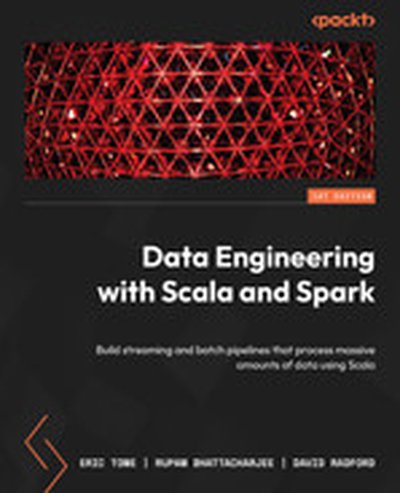
Data Engineering with Scala and Spark

Data Engineering with Scala and Spark guides you through building robust data pipelines that process massive datasets efficiently. You will learn practical techniques leveraging Scala and Spark with a hands-on approach to mastering data engineering tasks including ingestion, transformation, and orchestration. What this Book will help me do Set up a data pipeline development environment using Scala Utilize Spark APIs like DataFrame and Dataset for effective data processing Implement CI/CD and testing strategies for pipeline maintainability Optimize pipeline performance through tuning techniques Apply data profiling and quality enforcement using tools like Deequ Author(s) Eric Tome, Rupam Bhattacharjee, and David Radford bring decades of combined experience in data engineering and distributed systems. Their work spans cutting-edge data processing solutions using Scala and Spark. They aim to help professionals excel in building reliable, scalable pipelines. Who is it for? This book is tailored for working data engineers familiar with data workflow processes who desire to enhance their expertise in Scala and Spark. If you aspire to build scalable, high-performance data solutions or transition raw data into strategic assets, this book is ideal.

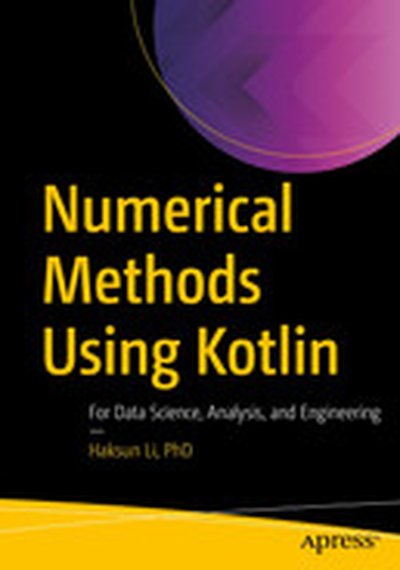
Numerical Methods Using Kotlin: For Data Science, Analysis, and Engineering

This in-depth guide covers a wide range of topics, including chapters on linear algebra, root finding, curve fitting, differentiation and integration, solving differential equations, random numbers and simulation, a whole suite of unconstrained and constrained optimization algorithms, statistics, regression and time series analysis. The mathematical concepts behind the algorithms are clearly explained, with plenty of code examples and illustrations to help even beginners get started. In this book, you'll implement numerical algorithms in Kotlin using NM Dev, an object-oriented and high-performance programming library for applied and industrial mathematics. Discover how Kotlin has many advantages over Java in its speed, and in some cases, ease of use. In this book, you’ll see how it can help you easily create solutions for your complex engineering and data science problems. After reading this book, you'll come away with the knowledge to create your own numerical models and algorithms using the Kotlin programming language. What You Will Learn Program in Kotlin using a high-performance numerical library Learn the mathematics necessary for a wide range of numerical computing algorithms Convert ideas and equations into code Put together algorithms and classes to build your own engineering solutions Build solvers for industrial optimization problems Perform data analysis using basic and advanced statistics Who This Book Is For Programmers, data scientists, and analysts with prior experience programming in any language, especially Kotlin or Java.

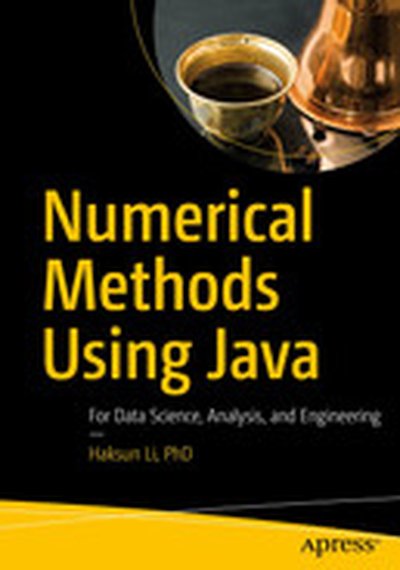
Numerical Methods Using Java: For Data Science, Analysis, and Engineering

Implement numerical algorithms in Java using NM Dev, an object-oriented and high-performance programming library for mathematics.You’ll see how it can help you easily create a solution for your complex engineering problem by quickly putting together classes. Numerical Methods Using Java covers a wide range of topics, including chapters on linear algebra, root finding, curve fitting, differentiation and integration, solving differential equations, random numbers and simulation, a whole suite of unconstrained and constrained optimization algorithms, statistics, regression and time series analysis. The mathematical concepts behind the algorithms are clearly explained, with plenty of code examples and illustrations to help even beginners get started. What You Will Learn Program in Java using a high-performance numerical library Learn the mathematics for a wide range of numerical computing algorithms Convert ideas and equations into code Put together algorithms and classes to build your own engineering solution Build solvers for industrial optimization problems Do data analysis using basic and advanced statistics Who This Book Is For Programmers, data scientists, and analysts with prior experience with programming in any language, especially Java.

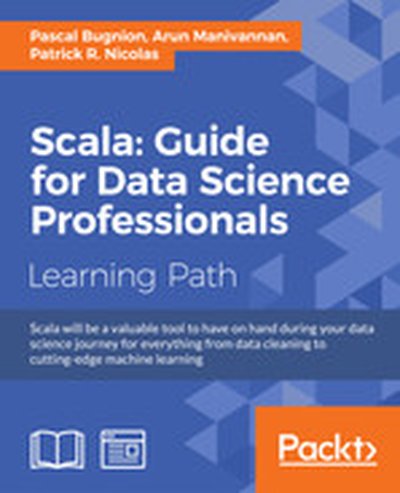
Scala: Guide for Data Science Professionals

Scala will be a valuable tool to have on hand during your data science journey for everything from data cleaning to cutting-edge machine learning About This Book Build data science and data engineering solutions with ease An in-depth look at each stage of the data analysis process — from reading and collecting data to distributed analytics Explore a broad variety of data processing, machine learning, and genetic algorithms through diagrams, mathematical formulations, and source code Who This Book Is For This learning path is perfect for those who are comfortable with Scala programming and now want to enter the field of data science. Some knowledge of statistics is expected. What You Will Learn Transfer and filter tabular data to extract features for machine learning Read, clean, transform, and write data to both SQL and NoSQL databases Create Scala web applications that couple with JavaScript libraries such as D3 to create compelling interactive visualizations Load data from HDFS and HIVE with ease Run streaming and graph analytics in Spark for exploratory analysis Bundle and scale up Spark jobs by deploying them into a variety of cluster managers Build dynamic workflows for scientific computing Leverage open source libraries to extract patterns from time series Master probabilistic models for sequential data In Detail Scala is especially good for analyzing large sets of data as the scale of the task doesn’t have any significant impact on performance. Scala’s powerful functional libraries can interact with databases and build scalable frameworks — resulting in the creation of robust data pipelines. The first module introduces you to Scala libraries to ingest, store, manipulate, process, and visualize data. Using real world examples, you will learn how to design scalable architecture to process and model data — starting from simple concurrency constructs and progressing to actor systems and Apache Spark. After this, you will also learn how to build interactive visualizations with web frameworks. Once you have become familiar with all the tasks involved in data science, you will explore data analytics with Scala in the second module. You’ll see how Scala can be used to make sense of data through easy to follow recipes. You will learn about Bokeh bindings for exploratory data analysis and quintessential machine learning with algorithms with Spark ML library. You’ll get a sufficient understanding of Spark streaming, machine learning for streaming data, and Spark graphX. Armed with a firm understanding of data analysis, you will be ready to explore the most cutting-edge aspect of data science — machine learning. The final module teaches you the A to Z of machine learning with Scala. You’ll explore Scala for dependency injections and implicits, which are used to write machine learning algorithms. You’ll also explore machine learning topics such as clustering, dimentionality reduction, Naïve Bayes, Regression models, SVMs, neural networks, and more. This learning path combines some of the best that Packt has to offer into one complete, curated package. It includes content from the following Packt products: Scala for Data Science, Pascal Bugnion Scala Data Analysis Cookbook, Arun Manivannan Scala for Machine Learning, Patrick R. Nicolas Style and approach A complete package with all the information necessary to start building useful data engineering and data science solutions straight away. It contains a diverse set of recipes that cover the full spectrum of interesting data analysis tasks and will help you revolutionize your data analysis skills using Scala. Downloading the example code for this book. You can download the example code files for all Packt books you have purchased from your account at http://www.PacktPub.com. If you purchased this book elsewhere, you can visit http://www.PacktPub.com/support and register to have the code file.