talk-data.com talk-data.com

Topic

Linux

operating_system open_source unix_like

200

tagged

Activity Trend

20 peak/qtr
2020-Q1 2026-Q1

Activities

Showing filtered results

Filtering by: O'Reilly Data Engineering Books ×
Linux on IBM eServer zSeries and S/390: Performance Toolkit for VM

This IBM Redbooks publication discusses Performance Toolkit for VM, a performance monitoring and analysis tool for z/VM. Derived from the earlier FCON/ESA product, Performance Toolkit for VM enables system administrators to collect and analyze VM performance data. Both real-time and history data can be processed by Performance Toolkit for VM, and it provides most of the functions that are available in Real Time Monitor (RTM) and Performance Reporting Facility (PRF). In this book, we present an overview of the functions and features of Performance Toolkit for VM. We show how to navigate through its major monitoring screens and configure it. We also describe configuration for monitoring remote z/VM systems. Using examples, we illustrate how to monitor your z/VM system to identify potential performance problems. Major performance factors for running Linux guests under z/VM are discussed.

Understanding the IBM TotalStorage Open Software Family

This IBM Redbooks publication describes and explains the features and functions of the IBM TotalStorage Open Software Family, which is designed to help you simplify your storage infrastructure, optimize storage utilization, and adapt quickly and dynamically to the on demand world. The book introduces storage virtualization, on-demand solutions, and storage management software by explaining the concepts, architecture, and systems management features of the IBM TotalStorage Open Software Family and showing available complementary products. It will help you design solutions to protect data holdings from losses ranging from those caused by user error to complete site disasters. This easy-to-follow guide gives a broad understanding of the IBM TotalStorage Open Software Family software, the key technologies to know, and the solutions available to protect your business. It offers understanding of how the IBM TotalStorage Open Software Family solutions will work in heterogeneous environments including Windows, UNIX/AIX/Linux, OS/400, and z/OS platforms, and with such mission-critical applications as DB/2, Oracle, Lotus Domino, Exchange, mySAP.com, and many more.

DB2 for Linux on iSeries: Implementation Guide

This IBM Redbooks publication discusses DB2 UDB for Linux on iSeries. We provide the installation and configuration steps for DB2 UDB for Linux on iSeries. We also present connectivity scenarios between OS/400 resources and Linux resources. With V8.1, DB2 UDB for Linux is available for running in a Linux partition on an IBM eServer iSeries system. Linux is one of the fastest growing operating systems in the industry today. Linux is quickly becoming a key enabler for e-business applications that are demanding more robust local database capabilities. Applications running in the Linux partition can certainly leverage DB2 UDB for iSeries through a variety of interfaces (DB2 Connect, JDBC, ODBC), and this is an excellent choice to leverage the low administration overhead, autonomic computing, and security benefits provided by DB2’s tight integration with OS/400. DB2 for Linux is an excellent choice to support Linux (or other client/server) applications when there is a need to have local data storage within the Linux application environment or to leverage specific features of DB2 UDB V8 such as Federated Database or Microsoft .NET Framework support.

Sams Teach Yourself PHP, MySQL® and Apache All in One

A new edition of the best selling book that covers three popular open-source tools in one complete Starter Kit package. Revised and updated to reflect major changes in new versions of PHP, MySQL, and PHP 5. Carefully steps the reader through the basic set up of PHP, MySQL, and Apache, and shows how to combine these technologies to quickly create simple interactive Web applications. CD-ROM allows the reader to install a safe, foolproof learning environment for either a Windows or Linux-based PC.

Deploying Linux on IBM eServer pSeries Clusters

System installation and administration Application case studies Cluster management For customers interested in Linux who need powerful and reliable servers to support their applications, IBM eServer pSeries offers 64-bit POWER servers to match their requirements at lower costs. Unlike other servers supporting solely high performance Linux needs, IBM eServer pSeries provides leadership price/performance with high reliability and a roadmap to provide the customer with investment protection. This IBM Redbook provides information and guidelines for how to deploy Linux on IBM eServer pSeries clusters. Topics covered include: System installation System administration Linux for pSeries RAS and problem determination Getting started with GPFS Cluster Systems Management (CSM) High Performance Computing case studies Commercial application case studies This redbook also includes hints and tips that illustrate particular observations discovered during the residency. Additional reference materials and Web sites have been included as well, to provide the reader with other sources of information necessary to implement Linux on pSeries clusters.

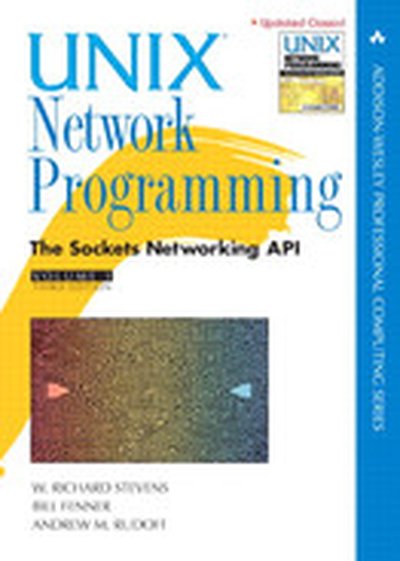
The Sockets Networking API: UNIX® Network Programming Volume 1, Third Edition

UNIX Network Programming, Volume 1: The Sockets Networking API, Third Edition "Everyone will want this book because it provides a great mix of practical experience, historical perspective, and a depth of understanding that only comes from being intimately involved in the field. I've already enjoyed and learned from reading this book, and surely you will too." --Sam Leffler The classic guide to UNIX networking APIs... now completely updated! To build today's highly distributed, networked applications and services, you need deep mastery of sockets and other key networking APIs. One book delivers comprehensive, start-to-finish guidance for building robust, high-performance networked systems in any environment: UNIX Network Programming, Volume 1, Third Edition. Building on the legendary work of W. Richard Stevens, this edition has been fully updated by two leading network programming experts to address today's most crucial standards, implementations, and techniques. New topics include: POSIX Single UNIX Specification Version 3 IPv6 APIs (including updated guidance on IPv6/IPv4 interoperability) The new SCTP transport protocol IPsec-based Key Management Sockets FreeBSD 4.8/5.1, Red Hat Linux 9.x, Solaris 9, AIX 5.x, HP-UX, and Mac OS X implementations New network program debugging techniques Source Specific Multicast API, the key enabler for widespread IP multicast deployment The authors also update and extend Stevens' definitive coverage of these crucial UNIX networking standards and techniques: TCP and UDP transport Sockets: elementary, advanced, routed, and raw I/O: multiplexing, advanced functions, nonblocking, and signal-driven Daemons and inetd UNIX domain protocols ioctl operations Broadcasting and multicasting Threads Streams Design: TCP iterative, concurrent, preforked, and prethreaded servers Since 1990, network programmers have turned to one source for the insights and techniques they need: W. Richard Stevens' UNIX Network Programming. Now, there's an edition specifically designed for today's challenges--and tomorrow's.

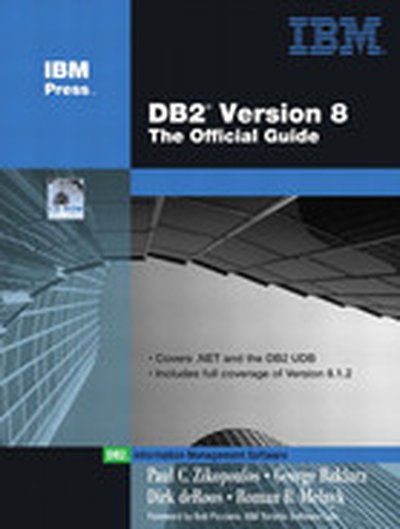
DB2® Version 8: The Official Guide

IBM DB2 Universal Database v8.1.2 will help you access any information, from any application, from anywhere in your organization, anytime—and do it all more easily and cost-effectively than you ever thought possible. Now, in DB2 Version 8: The Official Guide, a team of IBM DB2 experts shows experienced DB2 professionals exactly how to make the most of DB2 Version 8 in any environment—Linux®, UNIX®, or Windows®. The authors draw on extensive personal experience helping customers implement state-of-the-art DB2 solutions, and unparalleled access to the IBM DB2 development team. They offer detailed, never-before-published technical guidance for the key challenges you'll face in delivering high-performance DB2 databases, e-business infrastructure, and enterprise integration solutions. Coverage includes: Simplifying management with the Configuration Advisor, HealthCenter(, and Memory Visualizer Integrating the enterprise via Federated Web Services and the DB2 enhanced XML productivity tools Maximizing database scalability, availability, and robustness Using multidimensional data clustering and other integrated business intelligence tools Integrating with IBM WebSphere and Microsoft software development tools Leveraging key improvements in DB2 SQL functionality The accompanying CD-ROM contains a complete trial version of IBM® DB2® Universal Database Personal Edition Version 8.1, for Windows® Operating Environments, Evaluation Copy, plus the DB2 demonstration program for trying out the various SQL commands on your own machine. If you're an experienced DB2 professional who's ready to take DB2 Version 8 to the max, DB2 Version 8: The Official Guide is the book you've been searching for.

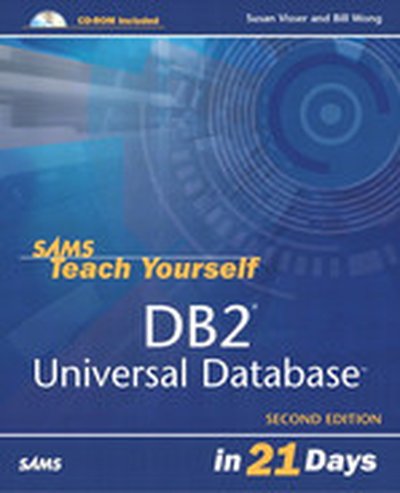
Sams Teach Yourself DB2® Universal Database™ in 21 Days, Second Edition

Marketshare for DB2 has been growing steadily over the past 5 years and with the recent release of DB2 Universal Database V8, the product has never had more momentum. Not only is the product used in every company on the Fortune 500, but it is becoming very popular in the small to medium sized businesses as well. Sams Teach Yourself DB2 Universal Database in 21 Days, Second Edition, focuses on performing tasks using the graphical interfaces and wizards that are provided with DB2 on the Windows platform. (DB2 also runs on z/OS, OS/400, AIX, Linux, HP-UX, and Sun Solaris.) Readers are guided through performing all the commonly used tasks to run DB2, including installing DB2, setting up DB2, creating databases and tables, populating the database with data, accessing the data, ensuring the database is tuned for performance. This book differs from the competition in that it provides examples and scenarios making it very easy for the reader to learn complicated tasks. It gives them everything they need for the commonly used tasks in a simple to understand manner. Quizzes and exercises strengthen the knowledge gained and ensure concepts are learned rather than memorized.

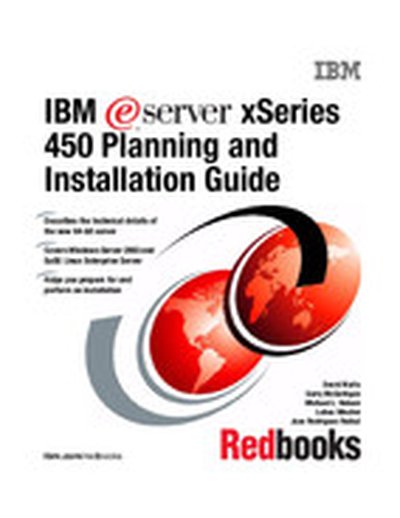
IBM eServer xSeries 450 Planning and Installation Guide

The IBM eServer xSeries 450 is IBM’s new 64-bit Itanium Processor Family (IPF) Architecture server and is the first implementation of the 64-bit IBM XA-64 chipset, as part of the Enterprise X-Architecture strategy. This IBM Redbooks publication is a comprehensive resource on the technical aspects of the server, and is divided into five key subject areas: Chapter 1, Technical description introduces the server and its subsystems and describes the key features and how they work. This includes the new Extensible Firmware Interface, which provides a powerful replacement to the BIOS facility found on the IA-32 platform. Chapter 2, Positioning examines the types of applications that would be used on a server such as the x450. Chapter 3, Planning describes the considerations when planning to purchase and planning to install the x450. It covers such topics as configuration, operating system specifics, scalability, and physical site planning. Chapter 4, Installation covers the process of installing Windows Server 2003, Enterprise Edition and SuSE Linux Enterprise Server on the x450. Chapter 5, Management describes how to use the Remote Supervisor Adapter to send alerts to an IBM Director management environment.

PostgreSQL

PostgreSQL is the world¿s most advanced open-source database. PostgreSQL is the most comprehensive, in-depth, and easy-to-read guide to this award-winning database. This book starts with a thorough overview of SQL, a description of all PostgreSQL data types, and a complete explanation of PostgreSQL commands. If you are a developer or an administrator, you¿ll love the chapter that explores PostgreSQL performance. The authors explain how PostgreSQL stores data on disk (and in memory) and how to measure and influence the effectiveness of PostgreSQL¿s caching mechanisms. You¿ll also learn how PostgreSQL generates and evaluates execution plans. The authors explain all of the query operators that can appear in the results of an EXPLAIN command, describing the performance implications of each operator as well as the conditions which will cause PostgreSQL to use that operator. PostgreSQL is also a complete guide for the developer. Whether you¿re developing with C, C++, ODBC, Embedded SQL, Java, Tcl/Tk, Perl, Python or PHP, you¿ll find a comprehensive description of the PostgreSQL API for your language of choice. Easy to follow exercises will walk you through the development of working applications that fully demonstrate the features offered by each API. You will also find a chapter that describes the PL/pgSQL server-side procedural language, learning how to build triggers, functions, and stored-procedures. The authors have even included a chapter that walks you through the process of extending the PostgreSQL server with custom-written C functions and new data types. The accompanying web site, www.conjectrix.com, contains downloadable versions of all of the sample code and a wealth of PostgreSQL-related resources. The last section of PostgreSQL was written for the PostgreSQL administrator. You will learn how to install PostgreSQL on Windows, Linux, and Unix systems, from source code or from pre-compiled installers. The authors have described all of the PostgreSQL configuration options (compile-time, startup, and on-the-fly). The chapter on PostgreSQL security describes all of the authentication protocols that you can choose from and describes how to secure your database, both internally and externally. If you have to support a multi-national environment, you will find the chapter on internationalization and localization to be invaluable. You won¿t find a more complete guide to PostgreSQL anywhere. The authors have made PostgreSQL approachable by leading the reader from basic concepts to advanced features. Whether you¿re a database beginner or an advanced user, you will find this book a valuable addition to your library.

Open Source Web Development with LAMP: Using Linux, Apache, MySQL, Perl, and PHP

Open Source technologies are providing contemporary developers with a range of cost-effective and robust alternatives to commercial software for building dynamic, data-driven Web applications. This practical guide presents a comprehensive survey of LAMP (Linux, Apache, MySQL, Perl, and PHP), and it shows how these solutions can be implemented efficiently and securely while improving reliability and dramatically cutting costs. focuses on the most important core material necessary so that developers can "hit the ground running" and begin building applications right away. This book presents a balanced overview of LAMP technologies and allows the reader to decide which tool may be appropriate for the particular task at hand. After a general overview of Open Source technologies, the book presents an overview of the Web before moving on to cover structural, static, dynamic, and embedded technologies. The coverage here provides a description of the strengths and weaknesses of each Open Source technology and also acts as a reference guide for each application. Open Source Web Development with LAMP Topics covered include: A comprehensive survey of Open Source technologies Static and dynamic data and embedded HTML on the Web Linux and Unix distributions, installations, and commands Apache Web Server, Perl, and MySQL Web site META language (WML) Common gateway interface (CGI) and mod_perl Server Side Includes (SSI), Embperl, and Mason PHP syntax and functions In addition to the discussions in the book, a companion Web site--www.opensourcewebbook.com--contains supplemental information, including tools, source code, helpful links to additional resources, and errata as needed. Complete in coverage and practical in presentation, spotlights the tools and technologies today's developers need to create workable, dynamic, and secure Web sites using Open Source technologies. Open Source Web Development with LAMP 020177061XB11072002

Sams Teach Yourself MySQL in 21 Days, Second Edition

MySQL is the most widely installed open-source database. Approximately 3.5 million MySQL servers are in use and more than 45% of databases used on Linux worldwide are MySQL databases. Its latest version, MySQL 4.1 closes the gap between MySQL and other, more sophisticated databases. Version 4.1 permits the use of MySQL as an embedded database, which means it can be compiled into another application and used in a range of devices. The second edition of Sams Teach Yourself MySQL in 21 Days has been completely rewritten by a new author. The book enables a reader to create powerful databases using MySQL. He willnot only learn how to integrate MySQL into a database-driven Web site, but also how to embed MySQL into other compiled applications.

Sams Teach Yourself PHP, MySQL™ and Apache in 24 Hours

Sams Teach Yourself PHP, MySQL, and Apache in 24 Hours combines coverage of three popular open-source Web development tools into one easy-to-understand book -- and it comes with one easy-to-use Starter Kit CD-ROM for Windows or Linux. You will learn to install, configure and set up the PHP scripting language, the MySQL database system and the Apache Web server. By the end of the book, you will understand how these technologies work, and -- more importantly -- how they can work together to create a dynamic Web site. After creating a simple website using these tools, you will be able to manage a simple mailing list and create an online address book, shopping cart and storefront. You will also know how to fine tune Apache and MySQL and cover simple Web server security.

MySQL Cookbook

While MySQL has turned up among high profile users such as Yahoo!, NASA and the U.S. Census Bureau, the rising popularity of this open source database is especially keen among users with little database experience. These days, even a small organization or web site has uses for a database, and MySQL is an obvious choice. Affordable and easy to use, MySQL packs the power, speed and efficiency that enable it to rival expensive, proprietary database solutions. Yet, even if you know the basics, anyone without practical MySQL experience--novices and skilled DBAs alike--might stumble over common database-related tasks. Fortunately, there's a sensible shortcut. MySQL Cookbook provides a unique problem-and-solution format that offers practical examples for everyday programming dilemmas. For every problem addressed in the book, there's a worked-out solution or "recipe"--short, focused pieces of code that you can insert directly into your applications. But MySQL Cookbook is more than a collection of cut-and-paste code. You also get explanations of how and why the code works, so you can learn to adapt the techniques to similar situations. The book covers a lot of ground. Solutions for typical MySQL dilemmas range from simple ways to find all records that contain a given string, to more difficult problems, such as finding matching/non-matching records in two tables. Whether you use MySQL on Unix, Linux, Windows or the Mac OS X platform, the book will show you how to: Import data from external sources Export data for use by external programs Access MySQL from your web server Use scripts with MySQL to read queries from a file Access MySQL from within client programs that use Perl, PHP, Java, Python and other languages Construct queries that solve commonly-occurring questions Interact with the server This learn-as-you-go resource will help users of all levels exploit MySQL more fully. MySQL Cookbook supplies you with an armory of ready-made techniques for specific problems so that, even if you're an experienced MySQL user, you don't have to write everything from scratch.

Managing & Using MySQL, 2nd Edition

MySQL is a popular and robust open source database product that supports key subsets of SQL on both Linux and Unix systems. MySQL is free for nonprofit use and costs a small amount for commercial use. Unlike commercial databases, MySQL is affordable and easy to use. This book includes introductions to SQL and to relational database theory. If you plan to use MySQL to build web sites or other Linux or Unix applications, this book teaches you to do that, and it will remain useful as a reference once you understand the basics. Ample tutorial material and examples are included throughout. This book has all you need to take full advantage of this powerful database management system. It takes you through the whole process from installation and configuration to programming interfaces and database administration. This second edition has a greatly enhanced administration chapter that includes information on administrative tools, server configuration, server startup and shutdown, log file management, database backup and restore, and database administration and repair. In addition, a new chapter on security describes data, server, and client-server security, while a chapter on extending MySQL provides an overview of MySQL internals and describes the use of MySQL user-defined functions. If you know C/C++, Java, Perl, PHP, or Python, you can write programs to interact with your MySQL database. In addition, you can embed queries and updates directly in an HTML file so that a web page becomes its own interface to the database. Managing and Using MySQL includes chapters on the programming language interfaces, and it also includes a complete reference section with specific function calls for each language. Also included in the reference section are references to the SQL language, and details of the MySQL system variables, programs, and utilities. New to the second edition is a reference to the internal MySQL tables, which will be of particular interest to those who want to work extensively with MySQL security.

Web Services Essentials

As a developer new to Web Services, how do you make sense of thisemerging framework so you can start writing your own servicestoday? This concise book gives programmers both a concreteintroduction and a handy reference to XML web services, first byexplaining the foundations of this new breed of distributedservices, and then by demonstrating quick ways to create serviceswith open-source Java tools. Web Services make it possible fordiverse applications to discover each other and exchange dataseamlessly via the Internet. For instance, programs written in Javaand running on Solaris can find and call code written in C# thatrun on Windows XP, or programs written in Perl that run on Linux,without any concern about the details of how that service isimplemented. A common set of Web Services is at the core ofMicrosoft's new .NET strategy, Sun Microsystems's Sun One Platform,and the W3C's XML Protocol Activity Group. In this book, authorEthan Cerami explores four key emerging technologies: XML Remote Procedure Calls (XML-RPC) SOAP - The foundation for most commercial WebServices development Universal Discovery, Description and Integration(UDDI) Web Services Description Language (WSDL) For each of these topics, Web Services Essentials provides aquick overview, Java tutorials with sample code, samples of the XMLdocuments underlying the service, and explanations offreely-available Java APIs. Cerami also includes a guide to thecurrent state of Web Services, pointers to open-source tools and acomprehensive glossary of terms. If you want to break through theWeb Services hype and find useful information on these evolvingtechnologies, look no further than Web Services Essentials.

S/390 Partners in Development: ThinkPad Enabled for S/390

A ThinkPad Enabled for S/390, generally known as a ThinkPad/EFS system, is the smallest S/390 currently available, and is intended for development and demonstration purposes. It is based on an IBM ThinkPad running Linux, and the S/390 emulation product FLEX-ES. FLEX-ES is a product of Fundamental Software, Incorporated (FSI) of Fremont, California. This package (the ThinkPad, Linux, and FLEX-ES) can run all current S/390 operating systems. This IBM Redbooks publication introduces the ThinkPad/EFS system, describes the setup process of the system in some detail, and then describes the installation and use of an OS/390 package known as the OS/390 AD CD-ROM system. While this publication is primarily directed at members of the IBM S/390 Partners in Development program (also known as PartnerWorld), most of the content applies to any ThinkPad/EFS system.

Oracle and Open Source

Oracle & Open Source is the first book to tie together the commercial world of Oracle and the free-wheeling world of open source software. As this book reveals, these two worlds are not as far apart as they may seem. Today, there are many excellent and freely available software tools that Oracle developers and database administrators can use, at no cost, to improve their own coding productivity and their system's performance. Moreover, many of the finest Oracle developers are now making their source code freely available so their peers can build upon this code base. Oracle Corporation is even porting its RDBMS to Linux and starting to incorporate a growing number of open source tools in the company's own software. Oracle & Open Source describes close to 100 open source tools you can use for Oracle development and database administration, from large and widely known open source systems (like Linux, Perl, Apache, TCL/Tk and Python) to more Oracle-specific tools (like Orasoft, Orac, OracleTool, and OraSnap). You'll learn how to obtain the software and how to adapt it to best advantage. The book abounds with code examples, download and installation instructions, and helpful usage hints. Not only does it tell you how to find and use existing open source code; Oracle & Open Source gives you the details and the motivation to build your own open source contributions and release them to the Oracle community. You'll learn all about tools like the Oracle Call Interface (OCI) and Perl-DBI (Database Interface), which provide the glue allowing new open source tools to link into commercial Oracle software. With Oracle & Open Source as a guide, you'll discover an enormous number of highly effective open source tools, while getting involved with the thriving community of open source development.

XML Processing with Python

Breakthrough techniques for building XML applications — fast! Includes a detailed Python tutorial Learn about DOM and SAX application development with Python Exclusive coverage of the new Pyxie XML processing library CD-ROM includes Python and Pyxie distributions for Windows NT and Linux—plus powerful utilities and lots of working code "XML processing is the newest required skill for webmasters and application developers. The Python language and Sean McGrath's book make it fun to learn and easy to do." — Charles F. Goldfarb When it comes to XML processing, Python is in a league of its own. If you're doing XML development without Python, you're wasting time! Python offers outstanding productivity — especially in the areas that matter most to XML developers, such as XML parsing, DOM/SAX implementations, string processing, and Internet APIs. And now there's Pyxie — the new open source library that makes Python XML processing even easier and more powerful. In XML Processing with Python, top XML developer Sean McGrath delivers the hands-on explanations and examples you need to get results with Python and Pyxie fast — even if you've never used them before! Install Python and the Pyxie XML package Learn the fundamentals of Python: control structures, classes, nested lists, dictionaries, and regular rexpresions Process XML with regular expression-driven, event-driven, and tree-driven techniques Understand Python's support for DOM and SAX APIs Explore the power of Python/XML through worked examples of GUI development, database integration, and an XML query-by-example implementation. Elegant, easy, powerful and fun, Python helps you build world-class XML applications in less time than you ever imagined. If you know XML, one book has all the techniques, code, and tools you'll need to process it: XML Processing with Python. CD-ROM INCLUDED The accompanying CD-ROM contains everything you need to develop XML applications with Python — including complete Python distributions for Windows and Linux the Pyxie open-source libraries powerful utility programs an extensive library of sample source code tested on both Windows NT and Linux

MySQL and mSQL

MySQL and mSQL are popular and robust database products that support key subsets of SQL on both Linux and Unix systems. Both products are free for nonprofit use and cost a small amount for commercial use. Even a small organization or web site has uses for a database. Perhaps you keep track of all your customers and find that your information is outgrowing the crude, flat-file format you started with. Or you want to ask your web site's visitors for their interests and preferences and put up a fresh web page that tallies the results. Unlike commercial databases, MySQL and mSQL are affordable and easy to use. If you know basic C, Java, Perl, or Python, you can quickly write a program to interact with your database. In addition, you can embed queries and updates right in an HTML file so that a web page becomes its own interface to the database. This book is all you need to make use of MySQL or mSQL. It takes you through the whole process from installation and configuration to programming interfaces and basic administration. Includes reference chapters and ample tutorial material. Topics include: Introductions to simple database design and SQL Building, installation, and configuration Basic programming APIs for C, C++, Java (JDBC), Perl, and Python CGI programming with databases in C and Perl Web interfaces: PHP, W3-mSQL, Lite, and mSQLPerl