talk-data.com talk-data.com

Topic

Monte Carlo

data_observability data_reliability data_quality

106

tagged

Activity Trend

12 peak/qtr
2020-Q1 2026-Q1

Activities

106 activities · Newest first

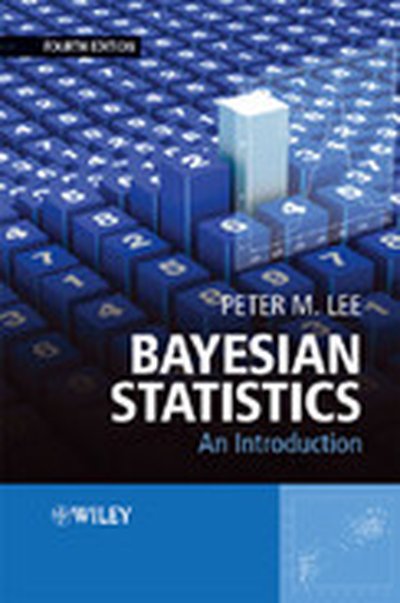
Bayesian Statistics: An Introduction, 4th Edition

Bayesian Statistics is the school of thought that combines prior beliefs with the likelihood of a hypothesis to arrive at posterior beliefs. The first edition of Peter Lee's book appeared in 1989, but the subject has moved ever onwards, with increasing emphasis on Monte Carlo based techniques. This new fourth edition looks at recent techniques such as variational methods, Bayesian importance sampling, approximate Bayesian computation and Reversible Jump Markov Chain Monte Carlo (RJMCMC), providing a concise account of the way in which the Bayesian approach to statistics develops as well as how it contrasts with the conventional approach. The theory is built up step by step, and important notions such as sufficiency are brought out of a discussion of the salient features of specific examples. This edition: Includes expanded coverage of Gibbs sampling, including more numerical examples and treatments of OpenBUGS, R2WinBUGS and R2OpenBUGS. Presents significant new material on recent techniques such as Bayesian importance sampling, variational Bayes, Approximate Bayesian Computation (ABC) and Reversible Jump Markov Chain Monte Carlo (RJMCMC). Provides extensive examples throughout the book to complement the theory presented. Accompanied by a supporting website featuring new material and solutions. More and more students are realizing that they need to learn Bayesian statistics to meet their academic and professional goals. This book is best suited for use as a main text in courses on Bayesian statistics for third and fourth year undergraduates and postgraduate students.
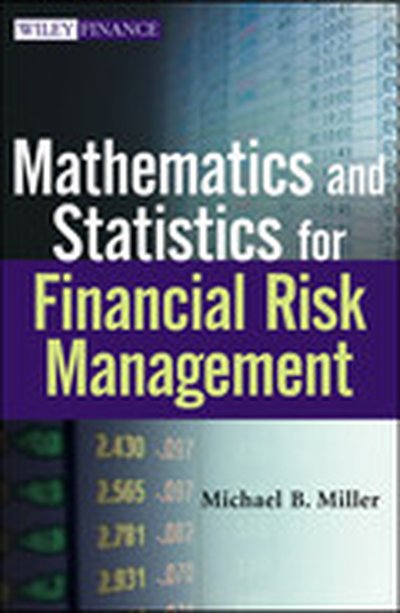
Mathematics and Statistics for Financial Risk Management

Mathematics and Statistics for Financial Risk Management is a practical guide to modern financial risk management for both practitioners and academics. The recent financial crisis and its impact on the broader economy underscore the importance of financial risk management in today's world. At the same time, financial products and investment strategies are becoming increasingly complex. Today, it is more important than ever that risk managers possess a sound understanding of mathematics and statistics. In a concise and easy-to-read style, each chapter of this book introduces a different topic in mathematics or statistics. As different techniques are introduced, sample problems and application sections demonstrate how these techniques can be applied to actual risk management problems. Exercises at the end of each chapter and the accompanying solutions at the end of the book allow readers to practice the techniques they are learning and monitor their progress. A companion website includes interactive Excel spreadsheet examples and templates. This comprehensive resource covers basic statistical concepts from volatility and Bayes' Law to regression analysis and hypothesis testing. Widely used risk models, including Value-at-Risk, factor analysis, Monte Carlo simulations, and stress testing are also explored. A chapter on time series analysis introduces interest rate modeling, GARCH, and jump-diffusion models. Bond pricing, portfolio credit risk, optimal hedging, and many other financial risk topics are covered as well. If you're looking for a book that will help you understand the mathematics and statistics of financial risk management, look no further.

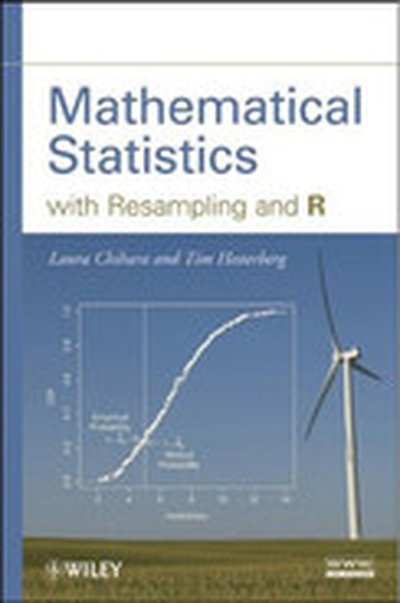
Mathematical Statistics with Resampling and R

This book bridges the latest software applications with the benefits of modern resampling techniques Resampling helps students understand the meaning of sampling distributions, sampling variability, P-values, hypothesis tests, and confidence intervals. This groundbreaking book shows how to apply modern resampling techniques to mathematical statistics. Extensively class-tested to ensure an accessible presentation, Mathematical Statistics with Resampling and R utilizes the powerful and flexible computer language R to underscore the significance and benefits of modern resampling techniques. The book begins by introducing permutation tests and bootstrap methods, motivating classical inference methods. Striking a balance between theory, computing, and applications, the authors explore additional topics such as: Exploratory data analysis Calculation of sampling distributions The Central Limit Theorem Monte Carlo sampling Maximum likelihood estimation and properties of estimators Confidence intervals and hypothesis tests Regression Bayesian methods Throughout the book, case studies on diverse subjects such as flight delays, birth weights of babies, and telephone company repair times illustrate the relevance of the real-world applications of the discussed material. Key definitions and theorems of important probability distributions are collected at the end of the book, and a related website is also available, featuring additional material including data sets, R scripts, and helpful teaching hints. Mathematical Statistics with Resampling and R is an excellent book for courses on mathematical statistics at the upper-undergraduate and graduate levels. It also serves as a valuable reference for applied statisticians working in the areas of business, economics, biostatistics, and public health who utilize resampling methods in their everyday work.

Matlab® in Bioscience and Biotechnology

MATLAB® in bioscience and biotechnology presents an introductory Matlab course oriented towards various collaborative areas of biotechnology and bioscience. It concentrates on Matlab fundamentals and gives examples of its application to a wide range of current bioengineering problems in computational biology, molecular biology, bio-kinetics, biomedicine, bioinformatics, and biotechnology. In the last decade Matlab has been presented to students as the first computer program they learn. Consequently, many non-programmer students, engineers and scientists have come to regard it as user-friendly and highly convenient in solving their specific problems. Numerous books are available on programming in Matlab for engineers in general, irrespective of their specialization, or for those specializing in some specific area, but none have been designed especially for such a wide, interdisciplinary, and topical area as bioengineering. Thus, in this book, Matlab is presented with examples and applications to various school-level and advanced bioengineering problems - from growing populations of microorganisms and population dynamics, reaction kinetics and reagent concentrations, predator-prey models, mass-transfer and flow problems, to sequence analysis and sequence statistics. This is the first book intended as a manual introducing biologists and other biotechnology engineers to work with Matlab It is suitable for beginners and inexperienced users; however, applications of Matlab to advanced problems such as the Monte Carlo method, curve fitting, and reliable machine diagnostics make the book relevant to university teachers as well The book is different in that it assumes a modest mathematical background for the reader and introduces the mathematical or technical concepts with a somewhat traditional approach; Matlab is then used as a tool for subsequent computer solution

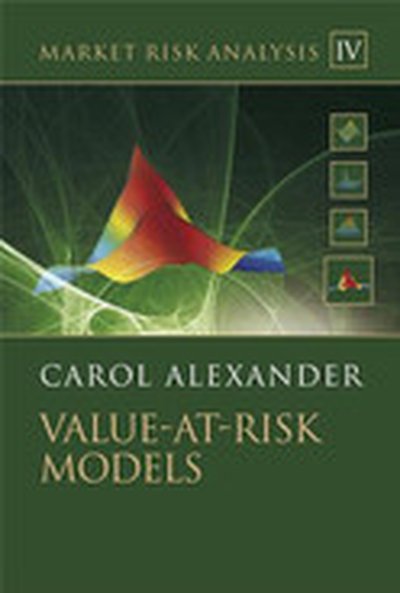
Market Risk Analysis Volume IV: Value-at-Risk Models

Written by leading market risk academic, Professor Carol Alexander, Value-at-Risk Models forms part four of the Market Risk Analysis four volume set. Building on the three previous volumes this book provides by far the most comprehensive, rigorous and detailed treatment of market VaR models. It rests on the basic knowledge of financial mathematics and statistics gained from Volume I, of factor models, principal component analysis, statistical models of volatility and correlation and copulas from Volume II and, from Volume III, knowledge of pricing and hedging financial instruments and of mapping portfolios of similar instruments to risk factors. A unifying characteristic of the series is the pedagogical approach to practical examples that are relevant to market risk analysis in practice. All together, the Market Risk Analysis four volume set illustrates virtually every concept or formula with a practical, numerical example or a longer, empirical case study. Across all four volumes there are approximately 300 numerical and empirical examples, 400 graphs and figures and 30 case studies many of which are contained in interactive Excel spreadsheets available from the the accompanying CD-ROM . Empirical examples and case studies specific to this volume include: Parametric linear value at risk (VaR)models: normal, Student t and normal mixture and their expected tail loss (ETL); New formulae for VaR based on autocorrelated returns; Historical simulation VaR models: how to scale historical VaR and volatility adjusted historical VaR; Monte Carlo simulation VaR models based on multivariate normal and Student t distributions, and based on copulas; Examples and case studies of numerous applications to interest rate sensitive, equity, commodity and international portfolios; Decomposition of systematic VaR of large portfolios into standard alone and marginal VaR components; Backtesting and the assessment of risk model risk; Hypothetical factor push and historical stress tests, and stress testing based on VaR and ETL. "The ebook version does not provide access to the companion files".

With thousands of new AI papers published monthly, many are quickly set aside and never advance beyond the labs where they originated, while others gain significant recognition and are cited extensively. Meanwhile, classic approaches like graph theory, Monte Carlo methods, ranking and search algorithms remain integral to AI solutions deployed in real-world applications every day. In this talk we will try to identify ideas from the world of GenAI that will have the most profound impact on enterprises and our daily lives.