talk-data.com talk-data.com

Topic

RAG

Retrieval Augmented Generation (RAG)

ai machine_learning llm

7

tagged

Activity Trend

83 peak/qtr
2020-Q1 2026-Q1

Activities

Showing filtered results

Filtering by: O'Reilly AI & ML Books ×
Generative AI on Microsoft Azure

Companies are now moving generative AI projects from the lab to production environments. To support these increasingly sophisticated applications, they're turning to advanced practices such as multiagent architectures and complex code-based frameworks. This practical handbook shows you how to leverage cutting-edge techniques using Microsoft's powerful ecosystem of tools to deploy trustworthy AI systems tailored to your organization's needs. Written for and by AI professionals, Generative AI on Microsoft Azure goes beyond the technical core aspects, examining underlying principles, tools, and practices in depth, from the art of prompt engineering to strategies for fine-tuning models to advanced techniques like retrieval-augmented generation (RAG) and agentic AI. Through real-world case studies and insights from top experts, you'll learn how to harness AI's full potential on Azure, paving the way for groundbreaking solutions and sustainable success in today's AI-driven landscape. Understand the technical foundations of generative AI and how the technology has evolved over the last few years Implement advanced GenAI applications using Microsoft services like Azure AI Foundry, Copilot, GitHub Models, Azure Databricks, and Snowflake on Azure Leverage patterns, tools, frameworks, and platforms to customize AI projects Manage, govern, and secure your AI-enabled systems with responsible AI practices Build upon expert guidance to avoid common pitfalls, future-proof your applications, and more
Building Agentic AI: Workflows, Fine-Tuning, Optimization, and Deployment

Transform Your Business with Intelligent AI to Drive Outcomes Building reactive AI applications and chatbots is no longer enough. The competitive advantage belongs to those who can build AI that can respond, reason, plan, and execute. Building Agentic AI: Workflows, Fine-Tuning, Optimization, and Deployment takes you beyond basic chatbots to create fully functional, autonomous agents that automate real workflows, enhance human decision-making, and drive measurable business outcomes across high-impact domains like customer support, finance, and research. Whether you're a developer deploying your first model, a data scientist exploring multi-agent systems and distilled LLMs, or a product manager integrating AI workflows and embedding models, this practical handbook provides tried and tested blueprints for building production-ready systems. Harness the power of reasoning models for applications like computer use, multimodal systems to work with all kinds of data, and fine-tuning techniques to get the most out of AI. Learn to test, monitor, and optimize agentic systems to keep them reliable and cost-effective at enterprise scale. Master the complete agentic AI pipeline Design adaptive AI agents with memory, tool use, and collaborative reasoning capabilities Build robust RAG workflows using embeddings, vector databases, and LangGraph state management Implement comprehensive evaluation frameworks beyond accuracy, including precision, recall, and latency metrics Deploy multimodal AI systems that seamlessly integrate text, vision, audio, and code generation Optimize models for production through fine-tuning, quantization, and speculative decoding techniques Navigate the bleeding edge of reasoning LLMs and computer-use capabilities Balance cost, speed, accuracy, and privacy in real-world deployment scenarios Create hybrid architectures that combine multiple agents for complex enterprise applications Register your book for convenient access to downloads, updates, and/or corrections as they become available. See inside book for details.

Building Machine Learning Systems with a Feature Store

Get up to speed on a new unified approach to building machine learning (ML) systems with a feature store. Using this practical book, data scientists and ML engineers will learn in detail how to develop and operate batch, real-time, and agentic ML systems. Author Jim Dowling introduces fundamental principles and practices for developing, testing, and operating ML and AI systems at scale. You'll see how any AI system can be decomposed into independent feature, training, and inference pipelines connected by a shared data layer. Through example ML systems, you'll tackle the hardest part of ML systems--the data, learning how to transform data into features and embeddings, and how to design a data model for AI. Develop batch ML systems at any scale Develop real-time ML systems by shifting left or shifting right feature computation Develop agentic ML systems that use LLMs, tools, and retrieval-augmented generation Understand and apply MLOps principles when developing and operating ML systems

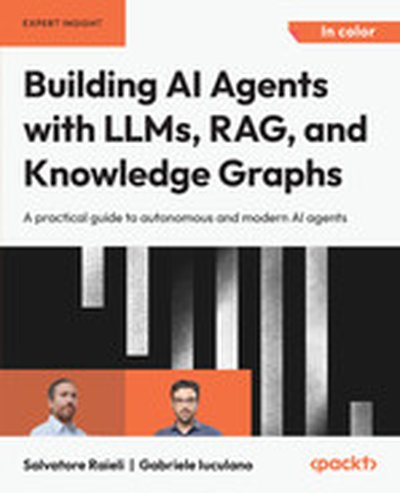
Building AI Agents with LLMs, RAG, and Knowledge Graphs

This book provides a comprehensive and practical guide to creating cutting-edge AI agents combining advanced technologies such as LLMs, retrieval-augmented generation (RAG), and knowledge graphs. By reading this book, you'll gain a deep understanding of how to design and build AI agents capable of real-world problem solving, reasoning, and action execution. What this Book will help me do Understand the foundations of LLMs, RAG, and knowledge graphs, and how they can be combined to build effective AI agents. Learn techniques to enhance factual accuracy and grounding through RAG pipelines and knowledge graphs. Develop AI agents that integrate planning, reasoning, and live tool usage to solve complex problems. Master the use of Python and popular AI libraries to build scalable AI agent applications. Acquire strategies for deploying and monitoring AI agents in production for reliable operation. Author(s) This book is written by Salvatore Raieli and Gabriele Iuculano, accomplished experts in artificial intelligence and machine learning. Both authors bring extensive professional experience from their work in AI-related fields, particularly in applying innovative AI methods to solve challenging problems. Through their clear and approachable writing style, they aim to make advanced AI concepts accessible to readers at various levels. Who is it for? This book is ideally suited for data scientists, AI practitioners, and technology enthusiasts seeking to deepen their knowledge in building intelligent AI agents. It is perfect for those who already have a foundational understanding of Python and general artificial intelligence concepts. Experienced professionals looking to explore state-of-the-art AI solutions, as well as beginners eager to advance their technical skills, will find this book invaluable.

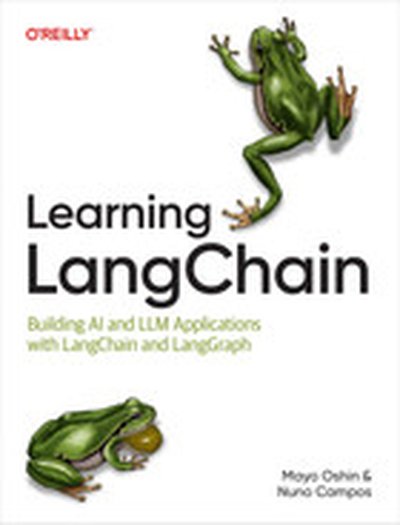
Learning LangChain

If you're looking to build production-ready AI applications that can reason and retrieve external data for context-awareness, you'll need to master--;a popular development framework and platform for building, running, and managing agentic applications. LangChain is used by several leading companies, including Zapier, Replit, Databricks, and many more. This guide is an indispensable resource for developers who understand Python or JavaScript but are beginners eager to harness the power of AI. Authors Mayo Oshin and Nuno Campos demystify the use of LangChain through practical insights and in-depth tutorials. Starting with basic concepts, this book shows you step-by-step how to build a production-ready AI agent that uses your data. Harness the power of retrieval-augmented generation (RAG) to enhance the accuracy of LLMs using external up-to-date data Develop and deploy AI applications that interact intelligently and contextually with users Make use of the powerful agent architecture with LangGraph Integrate and manage third-party APIs and tools to extend the functionality of your AI applications Monitor, test, and evaluate your AI applications to improve performance Understand the foundations of LLM app development and how they can be used with LangChain

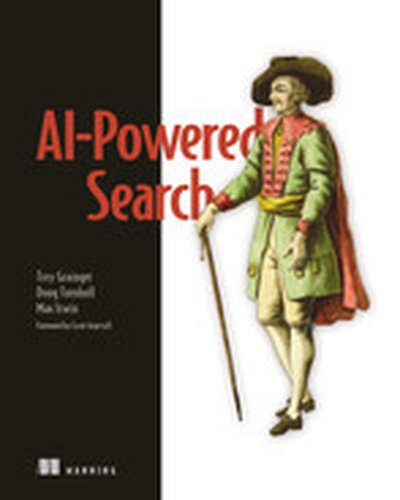
AI-Powered Search

Apply cutting-edge machine learning techniques—from crowdsourced relevance and knowledge graph learning, to Large Language Models (LLMs)—to enhance the accuracy and relevance of your search results. Delivering effective search is one of the biggest challenges you can face as an engineer. AI-Powered Search is an in-depth guide to building intelligent search systems you can be proud of. It covers the critical tools you need to automate ongoing relevance improvements within your search applications. Inside you’ll learn modern, data-science-driven search techniques like: Semantic search using dense vector embeddings from foundation models Retrieval augmented generation (RAG) Question answering and summarization combining search and LLMs Fine-tuning transformer-based LLMs Personalized search based on user signals and vector embeddings Collecting user behavioral signals and building signals boosting models Semantic knowledge graphs for domain-specific learning Semantic query parsing, query-sense disambiguation, and query intent classification Implementing machine-learned ranking models (Learning to Rank) Building click models to automate machine-learned ranking Generative search, hybrid search, multimodal search, and the search frontier AI-Powered Search will help you build the kind of highly intelligent search applications demanded by modern users. Whether you’re enhancing your existing search engine or building from scratch, you’ll learn how to deliver an AI-powered service that can continuously learn from every content update, user interaction, and the hidden semantic relationships in your content. You’ll learn both how to enhance your AI systems with search and how to integrate large language models (LLMs) and other foundation models to massively accelerate the capabilities of your search technology. About the Technology Modern search is more than keyword matching. Much, much more. Search that learns from user interactions, interprets intent, and takes advantage of AI tools like large language models (LLMs) can deliver highly targeted and relevant results. This book shows you how to up your search game using state-of-the-art AI algorithms, techniques, and tools. About the Book AI-Powered Search teaches you to create a search that understands natural language and improves automatically the more it is used. As you work through dozens of interesting and relevant examples, you’ll learn powerful AI-based techniques like semantic search on embeddings, question answering powered by LLMs, real-time personalization, and Retrieval Augmented Generation (RAG). What's Inside Sparse lexical and embedding-based semantic search Question answering, RAG, and summarization using LLMs Personalized search and signals boosting models Learning to Rank, multimodal, and hybrid search About the Reader For software developers and data scientists familiar with the basics of search engine technology. About the Author Trey Grainger is the Founder of Searchkernel and former Chief Algorithms Officer and SVP of Engineering at Lucidworks. Doug Turnbull is a Principal Engineer at Reddit and former Staff Relevance Engineer at Spotify. Max Irwin is the Founder of Max.io and former Managing Consultant at OpenSource Connections. Quotes Belongs on the shelf of every search practitioner! - Khalifeh AlJadda, Google A treasure map! Now you have decades of semantic search knowledge at your fingertips. - Mark Moyou, NVIDIA Modern and comprehensive! Everything you need to build world-class search experiences. - Kelvin Tan, SearchStax Kick starts your ability to implement AI search with easy to understand examples. - David Meza, NASA

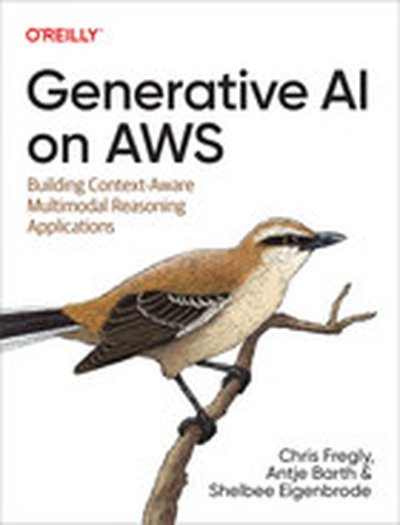
Generative AI on AWS

Companies today are moving rapidly to integrate generative AI into their products and services. But there's a great deal of hype (and misunderstanding) about the impact and promise of this technology. With this book, Chris Fregly, Antje Barth, and Shelbee Eigenbrode from AWS help CTOs, ML practitioners, application developers, business analysts, data engineers, and data scientists find practical ways to use this exciting new technology. You'll learn the generative AI project life cycle including use case definition, model selection, model fine-tuning, retrieval-augmented generation, reinforcement learning from human feedback, and model quantization, optimization, and deployment. And you'll explore different types of models including large language models (LLMs) and multimodal models such as Stable Diffusion for generating images and Flamingo/IDEFICS for answering questions about images. Apply generative AI to your business use cases Determine which generative AI models are best suited to your task Perform prompt engineering and in-context learning Fine-tune generative AI models on your datasets with low-rank adaptation (LoRA) Align generative AI models to human values with reinforcement learning from human feedback (RLHF) Augment your model with retrieval-augmented generation (RAG) Explore libraries such as LangChain and ReAct to develop agents and actions Build generative AI applications with Amazon Bedrock