Presenting a nonmathematical approach to this topic, Statistics for Environmental Science and Management introduces frequently used statistical methods and practical applications for the environmental field.
 talk-data.com
Topic
505
tagged
Presenting a nonmathematical approach to this topic, Statistics for Environmental Science and Management introduces frequently used statistical methods and practical applications for the environmental field.
Wouldn't it be great if there were a statistics book that made histograms, probability distributions, and chi square analysis more enjoyable than going to the dentist? Head First Statistics brings this typically dry subject to life, teaching you everything you want and need to know about statistics through engaging, interactive, and thought-provoking material, full of puzzles, stories, quizzes, visual aids, and real-world examples. Whether you're a student, a professional, or just curious about statistical analysis, Head First's brain-friendly formula helps you get a firm grasp of statistics so you can understand key points and actually use them. Learn to present data visually with charts and plots; discover the difference between taking the average with mean, median, and mode, and why it's important; learn how to calculate probability and expectation; and much more. Head First Statistics is ideal for high school and college students taking statistics and satisfies the requirements for passing the College Board's Advanced Placement (AP) Statistics Exam. With this book, you'll: Study the full range of topics covered in first-year statistics Tackle tough statistical concepts using Head First's dynamic, visually rich format proven to stimulate learning and help you retain knowledge Explore real-world scenarios, ranging from casino gambling to prescription drug testing, to bring statistical principles to life Discover how to measure spread, calculate odds through probability, and understand the normal, binomial, geometric, and Poisson distributions Conduct sampling, use correlation and regression, do hypothesis testing, perform chi square analysis, and more Before you know it, you'll not only have mastered statistics, you'll also see how they work in the real world. Head First Statistics will help you pass your statistics course, and give you a firm understanding of the subject so you can apply the knowledge throughout your life.
Need to learn statistics as part of your job, or want some help passing a statistics course? Statistics in a Nutshell is a clear and concise introduction and reference that's perfect for anyone with no previous background in the subject. This book gives you a solid understanding of statistics without being too simple, yet without the numbing complexity of most college texts. You get a firm grasp of the fundamentals and a hands-on understanding of how to apply them before moving on to the more advanced material that follows. Each chapter presents you with easy-to-follow descriptions illustrated by graphics, formulas, and plenty of solved examples. Before you know it, you'll learn to apply statistical reasoning and statistical techniques, from basic concepts of probability and hypothesis testing to multivariate analysis. Organized into four distinct sections, Statistics in a Nutshell offers you: Introductory material: Different ways to think about statistics Basic concepts of measurement and probability theory Data management for statistical analysis Research design and experimental design How to critique statistics presented by others Basic inferential statistics: Basic concepts of inferential statistics The concept of correlation, when it is and is not an appropriate measure of association Dichotomous and categorical data The distinction between parametric and nonparametric statistics Advanced inferential techniques: The General Linear Model Analysis of Variance (ANOVA) and MANOVA Multiple linear regression Specialized techniques: Business and quality improvement statistics Medical and public health statistics Educational and psychological statistics Unlike many introductory books on the subject, Statistics in a Nutshell doesn't omit important material in an effort to dumb it down. And this book is far more practical than most college texts, which tend to over-emphasize calculation without teaching you when and how to apply different statistical tests. With Statistics in a Nutshell, you learn how to perform most common statistical analyses, and understand statistical techniques presented in research articles. If you need to know how to use a wide range of statistical techniques without getting in over your head, this is the book you want.
A modernized new edition of one of the most trusted books on time series analysis. Since publication of the first edition in 1970, Time Series Analysis has served as one of the most influential and prominent works on the subject. This new edition maintains its balanced presentation of the tools for modeling and analyzing time series and also introduces the latest developments that have occurred n the field over the past decade through applications from areas such as business, finance, and engineering. The Fourth Edition provides a clearly written exploration of the key methods for building, classifying, testing, and analyzing stochastic models for time series as well as their use in five important areas of application: forecasting; determining the transfer function of a system; modeling the effects of intervention events; developing multivariate dynamic models; and designing simple control schemes. Along with these classical uses, modern topics are introduced through the book's new features, which include: A new chapter on multivariate time series analysis, including a discussion of the challenge that arise with their modeling and an outline of the necessary analytical tools New coverage of forecasting in the design of feedback and feedforward control schemes A new chapter on nonlinear and long memory models, which explores additional models for application such as heteroscedastic time series, nonlinear time series models, and models for long memory processes Coverage of structural component models for the modeling, forecasting, and seasonal adjustment of time series A review of the maximum likelihood estimation for ARMA models with missing values Numerous illustrations and detailed appendices supplement the book,while extensive references and discussion questions at the end of each chapter facilitate an in-depth understanding of both time-tested and modern concepts. With its focus on practical, rather than heavily mathematical, techniques, time Series Analysis, Fourth Edition is the upper-undergraduate and graduate levels. this book is also an invaluable reference for applied statisticians, engineers, and financial analysts.
THE MOST PRACTICAL, UP-TO-DATE GUIDE TO MODELLING AND ANALYZING TIME-TO-EVENT DATA—NOW IN A VALUABLE NEW EDITION Since publication of the first edition nearly a decade ago, analyses using time-to-event methods have increase considerably in all areas of scientific inquiry mainly as a result of model-building methods available in modern statistical software packages. However, there has been minimal coverage in the available literature to9 guide researchers, practitioners, and students who wish to apply these methods to health-related areas of study. Applied Survival Analysis, Second Edition provides a comprehensive and up-to-date introduction to regression modeling for time-to-event data in medical, epidemiological, biostatistical, and other health-related research. This book places a unique emphasis on the practical and contemporary applications of regression modeling rather than the mathematical theory. It offers a clear and accessible presentation of modern modeling techniques supplemented with real-world examples and case studies. Key topics covered include: variable selection, identification of the scale of continuous covariates, the role of interactions in the model, assessment of fit and model assumptions, regression diagnostics, recurrent event models, frailty models, additive models, competing risk models, and missing data. Features of the Second Edition include: Expanded coverage of interactions and the covariate-adjusted survival functions The use of the Worchester Heart Attack Study as the main modeling data set for illustrating discussed concepts and techniques New discussion of variable selection with multivariable fractional polynomials Further exploration of time-varying covariates, complex with examples Additional treatment of the exponential, Weibull, and log-logistic parametric regression models Increased emphasis on interpreting and using results as well as utilizing multiple imputation methods to analyze data with missing values New examples and exercises at the end of each chapter Analyses throughout the text are performed using Stata® Version 9, and an accompanying FTP site contains the data sets used in the book. Applied Survival Analysis, Second Edition is an ideal book for graduate-level courses in biostatistics, statistics, and epidemiologic methods. It also serves as a valuable reference for practitioners and researchers in any health-related field or for professionals in insurance and government.
This IBM® Redbooks® publication is written as part of the deployment guide series. This book provides a step-by-step guide for deploying ITCAM for Response Time V6.2. This deployment guide can help an IBM or business partner service person plan and perform the deployment of the product. The discussion of ITCAM for Response Time includes the explanation of product architecture and its components. We discuss planning and sizing considerations before you implement the product and some guidelines on setting up service engagement for the product. The deployment explained in the book would fit for a demonstration or a small deployment system, although the information is highly relevant for larger deployment engagements. This book also explains some usage scenario that can be performed for demonstrating the product.
Computational statistics and statistical computing are two areas that employ computational, graphical, and numerical approaches to solve statistical problems, making the versatile R language an ideal computing environment for these fields. One of the first books on these topics to feature R, Statistical Computing with R covers the traditiona
JMP Start Statistics: A Guide to Statistics and Data Analysis Using JMP, Fourth Edition, is a complete and orderly introduction to analyzing data using JMP statistical discovery software from SAS. A mix of software manual and statistics text, this book provides hands-on tutorials with just the right amount of conceptual and motivational material to illustrate how to use JMP's intuitive interface for data analysis. Each chapter features concept-specific tutorials, examples, brief reviews of concepts, step-by-step illustrations, and exercises. Written by John Sall, Lee Creighton, and Ann Lehman, this book is a great tool for statistics students or practitioners needing a software-related statistics review.
Forecasting returns is as important as forecasting volatility in multiple areas of finance. This topic, essential to practitioners, is also studied by academics. In this new book, Dr Stephen Satchell brings together a collection of leading thinkers and practitioners from around the world who address this complex problem using the latest quantitative techniques. Forecasting expected returns is an essential aspect of finance and highly technical The first collection of papers to present new and developing techniques *International authors present both academic and practitioner perspectives
What makes seasoned IT professionals run for cover? Answer: Forecasting Oracle Performance! Craig Shallahamer is an Oracle performance expert with over 18 years of experience. His book is the first to focus not on the problem of solving today's problem, but squarely on the problem of forecasting the future performance of an Oracle database. Other Oracle performance books are good for putting out fires; Craig's book helps you avoid all the heat in the first place. If you’re an IT practioner who appreciates application over mathematical proofs than you’ll be pleasantly surprised! Each chapter is filled with examples to transform the theory, mathematics, and methods into something you can practically apply. Craig's goal is to teach you about real-word Oracle performance forecasting. Period. There is no hidden agenda. This book is a kind of training course. After reading, studying, and practicing the material covered in this book, you to be able to confidently, responsibly, and professionally forecast performance and system capacity in a wide variety of real-life situations. If you are more management-minded (or want to be), you will be delighted with the service level management focus. Forecasting makes good business sense because it maximizes the return on IT investment and minimizes unplanned down time. To those who think forecasting is a waste of money: well...obviously, they’ve never been on the evening news because their company lost millions of dollars in revenue and brand destruction because of poorly performing or unavailable systems. Without a doubt, you will be equipped to deal with the realities of forecasting Oracle performance. But this book gives you more. Not only will you receive a technical and mathematical perspective, but also a communication, a presentation, and a management perspective. This is career building stuff and immensely satisfying! What you'll learn This book is a “how-to” book filled with examples to transform theory and mathematics into something you can practically apply. You will learn how to use a variety of forecasting models, which will enable you to methodically: Help manage service levels from a business value perspective Identify the risk of over utilized resources Predict what component of an architecture is at risk Predict when a system will be at risk Develop multiple risk mitigating strategies to ensure service levels are maintained Characterize a complex Oracle workload Who this book is for IT professionals who must ensure their production Oracle systems are meeting service levels, in part, through forecasting performance, identifying risk, and developing solutions to ensure systems are available without wasting budget. Readers include database administrators, IT managers, developers, capacity planners, systems architects, systems integrators.
Pharmaceutical Statistics Using SAS: A Practical Guide offers extensive coverage of cutting-edge biostatistical methodology used in drug development and the practical problems facing today's drug developers. Written by well-known experts in the pharmaceutical industry Alex Dmitrienko, Christy Chuang-Stein, and Ralph D'Agostino, it provides relevant tutorial material and SAS examples to help readers new to a certain area of drug development quickly understand and learn popular data analysis methods and apply them to real-life problems. Step-by-step, the book introduces a wide range of data analysis problems encountered in drug development and illustrates them using a wealth of case studies from actual pre-clinical experiments and clinical studies. The book also provides SAS code for solving the problems. Among the topics addressed are these:
drug discovery experiments to identify promising chemical compounds animal studies to assess the toxicological profile of these compounds clinical pharmacology studies to examine the properties of new drugs in healthy human subjects Phase II and Phase III clinical trials to establish therapeutic benefits of experimental drugs.
Additional features include a discussion of methodological issues, practical advice from subject-matter experts, and review of relevant regulatory guidelines. Most chapters are self-contained and include a fair amount of high-level introductory material to make them accessible to a broad audience of pharmaceutical scientists. This book will also serve as a useful reference for regulatory scientists as well as academic researchers and graduate students.
This book is part of the SAS Press program.
The second edition of Business Statistics, continues to retain the clear, crisp pedagogy of the first edition. It now adds new features and an even stronger emphasis on practical, applied statistics that will enhance the text's ability in developing decision-making ability of the reader. In this edition, efforts have been made to assist readers in converting data into useful information that can be used by decision-makers in making more thoughtful, information-based decisions.
The field of statistics is broad and complex, but this Infoline will help training professionals use statistics to execute their jobs even better. Why statistics? First, they allow you to make better decisions because data can be analyzed using proven mathematical principles and logic. Second, data are generated each moment across all business functions, and statistics allows the trainer quickly relate to business processes. Third, repetition is important for learner comprehension, and incorporating statistics and measures into training delivery helps learners acquire knowledge better and faster. And finally, the judicious use of statistics in presentations is a powerful way to support your case at higher organizational levels
The essentials of regression analysis through practical applications Regression analysis is a conceptually simple method for investigating relationships among variables. Carrying out a successful application of regression analysis, however, requires a balance of theoretical results, empirical rules, and subjective judgement. Regression Analysis by Example, Fourth Edition has been expanded and thoroughly updated to reflect recent advances in the field. The emphasis continues to be on exploratory data analysis rather than statistical theory. The book offers in-depth treatment of regression diagnostics, transformation, multicollinearity, logistic regression, and robust regression. This new edition features the following enhancements: Chapter 12, Logistic Regression, is expanded to reflect the increased use of the logit models in statistical analysis A new chapter entitled Further Topics discusses advanced areas of regression analysis Reorganized, expanded, and upgraded exercises appear at the end of each chapter A fully integrated Web page provides data sets Numerous graphical displays highlight the significance of visual appeal Regression Analysis by Example, Fourth Edition is suitable for anyone with an understanding of elementary statistics. Methods of regression analysis are clearly demonstrated, and examples containing the types of irregularities commonly encountered in the real world are provided. Each example isolates one or two techniques and features detailed discussions of the techniques themselves, the required assumptions, and the evaluated success of each technique. The methods described throughout the book can be carried out with most of the currently available statistical software packages, such as the software package R.
Want to calculate the probability that an event will happen? Be able to spot fake data? Prove beyond doubt whether one thing causes another? Or learn to be a better gambler? You can do that and much more with 75 practical and fun hacks packed into Statistics Hacks. These cool tips, tricks, and mind-boggling solutions from the world of statistics, measurement, and research methods will not only amaze and entertain you, but will give you an advantage in several real-world situations-including business. This book is ideal for anyone who likes puzzles, brainteasers, games, gambling, magic tricks, and those who want to apply math and science to everyday circumstances. Several hacks in the first chapter alone-such as the "central limit theorem,", which allows you to know everything by knowing just a little-serve as sound approaches for marketing and other business objectives. Using the tools of inferential statistics, you can understand the way probability works, discover relationships, predict events with uncanny accuracy, and even make a little money with a well-placed wager here and there. Statistics Hacks presents useful techniques from statistics, educational and psychological measurement, and experimental research to help you solve a variety of problems in business, games, and life. You'll learn how to: Play smart when you play Texas Hold 'Em, blackjack, roulette, dice games, or even the lottery Design your own winnable bar bets to make money and amaze your friends Predict the outcomes of baseball games, know when to "go for two" in football, and anticipate the winners of other sporting events with surprising accuracy Demystify amazing coincidences and distinguish the truly random from the only seemingly random--even keep your iPod's "random" shuffle honest Spot fraudulent data, detect plagiarism, and break codes How to isolate the effects of observation on the thing observed Whether you're a statistics enthusiast who does calculations in your sleep or a civilian who is entertained by clever solutions to interesting problems, Statistics Hacks has tools to give you an edge over the world's slim odds.
WILEY-INTERSCIENCE PAPERBACK SERIES The Wiley-Interscience Paperback Series consists of selected books that have been made more accessible to consumers in an effort to increase global appeal and general circulation. With these new unabridged softcover volumes, Wiley hopes to extend the lives of these works by making them available to future generations of statisticians, mathematicians, and scientists. ". . .this is a very competently written and useful addition to the statistical literature; a book every statistician should look at and that many should study!" -Short Book Reviews, International Statistical Institute ". . .reading this book was an enjoyable learning experience. The suggestions and recommendations on the methods [make] this book an excellent reference for anyone interested in simulation. With its compact structure and good coverage of material, it [is] an excellent textbook for a simulation course." -Technometrics ". . .this work is an excellent comprehensive guide to simulation methods, written by a very competent author. It is especially recommended for those users of simulation methods who want more than a 'cook book'. " -Mathematics Abstracts This book is a comprehensive guide to simulation methods with explicit recommendations of methods and algorithms. It covers both the technical aspects of the subject, such as the generation of random numbers, non-uniform random variates and stochastic processes, and the use of simulation. Supported by the relevant mathematical theory, the text contains a great deal of unpublished research material, including coverage of the analysis of shift-register generators, sensitivity analysis of normal variate generators, analysis of simulation output, and more.
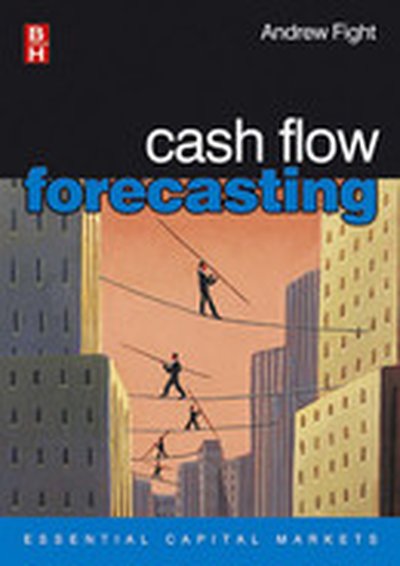
Budgets are like road maps -- they provide a direction for a corporates financial management. Balance sheets and statements of revenues also provide insights into how well a company is following that direction. But cash flow and cash flow forecasts are what guide the day-to-day itinerary for an organization. Budgets and cash flow are dynamic -- adjustments and changes can and should occur. If you understand what you are looking at, you can use cash flow to create better budgets and thus more accurate cash flow forecasting. Cash Flow Forecasting outlines the techniques required to undertake a detailed analysis of the cash flow dynamics of the business from both a historical and forward looking perspective. Cash Flow Forecasting explains how to: * Determine appropriate cash flow figures from pro forma financial statements * Interpret detailed cash flow forecasts and understand the difference between profit and cash flow * Conserve or generate cash in the short term * Evaluate different methods of project evaluation * Recognize the limitations of accounting information in valuing companies *Inspired by basic entry level training courses that have been developed by major international banks worldwide * Will enable students and those already in the finance profession to gain an understanding of the basic information and principles of cash flow forecasting * Includes questions with answers, study topics, practical "real world" examples and extensive bibliography

Women now drive some 80% of all buying decisions. By 2010, they'll account for half of America's private wealth: $13 trillion dollars. A few remarkable companies have learned how to refocus on women -- and, in so doing, have achieved truly stunning results. In The Power of the Purse, top journalist Fara Warner takes you behind the scenes at those companies, revealing how they did it -- and how you can, too. Unlike previous books on marketing to women, this one doesn't settle for generalities: it offers in-depth, start-to-finish case studies. Discover how McDonald's turned around its business by recognizing women as full-fledged consumers, not just 'Moms.' Learn how Kodak's digital camera business soared from fourth to first by recognizing women's importance as family 'memory makers'. See how P G built Swiffer into a cultural revolution, and how the diamond industry did the same for right-hand rings. Watch Bratz topple Barbie, Torrid create its enormously successful plus-size stores for teenagers, and Avon connect with a radically new generation of women. From Nike to Home Depot, each story is unique -- but in every case, these companies put women at the center of their strategies, and listened intently to what real women consumers were telling them. It's not about 'painting your products pink': it's about transforming the way you think about women. Do that, and you'll create products that sell better to everyone.
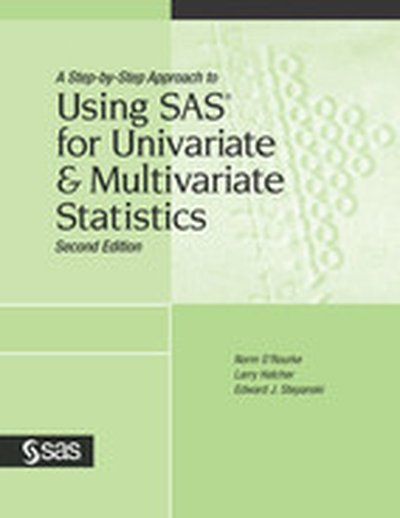
Updated for SA®9, this second edition is an easy-to-understand introduction to SAS as well as to univariate and multivariate statistics. Clear explanations and simple language guide you through the research terminology, data input, data manipulation, and types of statistical analysis that are most commonly used in the social and behavioral sciences. Providing practice data inspired by actual studies, this book teaches you how to choose the right statistic, understand the assumptions underlying the procedure, prepare the SAS program for the analysis, interpret the output, and summarize the analysis and results according to the format prescribed in the Publication Manual of the American Psychological Association. Step by step you will learn how to perform the following types of analysis: simple descriptive statistics, measures of bivariate association, t tests: independent samples and paired samples, NOVA and MANOVA, multiple regression, principal component analysis, and assessing scale reliability with coefficient alpha. This text is ideally suited to students who are beginning their study of data analysis, and to professors and researchers who want a handy reference on their bookshelf.
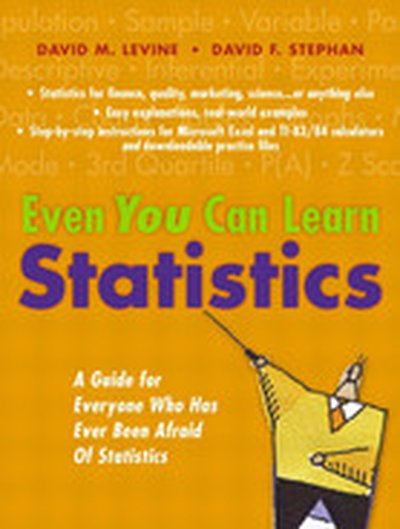
Even You Can Learn Statistics A Guide for Everyone Who Has Ever Been Afraid Of Statistics One easy step at a time, this book will teach you the key statistical techniques you'll need for finance, quality, marketing, the social sciences, or just about any other field. Each technique is introduced with a simple, jargon-free explanation, practical examples, and hands-on guidance for solving real problems with Excel or a TI-83/84 series calculator, including Plus models. Hate math? No sweat. You'll be amazed how little you need! For those who do have an interest in mathematics, optional "Equation Blackboard" sections review the equations that provide the foundations for important concepts. David M. Levine is a much-honored innovator in statistics education. He is Professor Emeritus of Statistics and Computer Information Systems at Bernard M. Baruch College (CUNY), and co-author of several best-selling books, including Statistics for Managers using Microsoft Excel, Basic Business Statistics, Quality Management, and Six Sigma for Green Belts and Champions. Instructional designer David F. Stephan pioneered the classroom use of personal computers, and is a leader in making Excel more accessible to statistics students. He has co-authored several textbooks with David M. Levine. Here's just some of what you'll learn how to do... Use statistics in your everyday work or study Perform common statistical tasks using a Texas Instruments statistical calculator or Microsoft Excel Build and interpret statistical charts and tables "Test Yourself" at the end of each chapter to review the concepts and methods that you learned in the chapter Work with mean, median, mode, standard deviation, Z scores, skewness, and other descriptive statistics Use probability and probability distributions Work with sampling distributions and confidence intervals Test hypotheses and decision-making risks with Z, t, Chi-Square, ANOVA, and other techniques Perform regression analysis and modeling The easy, practical introduction to statistics–for everyone! Thought you couldn't learn statistics? Think again. You can–and you will! Complementary Web site Downloadable practice files at http://www.ftpress.com/youcanlearnstatistics