talk-data.com talk-data.com

Topic

statistics

505

tagged

Activity Trend

1 peak/qtr
2020-Q1 2026-Q1

Activities

Showing filtered results

Filtering by: O'Reilly Data Science Books ×
Data Analysis and Applications 2

This series of books collects a diverse array of work that provides the reader with theoretical and applied information on data analysis methods, models and techniques, along with appropriate applications. Volume 2 begins with an introductory chapter by Gilbert Saporta, a leading expert in the field, who summarizes the developments in data analysis over the last 50 years. The book is then divided into four parts: Part 1 examines (in)dependence relationships, innovation in the Nordic countries, dentistry journals, dependence among growth rates of GDP of V4 countries, emissions mitigation, and five-star ratings; Part 2 investigates access to credit for SMEs, gender-based impacts given Southern Europe’s economic crisis, and labor market transition probabilities; Part 3 looks at recruitment at university job-placement offices and the Program for International Student Assessment; and Part 4 examines discriminants, PageRank, and the political spectrum of Germany.

Statistics for Biomedical Engineers and Scientists

Statistics for Biomedical Engineers and Scientists: How to Analyze and Visualize Data provides an intuitive understanding of the concepts of basic statistics, with a focus on solving biomedical problems. Readers will learn how to understand the fundamental concepts of descriptive and inferential statistics, analyze data and choose an appropriate hypothesis test to answer a given question, compute numerical statistical measures and perform hypothesis tests ‘by hand’, and visualize data and perform statistical analysis using MATLAB. Practical activities and exercises are provided, making this an ideal resource for students in biomedical engineering and the biomedical sciences who are in a course on basic statistics. Presents a practical guide on how to visualize and analyze statistical data Provides numerous practical examples and exercises to illustrate the power of statistics in biomedical engineering applications Gives an intuitive understanding of statistical tests Covers practical skills by showing how to perform operations ‘by hand’ and by using MATLAB as a computational tool Includes an online resource with downloadable materials for students and teachers

Statistics Essentials For Dummies

Statistics Essentials For Dummies (9781119590309) was previously published as Statistics Essentials For Dummies (9780470618394). While this version features a new Dummies cover and design, the content is the same as the prior release and should not be considered a new or updated product. Statistics Essentials For Dummies not only provides students enrolled in Statistics I with an excellent high-level overview of key concepts, but it also serves as a reference or refresher for students in upper-level statistics courses. Free of review and ramp-up material, Statistics Essentials For Dummies sticks to the point, with content focused on key course topics only. It provides discrete explanations of essential concepts taught in a typical first semester college-level statistics course, from odds and error margins to confidence intervals and conclusions. This guide is also a perfect reference for parents who need to review critical statistics concepts as they help high school students with homework assignments, as well as for adult learners headed back into the classroom who just need a refresher of the core concepts. The Essentials For Dummies Series Dummies is proud to present our new series, The Essentials For Dummies. Now students who are prepping for exams, preparing to study new material, or who just need a refresher can have a concise, easy-to-understand review guide that covers an entire course by concentrating solely on the most important concepts. From algebra and chemistry to grammar and Spanish, our expert authors focus on the skills students most need to succeed in a subject.

Introduction to Probability.

An essential guide to the concepts of probability theory that puts the focus on models and applications Introduction to Probability offers an authoritative text that presents the main ideas and concepts, as well as the theoretical background, models, and applications of probability. The authors—noted experts in the field—include a review of problems where probabilistic models naturally arise, and discuss the methodology to tackle these problems. A wide-range of topics are covered that include the concepts of probability and conditional probability, univariate discrete distributions, univariate continuous distributions, along with a detailed presentation of the most important probability distributions used in practice, with their main properties and applications. Designed as a useful guide, the text contains theory of probability, de finitions, charts, examples with solutions, illustrations, self-assessment exercises, computational exercises, problems and a glossary. This important text: • Includes classroom-tested problems and solutions to probability exercises • Highlights real-world exercises designed to make clear the concepts presented • Uses Mathematica software to illustrate the text’s computer exercises • Features applications representing worldwide situations and processes • Offers two types of self-assessment exercises at the end of each chapter, so that students may review the material in that chapter and monitor their progress. Written for students majoring in statistics, engineering, operations research, computer science, physics, and mathematics, Introduction to Probability: Models and Applications is an accessible text that explores the basic concepts of probability and includes detailed information on models and applications.

Nonparametric Statistical Process Control

A unique approach to understanding the foundations of statistical quality control with a focus on the latest developments in nonparametric control charting methodologies Statistical Process Control (SPC) methods have a long and successful history and have revolutionized many facets of industrial production around the world. This book addresses recent developments in statistical process control bringing the modern use of computers and simulations along with theory within the reach of both the researchers and practitioners. The emphasis is on the burgeoning field of nonparametric SPC (NSPC) and the many new methodologies developed by researchers worldwide that are revolutionizing SPC. Over the last several years research in SPC, particularly on control charts, has seen phenomenal growth. Control charts are no longer confined to manufacturing and are now applied for process control and monitoring in a wide array of applications, from education, to environmental monitoring, to disease mapping, to crime prevention. This book addresses quality control methodology, especially control charts, from a statistician’s viewpoint, striking a careful balance between theory and practice. Although the focus is on the newer nonparametric control charts, the reader is first introduced to the main classes of the parametric control charts and the associated theory, so that the proper foundational background can be laid. Reviews basic SPC theory and terminology, the different types of control charts, control chart design, sample size, sampling frequency, control limits, and more Focuses on the distribution-free (nonparametric) charts for the cases in which the underlying process distribution is unknown Provides guidance on control chart selection, choosing control limits and other quality related matters, along with all relevant formulas and tables Uses computer simulations and graphics to illustrate concepts and explore the latest research in SPC Offering a uniquely balanced presentation of both theory and practice, Nonparametric Methods for Statistical Quality Control is a vital resource for students, interested practitioners, researchers, and anyone with an appropriate background in statistics interested in learning about the foundations of SPC and latest developments in NSPC.

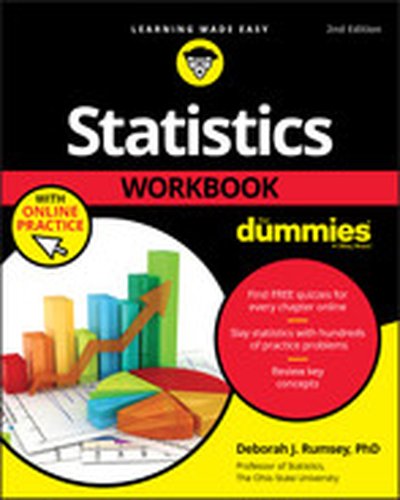
Statistics Workbook For Dummies with Online Practice, 2nd Edition

Practice your way to a higher statistics score The adage that "practice makes perfect" is never truer than with math problems. S tatistics Workbook For Dummies with Online Practice provides succinct content reviews for every topic, with plenty of examples and practice problems for each concept, in the book and online. Every lesson begins with a concept review, followed by a few example problems and plenty of practice problems. There's a step-by-step solution for every problem, with tips and tricks to help with comprehension and retention. New for this edition, free online practice quizzes for each chapter provide extra opportunities to test your knowledge and understanding. Get FREE access to chapter quizzes in an online test bank Work along with each chapter or use the test bank for final exam review Discover which statistical measures are most meaningful Scoring high in your Statistics class has never been easier!

Model Identification and Data Analysis

This book is about constructing models from experimental data. It covers a range of topics, from statistical data prediction to Kalman filtering, from black-box model identification to parameter estimation, from spectral analysis to predictive control. Written for graduate students, this textbook offers an approach that has proven successful throughout the many years during which its author has taught these topics at his University. The book: Contains accessible methods explained step-by-step in simple terms Offers an essential tool useful in a variety of fields, especially engineering, statistics, and mathematics Includes an overview on random variables and stationary processes, as well as an introduction to discrete time models and matrix analysis Incorporates historical commentaries to put into perspective the developments that have brought the discipline to its current state Provides many examples and solved problems to complement the presentation and facilitate comprehension of the techniques presented

Probability, Random Variables, Statistics, and Random Processes

Probability, Random Variables, Statistics, and Random Processes: Fundamentals & Applications is a comprehensive undergraduate-level textbook. With its excellent topical coverage, the focus of this book is on the basic principles and practical applications of the fundamental concepts that are extensively used in various Engineering disciplines as well as in a variety of programs in Life and Social Sciences. The text provides students with the requisite building blocks of knowledge they require to understand and progress in their areas of interest. With a simple, clear-cut style of writing, the intuitive explanations, insightful examples, and practical applications are the hallmarks of this book. The text consists of twelve chapters divided into four parts. Part-I, Probability (Chapters 1 – 3), lays a solid groundwork for probability theory, and introduces applications in counting, gambling, reliability, and security. Part-II, Random Variables (Chapters 4 – 7), discusses in detail multiple random variables, along with a multitude of frequently-encountered probability distributions. Part-III, Statistics (Chapters 8 – 10), highlights estimation and hypothesis testing. Part-IV, Random Processes (Chapters 11 – 12), delves into the characterization and processing of random processes. Other notable features include: Most of the text assumes no knowledge of subject matter past first year calculus and linear algebra With its independent chapter structure and rich choice of topics, a variety of syllabi for different courses at the junior, senior, and graduate levels can be supported A supplemental website includes solutions to about 250 practice problems, lecture slides, and figures and tables from the text Given its engaging tone, grounded approach, methodically-paced flow, thorough coverage, and flexible structure, Probability, Random Variables, Statistics, and Random Processes: Fundamentals & Applications clearly serves as a must textbook for courses not only in Electrical Engineering, but also in Computer Engineering, Software Engineering, and Computer Science.

Testing Statistical Assumptions in Research

Comprehensively teaches the basics of testing statistical assumptions in research and the importance in doing so This book facilitates researchers in checking the assumptions of statistical tests used in their research by focusing on the importance of checking assumptions in using statistical methods, showing them how to check assumptions, and explaining what to do if assumptions are not met. Testing Statistical Assumptions in Research discusses the concepts of hypothesis testing and statistical errors in detail, as well as the concepts of power, sample size, and effect size. It introduces SPSS functionality and shows how to segregate data, draw random samples, file split, and create variables automatically. It then goes on to cover different assumptions required in survey studies, and the importance of designing surveys in reporting the efficient findings. The book provides various parametric tests and the related assumptions and shows the procedures for testing these assumptions using SPSS software. To motivate readers to use assumptions, it includes many situations where violation of assumptions affects the findings. Assumptions required for different non-parametric tests such as Chi-square, Mann-Whitney, Kruskal Wallis, and Wilcoxon signed-rank test are also discussed. Finally, it looks at assumptions in non-parametric correlations, such as bi-serial correlation, tetrachoric correlation, and phi coefficient. An excellent reference for graduate students and research scholars of any discipline in testing assumptions of statistical tests before using them in their research study Shows readers the adverse effect of violating the assumptions on findings by means of various illustrations Describes different assumptions associated with different statistical tests commonly used by research scholars Contains examples using SPSS, which helps facilitate readers to understand the procedure involved in testing assumptions Looks at commonly used assumptions in statistical tests, such as z, t and F tests, ANOVA, correlation, and regression analysis Testing Statistical Assumptions in Research is a valuable resource for graduate students of any discipline who write thesis or dissertation for empirical studies in their course works, as well as for data analysts.

International Futures

International Futures: Building and Using Global Models extensively covers one of the most advanced systems for integrated, long-term, global and large-scale forecasting analysis available today, the International Futures (IFs) system. Key elements of a strong, long-term global forecasting system are described, i.e. the formulations for the driving variables in separate major models and the manner in which these separate models are integrated. The heavy use of algorithmic and rule-based elements and the use of elements of control theory is also explained. Furthermore, the IFs system is compared and contrasted with all other major modeling efforts, also outlining the major benefits of the IFs system. Finally, the book provides suggestions on how the development of forecasting systems might most productively proceed in the coming years. Helps readers understand the IFs system, not at a detailed equation and technical level, but in terms of the important decisions made that dominate the structure and long-term behavior Presents information on the universe of long-term global forecasting systems, key decisions made, and the range of similarities and differences in the systems Covers the relationship between long-term forecasts in a variety of global issues and the forecasting systems and assumptions that underly them (essential information for forecast consumers)

Advanced Time Series Data Analysis

Introduces the latest developments in forecasting in advanced quantitative data analysis This book presents advanced univariate multiple regressions, which can directly be used to forecast their dependent variables, evaluate their in-sample forecast values, and compute forecast values beyond the sample period. Various alternative multiple regressions models are presented based on a single time series, bivariate, and triple time-series, which are developed by taking into account specific growth patterns of each dependent variables, starting with the simplest model up to the most advanced model. Graphs of the observed scores and the forecast evaluation of each of the models are offered to show the worst and the best forecast models among each set of the models of a specific independent variable. Advanced Time Series Data Analysis: Forecasting Using EViews provides readers with a number of modern, advanced forecast models not featured in any other book. They include various interaction models, models with alternative trends (including the models with heterogeneous trends), and complete heterogeneous models for monthly time series, quarterly time series, and annually time series. Each of the models can be applied by all quantitative researchers. Presents models that are all classroom tested Contains real-life data samples Contains over 350 equation specifications of various time series models Contains over 200 illustrative examples with special notes and comments Applicable for time series data of all quantitative studies Advanced Time Series Data Analysis: Forecasting Using EViews will appeal to researchers and practitioners in forecasting models, as well as those studying quantitative data analysis. It is suitable for those wishing to obtain a better knowledge and understanding on forecasting, specifically the uncertainty of forecast values.

Dynamic System Reliability

Offers timely and comprehensive coverage of dynamic system reliability theory This book focuses on hot issues of dynamic system reliability, systematically introducing the reliability modeling and analysis methods for systems with imperfect fault coverage, systems with function dependence, systems subject to deterministic or probabilistic common-cause failures, systems subject to deterministic or probabilistic competing failures, and dynamic standby sparing systems. It presents recent developments of such extensions involving reliability modelling theory, reliability evaluation methods, and features numerous case studies based on real-world examples. The presented dynamic reliability theory can enable a more accurate representation of actual complex system behavior, thus more effectively guiding the reliable design of real-world critical systems. Dynamic System Reliability: Modelling and Analysis of Dynamic and Dependent Behaviors begins by describing the evolution from the traditional static reliability theory to the dynamic system reliability theory, and provides a detailed investigation of dynamic and dependent behaviors in subsequent chapters. Although written for those with a background in basic probability theory and stochastic processes, the book includes a chapter reviewing the fundamentals that readers need to know in order to understand contents of other chapters which cover advanced topics in reliability theory and case studies. The first book systematically focusing on dynamic system reliability modelling and analysis theory Provides a comprehensive treatment on imperfect fault coverage (single-level/multi-level or modular), function dependence, common cause failures (deterministic and probabilistic), competing failures (deterministic and probabilistic), and dynamic standby sparing Includes abundant illustrative examples and case studies based on real-world systems Covers recent advances in combinatorial models and algorithms for dynamic system reliability analysis Offers a rich set of references, providing helpful resources for readers to pursue further research and study of the topics Dynamic System Reliability: Modelling and Analysis of Dynamic and Dependent Behaviors is an excellent book for undergraduate and graduate students, and engineers and researchers in reliability and related disciplines.

Forecasting With The Theta Method

The first book to be published on the Theta method, outlining under what conditions the method outperforms other forecasting methods This book is the first to detail the Theta method of forecasting – one of the most difficult-to-beat forecasting benchmarks, which topped the biggest forecasting competition in the world in 2000: the M3 competition. Written by two of the leading experts in the forecasting field, it illuminates the exact replication of the method and under what conditions the method outperforms other forecasting methods. Recent developments such as multivariate models are also included, as are a series of practical applications in finance, economics, and healthcare. The book also offers practical tools in MS Excel and guidance, as well as provisional access, for the use of R source code and respective packages. Forecasting with the Theta Method: Theory and Applications includes three main parts. The first part, titled Theory, Methods, Models & Applications details the new theory about the method. The second part, Applications & Performance in Forecasting Competitions, describes empirical results and simulations on the method. The last part roadmaps future research and also include contributions from another leading scholar of the method – Dr. Fotios Petropoulos. First ever book to be published on the Theta Method Explores new theory and exact conditions under which methods would outperform most forecasting benchmarks Clearly written with practical applications Employs R – open source code with all included implementations Forecasting with the Theta Method: Theory and Applications is a valuable tool for both academics and practitioners involved in forecasting and respective software development.

Multivariate Time Series Analysis and Applications

An essential guide on high dimensional multivariate time series including all the latest topics from one of the leading experts in the field Following the highly successful and much lauded book, Time Series Analysis—Univariate and Multivariate Methods, this new work by William W.S. Wei focuses on high dimensional multivariate time series, and is illustrated with numerous high dimensional empirical time series. Beginning with the fundamentalconcepts and issues of multivariate time series analysis,this book covers many topics that are not found in general multivariate time series books. Some of these are repeated measurements, space-time series modelling, and dimension reduction. The book also looks at vector time series models, multivariate time series regression models, and principle component analysis of multivariate time series. Additionally, it provides readers with information on factor analysis of multivariate time series, multivariate GARCH models, and multivariate spectral analysis of time series. With the development of computers and the internet, we have increased potential for data exploration. In the next few years, dimension will become a more serious problem. Multivariate Time Series Analysis and its Applications provides some initial solutions, which may encourage the development of related software needed for the high dimensional multivariate time series analysis. Written by bestselling author and leading expert in the field Covers topics not yet explored in current multivariate books Features classroom tested material Written specifically for time series courses Multivariate Time Series Analysis and its Applications is designed for an advanced time series analysis course. It is a must-have for anyone studying time series analysis and is also relevant for students in economics, biostatistics, and engineering.

Stata

Stata is one of the most popular statistical software in the world and suited for all kinds of users, from absolute beginners to experienced veterans. This book offers a clear and concise introduction to the usage and the workflow of Stata. Included topics are importing and managing datasets, cleaning and preparing data, creating and manipulating variables, producing descriptive statistics and meaningful graphs as well as central quantitative methods, like linear (OLS) and binary logistic regressions and matching. Additional information about diagnostical tests ensures that these methods yield valid and correct results that live up to academic standards. Furthermore, users are instructed how to export results that can be directly used in popular software like Microsoft Word for seminar papers and publications. Lastly, the book offers a short yet focussed introduction to scientific writing, which should guide readers through the process of writing a first quantitative seminar paper or research report. The book underlines correct usage of the software and a productive workflow which also introduces aspects like replicability and general standards for academic writing. While absolute beginners will enjoy the easy to follow point-and-click interface, more experienced users will benefit from the information about do-files and syntax which makes Stata so popular. Lastly, a wide range of user-contributed software („Ados") is introduced which further improves the general workflow and guarantees the availability of state of the art statistical methods.

Theory of Ridge Regression Estimation with Applications

A guide to the systematic analytical results for ridge, LASSO, preliminary test, and Stein-type estimators with applications Theory of Ridge Regression Estimation with Applications offers a comprehensive guide to the theory and methods of estimation. Ridge regression and LASSO are at the center of all penalty estimators in a range of standard models that are used in many applied statistical analyses. Written by noted experts in the field, the book contains a thorough introduction to penalty and shrinkage estimation and explores the role that ridge, LASSO, and logistic regression play in the computer intensive area of neural network and big data analysis. Designed to be accessible, the book presents detailed coverage of the basic terminology related to various models such as the location and simple linear models, normal and rank theory-based ridge, LASSO, preliminary test and Stein-type estimators. The authors also include problem sets to enhance learning. This book is a volume in the Wiley Series in Probability and Statistics series that provides essential and invaluable reading for all statisticians. This important resource: Offers theoretical coverage and computer-intensive applications of the procedures presented Contains solutions and alternate methods for prediction accuracy and selecting model procedures Presents the first book to focus on ridge regression and unifies past research with current methodology Uses R throughout the text and includes a companion website containing convenient data sets Written for graduate students, practitioners, and researchers in various fields of science, Theory of Ridge Regression Estimation with Applications is an authoritative guide to the theory and methodology of statistical estimation.

Robust Statistics, 2nd Edition

A new edition of this popular text on robust statistics, thoroughly updated to include new and improved methods and focus on implementation of methodology using the increasingly popular open-source software R. Classical statistics fail to cope well with outliers associated with deviations from standard distributions. Robust statistical methods take into account these deviations when estimating the parameters of parametric models, thus increasing the reliability of fitted models and associated inference. This new, second edition of Robust Statistics: Theory and Methods (with R) presents a broad coverage of the theory of robust statistics that is integrated with computing methods and applications. Updated to include important new research results of the last decade and focus on the use of the popular software package R, it features in-depth coverage of the key methodology, including regression, multivariate analysis, and time series modeling. The book is illustrated throughout by a range of examples and applications that are supported by a companion website featuring data sets and R code that allow the reader to reproduce the examples given in the book. Unlike other books on the market, Robust Statistics: Theory and Methods (with R) offers the most comprehensive, definitive, and up-to-date treatment of the subject. It features chapters on estimating location and scale; measuring robustness; linear regression with fixed and with random predictors; multivariate analysis; generalized linear models; time series; numerical algorithms; and asymptotic theory of M-estimates. Explains both the use and theoretical justification of robust methods Guides readers in selecting and using the most appropriate robust methods for their problems Features computational algorithms for the core methods Robust statistics research results of the last decade included in this 2nd edition include: fast deterministic robust regression, finite-sample robustness, robust regularized regression, robust location and scatter estimation with missing data, robust estimation with independent outliers in variables, and robust mixed linear models. Robust Statistics aims to stimulate the use of robust methods as a powerful tool to increase the reliability and accuracy of statistical modelling and data analysis. It is an ideal resource for researchers, practitioners, and graduate students in statistics, engineering, computer science, and physical and social sciences.

Linear Models and Time-Series Analysis

A comprehensive and timely edition on an emerging new trend in time series Linear Models and Time-Series Analysis: Regression, ANOVA, ARMA and GARCH sets a strong foundation, in terms of distribution theory, for the linear model (regression and ANOVA), univariate time series analysis (ARMAX and GARCH), and some multivariate models associated primarily with modeling financial asset returns (copula-based structures and the discrete mixed normal and Laplace). It builds on the author's previous book, Fundamental Statistical Inference: A Computational Approach, which introduced the major concepts of statistical inference. Attention is explicitly paid to application and numeric computation, with examples of Matlab code throughout. The code offers a framework for discussion and illustration of numerics, and shows the mapping from theory to computation. The topic of time series analysis is on firm footing, with numerous textbooks and research journals dedicated to it. With respect to the subject/technology, many chapters in Linear Models and Time-Series Analysis cover firmly entrenched topics (regression and ARMA). Several others are dedicated to very modern methods, as used in empirical finance, asset pricing, risk management, and portfolio optimization, in order to address the severe change in performance of many pension funds, and changes in how fund managers work. Covers traditional time series analysis with new guidelines Provides access to cutting edge topics that are at the forefront of financial econometrics and industry Includes latest developments and topics such as financial returns data, notably also in a multivariate context Written by a leading expert in time series analysis Extensively classroom tested Includes a tutorial on SAS Supplemented with a companion website containing numerous Matlab programs Solutions to most exercises are provided in the book Linear Models and Time-Series Analysis: Regression, ANOVA, ARMA and GARCH is suitable for advanced masters students in statistics and quantitative finance, as well as doctoral students in economics and finance. It is also useful for quantitative financial practitioners in large financial institutions and smaller finance outlets.

Reliability Prediction and Testing Textbook

This textbook reviews the methodologies of reliability prediction as currently used in industries such as electronics, automotive, aircraft, aerospace, off-highway, farm machinery, and others. It then discusses why these are not successful; and, presents methods developed by the authors for obtaining accurate information for successful prediction. The approach is founded on approaches that accurately duplicate the real world use of the product. Their approach is based on two fundamental components needed for successful reliability prediction; first, the methodology necessary; and, second, use of accelerated reliability and durability testing as a source of the necessary data. Applicable to all areas of engineering, this textbook details the newest techniques and tools to achieve successful reliabilityprediction and testing. It demonstrates practical examples of the implementation of the approaches described. This book is a tool for engineers, managers, researchers, in industry, teachers, and students. The reader will learn the importance of the interactions of the influencing factors and the interconnections of safety and human factors in product prediction and testing.