talk-data.com talk-data.com

Topic

transact-sql

10

tagged

Activity Trend

1 peak/qtr
2020-Q1 2026-Q1

Activities

Showing filtered results

Filtering by: O'Reilly Data Engineering Books ×
Advanced Analytics with Transact-SQL: Exploring Hidden Patterns and Rules in Your Data

Learn about business intelligence (BI) features in T-SQL and how they can help you with data science and analytics efforts without the need to bring in other languages such as R and Python. This book shows you how to compute statistical measures using your existing skills in T-SQL. You will learn how to calculate descriptive statistics, including centers, spreads, skewness, and kurtosis of distributions. You will also learn to find associations between pairs of variables, including calculating linear regression formulas and confidence levels with definite integration. No analysis is good without data quality. Advanced Analytics with Transact-SQL introduces data quality issues and shows you how to check for completeness and accuracy, and measure improvements in data quality over time. The book also explains how to optimize queries involving temporal data, such as when you search for overlapping intervals. More advanced time-oriented information in the book includes hazard and survival analysis. Forecasting with exponential moving averages and autoregression is covered as well. Every web/retail shop wants to know the products customers tend to buy together. Trying to predict the target discrete or continuous variable with few input variables is important for practically every type of business. This book helps you understand data science and the advanced algorithms use to analyze data, and terms such as data mining, machine learning, and text mining. Key to many of the solutions in this book are T-SQL window functions. Author Dejan Sarka demonstrates efficient statistical queries that are based on window functions and optimized through algorithms built using mathematical knowledge and creativity. The formulas and usage of those statistical procedures are explained so you can understand and modify the techniques presented. T-SQL is supported in SQL Server,Azure SQL Database, and in Azure Synapse Analytics. There are so many BI features in T-SQL that it might become your primary analytic database language. If you want to learn how to get information from your data with the T-SQL language that you already are familiar with, then this is the book for you. What You Will Learn Describe distribution of variables with statistical measures Find associations between pairs of variables Evaluate the quality of the data you are analyzing Perform time-series analysis on your data Forecast values of a continuous variable Perform market-basket analysis to predict customer purchasing patterns Predict target variable outcomes from one or more input variables Categorize passages of text by extracting and analyzing keywords Who This Book Is For Database developers and database administrators who want to translate their T-SQL skills into the world of business intelligence (BI) and data science. For readers who want to analyze large amounts of data efficiently by using their existing knowledge of T-SQL and Microsoft’s various database platforms such as SQL Server and Azure SQL Database. Also for readers who want to improve their querying by learning new and original optimization techniques.
Refactoring Legacy T-SQL for Improved Performance: Modern Practices for SQL Server Applications

Breathe new life into older applications by refactoring T-SQL queries and code using modern techniques. This book shows you how to significantly improve the performance of older applications by finding common anti-patterns in T-SQL code, then rewriting those anti-patterns using new functionality that is supported in current versions of SQL Server, including SQL Server 2019. The focus moves through the different types of database objects and the code used to create them, discussing the limitations and anti-patterns commonly found for each object type in your database. Legacy code isn’t just found in queries and external applications. It’s also found in the definitions of underlying database objects such as views and tables. This book helps you quickly find problematic code throughout the database and points out where and how modern solutions can replace older code, thereby making your legacy applications run faster and extending their lifetimes. Author Lisa Bohm explains the logic behind each anti-pattern, helping you understand why each pattern is a problem and showing how it can be avoided. Good coding habits are discussed, including guidance on topics such as readability and maintainability. What You Will Learn Find specific areas in code to target for performance gains Identify pain points quickly and understand why they are problematic Rewrite legacy T-SQL to reduce or eliminate hidden performance issues Write modern code with an awareness of readability and maintainability Recognize and correlate T-SQL anti-patterns with techniques for better solutions Make a positive impact on application user experience in your organization Who This Book Is For Database administrators or developers who maintain older code, those frustrated with complaints about slow codewhen there is so much of it to fix, and those who want a head start in making a positive impact on application user experience in their organization

Expert T-SQL Window Functions in SQL Server 2019: The Hidden Secret to Fast Analytic and Reporting Queries

Become an expert who can use window functions to solve T-SQL query problems. Replace slow cursors and self-joins with queries that are easy to write and perform better. This new edition provides expanded examples, including a chapter from the world of sports, and covers the latest performance enhancements through SQL Server 2019. Window functions are useful in analytics and business intelligence reporting. They came into full blossom with SQL Server 2012, yet they are not as well known and used as often as they ought to be. This group of functions is one of the most notable developments in SQL, and this book shows how every developer and DBA can benefit from their expressive power in solving day-to-day business problems. Once you begin using window functions, such as ROW_NUMBER and LAG, you will discover many ways to use them. You will approach SQL Server queries in a different way, thinking about sets of data instead of individual rows. Your querieswill run faster, be easier to write, and easier to deconstruct, maintain, and enhance in the future. Just knowing and using these functions is not enough. You also need to understand how to tune the queries. Expert T-SQL Window Functions in SQL Server clearly explains how to get the best performance. The book also covers the rare cases when older techniques are the best bet. What You Will Learn Solve complex query problems without cumbersome self-joins that run slowly and are difficult to read Create sliding windows in a result set for computing such as running totals and moving averages Return aggregate and detail data simultaneously from the same SELECT statement Compute lag and lead and other values that access data from multiple rows in a result set Understand the OVER clause syntax and how to control the window Avoid framing errors that can lead to unexpected results Who This Book Is For Anyone who writes T-SQL queries, including database administrators, developers, business analysts, and data scientists. Before reading this book, you should understand how to join tables, write WHERE clauses, and build aggregate queries.

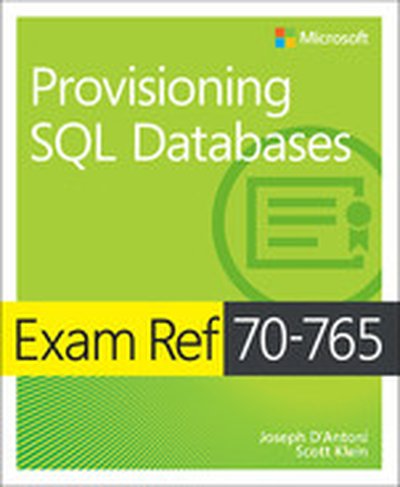
Exam Ref 70-765 Provisioning SQL Databases, First Edition

Prepare for Microsoft Exam 70-765–and help demonstrate your real-world mastery of provisioning SQL Server databases both on premise and in SQL Azure. Designed for experienced IT professionals ready to advance their status, Exam Ref focuses on the critical thinking and decision-making acumen needed for success at the MCSA level. Focus on the expertise measured by these objectives: • Implement SQL in Azure • Manage databases and instances • Manage storage This Microsoft Exam Ref: • Organizes its coverage by exam objectives • Features strategic, what-if scenarios to challenge you • Assumes you have working knowledge of SQL Server administration and maintenance, as well as Azure skills Provisioning SQL Databases About the Exam Exam 70-765 focuses on skills and knowledge for provisioning, upgrading, and configuring SQL Server; managing databases and files; and provisioning, migrating, and managing databases in the Microsoft Azure cloud. About Microsoft Certification Passing this exam as well as Exam 70-764: Administering a SQL Database Infrastructure earns you MCSA: SQL 2016 Database Administration certification, qualifying you for a position as a database administrator or infrastructure specialist. See full details at: microsoft.com/learning

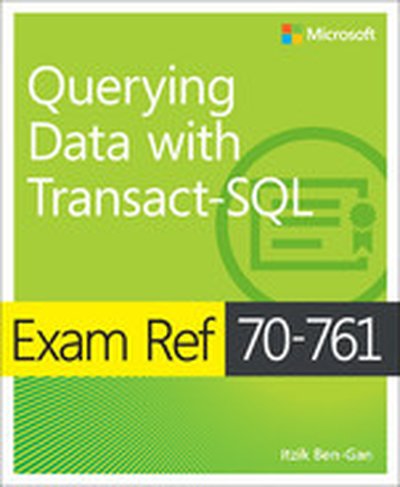
Exam Ref 70-761 Querying Data with Transact-SQL, 1st Edition

Prepare for Microsoft Exam 70-761–and help demonstrate your real-world mastery of SQL Server 2016 Transact-SQL data management, queries, and database programming. Designed for experienced IT professionals ready to advance their status, Exam Ref focuses on the critical-thinking and decision-making acumen needed for success at the MCSA level. Focus on the expertise measured by these objectives: Filter, sort, join, aggregate, and modify data Use subqueries, table expressions, grouping sets, and pivoting Query temporal and non-relational data, and output XML or JSON Create views, user-defined functions, and stored procedures Implement error handling, transactions, data types, and nulls This Microsoft Exam Ref: Organizes its coverage by exam objectives Features strategic, what-if scenarios to challenge you Assumes you have experience working with SQL Server as a database administrator, system engineer, or developer Includes downloadable sample database and code for SQL Server 2016 SP1 (or later) and Azure SQL Database Querying Data with Transact-SQL About the Exam Exam 70-761 focuses on the skills and knowledge necessary to manage and query data and to program databases with Transact-SQL in SQL Server 2016. About Microsoft Certification Passing this exam earns you credit toward a Microsoft Certified Solutions Associate (MCSA) certification that demonstrates your mastery of essential skills for building and implementing on-premises and cloud-based databases across organizations. Exam 70-762 (Developing SQL Databases) is also required for MCSA: SQL 2016 Database Development certification. See full details at: microsoft.com/learning

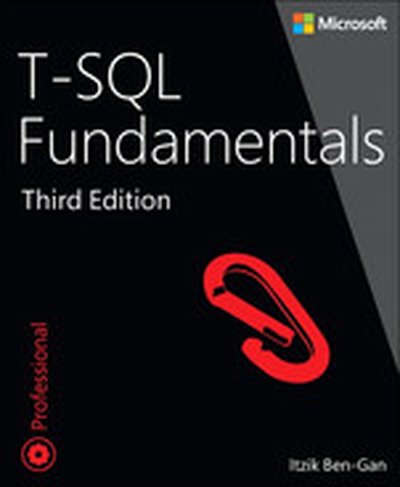
T-SQL Fundamentals, Third Edition

Effectively query and modify data using Transact-SQL Master T-SQL fundamentals and write robust code for Microsoft SQL Server and Azure SQL Database. Itzik Ben-Gan explains key T-SQL concepts and helps you apply your knowledge with hands-on exercises. The book first introduces T-SQL’s roots and underlying logic. Next, it walks you through core topics such as single-table queries, joins, subqueries, table expressions, and set operators. Then the book covers more-advanced data-query topics such as window functions, pivoting, and grouping sets. The book also explains how to modify data, work with temporal tables, and handle transactions, and provides an overview of programmable objects. Related Content Book: T-SQL Fundamentals, 4th Edition Microsoft Data Platform MVP Itzik Ben-Gan shows you how to: Review core SQL concepts and its mathematical roots Create tables and enforce data integrity Perform effective single-table queries by using the SELECT statement Query multiple tables by using joins, subqueries, table expressions, and set operators Use advanced query techniques such as window functions, pivoting, and grouping sets Insert, update, delete, and merge data Use transactions in a concurrent environment Get started with programmable objects–from variables and batches to user-defined functions, stored procedures, triggers, and dynamic SQL

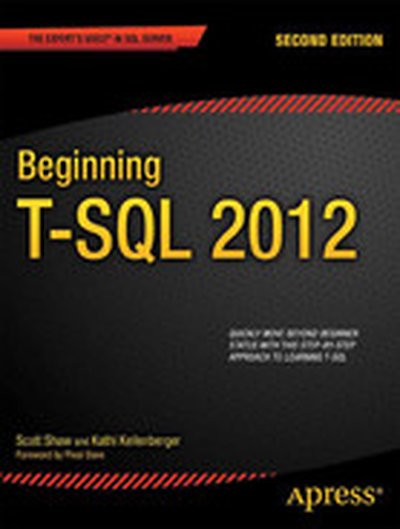
Beginning T-SQL 2012

Beginning T-SQL 2012 is the first step toward learning the T-SQL language that underlies Microsoft's SQL Server database engine. T-SQL is essential in writing SQL statements to get data into and out of a database. T-SQL is the foundation for business logic embedded in the database in the form of stored procedures and functions. Beginning T-SQL 2012 starts you on the path to mastering T-SQL, with an emphasis on best practices and sound coding techniques. Beginning T-SQL 2012 begins with an introduction to databases, normalization, and to SQL Server Management Studio. Each subsequent chapter teaches an aspect of T-SQL, building on the skills learned in previous chapters. Exercises in each chapter give readers an opportunity for the hands-on practice that leads to true learning and distinguishes the competent professional. Imparts best practices for writing T-SQL Helps you avoid common errors Shows how to write scalable code for good performance

Beginning Transact-SQL with SQL Server 2000 and 2005

Beginning Transact-SQL with SQL Server 2000 and 2005 Transact-SQL is a powerful implementation of the ANSI standard SQL database query language. In order to build effective database applications, you must gain a thorough understanding of these features. This book provides you with a comprehensive introduction to the T-SQL language and shows you how it can be used to work with both the SQL Server 2000 and 2005 releases. Beginning with an overview of the SQL Server query operations and tools that are used with T-SQL, the author goes on to explain how to design and build applications of increasing complexity. By gaining an understanding of the power of the T-SQL language, you'll be prepared to meet the ever-increasing demands of programming. What you will learn from this book How T-SQL provides you with the means to create tools for managing hundreds of databases Various programming techniques that use views and stored procedures Ways to optimize query performance How to create databases that will be an essential foundation to applications you develop later Who this book is for This book is for database developers and administrators who have not yet programmed with Transact-SQL. Some familiarity with relational databases and basic SQL is helpful, and some programming experience is helpful. Wrox Beginning guides are crafted to make learning programming languages and technologies easier than you think, providing a structured, tutorial format that will guide you through all the techniques involved.

Transact-SQL Cookbook

This unique cookbook contains a wealth of solutions to problems that SQL programmers face all the time. The recipes inside range from how to perform simple tasks, like importing external data, to ways of handling issues that are more complicated, like set algebra. Authors Ales Spetic and Jonathan Gennick, two authorities with extensive database and SQL programming experience, include a discussion with each recipe to explain the logic and concepts underlying the solution.SQL (Structured Query Language) is the closest thing to a standard query language that currently exists, and Transact-SQL -- a full-featured programming language that dramatically extends the power of SQL -- is the procedural language of choice for both Microsoft SQL Server and Sybase SQL Server systems. The Transact-SQL Cookbook is designed so you can use the recipes directly, as a source of ideas, or as a way to learn a little more about SQL and what you can do with it. Topics covered include: With an abundance of recipes to help you get your job done more efficiently, the Audit logging. In addition to recipes for implementing an audit log, this chapter also includes recipes for: improving performance where large log tables are involved; supporting multiple-languages; and simulating server push. Hierarchies. Recipes show you how to manipulate hierarchical data using Transact-SQL. Importing data. This chapter introduces concepts like normalization and recipes useful for working with imported data tables. Sets. Recipes demonstrate different operations, such as how to find common elements, summarize the data in a set, and find the element in a set that represents an extreme. Statistics. This chapter?s recipes show you how to effectively use SQL for common statistical operations from means and standard deviations to weighted moving averages. Temporal data. Recipes demonstrate how to construct queries against time-based data. Data Structures. This chapter shows how to manipulate data structures like stacks, queues, matrices, and arrays. Transact-SQL Cookbook is sure to become an essential part of your library.

The Guru's Guide to Transact-SQL

Since its introduction over a decade ago, the Microsoft SQL Server query language, Transact-SQL, has become increasingly popular and more powerful. The current version sports such advanced features as OLE Automation support, cross-platform querying facilities, and full-text search management. This book is the consummate guide to Microsoft Transact-SQL. From data type nuances to complex statistical computations to the bevy of undocumented features in the language, imparts the knowledge you need to become a virtuoso of the language as quickly as possible. The Guru's Guide to Transact-SQL In this book, you will find the information, explanations, and advice you need to master Transact-SQL and develop the best possible Transact-SQL code. Some 600 code examples not only illustrate important concepts and best practices, but also provide working Transact-SQL code that can be incorporated into your own real-world DBMS applications. Your journey begins with an introduction explaining language fundamentals such as database and table creation, inserting and updating data, queries, joins, data presentation, and managing transactions. Moving on to more advanced topics, the journey continues with in-depth coverage of: Transact-SQL performance tuning using tools such as Query Analyzer and Performance Monitor Nuances of the various T-SQL data types Complex statistical calculations such as medians, modes, and sliding aggregates Run, sequence, and series identification and interrogation Advanced Data Definition Language (DDL) and Data Management Language (DML) techniques Stored procedure and trigger best practices and coding methods Transaction management Optimal cursor use and caveats to look out for Full-text search Hierarchies and arrays Administrative Transact-SQL OLE Automation More than 100 undocumented commands and language features, including numerous unpublished DBCC command verbs, trace flags, stored procedures, and functions Comprehensive, written in understandable terms, and full of practical information and examples, is an indispensable reference for anyone working with this database development language. The accompanying CD-ROM includes the complete set of code examples found in the book as well as a SQL programming environment that will speed the development of your own top-notch Transact-SQL code. The Guru's Guide to Transact-SQL