talk-data.com talk-data.com

Event

O'Reilly Data Engineering Books

2001-10-19 – 2027-05-25 Oreilly Visit website ↗

Activities tracked

397

Collection of O'Reilly books on Data Engineering.

Filtering by: Oracle ×

Sessions & talks

Showing 351–375 of 397 · Newest first

Search within this event →
TOAD® Handbook

TOAD Handbook is a guide for developing Oracle applications and administering Oracle databases with TOAD. Starting with installation and configuration, the book covers the TOAD SQL editors in depth, including dozens of helpful, undocumented features. Later chapters discuss reporting and exporting data and using several add-on tools designed to enhance TOAD development. Along the way, the authors provide critical insights into the workings of TOAD and how developers can use it to make the most of their applications. Includes a foreword by Jim McDaniel, the inventor of TOAD.

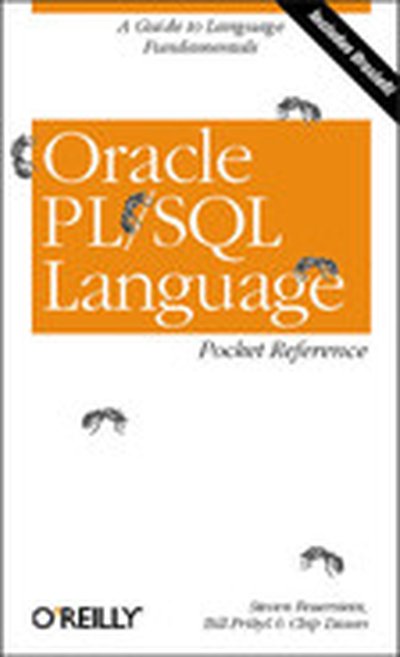
Oracle PL/SQL Language Pocket Reference, Second Edition

Like most PL/SQL programmers, you've found Oracle PL/SQL Programming to be a reference book you can't do without. Packed with examples and recommendations, it's a book that has helped everyone, from Oracle Forms developers to database administrators, make the most of PL/SQL. But you can't always carry it with you, and even at your desk there are times when you just need a reminder, a quick answer to a problem you're up against. For times like those, PL/SQL experts Stephen Feuerstein, Bill Pribyl, and Chip Dawes have written a new edition of Oracle PL/SQL Language Pocket Reference. Updated for Oracle9i, this little book is easy to take with you and use anywhere for quick problem solving. The second edition of the Oracle PL/SQL Language Pocket Reference boils down the most vital information from Oracle PL/SQL Programming into a convenient quick reference to PL/SQL basics. This compact book will be indispensable for new and seasoned Oracle database developers alike. It summarizes features available in Oracle9i and provides essential information on PL/SQL block structure, fundamental language elements, control statements, and use of procedures, functions, packages, triggers, Oracle objects, external procedures, and methods of calling Java classes from PL/SQL. O'Reilly's Pocket References have become a favorite among developers and database administrators everywhere. By providing a wealth of important details in a concise, well-organized format, these handy books deliver just what you need to complete the task at hand. When you've reached a sticking point in your work and need to get to a solution quickly, the new edition of Oracle PL/SQL Language Pocket Reference is the book you'll want to have.

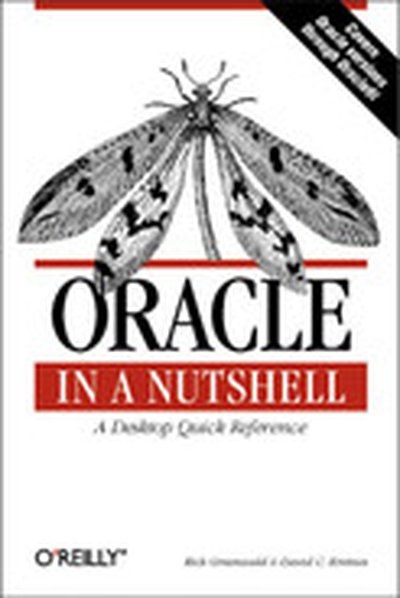
Oracle in a Nutshell

Introduced a quarter-century ago, the Oracle database remains the leading enterprise relational database management system (RDBMS) in the world. Oracle is a complex system, offering a myriad of products, languages, and tools. Frequent updates, releases, and editions complicate the ability of Oracle users to keep up with the huge amounts of frequently changing information about the database and its capabilities.The goal of Oracle in a Nutshell is to pull together the most essential information on Oracle architecture, syntax, and user interfaces. The content and format of this book, an admirable addition to O'Reilly's respected In-a-Nutshell line, combine to boil down vital Oracle commands, language constructs, parameters, and file formats in a succinct and highly accessible desktop reference. Oracle in a Nutshell covers the information that database administrators PL/SQL and Java developers, and system, network, and security administrators need as they manage Oracle databases and write code for these databases. It includes: Oracle Foundations--Overview of the Oracle architecture (memory structures and fundamental concepts), Oracle's various editions and packaging options, summary of the initialization file parameters and data dictionary views, and fundamentals of Oracle's concurrency scheme, security mechanisms (privileges, profiles, roles), and networking files (TNSNAMES.ORA, SQLNET.ORA, LISTENER.ORA, DAP.ORA, NAMES.ORA, CMAN.ORA) and options. Oracle Languages--Syntax summary for SQL language statements, SQL function calls PL/SQL language statements and characteristics, PL/SQL built-in package headers, and Java (JDBC and SQLJ) interfaces to the Oracle database. Oracle Tools--Commands provided with SQLPlus, SQLLoader, Import and Export, Oracle Recovery Manager (RMAN) and other backup/recovery methods, Oracle Enterprise Manager, and various performance tuning tools (Explain Plan, TKPROF, AUTOTRACE, UTLBSTAT, UTLESTAT, Statspack). Appendixes--Summary of Oracle datatypes, operators, expressions, conditions, numeric and date formats, and resources for additional reading.

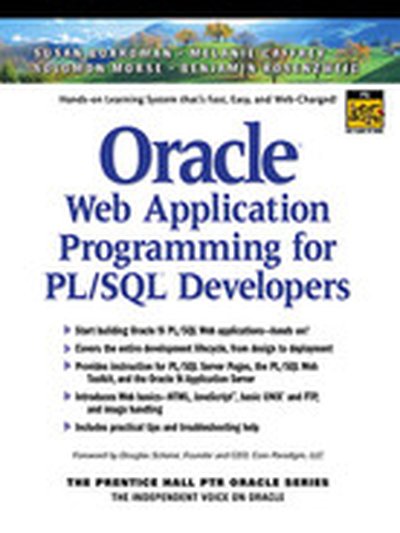
Oracle® Web Application Programming for PL/SQL® Developers

The hands-on, rapid-mastery guide to Oracle PL/SQL Web development. Start building Oracle 9i PL/SQL Web applications—hands on Covers the entire development lifecycle, from design to deployment Provides instruction for PL/SQL Server Pages, the PL/SQL Web Toolkit, and the Oracle 9i Application Server Introduces Web basics—HTML, JavaScript, basic UNIX and FTP, and image handling Reviews PL/SQL and SQL concepts Includes practical tips and troubleshooting help Leverage your SQL and PL/SQL experience to build powerful data-driven Web and e-business applications—starting right now! In this book, a team of Columbia University PL/SQL instructors cover the core pieces of what you need to know, from preliminary configuration to deployment of dynamic, data-driven applications. You'll find practical examples, hands-on exercises, and dozens of practical tips and solutions designed to save you time, effort, and frustration. One step at a time, discover how to: Configure Oracle's Internet Application Server Control Web applications and servers remotely Build Oracle Web applications with PL/SQL Create dynamic, data-driven pages Test, debug, troubleshoot, and deploy your applications Maintain and optimize running Web applications Whether you've been writing simple queries or complex PL/SQL code, this book takes your database development skills onto the Web—and into the future!

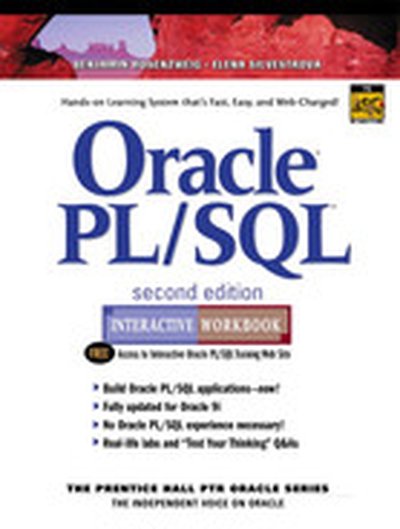
Oracle® PL/SQL® Interactive Workbook, Second Edition

Build Oracle PL/SQL applications—now. Fully updated for Oracle 9i No Oracle PL/SQL experience necessary. Real-life labs and "Test Your Thinking" Q&As Start developing applications with Oracle PL/SQL—fast. This integrated book-and-Web learning solution teaches all the Oracle PL/SQL skills you need, hands on, through real-world labs, exercises, projects, and a complete Web-based training site. Completely updated for Oracle 9i, it covers all the fundamentals—and a whole lot more. Master PL/SQL syntax, iterative and conditional control, scoping, anchored datatypes, cursors, triggers, security, tables, and packaging—plus powerful new techniques for working with exceptions, cursors, collections, and records. Your free Web-based training module includes a Virtual Study Lounge where you can interact with other learners, work on new projects, and get updates. Totally integrated with a FREE, state-of-the-art Oracle 9i learning Web site. Every Prentice Hall Oracle Interactive Workbook is fully integrated with its own exclusive Web site, giving you all this and more: "Test Your Thinking" project solutions and detailed explanations Additional self-review exercises with instant feedback and explanations An exclusive Virtual Study Lounge where you can interact with other students. Just the facts. No endless, boring discussions here. You'll learn hands on through practical exercises, self-review questions, and real-world answers. Exclusive "Test Your Thinking" projects guarantee you'll go beyond rote knowledge to really master the subject. It's an integrated learning system that's proven to work. Dozens of exercises cover the real-world tasks that matter most. Hundreds of self-review questions and answers make sure you understand.

Sams Teach Yourself XML in 10 Minutes

XML is the de-facto standard for manipulating and sharing data among applications. It is supported by every major programming tool and language, including Java, Microsoft .NET, Oracle, SQL Server, etc. All professional developers and administrators - even those who don't intend to build XML applications - need a basic understanding of it just to read and maintain data they receive and process. Many of them don't have the time for a thick reference book or detailed tutorial. Sams Teach Yourself XML in 10 Minutes quickly covers the basics of XML and its family of related concepts, including basic syntax, DTDs, XML Schema, DOM, SAX, XSL, and XPath. Each topic is illustrated with an example to ensure readers' understanding.

Sams Teach Yourself SQL in 21 Days, Fourth Edition

Sams Teach Yourself SQL in 21 Days, Fourth Edition provides a sold foundation in understanding the fundamentals of SQL (Structured Query Language). SQL is the query language used by relational databases such a Oracle, Microsoft Access, and Microsoft SQL Server. The new edition covers object-oriented programming with SQL, ODBC, JDBC, embedded SQL, accessing remote databases, and constructs. All new examples based on an open source database such as MySQL enhance this new edition by making the examples readily useable for readers.

Oracle SQL Plus Pocket Reference, 2nd Edition

SQLPlus is available at every Oracle site--from the largest data warehouse to the smallest single-user system--and it's a critical tool for virtually every Oracle user. Despite its wide use, few developers and DBAs know how powerful a tool SQLPlus can be. This pocket reference provides quick reference information that will help you use SQLPlus, Oracle's interactive query tool. It summarizes all of the SQLPlus syntax, including the syntax for the Oracle9i release. This book boils down the most vital information from Gennick's best-selling book, "Oracle SQL8Plus: The Definitive Guide", into an accessible summary and works as a vital companion to the larger book. It concisely describes interacting with SQLPlus, selecting data, formatting reports with SQLPlus, and tuning SQL queries. It also contains quick references to the SQLPlus commands and format elements. The new 2nd edition of our Oracle SQLPlus Pocket Reference includes many new features for Oracle9i (e.g., COALESCE function, searched CASE expressions, new table join syntax, partition operations, MERGE statement, and syntax changes in existing SQLPlus statements such as ACCEPT, DESRIBE, HELP, and SET) It also adds sections on basic SQL (a much-requested feature): INSERT, DELETE, UPDATE, SELECT, and transaction management. The pocket reference size is especially appropriate for this particular subject, since Oracle SQLPlus is used on every possible platform, it's particularly convenient to be able to carry a small book around from office computer to home computer to laptop.

XML Schema Complete Reference, The

With the successful implementation of XML Schema, developers are learning how to increase productivity, improve software reliability, minimize development time, and decrease time to market. This in-depth reference is an all-in-one resource designed to help developers leverage the power and potential of XML schemas by offering a complete roadmap to their creation, design, and use. This authoritative reference and tutorial is filled with practical insights and detailed examples. The book begins by providing a conceptual introduction to XML Schema. From there, coverage shifts to the W3C Schema Recommendation and how to apply schemas to specific business goals. The authors provide insight and instruction throughout on integrating XML schemas into existing technologies such as .NET, Java, Visual Basic, Oracle, and more. The book concludes with a complete case study designed to reinforce and illustrate material covered. Additional topics include: Applications for schemas Simple and complex types XML schema processing and validation Namespaces in XML Using schemas with DOM and SAX XML schema document syntax XML Information Sets XML Schema applications of XPath Whether designing a schema from scratch or integrating schemas into contemporary technologies, is the most complete and definitive sourcebook available for the XML Schema environment. The XML Schema Complete Reference 0672323745B08162002

Oracle PL/SQL Programming, Third Edition

Nearly a quarter-million PL/SQL programmers--novices and experienced developers alike--have found the first and second editions of Oracle PL/SQL Programming to be indispensable references to this powerful language. Packed with examples and recommendations, this book has helped everyone, from Oracle Forms developers to database administrators, make the most of PL/SQL. This new edition is a comprehensive update of the original book, covering all versions of PL/SQL through Oracle9i Release 2. It adds much-requested new chapters on how to create and run PL/SQL programs, call Java methods from within PL/SQL, and define and use database triggers. An extensive new chapter--designed especially for experienced PL/SQL developers--describes PL/SQL's runtime architecture and how to use knowledge of Oracle internals to get the best performance from PL/SQL. The book contains information about the latest Oracle9i PL/SQL features, including: Record-based DML: You can now use records in INSERT and DELETE statements. Table functions: These are functions that return a result set (in the form of a PL/SQL collection). Such functions existed in Oracle8i but they are now much expanded. New and improved datatypes: Oracle now offers dramatically improved support for timestamps, time zone management, and interval calculations. In addition, the XMLType datatype has now been implemented. Inheritance for object types: You can now define a hierarchy of object types (which were first introduced in Oracle8). Enhancements to PL/SQL collections. PL/SQL now supports multiple-level collections (nesting collections within collections), as well as associative arrays (previously called index-by tables), which allow you to index by PLS_INTEGER and VARCHAR2. Native compilation of PL/SQL code: PL/SQL source code can now optionally be compiled into native object code that is linked into Oracle. Part I, Programming in PL/SQL Part II, PL/SQL Program Structure Part III, PL/SQL Program Data Part IV, SQL in PL/SQL Part V, PL/SQL Application Construction Part VI, Advanced PL/SQL Topics The book is divided into six parts: Even if you've been a PL/SQL developer for years, you'll find an enormous amount of new and revised information in this third edition and on its companion web site. If you're new to PL/SQL, you'll find Oracle PL/SQL Programming an invaluable companion on the road to mastery.

Oracle SQL and PL/SQL Handbook: A Guide for Data Administrators, Developers, and Business Analysts

Concise and practical, this indispensable volume brings the world’s most popular Relational Database Management System (RDBMS), its query language SQL, and its programming language PL/SQL into clear focus for today’s busy database professional or business analyst. Covering the most commonly used Oracle features, is ideal for the developer or business user challenged with implementing, maintaining, and retrieving mission-critical data within the Oracle database environment. Oracle SQL and PL/SQL Handbook Broadly designed as both a basic reference and how-to, this book offers extensive coverage of Oracle’s SQL language and database concepts, providing an excellent review for the Oracle certification exams. The initial chapters offer a complete introduction to the relational database environment, including a discussion of how to use the logical data model to understand the database. Oracle database objects are explored, along with uses of the Data Definition Language (DDL), the Data Control Language (DCL), and the Data Manipulation Language (DML). Later chapters offer complete coverage of the Select command used to retrieve information from the database. Also included are coverage of Oracle’s new analytic functions, a chapter on performance-tuning techniqes needed for complex SQL, and a detailed overview of Oracle’s PL/SQL language. In addition, many chapters provide practice questions designed to reinforce newly introduced concepts, as well as numerous examples of SQL techniques. The broad-based and comprehensive coverage also includes: Understanding the database using entity relationship diagrams and database schema diagrams Applying the Data Definition, Data Control, and Data Manipulation languages to create and maintain the database Using the SQL language to retrieve information from the database Creating special business information using Oracle’s new analytic functions Making your SQL perform better with common troubleshooting techniques Producing business information with business objects Using Java with PL/SQL Authoritative and practical, provides today’s administrator and business analyst alike with the most comprehensive sourcebook of solutions and techniques for improving their use of Oracle. Oracle SQL and PL/SQL Handbook 0201752948B07152002

Database Tuning

Tuning your database for optimal performance means more than following a few short steps in a vendor-specific guide. For maximum improvement, you need a broad and deep knowledge of basic tuning principles, the ability to gather data in a systematic way, and the skill to make your system run faster. This is an art as well as a science, and Database Tuning: Principles, Experiments, and Troubleshooting Techniques will help you develop portable skills that will allow you to tune a wide variety of database systems on a multitude of hardware and operating systems. Further, these skills, combined with the scripts provided for validating results, are exactly what you need to evaluate competing database products and to choose the right one. Forward by Jim Gray, with invited chapters by Joe Celko and Alberto Lerner Includes industrial contributions by Bill McKenna (RedBrick/Informix), Hany Saleeb (Oracle), Tim Shetler (TimesTen), Judy Smith (Deutsche Bank), and Ron Yorita (IBM) Covers the entire system environment: hardware, operating system, transactions, indexes, queries, table design, and application analysis Contains experiments (scripts available on the author's site) to help you verify a system's effectiveness in your own environment Presents special topics, including data warehousing, Web support, main memory databases, specialized databases, and financial time series Describes performance-monitoring techniques that will help you recognize and troubleshoot problems

PHP and PostgreSQL: Advanced Web Programming

Sams¿ PHP and MySQL Web Development, by Luke Welling and Laura Thomson, showed that there is a strong demand for books that describe how to use PHP together with a specific open-source database to develop Web applications. While MySQL is very popular, PostgreSQL is widely considered to be the more powerful of the two open-source databases. And PostgreSQL is rapidly gaining market share large organizations are beginning to use PostgreSQL instead of Oracle; the demand for PostgreSQL training and support has increased by some accounts 50% in the last six months; and Web hosting services increasingly offer PostgreSQL along with MySQL. PHP and PostgreSQL Advanced Web Programming focuses on the specific needs of a PostgreSQL developer and will detail how to make use of PostgreSQL¿s unique, advanced features to develop high-availability, fail-safe Web applications with PHP and PostgreSQL.

Understanding Web Services: XML, WSDL, SOAP, and UDDI

Web services enable the new generation of Internet-based applications. These services support application-to-application Internet communication--that is, applications at different network locations can be integrated to function as if they were part of a single, large software system. Examples of applications made possible by Web services include automated business transactions and direct (nonbrowser) desktop and handheld device access to reservations, stock trading, and order-tracking systems. Several key standards have emerged that together form the foundation for Web services: XML (Extensible Markup Language), WSDL (Web Services Definition Language), SOAP (Simple Object Access Protocol), and UDDI (Universal Description, Discovery, and Integration). In addition, ebXML (Electronic Business XML) has been specified to facilitate automated business process integration among trading partners. This book introduces the main ideas and concepts behind core and extended Web services' technologies and provides developers with a primer for each of the major technologies that have emerged in this space. In addition, summarizes the major architectural approaches to Web services, examines the role of Web services within the .NET and J2EE communities, and provides information about major product offerings from BEA, Hewlett-Packard, IBM, IONA, Microsoft, Oracle, Sun Microsystems, and others. Understanding Web Services Key topics include: XML facilities for structuring and serializing data How WSDL maps services onto communication protocols and transports WSDL support for RPC-oriented and document-oriented interactions SOAP's required and optional elements Message processing and the role of intermediaries in SOAP UDDI data formats and APIs How ebXML offers an alternative to Web services that supports reliable messaging, security, and trading-partner negotiations With , you will be well informed and well positioned to participate in this vast, emerging marketplace. Understanding Web Services

Mastering Oracle SQL

If you write programs to run against an Oracle database, you spend a lot of time and mental energy writing queries to return the data your programs need. Knowledge of SQL, and particularly of Oracle's implementation of SQL, is the key to writing good queries in a timely manner. In this book, the authors share their knowledge of Oracle SQL, and show you many creative techniques that you can use to advantage in your own applications. This book shows you how to: Leverage Oracle's vast library of built-in SQL functions Query time-based data, and write joins involving date and time ranges Use Oracle SQL's hierarchical query features to deal with data best represented in a tree format Use DECODE and CASE to implement conditional logic in your queries Use Oracle's new, analytic SQL features to write ranking queries, lag and lead queries, windowing queries, and more Join data from two or more tables using the newly supported SQL92 join syntax In addition, you'll see how SQL can best be integrated with PL/SQL. You'll also learn various best practices to help you write SQL queries that perform efficiently. Precious few books on the market today go beyond discussing syntax and the barest rudiments of using Oracle SQL. This book changes that, showing you how to creatively leverage the full power of SQL to write queries in an Oracle environment.

Practical PostgreSQL

Arguably the most capable of all the open source databases, PostgreSQL is an object-relational database management system first developed in 1977 by the University of California at Berkeley. In spite of its long history, this robust database suffers from a lack of easy-to-use documentation. Practical PostgreSQL fills that void with a fast-paced guide to installation, configuration, and usage. This comprehensive new volume shows you how to compile PostgreSQL from source, create a database, and configure PostgreSQL to accept client-server connections. It also covers the many advanced features, such as transactions, versioning, replication, and referential integrity that enable developers and DBAs to use PostgreSQL for serious business applications. The thorough introduction to PostgreSQL's PL/pgSQL programming language explains how you can use this very useful but under-documented feature to develop stored procedures and triggers. The book includes a complete command reference, and database administrators will appreciate the chapters on user management, database maintenance, and backup & recovery. With Practical PostgreSQL, you will discover quickly why this open source database is such a great open source alternative to proprietary products from Oracle, IBM, and Microsoft.

Oracle SQL Tuning Pocket Reference

One of the most important challenges faced by Oracle database administrators and Oracle developers is the need to tune SQL statements so that they execute efficiently. Poorly tuned SQL statements are one of the leading causes of substandard database performance and poor response time. SQL statements that perform poorly result in frustration for users, and can even prevent a company from serving its customers in a timely manner. In this book, Mark Gurry shares his in-depth knowledge of Oracle's SQL statement optimizers. Mark's knowledge is the result of many hard-fought tuning battles during his many years of providing Oracle tuning services to clients. Mark provides insights into the workings of the rule-based optimizer that go well beyond what the rules tell you. Mark also provides solutions to many common problems that occur with both the rule-based and cost-based optimizers. In addition to the specific problem/solution scenarios for the optimizers, Mark provides a number of handy SQL tuning tips. He discusses the various optimizer hints, telling you when they can be used to good effect. Finally, Mark discusses the use of the DBMS_STATS package to manage database statistics, and the use of outlines to specify execution plans for SQL statements in third-party applications that you can't otherwise modify.

Oracle9i™ Development by Example

Learn the ins and outs of the Oracle9i development environment from product installation to advanced management configuration. Oracle 9i Development by Example provides coverage of everything from building, monitoring, and tuning an Oracle9i database to building forms and reports using developer 6i to understanding newer tools such as Log Miner in an easy to learn format.

Migrating Siebel Database from DB2/Oracle for NT to DB2 for OS/390

This IBM Redbooks publication will help you to migrate the Siebel 2000 V6.2.1 database from: DB2 for NT V6 to DB2 for OS/390 V6 Oracle for NT V8.1.6 to DB2 for NT V6 Oracle for NT V8.1.6 to DB2 for OS/390 V6 The book describes the migration experiences gained while migrating a Siebel 2000 database at the IBM ITSO Poughkeepsie Center in New York, and at the IBM Hursley Laboratory in the UK. It provides an overview of Siebel architecture, and introduces the migration methodology needed to move the Siebel database from a DB2/Oracle for NT platform to a DB2 for OS/390 platform. It offers a step-by-step description of the database migration process, and discusses in detail the different methods of moving data from one platform to the other. This book will be especially useful for those migrating the Siebel database for the first time.

Learning Oracle PL/SQL

PL/SQL, Oracle's programming language for stored procedures, delivers a world of possibilities for your database programs. PL/SQL supplements the standard relational database language, SQL, with a wide range of procedural features, including loops, IF-THEN statements, advanced data structures, and rich transactional control--all closely integrated with the Oracle database server. Knowing where to start with Oracle's procedural language is not always obvious to a newcomer, especially considering the language's feature set and the sheer size of the official documentation (not to mention Oracle's ever-increasing number of pre-built PL/SQL programs). But Learning Oracle PL/SQL offers the signposts and guidance you need to come up to speed on the language, delivered in a manageable number of pages while covering all the essentials. Topics include: PL/SQL--what is it, and why use it? Why use PL/SQL instead of Java? Syntax and examples of all core language constructs Creating, using, and reusing stored procedures, functions, and packages Building web-based applications using PL/SQL features available "out of the box" (such as PL/SQL Server Pages) Securing PL/SQL programs against attack Benefits of third-party developer tools and integrated development environments Connecting PL/SQL to email, Java, and the Internet Meticulously crafted with all-new examples downloadable from examples.oreilly.com/learnoracle, the book addresses language features available in all versions of Oracle, from Oracle7 to Oracle8i to Oracle9i. Learning Oracle PL/SQL was written by PL/SQL experts Bill Pribyl and Steven Feuerstein, whose easy-to-read style and attention to detail has made other O'Reilly books (such as the bestselling Oracle PL/SQL Programming) very popular among Oracle developers worldwide. Learning Oracle PL/SQL is meant for a wide range of target audiences, including both beginning programmers and those already experienced with other programming languages. Whether you are a new developer, a crossover programmer from another database system, or a new database administrator who needs to learn PL/SQL, this book will get you well on your way. It is the perfect introduction to Oracle PL/SQL Programming, also by Pribyl and Feuerstein.

Oracle RMAN Pocket Reference

Oracle RMAN Pocket Reference is a handy guide for DBAs who intend to use Oracle Recovery Manager for database backup and recovery. Because Recovery Manager (RMAN) is a relatively new tool, many DBAs are just becoming familiar with it. They will welcome a timely book that explains clearly and concisely how to use RMAN for common backup and recovery tasks that are infrequent, yet extremely vital. The first portion of the book is primarily task-oriented. After a short section on RMAN architecture, the book shows (in checklist style) how to perform common backup and recovery tasks such as: Implementing a recovery catalog Creating and running RMAN scripts Configuring input/output channels Taking a full database backup Backing up tablespaces and datafiles Taking incremental backups Recovering lost datafiles The second portion of the book consists of a handy syntax reference to the many RMAN commands. Having a quick reference to RMAN commands is a great convenience to DBAs who otherwise, often under the pressure of a recovery situation, would have to wade through Oracle's online documentation.

Backing Up Oracle Using Tivoli Storage Management

This IBM Redbooks publication is designed to assist Oracle Database administrators and system/storage administrators with Oracle backup solutions using Tivoli Storage Manager V4.1. The primary tool we used for backup and recovery is Tivoli Data Protection (TDP) for Oracle V1.1, and the book covers setup and configuration of TDP as well as day-to-day management examples. Operating environments covered by the project are AIX, Sun Solaris, and Microsoft Windows 2000. We provide an overview of relational database management systems and how to plan for protecting them. This book will help you install, tailor, and configure Tivoli Storage Manager and Tivoli Data Protection for Oracle on UNIX and Microsoft Windows 2000 platforms in order to accomplish backup and restore of Oracle8i databases. RMAN commands and setup are covered in detail, and emphasis is placed on practical recovery scenarios. Also featured are new solutions utilizing Tivoli's hardware integration features for IBM's ESS intelligent storage subsystem, as well as an update on using TDP for Oracle V2.2 new features. Note: This book replaces relevant sections of the earlier book, Using ADSM to Back Up Databases, SG24-4335-03, by updating and re-branding the content of that book.

Special Edition Using Oracle® 11i

The first part of Special Edition Using Oracle 11i introduces the Oracle ERP applications and R11i concepts. The reader is then educated on proven techniques for implementing these complex and integrated systems. Configuration and usage of each of the financial, distribution, manufacturing, HRMS, and projects applications are covered, followed by a discussion of working with Oracle Support, consulting firms, and compatible software vendors. The appendixes review the employment market, consulting opportunities, and provide the reader with an implementation checklist. All of R11i's new features are covered in-depth and in practical terms. Not only will readers understand Oracle's new capabilities, they will be able to apply them right away.

Practical SQL Handbook, The: Using SQL Variants, Fourth Edition

This latest edition of the best-selling implementation guide to the Structured Query Language teaches SQL fundamentals while providing practical solutions for critical business applications. now includes expanded platform SQL coverage and extensive real-world examples based on feedback from actual SQL users. The Practical SQL Handbook, Fourth Edition begins with a step-by-step introduction to SQL basics and examines the issues involved in designing SQL-based database applications. It fully explores SQL’s most popular implementations from industry leaders, Oracle, Microsoft, Sybase, and Informix. The Practical SQL Handbook Highlights include: Detailed coverage of SQL commands for creating databases, tables, and indexes, and for adding, changing, and deleting data Using the SELECT command to retrieve specific data Handling NULL values (missing information) in a relational database Joining tables, including self joins and outer joins (ANSI and WHERE-clause syntax) Working with nested queries (subqueries) to get data from multiple tables Creating views (virtual tables) to provide customized access to data Using SQL functions A bonus CD-ROM contains a time-limited, full-feature version of the Sybase® Adaptive Server Anywhere™ software as well as the sample database, scripts, and examples included in the book. is the most complete reference available for day-to-day SQL implementations. The Practical SQL Handbook 0201703092B05222001

Oracle Essentials: Oracle9i, Oracle8i and Oracle8, Second Edition

The second edition of O'Reilly's bestselling Oracle Essentials has been updated to include the latest Oracle release, Oracle9 i. Oracle Essentials distills an enormous amount of information about Oracle's myriad technologies and releases into a compact, easy-to-read volume filled with focused text, illustrations, and helpful hints. Oracle9 i promises to be an even more significant upgrade than Oracle8 i, offering such major features as Real Application Clusters, flashback queries, Oracle personalization, clickstream intelligence, and Oracle Database Cache and Web Cache; it also promises significant improvements in Oracle's business intelligence, XML integration, high availability, and management capabilities. The book includes overviews of these features, as well as the new Oracle9 I Application Server (Oracle9 iAS) and Oracle9 i Portal. The book contains chapters on: Oracle products, options, and overall architecture for Oracle9 i and other recent releases Installing and running Oracle: creating databases, configuring Net8 (known as Oracle Net in Oracle9 i), starting up and shutting down Oracle Oracle data structures, datatypes, and ways of extending datatypes Managing Oracle: security, the Oracle Enterprise Manager, fragmentation and reorganization, and backup and recovery Oracle networking, monitoring, and tuning Multi-user concurrency, online transaction processing (OLTP), and high availability Hardware architectures (e.g., SMP, MPP, NUMA) and their impact on Oracle Data warehousing and distributed databases Oracle9 i, Oracle8 i, and the Web, including the latest Java, web, and XML technologies, interMedia, Oracle9 i Application Server, and Oracle9 i Portal For new Oracle users, DBAs, developers, and managers, Oracle Essentials is an all-in-one introduction to the full range of Oracle features and technologies, including the just-released Oracle9 i features. But even if you already have a library full of Oracle documentation, this compact book is the one you'll turn to, again and again, as your one-stop, truly essential reference.