Businesses are collecting more data than ever before. But is bigger always better? Many companies are starting to question whether massive datasets and complex infrastructure are truly delivering results or just adding unnecessary costs and complications. How can you make sure your data strategy is aligned with your actual needs? What if focusing on smaller, more manageable datasets could improve your efficiency and save resources, all while delivering the same insights? Ryan Boyd is the Co-Founder & VP, Marketing + DevRel at MotherDuck. Ryan started his career as a software engineer, but since has led DevRel teams for 15+ years at Google, Databricks and Neo4j, where he developed and executed numerous marketing and DevRel programs. Prior to MotherDuck, Ryan worked at Databricks and focussed the team on building an online community during the pandemic, helping to organize the content and experience for an online Data + AI Summit, establishing a regular cadence of video and blog content, launching the Databricks Beacons ambassador program, improving the time to an “aha” moment in the online trial and launching a University Alliance program to help professors teach the latest in data science, machine learning and data engineering. In the episode, Richie and Ryan explore data growth and computation, the data 1%, the small data movement, data storage and usage, the shift to local and hybrid computing, modern data tools, the challenges of big data, transactional vs analytical databases, SQL language enhancements, simple and ergonomic data solutions and much more. Links Mentioned in the Show: MotherDuckThe Small Data ManifestoConnect with RyanSmall DataSF conferenceRelated Episode: Effective Data Engineering with Liya Aizenberg, Director of Data Engineering at AwayRewatch sessions from RADAR: AI Edition New to DataCamp? Learn on the go using the DataCamp mobile appEmpower your business with world-class data and AI skills with DataCamp for business
 talk-data.com

Speaker
Ryan Boyd
5
talks
Ryan Boyd is a Boulder-based software engineer, data + authNZ geek and technology executive. He's currently a co-founder at MotherDuck, where they're making data analytics fun, frictionless and ducking awesome. He previously led developer relations teams at Databricks, Neo4j and Google Cloud. He's the author of O'Reilly's Getting Started with OAuth 2.0. Ryan advises B2B SaaS startups on growth marketing and developer relations as a Partner at Hypergrowth Partners.
Bio from: Databricks DATA + AI Summit 2023
Filter by Event / Source
Talks & appearances
5 activities · Newest first
Silicon Valley engineers and engineering challenges have ruled the data world for 20 years. The net result is data infrastructure companies focus on the largest scale and fastest systems to process enormous amounts of data, regardless of usability. We don't all have movie libraries the size of Netflix, search indexes the size of Google, or social graphs the size of Meta.
Instead of focusing on consensus algorithms for large-scale distributed computing, our engineers should focus on making data more accessible and usable and reduce the time between "problem statement" and "answer". In this session, we explore the changes in hardware and mindsets, enabling a new breed of software optimized for the 95% of us who do not have petabytes to process daily.
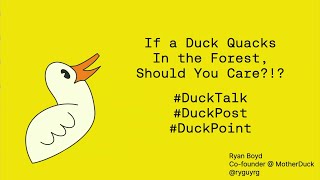
YES! "Duck posting" has become an internet meme for praising DuckDB on Twitter. Nearly every quack using DuckDB has done it once or twice. But, why all the fuss? With advances in CPUs, memory, SSDs, and the software that enables it all, our personal machines are powerful beasts relegated to handling a few Chrome tabs and sitting 90% idle. As data engineers and data analysts, this seems like a waste that's not only expensive, but also impacting the environment.
In this session, you will see how DuckDB brings SQL analytics capabilities to a 2MB standalone executable on your laptop that only recently required a large cluster. This session will explain the architecture of DuckDB that enables high performance analytics on a laptop: great query optimization, vectorized execution, continuous improvements in compression and more. We will show its capabilities using live demos, from the pandas library to WASM, to the command-line. We'll demonstrate performance on large datasets, and talk about how we're exploring using the laptop to augment cloud analytics workloads.
Talk by: Ryan Boyd
Here’s more to explore: Why the Data Lakehouse Is Your next Data Warehouse: https://dbricks.co/3Pt5unq Lakehouse Fundamentals Training: https://dbricks.co/44ancQs
Connect with us: Website: https://databricks.com Twitter: https://twitter.com/databricks LinkedIn: https://www.linkedin.com/company/databricks Instagram: https://www.instagram.com/databricksinc Facebook: https://www.facebook.com/databricksinc
Ryan Boyd and I chat about the evolution and future of databases, the pendulum between single-server and distributed computing, DuckDB and Motherduck, and much more.
We also talk about developer relations, which I consider Ryan as one of the OG's in the field.
Note - this was recorded the week of Databricks Summit 2023.
If you like this show, give it a 5-star rating on your favorite podcast platform.
Purchase Fundamentals of Data Engineering at your favorite bookseller.
Subscribe to my Substack: https://joereis.substack.com/