Découvrez comment Scor a déployé l’IA sur Azure pour transformer ses processus métier, avec des cas concrets d’assistants en production et une vision sur l’automatisation agent pour 2026. La session couvrira stratégie, gouvernance et retours d’usage à grande échelle.
 talk-data.com
Topic
AI/ML
Artificial Intelligence/Machine Learning
data_science
algorithms
predictive_analytics
9014
tagged
Activity Trend
1532
peak/qtr
2020-Q1
2026-Q1
Top Events
Google Cloud Next '25
761
Microsoft Ignite 2025
699
Google Cloud Next '24
553
Data + AI Summit 2025
425
O'Reilly Data Science Books
333
Databricks DATA + AI Summit 2023
287
Data Engineering Podcast
271
O'Reilly Data Engineering Books
240
DataFramed
239
Making Data Simple
223
AWS re:Invent 2024
223
DATA MINER Big Data Europe Conference 2020
215
Innovation ou productivité ? Pour les experts ou pour tous ? Généraliste ou spécialiste ? DIY ou clé en main ? POC ou transformation ? Ces arbitrages, toutes les organisations y font face. Rejoignez-nous pour comprendre comment en faire des leviers de compétitivité et passer du test à l’impact.
L’objectif de cet atelier sera de présenter un outil, basé sur un LLM, développé conjointement entre l'Unédic et Artik Consulting, qui permet d'évaluer la conformité d'une application d'IA à l'AI Act. Les concepteurs de cette solution vous en présenteront les enjeux, les solutions technologiques retenues et les raison de ces choix, ainsi que les résultats obtenus, notamment le formulaire d'évaluation.
Comment utiliser l'IA pour évaluer la conformité d'une application à l'AI Act.
There is an impossible choice most organizations face. Companies building modern AI face a brutal, binary-feeling decision: either ship a privacy-first model that “kinda low key sucks,” or ship a high-performing model that likely exposes sensitive personal data. Luckily, there's a third option, and that's what I will share with you in this episode! Check out Tonic Textual here: 👉 https://www.tonic.ai/products/textual 💌 Join 10k+ aspiring data analysts & get my tips in your inbox weekly 👉 https://www.datacareerjumpstart.com/newsletter 🆘 Feeling stuck in your data journey? Come to my next free "How to Land Your First Data Job" training 👉 https://www.datacareerjumpstart.com/training 👩💻 Want to land a data job in less than 90 days? 👉 https://www.datacareerjumpstart.com/daa 👔 Ace The Interview with Confidence 👉 https://www.datacareerjumpstart.com/interviewsimulator ⌚ TIMESTAMPS 00:00 - Introduction: The Ethical Dilemma in AI Development 01:21 - The "A Very Smith Health Solutions" LEAKED Zoom debate! 02:45 - Sensitive Data Discovery and Synthesis 03:41 - Redacting and Synthesizing Data with Tonic Textual 04:30 - Applications and Benefits 🔗 CONNECT WITH AVERY 🎥 YouTube Channel: https://www.youtube.com/@averysmith 🤝 LinkedIn: https://www.linkedin.com/in/averyjsmith/ 📸 Instagram: https://instagram.com/datacareerjumpstart 🎵 TikTok: https://www.tiktok.com/@verydata 💻 Website: https://www.datacareerjumpstart.com/ Mentioned in this episode: Join the last cohort of 2025! The LAST cohort of The Data Analytics Accelerator for 2025 kicks off on Monday, December 8th and enrollment is officially open!
To celebrate the end of the year, we’re running a special End-of-Year Sale, where you’ll get: ✅ A discount on your enrollment 🎁 6 bonus gifts, including job listings, interview prep, AI tools + more
If your goal is to land a data job in 2026, this is your chance to get ahead of the competition and start strong.
👉 Join the December Cohort & Claim Your Bonuses: https://DataCareerJumpstart.com/daa https://www.datacareerjumpstart.com/daa
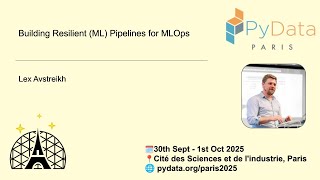
This talk explores the disconnect between MLOps fundamental principles and their practical application in designing, operating and maintaining machine learning pipelines. We’ll break down these principles, examine their influence on pipeline architecture, and conclude with a straightforward, vendor-agnostic mind-map, offering a roadmap to build resilient MLOps systems for any project or technology stack. Despite the surge in tools and platforms, many teams still struggle with the same underlying issues: brittle data dependencies, poor observability, unclear ownership, and pipelines that silently break once deployed. Architecture alone isn't the answer — systems thinking is.
We'll use concrete examples to walk through common failure modes in ML pipelines, highlight where analogies fall apart, and show how to build systems that tolerate failure, adapt to change, and support iteration without regressions.
Topics covered include: - Common failure modes in ML pipelines - Modular design: feature, training, inference - Built-in observability, versioning, reuse - Orchestration across batch, real-time, LLMs - Platform-agnostic patterns that scale
Key takeaways: - Resilience > diagrams - Separate concerns, embrace change - Metadata is your backbone - Infra should support iteration, not block it
FFT, a global leader in innovative manufacturing systems, has developed a solution to the persistent challenge of bridging IT and OT data. In just six months, FFT launched the FFT DataBridge, which resides on shopfloor edge devices and seamlessly integrates production data into the Snowflake AI Data Cloud. This solution unlocks critical shopfloor analytics, AI-based forecasting, and predictive maintenance. By leveraging the power of Snowflake, FFT is helping manufacturing companies transform their operations and is continuing their journey by building a suite of IT/OT-centric applications for the Snowflake Marketplace.
The retail and consumer goods industries are undergoing significant transformation, driven by shifting consumer behaviors, global economic changes, supply chain disruptions and, most importantly, rapid technological innovation. This session is designed for business and technology leaders in RCG, offering them insights and strategies needed to navigate and thrive in this evolving landscape. Learn from the transformational experience of the leading global consumer goods company, Snowflake industry experts and key partners as they explore how data and AI technologies are shaping the industries' future.
L'alliance entre un leader de l'assurance française et un pionnier de l'IA vocale souveraine.
Plongez dans les coulisses d’un partenariat stratégique : l’alliance entre BPCE Vie, acteur majeur de l’assurance en France, et Zaion, pionnier de l’IA vocale appliquée à la relation client. Lors de cette conférence, découvrez comment la solution GenAI Agent Assist révolutionne l’expérience client, notamment à travers la génération automatisée et en temps réel des comptes rendus post-appel pour les conseillers.
Ce retour d’expérience met en lumière la façon dont deux entreprises françaises s’appuient concrètement sur une technologie d’intelligence artificielle de nouvelle génération, souveraine et éthique, pour façonner l’avenir de la relation client—et illustrer la force de l’innovation « Made in France ».
IA, GRC et Cybersécurité
Découvrez comment Risk Hunter vous permet de maîtriser votre GRC et cybersécurité grâce à notre plateforme AI Driven Innovante.
Dans un monde où les volumes de données explosent et où les attentes en matière de performance analytique ne cessent de croître, construire une base de données réellement adaptée aux workloads modernes est un défi technique de taille. ClickHouse est une base de données open source orientée colonnes, conçue pour exécuter des requêtes analytiques en temps réel sur des milliards de lignes — avec une latence de l’ordre de la milliseconde.
Dans cette session technique, nous explorerons les choix architecturaux qui rendent cela possible : exécution vectorisée, stockage optimisé, traitement distribué, vues matérialisées et plus encore. Nous détaillerons aussi comment nous faisons évoluer ClickHouse au cœur de l’écosystème moderne de la donnée (cloud, IA, iceberg, observabilité) tout en restant fidèle à ses principes de performance et de simplicité.
Une plongée dans les coulisses d’un moteur analytique open source — pour répondre aux besoins d’aujourd’hui, et anticiper ceux de demain.
Quand on parle d’IA, on pense souvent à des cas d’usage précis : comment utiliser l’intelligence artificielle comme une extension du système d’information pour répondre à un besoin particulier.
Mais la vraie révolution n’est-elle pas ailleurs ? Positionner l’IA au cœur du système d’information transforme en profondeur la relation que l’on entretient avec celui-ci. Elle fait évoluer le SI d’un simple outil fonctionnel vers un environnement capable d’anticiper, de recommander et de simplifier l’ensemble des processus métier.
Agents IA
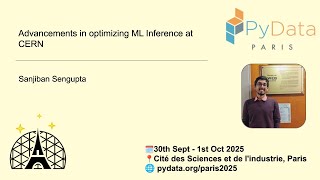
At CERN- the European Organization for Nuclear Research, machine learning is applied across a wide range of scenarios, from simulations and event reconstruction to classifying interesting experimental events, all while handling data rates in the order of terabytes per second. As a result, beyond developing complex models, CERN also requires highly optimized mechanisms for model inference.
From the ML4EP team at CERN, we have developed SOFIE (System for Optimized Fast Inference code Emit), an open-source tool designed for fast inference on ML models with minimal dependencies and low latency. SOFIE is under active development, driven by feedback not only from high-energy physics researchers but also from the broader scientific community.
With upcoming upgrades to CERN’s experiments expected to increase data generation, we have been investigating optimization methods to make SOFIE even more efficient in terms of time and memory usage, while improving its accessibility and ease of integration with other software stacks.
In this talk, we will introduce SOFIE and present novel optimization strategies developed to accelerate ML inference and reduce resource overhead.