talk-data.com talk-data.com

Topic

AI/ML

Artificial Intelligence/Machine Learning

data_science algorithms predictive_analytics

9014

tagged

Activity Trend

1532 peak/qtr
2020-Q1 2026-Q1

Activities

9014 activities · Newest first

Searching for My Next Chart

Abstract

As a data visualization practitioner, I frequently draw inspiration from the diverse and rapidly expanding community, particularly through challenges like #TidyTuesday. However, the sheer volume of remarkable visualizations quickly overwhelmed my manual curation methods—from Pinterest boards to Notion pages. This created a significant bottleneck in my workflow, as I found myself spending more time cataloging charts than actively creating them.

In this talk, I will present a RAG (Retrieval Augmented Generation) based retrieval system that I designed specifically for data visualizations. I will detail the methodology behind this system, illustrating how I addressed my own workflow inefficiencies by transforming a dispersed collection of charts into a semantically searchable knowledge base. This project serves as a practical example of applying advanced AI techniques to enhance creative technical work, demonstrating how a specialized retrieval system can significantly improve the efficiency and quality of data visualization creation process.

In this episode, Conor and Bryce chat with Sean Parent about AI and Cursor! Link to Episode 253 on WebsiteDiscuss this episode, leave a comment, or ask a question (on GitHub)Socials ADSP: The Podcast: TwitterConor Hoekstra: Twitter | BlueSky | MastodonBryce Adelstein Lelbach: TwitterAbout the Guest: Sean Parent is a senior principal scientist and software architect managing Adobe's Software Technology Lab. Sean first joined Adobe in 1993 working on Photoshop and is one of the creators of Photoshop Mobile, Lightroom Mobile, and Lightroom Web. In 2009 Sean spent a year at Google working on Chrome OS before returning to Adobe. From 1988 through 1993 Sean worked at Apple, where he was part of the system software team that developed the technologies allowing Apple’s successful transition to PowerPC. Show Notes Date Recorded: 2025-08-21 Date Released: 2025-09-26 C++ Under the SeaBetter codeAdobe ASL Adam & Eve ArchitectureAdobe Software Technology LabASL LibrariesRust Programming LanguageIntro Song Info Miss You by Sarah Jansen https://soundcloud.com/sarahjansenmusic Creative Commons — Attribution 3.0 Unported — CC BY 3.0 Free Download / Stream: http://bit.ly/l-miss-you Music promoted by Audio Library https://youtu.be/iYYxnasvfx8

Operationalizing ML isn’t just about models — it’s about moving and engineering data. At Hopsworks, we built a composable AI pipeline builder (Brewer) based on two principles: Tasks and Data Sources. This lets users define workflows that automatically analyse, clean, create and update feature groups, without glue code or brittle scheduling logic.

In this talk, we’ll show how Brewer drives the automation of feature engineering, enabling reproducible, declarative pipelines that respond to changes in upstream data. We’ll explore how this fits into broader ML workflows, from ingestion to feature materialization, and how it integrates with warehouses, streams, and file-based systems.

How to Keep Your LLM Chatbots Real: A Metrics Survival Guide

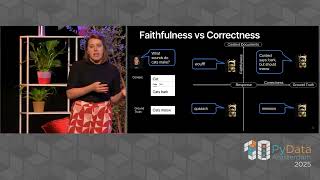
In this brave new world of vibe coding and YOLO-to-prod mentality, let’s take a step back and keep things grounded (pun intended). None of us would ever deploy a classical ML model to production without clearly defined metrics and proper evaluation, so let's talk about methodologies for measuring performance of LLM-powered chatbots. Think of retriever recall, answer relevancy, correctness, faithfulness and hallucination rates. With the wild west of metric standards still in full swing, I’ll guide you through the challenges of curating a synthetic test set, and selecting suitable metrics and open-source packages that help evaluating your use case. Everything is possible, from simple LLM-as-a-judge approaches like those inherent to many packages like MLFLow now up to complex multi-step quantification approaches with Ragas. If you work in the GenAI space or with LLM-powered chatbots, this session is for you! Prior or background knowledge is of advantage, but not required.

This talk presents an end-to-end solution for detecting unattended objects in public transport hubs to enhance social security. The project, developed in a three-week challenge, focuses on proactively identifying unattended items using existing camera infrastructure. We will cover the entire pipeline, from data anonymization and preprocessing to building a data labeling platform, object detection with YOLO, and tracking objects over time. The presentation will also discuss the evaluation of the system.

Recently, the integration of Generative AI (GenAI) technologies into both our personal and professional lives has surged. In most organizations, the deployment of GenAI applications is on the rise, and this trend is expected to continue in the foreseeable future. Evaluating GenAI systems presents unique challenges not present in traditional ML. The main peculiarity is the absence of ground truth for textual metrics such as: text clarity, location extraction accuracy, factual accuracy and so on. Nevertheless the non-negligible model serving cost demands an even more thorough evaluation of the system to be deployed in production.

Defining the metric ground truth is a costly and time consuming process requiring human annotation. To address this, we are going to present how to evaluate LLM-based applications by leveraging LLMs themselves as evaluators. Moreover we are going to outline the complexities and evaluation methods for LLM-based Agents which operate with autonomy and present further evaluation challenges. Lastly, we will explore the critical role of evaluation in the GenAI lifecycle and outline the steps taken to integrate these processes seamlessly.

Whether you are an AI practitioner, user or enthusiast, join us to gain insights into the future of GenAI evaluation and its impact on enhancing application performance.

Optimize the Right Thing: Cost-Sensitive Classification in Practice

Not all mistakes in machine learning are equal—a false negative in fraud detection or medical diagnosis can be far costlier than a false positive. Cost-sensitive learning helps navigate these trade-offs by incorporating error costs into the training process, leading to smarter decision-making. This talk introduces Empulse, an open-source Python package that brings cost-sensitive learning into scikit-learn. Attendees will learn why standard models fall short in cost-sensitive scenarios and how to build better classifiers with Scikit-Learn and Empulse.

Image processing, artificial intelligence, and autonomous systems

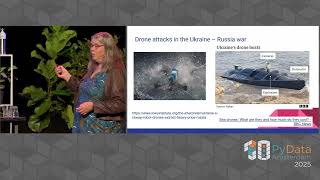
In this talk, an overview of the field of image processing and the impact of artificial intelligence on this field are shown. Starting from the different tasks that can be performed with image processing, solutions using different AI technologies are shown, including the use of generative AI. Finally, the effect of AI for autonomous systems, and the challenges that are faced are discussed.

DAX for Humans

Level up your Power BI skills by learning DAX in an easy, fun, and practical way using one core pattern that can be used to solve most problems Key Features Learn simple through advanced DAX in a clear, concise way using real-world examples Explore powerful techniques for debugging DAX and increasing efficiency Use artificial intelligence to write, refine, and troubleshoot your DAX formulas Purchase of the print or Kindle book includes a free PDF eBook Book Description Although DAX has been around for over a decade, many struggle to master the language primarily because DAX is often taught through the CALCULATE function, which is the most complex and unintuitive function in all of DAX. But what if DAX could be taught without CALCULATE? The result would be an incredibly intuitive and easy way to learn DAX. DAX for Humans stands the traditional approach to learning DAX on its head, foregoing the traditional, legacy methods of learning DAX for a more modern approach that focuses on core DAX concepts and not any specific function. Even if you know nothing about DAX, from the very first chapter you will learn the essentials of the DAX language, as well as a single pattern to solve the majority of DAX problems. From that point forward, you’ll explore how to work with the basic building blocks of the DAX language and apply what you learn to real-world business scenarios across customers, human resources, projects, finance, operations, and more. By the end of this book, you’ll be able to apply your DAX skills to simple, complex, and advanced scenarios; understand how to optimize and debug your DAX code; and even know how to efficiently apply artificial intelligence to help you write and debug your DAX code. What you will learn Master techniques to solve common DAX calculations Apply DAX to real-word, practical business scenarios Explore advanced techniques for tackling unusual DAX scenarios Discover new ideas, tricks, and time-saving techniques for better calculations Find out how to optimize and debug DAX effectively Leverage AI to assist in writing, troubleshooting, and improving DAX Who this book is for If you use Power BI but struggle with DAX or if you know DAX but want to improve and expand your skills, then this book is for you. Even if you have never used Power BI or DAX before, you will find this book helpful as you progress from the basics to mastery of the DAX language using real-world scenarios as your guide.

Mina will highlight why AI ethics matter and how the regulatory landscape is evolving. She will show how organizations can go beyond compliance toward true leadership in responsible AI - embedding ethical principles into daily work and long-term strategy. She’ll also explain why this is especially relevant for Deutsche Bank, where ESG is central, and how AI can support more sustainable and responsible business practices.