talk-data.com talk-data.com

Topic

analytics-platforms

402

tagged

Activity Trend

1 peak/qtr
2020-Q1 2026-Q1

Activities

402 activities · Newest first

Qlikview Unlocked

Dive into the world of QlikView with 'QlikView Unlocked,' a comprehensive guide to mastering this powerful business intelligence tool. This book is packed with practical tips, actionable advice, and hands-on techniques to help you design, develop, and optimize QlikView applications efficiently. Whether you're looking to improve your scripting skills, enhance data visualization, or streamline your project workflows, this book covers it all. What this Book will help me do You will learn how to effectively build and configure the QlikView environment for robust and flexible solutions. Gain expertise in applying QlikView development best practices to create optimized and efficient projects. Learn advanced techniques for data modeling and service integration to enhance project scalability. Find out how to troubleshoot and solve common challenges in server deployment and publisher setups. Master data visualization strategies and create stunning, user-friendly dashboards leveraging QlikView's capabilities. Author(s) Roger Stone and Andrew Dove are experienced QlikView developers and consultants with years of practice in delivering optimal business intelligence solutions. They are passionate about sharing their knowledge to empower developers of all levels to realize the potential of QlikView. Their writing is approachable, focusing on practical applications and actionable guidance. Who is it for? This book is ideal for professionals involved in designing or supporting QlikView applications, ranging from beginners getting their first exposure to data-driven decision making to seasoned developers looking for advanced techniques. It's perfect for consultants, data analysts, or anyone seeking to refine their QlikView skills and create impactful business intelligence solutions.
Sharpening Your Advanced SAS Skills

This guide presents sophisticated SAS programming techniques, procedures, and tools, such as Proc SQL, hash tables, and SAS Macro programming, for any industry. It empowers both advanced programmers who need a quick refresher and programmers interested in learning new techniques. It shows how to take advantage of the latest SAS options and new SAS procedures. The book illustrates syntax with simple, common task-oriented examples and prepares readers for the advanced SAS certification exam. Mindmaps and process flowcharts are available on the author's website.

SAS Programming and Data Visualization Techniques: A Power User’s Guide

SAS Programming and Data Visualization Techniques: A Power User’s Guide brings together a wealth of ideas about strategic and tactical solutions to everyday situations experienced when transferring, extracting, processing, analyzing, and reporting the valuable data you have at your fingertips. Best, you can achieve most of the solutions using the SAS components you already license, meaning that this book’s insights can keep you from throwing money at problems needlessly. Author Philip R. Holland advises a broad range of clients throughout Europe and the United States as an independent consultant and founder of Holland Numerics Ltd, a SAS technical consultancy. In this book he explains techniques—through code samples and example—that will enable you to increase your knowledge of all aspects of SAS programming, improve your coding productivity, and interface SAS with other programs. He also provides an expert’s overview of Graph Templates, which was recently moved into Base SAS. You will learn to create attractive, standardized, reusable, and platform-independent graphs—both statistical and non-statistical—to help you and your business users explore, visualize, and capitalize on your company’s data. In addition, you will find many examples and cases pertaining to healthcare, finance, retail, and other industries. Among other things, SAS Programming and Data Visualization Techniques will show you how to: Write efficient and reusable SAS code Combine look-up data sets with larger data sets effectively Run R and Perl from SAS Run SAS programs from SAS Studio and Enterprise Guide Output data into insightful, valuable charts and graphs SAS Programming and Data Visualization Techniques prepares you to make better use of your existing SAS components by learning to use the newest features, improve your coding efficiency, help you develop applications that are easier to maintain, and make data analysis easier. In other words, it will save you time, money, and effort—and make you a more valuable member of the development team.

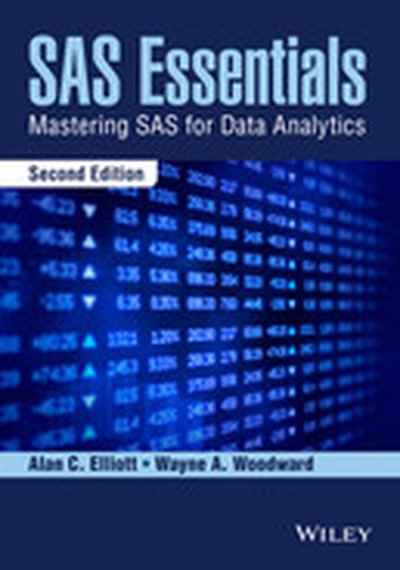
SAS Essentials: Mastering SAS for Data Analytics, 2nd Edition

A step-by-step introduction to using SAS statistical software as a foundational approach to data analysis and interpretation Presenting a straightforward introduction from the ground up, SAS Essentials: Mastering SAS for Data Analytics, Second Edition illustrates SAS using hands-on learning techniques and numerous real-world examples. Keeping different experience levels in mind, the highly-qualified author team has developed the book over 20 years of teaching introductory SAS courses. Divided into two sections, the first part of the book provides an introduction to data manipulation, statistical techniques, and the SAS programming language. The second section is designed to introduce users to statistical analysis using SAS Procedures. Featuring self-contained chapters to enhance the learning process, the Second Edition also includes: Programming approaches for the most up-to-date version of the SAS platform including information on how to use the SAS University Edition Discussions to illustrate the concepts and highlight key fundamental computational skills that are utilized by business, government, and organizations alike New chapters on reporting results in tables and factor analysis Additional information on the DATA step for data management with an emphasis on importing data from other sources, combining data sets, and data cleaning Updated ANOVA and regression examples as well as other data analysis techniques A companion website with the discussed data sets, additional code, and related PowerPoint slides SAS Essentials: Mastering SAS for Data Analytics, Second Edition is an ideal textbook for upper-undergraduate and graduate-level courses in statistics, data analytics, applied SAS programming, and statistical computer applications as well as an excellent supplement for statistical methodology courses. The book is an appropriate reference for researchers and academicians who require a basic introduction to SAS for statistical analysis and for preparation for the Basic SAS Certification Exam.

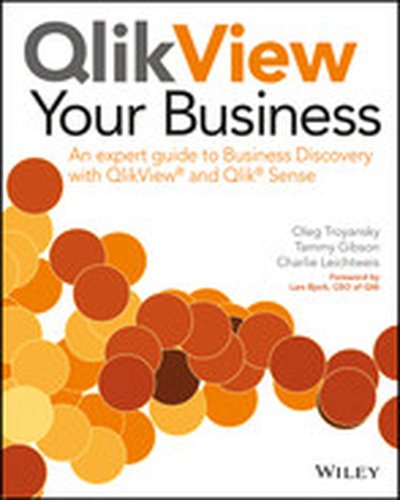
QlikView Your Business

Unlock the meaning of your data with QlikView The Qlik platform was designed to provide a fast and easy data analytics tool, and QlikView Your Business is your detailed, full-color, step-by-step guide to understanding Qlikview's powerful features and techniques so you can quickly start unlocking your data’s potential. This expert author team brings real-world insight together with practical business analytics, so you can approach, explore, and solve business intelligence problems using the robust Qlik toolset and clearly communicate your results to stakeholders using powerful visualization features in QlikView and Qlik Sense. This book starts at the basic level and dives deep into the most advanced QlikView techniques, delivering tangible value and knowledge to new users and experienced developers alike. As an added benefit, every topic presented in the book is enhanced with tips, tricks, and insightful recommendations that the authors accumulated through years of developing QlikView analytics. This is the book for you: If you are a developer whose job is to load transactional data into Qlik BI environment, and who needs to understand both the basics and the most advanced techniques of Qlik data modelling and scripting If you are a data analyst whose job is to develop actionable and insightful QlikView visualizations to share within your organization If you are a project manager or business person, who wants to get a better understanding of the Qlik Business Intelligence platform and its capabilities What You Will Learn: The book covers three common business scenarios - Sales, Profitability, and Inventory Analysis. Each scenario contains four chapters, covering the four main disciplines of business analytics: Business Case, Data Modeling, Scripting, and Visualizations. The material is organized by increasing levels of complexity. Following our comprehensive tutorial, you will learn simple and advanced QlikView and Qlik Sense concepts, including the following: Data Modeling: Transforming Transactional data into Dimensional models Building a Star Schema Linking multiple fact tables using Link Tables Combing multiple tables into a single fact able using Concatenated Fact models Managing slowly changing dimensions Advanced date handling, using the As of Date table Calculating running balances Basic and Advanced Scripting: How to use the Data Load Script language for implementing data modeling techniques How to build and use the QVD data layer Building a multi-tier data architectures Using variables, loops, subroutines, and other script control statements Advanced scripting techniques for a variety of ETL solutions Building Insightful Visualizations in QlikView: Introduction into QlikView sheet objects — List Boxes, Text Objects, Charts, and more Designing insightful Dashboards in QlikView Using advanced calculation techniques, such as Set Analysis and Advanced Aggregation Using variables for What-If Analysis, as well as using variables for storing calculations, colors, and selection filters Advanced visualization techniques - normalized and non-normalized Mekko charts, Waterfall charts, Whale Tail charts, and more Building Insightful Visualizations in Qlik Sense: Introducing Qlik Sense - how it is different from QlikView and what is similar? Creating Sense sheet objects Building and using the Library of Master Items Exploring Qlik Sense unique features — Storytelling, Geo Mapping, and using Extensions Whether you are jus

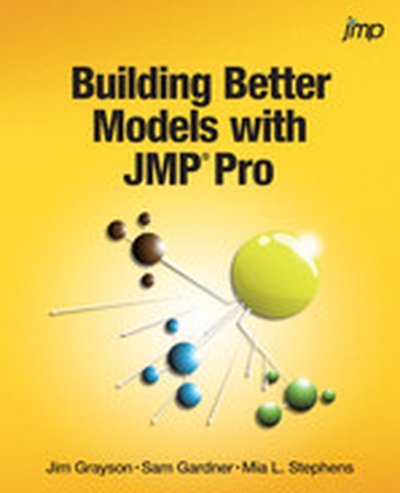
Building Better Models with JMP Pro

Building Better Models with JMP® Pro provides an example-based introduction to business analytics, with a proven process that guides you in the application of modeling tools and concepts. It gives you the "what, why, and how" of using JMP® Pro for building and applying analytic models. This book is designed for business analysts, managers, and practitioners who may not have a solid statistical background, but need to be able to readily apply analytic methods to solve business problems.

In addition, this book will greatly benefit faculty members who teach any of the following subjects at the lower to upper graduate level: predictive modeling, data mining, and business analytics. Novice to advanced users in business statistics, business analytics, and predictive modeling will find that it provides a peek inside the black box of algorithms and the methods used.

Topics include: regression, logistic regression, classification and regression trees, neural networks, model cross-validation, model comparison and selection, and data reduction techniques. Full of rich examples, Building Better Models with JMP Pro is an applied book on business analytics and modeling that introduces a simple methodology for managing and executing analytics projects. No prior experience with JMP is needed.

Make more informed decisions from your data using this newest JMP book.

IBM Cognos Dynamic Cubes

IBM® Cognos® Business Intelligence (BI) provides a proven enterprise BI platform with an open data strategy. Cognos BI provides customers with the ability to use data from any source, package it into a business model, and make it available to consumers in various interfaces that are tailored to the task. IBM Cognos Dynamic Cubes complements the existing Cognos BI capabilities and continues the tradition of an open data model. It focuses on extending the scalability of the IBM Cognos platform to enable speed-of-thought analytics over terabytes of enterprise data, without having to invest in a new data warehouse appliance. This capability adds a new level of query intelligence so you can unleash the power of your enterprise data warehouse. This IBM Redbooks® publication addresses IBM Cognos Business Intelligence V10.2.2 and specifically, the IBM Cognos Dynamic Cubes capabilities. This book can help you in the following ways: Understand core features of the Cognos Dynamic Cubes capabilities of Cognos BI V10.2 Learn by example with practical scenarios by using the IBM Cognos samples This book uses fictional business scenarios to demonstrate the power and capabilities of IBM Cognos Dynamic Cubes. It primarily focuses on the roles of the modeler, administrator, and IT architect.

SAS 9.4 SQL Procedure User's Guide, Second Edition, 2nd Edition

Describes the basics of using the SQL procedure and provides comprehensive reference information. The usage information includes retrieving data from single and multiple tables; selecting specific data from tables; subsetting, ordering, and summarizing data; updating tables; combining tables to create new tables and useful reports; performing queries on database management system (DBMS) tables; using PROC SQL with the SAS macro facility; and debugging and optimizing PROC SQL code. The reference information includes statements, dictionary components, and system options.

Exercises and Projects for The Little SAS Book, Fifth Edition

The best-selling Little SAS Book just got even better. Readers worldwide study this easy-to-follow book to help them learn the basics of SAS programming. Now Rebecca Ottesen has teamed up with the original authors, Lora Delwiche and Susan Slaughter, to provide a new way to challenge and improve your SAS skills through thought-provoking questions, exercises, and projects. Each chapter in Exercises and Projects for The Little SAS Book is matched to a chapter in The Little SAS Book, Fifth Edition. This hands-on workbook is designed to hone your SAS skills whether you are a

student or a professional.

This book covers DATA step programming, report writing, statistical and graphical procedures, the Output Delivery System, macros, and more; contains a mixture of multiple-choice questions, open-ended discussion topics, and programming exercises with selected answers and hints; and includes comprehensive programming projects that are designed to encourage self-study and to test the skills developed by The Little SAS Book.

Predictive Analytics using Rattle and Qlik Sense

Explore the practical applications of predictive analytics with a focus on leveraging Rattle and Qlik Sense in your projects. From setting up your environment to constructing comprehensive data applications, this book provides a complete roadmap for mastering these tools and techniques. Gain valuable insights into your data and elevate your analytical skills for real-world business scenarios. What this Book will help me do Set up your analytics environment with Qlik Sense, R, and Rattle to kick-start your projects. Master visualization techniques and statistical methods to uncover meaningful insights. Develop data-driven predictive models and evaluate their performances effectively. Learn unsupervised and supervised machine learning techniques for diverse data problems. Build data storytelling and dashboards in Qlik Sense to showcase your results compellingly. Author(s) Ferran Garcia Pagans is a seasoned data analyst and author with extensive experience in predictive analytics and data visualization. His deep knowledge of modern analytics tools like Rattle and Qlik Sense enables him to guide professionals in deriving actionable insights from data. He excels in breaking down complex concepts into accessible knowledge, making his work invaluable for learners. Who is it for? This book is perfect for business analysts, data professionals, and enthusiasts looking to enhance their understanding of predictive analytics. It suits those with foundational knowledge of statistics and tools like Excel and R. If your goal is to implement real-world predictive models and data storytelling using Rattle and Qlik Sense, this book is an ideal companion.

Using JMP Student Edition, Third Edition

Using JMP Student Edition is the official user guide for JMP Student Edition, the streamlined edition of JMP for first year statistics students. Clearly written, with easy-to-follow, step-by-step instructions, this book provides engaging illustrations and concept overviews. Chapters cover JMP basics such as importing data, creating formulas, creating graphs with Graph Builder, and performing univariate and bivariate data analysis. More complex analyses are covered, including Partition, Multiple Regression, Time Series, Design of Experiments, Variability Gauge Charts, and Quality Control, and more. JMP Student Edition software is available from major textbook publishers when packaged with their textbooks for course use.

PROC TABULATE by Example, Second Edition

An abundance of real-world examples highlights Lauren Haworth Lake’s and Julie McKnight's PROC TABULATE by Example, Second Edition. Beginning and intermediate SAS® users will find this step-by-step guide to producing tables and reports using the TABULATE procedure both convenient and inviting. Topics are presented in order of increasing complexity, making this an excellent training manual or self-tutorial. The concise format also makes this a quick reference guide for specific applications for more advanced users. A very handy section on common problems and their solutions is also included. With this book, you will quickly learn how to generate tables using macros, handle percentages and missing data, modify row and column headings, and produce one-, two-, and three-dimensional tables using PROC TABULATE. Also provided are more advanced tips on complex formatting with the Output Delivery System (ODS) and exporting PROC TABULATE output to other applications.

Analyzing Receiver Operating Characteristic Curves with SAS

As a diagnostic decision-making tool, receiver operating characteristic (ROC) curves provide a comprehensive and visually attractive way to summarize the accuracy of predictions. They are used extensively in medical diagnosis and increasingly in fields such as data mining, credit scoring, weather forecasting, and psychometry. In Analyzing Receiver Operating Characteristic Curves with SAS, author Mithat Gonen illustrates the many existing SAS procedures that can be tailored to produce ROC curves and expands upon further analyses using other SAS procedures and macros. Both parametric and nonparametric methods for analyzing ROC curves are covered in detail. Topics addressed include: Appropriate methods for binary, ordinal, and continuous measures Computations using PROC FREQ, PROC LOGISTIC, PROC NLMIXED, and macros Comparing the ROC curves of several markers and adjusting them for covariates ROC curves with censored data Using the ROC curve for evaluating multivariable prediction models via bootstrap and cross-validation ROC curves in SAS Enterprise Miner And more! Written for any statistician interested in learning more about ROC curve methodology, the book assumes readers have a basic understanding of regression procedures and moderate familiarity with Base SAS and SAS/STAT. Some familiarity with SAS/GRAPH is helpful but not essential. This book is part of the SAS Press program.

Cody's Data Cleaning Techniques Using SAS, Second Edition

Thoroughly updated for SAS 9, Cody's Data Cleaning Techniques Using SAS, Second Edition, addresses tasks that nearly every SAS programmer needs to do - that is, make sure that data errors are located and corrected. Written in Ron Cody's signature informal, tutorial style, this book develops and demonstrates data cleaning programs and macros that you can use as written or modify for your own special data cleaning needs. Each topic is developed through specific examples, and every program and macro is explained in detail.

Exchanging Data between SAS and Microsoft Excel

Master simple-to-complex techniques for transporting and managing data between SAS and Excel William Benjamin's Exchanging Data between SAS and Microsoft Excel: Tips and Techniques to Transfer and Manage Data More Efficiently describes many of the options and methods that enable a SAS programmer to transport data between SAS and Excel. The book includes examples that all levels of SAS and Excel users can apply to their everyday programming tasks. Because the book makes no assumptions about the skill levels of either SAS or Excel users, it has a wide-ranging application, providing detailed instructions about how to apply the techniques shown. It contains sections that gather instructional and syntactical information together that are otherwise widely dispersed, and it provides detailed examples about how to apply the software to everyday applications. These examples enable novice users and power developers alike the chance to expand their capabilities and enhance their skillsets. By moving from simple-to-complex applications and examples, the layout of the book allows it to be used as both a training and a reference tool. Excel users and SAS programmers are presented with tools that will assist in the integration of SAS and Excel processes in order to automate reporting and programming interfaces. This enables programming staff to request their own reports or processes and, in turn, support a much larger community.