talk-data.com talk-data.com

Topic

analytics-platforms

402

tagged

Activity Trend

1 peak/qtr
2020-Q1 2026-Q1

Activities

402 activities · Newest first

JMP 11 Specialized Models

JMP 11 Specialized Models provides details about modeling techniques such as partitioning, neural networks, nonlinear regression, and time series analysis. Topics include the Gaussian platform, which is useful in analyzing computer simulation experiments. The book also covers the Response Screening platform, which is useful in testing the effect of a predictor when you have many responses.

SAS Macro Language Magic

SAS Macro Language Magic: Discovering Advanced Techniques pushes the SAS macro language to the limit. It explores how even common tools, when used to their full advantage, can transform into amazing applications. This book assumes a basic knowledge of the SAS macro language and then shows how to apply that knowledge in new and different ways.

This book enables you to find a technique that you like and then explore it to discover what works and what the possibilities are. You can experiment, focusing more on the application and less on the syntax, while at the same time visualizing the SAS program you want to generate.

Discover and develop powerful programming techniques down the path to demystifying MACROS. All the tricks and secrets are revealed, enabling you to write SAS macros that work like MAGIC.

This book is part of the SAS Press program.

How to Become a Top SAS Programmer

Would you like to be a top SAS programmer? Would you like to be the person that other SAS programmers turn to for solutions to programming problems? If so, then How to Become a Top SAS Programmer, written by Michael Raithel is the book for you.

This self-help book provides invaluable strategies for enhancing your SAS programming skills and introduces you to a wide variety of SAS resources that are readily available to you. Inside this book, you will learn: what makes a top SAS programmer fundamentals that every top SAS programmer should master ideas for advancing your SAS career within your organization where to find SAS documentation to learn new programming techniques how to participate in local and regional SAS user groups and SAS Global Forum how to make SAS training and certification work for you how to take part in SAS virtual communities to learn, contribute, and become well-known …and much more

Want to increase your SAS acumen, solidify the use of SAS in your organization, be a greater benefit to your organization as a SAS programmer, contribute to the world-wide SAS community, and enjoy good career growth? Michael’s book will help the novice SAS programmer or a seasoned professional to do all that and more.

Start reading it now and become the top SAS programmer in your organization who everyone goes to for insight and guidance into the many aspects of the SAS world!

This book is part of the SAS Press program.

IBM Cognos 10 Report Studio Cookbook - Second Edition

This cookbook is a comprehensive guide to mastering IBM Cognos 10 Report Studio, enabling users to become proficient in developing professional-grade reports. Through practical recipes, you will learn how to harness the full potential of Report Studio, mastering both fundamental and advanced features for real-world application. What this Book will help me do Efficiently organize and process data using advanced sorting and filtering techniques. Create visually engaging and functional reports, including dynamic drill-through links and enhanced formatting options. Master the use of conditional formatting, cascaded prompts, and master-detailed queries in your reports. Enhance reports with Active Reports, direct XML editing, and by integrating JavaScript and HTML elements. Adopt industry best practices for report development, including version control and regression testing. Author(s) The author of this cookbook is an experienced IBM Cognos consultant with years of experience in developing business intelligence solutions and creating comprehensive reports. They focus on combining technical expertise with practical examples, presenting information in an approachable and user-friendly manner. Who is it for? This book is ideal for Business Intelligence Developers with a working knowledge of IBM Cognos 10 who seek to enhance their report-building skills. It also serves Business Analysts or Power Users familiar with basic report authoring who aim to explore advanced features. Prior knowledge of IBM Cognos 10 architecture and basic Report Studio functionalities is assumed.

SAS Business Intelligence for the Health Care Industry

SAS Business Intelligence for the Health Care Industry: Practical Applications teaches health care executives, managers, providers, and business analysts how to use SAS Business Intelligence (BI) tools to convert data into knowledge and value at all levels in the health care industry.

This book demonstrates how SAS BI solutions can be applied to the health care industry and offers detailed explanations of code and tasks in an approachable case study format. All applications are created with sample data that has the richness and complexity of operational health care data. Topics include:

using SAS Add-In for Microsoft Office and SAS Stored Processes technology to better track and forecast revenues and margins

creating OLAP and relational web reports that enable care management programs to locate and assist the neediest patients

implementing data access restrictions on OLAP and relational data in accordance with the industry’s need for secure data access

creating dashboards to help executives monitor their health care organization

With its level of depth and perfect blend of technology and business contexts, this book provides health care analysts, researchers, and statisticians with information and examples that can be used effectively and immediately. It is an indispensable aid to the health care professional in keeping up with a fast-changing industry.

This book is part of the SAS Press program.

Segmentation and Lifetime Value Models Using SAS

Help your organization determine the value of its customer relationships with Segmentation and Lifetime Value Models Using SAS. This book contains a wealth of information that will help you perform analyses to identify your customers and make informed marketing investments. It answers core questions on customer relationship management (CRM), provides an overall framework for thinking about CRM, and offers real-world examples across a variety of industries.

Edward C. Malthouse introduces you to a number of useful models, ranging from simple to more complicated examples, and discusses their applications. You'll learn about segmentation models for identifying groups of customers and about lifetime value models for estimating the future value of the segments. You'll learn how to prepare data and estimate models using Base SAS, SAS/STAT, SAS/IML, and SQL.

Marketing analysts, CRM analysts, database managers, and anyone looking to address the challenges of allocating marketing resources to different customer groups will benefit from the concepts and exercises in this book. Analysts will learn how to approach unique business problems. Managers will gain a sense of what's possible and what to ask of their analytics departments.

This book is part of the SAS Press program.

Decision Trees for Analytics Using SAS Enterprise Miner

Decision Trees for Analytics Using SAS Enterprise Miner is the most comprehensive treatment of decision tree theory, use, and applications available in one easy-to-access place. This book illustrates the application and operation of decision trees in business intelligence, data mining, business analytics, prediction, and knowledge discovery. It explains in detail the use of decision trees as a data mining technique and how this technique complements and supplements data mining approaches such as regression, as well as other business intelligence applications that incorporate tabular reports, OLAP, or multidimensional cubes.

An expanded and enhanced release of Decision Trees for Business Intelligence and Data Mining Using SAS Enterprise Miner, this book adds up-to-date treatments of boosting and high-performance forest approaches and rule induction. There is a dedicated section on the most recent findings related to bias reduction in variable selection. It provides an exhaustive treatment of the end-to-end process of decision tree construction and the respective considerations and algorithms, and it includes discussions of key issues in decision tree practice.

Analysts who have an introductory understanding of data mining and who are looking for a more advanced, in-depth look at the theory and methods of a decision tree approach to business intelligence and data mining will benefit from this book.

This book is part of the SAS Press program.
QlikView for Developers Cookbook

"QlikView for Developers Cookbook" empowers you to elevate your QlikView development skills beyond the introductory level. Through practical recipes, this book provides hands-on exercises covering topics like advanced visualizations, data modeling challenges, and script writing. This is an ideal resource for developers looking to master QlikView's functionalities and apply advanced techniques. What this Book will help me do Master techniques for creating advanced visualizations in QlikView. Improve your applications by applying best practices in data modeling. Learn to script and automate tasks effectively within QlikView. Enhance performance optimization to deliver faster QlikView applications. Implement robust security measures for your QlikView solutions. Author(s) Stephen Redmond is a seasoned QlikView developer with over seven years of experience in designing and implementing business intelligence solutions. His expertise encompasses advanced scripting, data modeling, and visualization techniques, making him an authority on QlikView development. Stephen's hands-on approach in teaching helps practitioners achieve excellence in their use of QlikView. Who is it for? This book is tailored for individuals with a foundational knowledge of QlikView who want to advance their skills. Whether you're a developer at a QlikView customer, partner, or QlikView itself, or someone aiming to become an expert in QlikView development, this book is crafted for you. It assumes you have a basic understanding and are eager to solve complex problems and create advanced solutions.

IBM Cognos 10 Framework Manager

"IBM Cognos 10 Framework Manager" is your complete guide to mastering the key features of IBM Cognos Framework Manager for robust data modeling. By following practical, step-by-step lessons enhanced with expert tips, you'll progress from handling imported data to developing dynamic, user-friendly data models optimized for Business Intelligence reporting. What this Book will help me do Import and model relational data effectively to support diverse reporting needs. Create organized, well-structured reporting packages for easy data access and usage. Utilize parameters and parameter reports to enable dynamic and adaptable reporting solutions. Manage models in multi-user environments, fostering collaboration and enhanced functionality. Leverage the Model Design Accelerator to quickly develop well-designed initial data models. Author(s) Terence Phillip Curran has extensive experience in data modeling and IBM Cognos technology. Through his practical expertise and hands-on teaching methods, he has become a trusted source of guidance in the field. In this book, Curran combines his practical knowledge with clear explanations to help users fully utilize IBM Cognos Framework Manager. Who is it for? This book serves developers interested in using IBM Cognos Framework Manager to build and optimize data models. If you're new to the tool, you'll benefit from its thorough and accessible approach to learning. For experienced users, it offers advanced techniques and tips to improve and streamline your modeling efforts. Whether you're preparing reporting packages or building multi-user collaborative models, this book provides the practical guidance you need.

Simulating Data with SAS

Data simulation is a fundamental technique in statistical programming and research. Rick Wicklin's Simulating Data with SAS brings together the most useful algorithms and the best programming techniques for efficient data simulation in an accessible how-to book for practicing statisticians and statistical programmers.

This book discusses in detail how to simulate data from common univariate and multivariate distributions, and how to use simulation to evaluate statistical techniques. It also covers simulating correlated data, data for regression models, spatial data, and data with given moments. It provides tips and techniques for beginning programmers, and offers libraries of functions for advanced practitioners.

As the first book devoted to simulating data across a range of statistical applications, Simulating Data with SAS is an essential tool for programmers, analysts, researchers, and students who use SAS software.

This book is part of the SAS Press program.
JMP for Basic Univariate and Multivariate Statistics, 2nd Edition

JMP Start Statistics: A Guide to Statistics and Data Analysis Using JMP, Fifth Edition, is the perfect mix of software manual and statistics text. Authors John Sall, Ann Lehman, Mia Stephens, and Lee Creighton provide hands-on tutorials with just the right amount of conceptual and motivational material to illustrate how to use the intuitive interface for data analysis in JMP. Each chapter features concept-specific tutorials, examples, brief reviews of concepts, step-by-step illustrations, and exercises.

JMP Start Statistics, Fifth Edition, includes many new features of JMP 10, including an enhanced ability to manage a JMP session by easily tracking open and recently opened JMP tables; scripts, analyses, JMP projects, and other files; vastly expanded tools for instructors to demonstrate statistical concepts and interactive scripts to help students grasp difficult topics; Split-Plot designs with examples; examples of Graph Builder and Control Chart Builder; and new features that make the software easier to use.

This book is part of the SAS Press program.
PROC TEMPLATE Made Easy

This straightforward guide to PROC TEMPLATE shows you how to build your own custom styles and tables in SAS. You'll learn how to create new styles to match your organization's standards or simply to increase your report's aesthetic potential build custom tables with complex structures and traffic lighting to make them easier to read and interpret manage your templates and share them with other SAS users

Written for all levels of users, PROC TEMPLATE Made Easy guides you through the process of writing templates. Beginners will benefit from learning how to do so from the ground up. Intermediate and advanced users will learn the more complex features of PROC TEMPLATE as well as how to use styles in the Base SAS reporting procedures. This book explains how PROC TEMPLATE saves templates and teaches you how to create shareable template stores, allowing you to customize your working environment. The visual appendixes of all style attributes and graph colors serve as an essential reference for anyone using PROC TEMPLATE.

PROC TEMPLATE allows you to take advantage of all that the Output Delivery System has to offer, and PROC TEMPLATE Made Easy teaches you how.

This book is part of the SAS Press program.
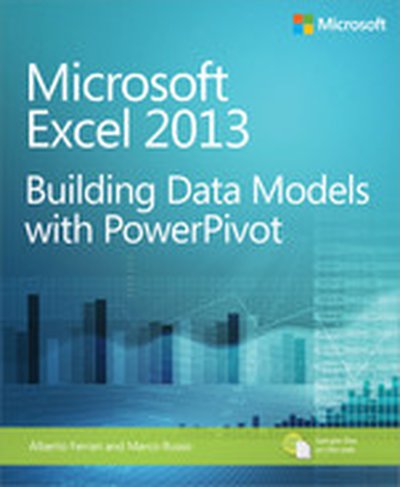
Microsoft Excel 2013: Building Data Models with PowerPivot

Your guide to quickly turn data into results. Transform your skills, data, and business—and create your own BI solutions using software you already know and love: Microsoft Excel. Two business intelligence (BI) experts take you inside PowerPivot functionality for Excel® 2013, with a focus on real world scenarios, problem-solving, and data modeling. You'll learn how to quickly turn mass quantities of data into meaningful information and on-the-job results—no programming required! Understand the differences between PowerPivot for Self Service BI and SQL Server Analysis Services for Corporate BI Extend your existing data-analysis skills to create your own BI solutions Quickly manipulate large data sets, often in millions of rows Perform simple-to-sophisticated calculations and what-if analysis Create complex reporting systems with data modeling and Data Analysis Expressions Share your results effortlessly across your organization using Microsoft SharePoint®

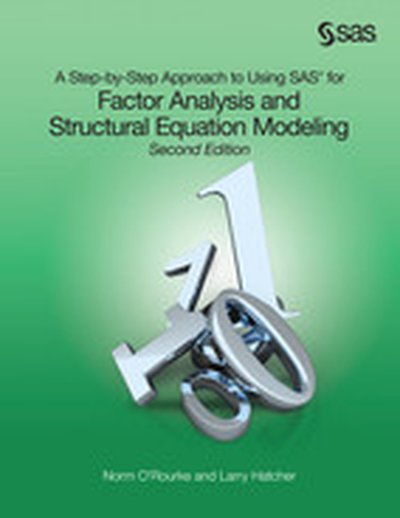
A Step-by-Step Approach to Using SAS for Factor Analysis and Structural Equation Modeling, Second Edition, 2nd Edition

This easy-to-understand guide makes SEM accessible to all users. This second edition contains new material on sample-size estimation for path analysis and structural equation modeling. In a single user-friendly volume, students and researchers will find all the information they need in order to master SAS basics before moving on to factor analysis, path analysis, and other advanced statistical procedures.

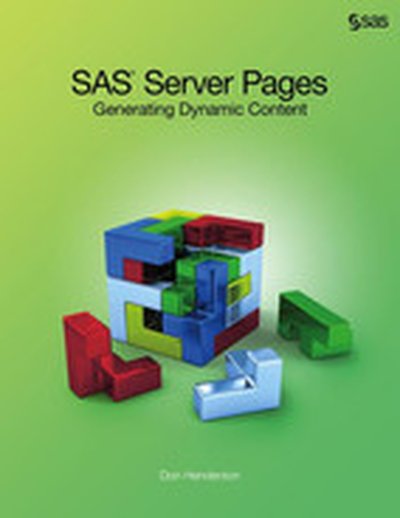
SAS Server Pages

SAS Server Pages have been used by SAS developers as a way of creating custom user interfaces for Web-based applications. This enhanced book offers information on how to create SAS Server Pages using the SAS 9.3 experimental procedure PROC STREAM, providing users with a foundation technology that greatly expands the capabilities of SAS for dynamic and rich content generation. By combining PROC STREAM and the Macro facility, SAS can now more easily generate any type of markup or text-based content such as HTML, XML, and CSV.

Exclusively available in electronic format, this book provides more extensive and flexible ways to develop applications using video examples of a wide range of PROC STREAM and SAS Server Pages techniques, including both Web applications and Base SAS implementations. Users can see results immediately and can access additional content and information online through embedded links. It also offers basic how-to documentation on PROC STREAM and an overview of a Portal Reporting Framework that illustrates creating custom user interfaces for stored processes within the SAS Portal.

Ideal for SAS programmers who have some knowledge of the Macro facility as well as BI users, SAS Server Pages: Generating Dynamic Content removes the difficulties associated with HTML-based content creation while providing a resource on using PROC STREAM in a dynamic, enhanced format.