talk-data.com talk-data.com

Topic

data-engineering

3377

tagged

Activity Trend

1 peak/qtr
2020-Q1 2026-Q1

Activities

Showing filtered results

Filtering by: O'Reilly Data Engineering Books ×
SQL Server 2008 Administration in Action

SQL Server 2008 Administration in Action offers over 100 DBA-tested, high-value, best practices that will help you tame the beast and keep it under control. Unlike the many comprehensive SQL Server reference tomes out there that attempt to cover the whole SQL Server feature set, this book drills down on the techniques, procedures, and practices that help you keep your database running like clockwork. About the Technology The integrity and security of your database is crucial to your business. SQL Server 2008 is a massive and mature product with a very large feature set. As a SQL Server administrator, you must be equipped to handle myriad day-to-day tasks to keep your database healthy, and you must also be prepared to act quickly when something unexpected happens. About the Book SQL Server 2008 Administration in Action focuses the production DBA, digging deep into the various tasks specific to that role. Expert author Rod Colledge — check him out at sqlCrunch.com — teaches you best practices that cover the lifecycle of a SQL Server system, including infrastructure design, installation, and operational maintenance. And while many of these techniques will work in any recent version of SQL Server, you'll find full coverage of emerging SQL Server 2008 best practices. Each technique is presented in a task-driven style, and in the order of the typical life cycle of a SQL Server system. This allows you to easily open the book at the appropriate page and focus on what you need to know for each specific situation. What's Inside Selecting and configuring server components Distributing I/O load over multiple controllers Selecting the appropriate stripe size Configuring storage cache Preparing for SQL Server clustering Configure the private network for cluster use only Configure the cluster network priority Prepare resources for a clustered SQL Server installation Index selection and maintenance Identify and drop unused indexes Identify and create missing indexes Select the appropriate clustered index Database mirroring Prepare the mirror server for failover Select the appropriate failover mode Consider disabling log stream compression for CPU bottlenecked systems Upgrading SQL Server Reduce downtime with T-Log backup/restore and the side-by-side upgrade method Prior to an upgrade, run DBCC checks and take full backups with verification Ensure read only is not enabled prior to the upgrade About the Reader This book is a DBA's best friend. It covers the most important and often overlooked areas that you need to maintain to keep your databases secure, in-tune, and well-protected in the event of disaster. About the Author Rod Colledge is an independent SQL Server consultant based in Brisbane, Australia. Since 1996, Rod has specialized in the development and administration of SQL Server database systems. His recent work has included the design and implementation of custom transactional replication and log shipping solutions, performance tuning large, high-volume databases, and developing procedures for operational maintenance of large database systems. In September 2007, Rod founded sqlCrunch.com, a website specializing in summarizing and categorizing links to SQL Server white papers and best practices. Quotes Simply loaded with excellent and immediately useful information. - Kevin Kline, Quest Software I thought I knew SQL Server until I read this book. - Tariq Ahmed, Coauthor of Flex 4 in Action A refreshing database administration book. - Michael Redman, Microsoft Required for any MS DBA. - Andrew Siemer, OTX Research It delivered way beyond my expectations...Packed with useful enterprise-level knowledge. - Darren Neimke, Author of ASP.NET 2.0 Web Parts in Action
Strategic Data Warehousing

Organization of data warehouses are vital but often ignored aspects of growing enterprises. This work merges technological know-how with managerial practices to show both the business manager and the IT professional how better alignment between data warehouse plans and business strategies can lead to a successful data warehouse adoption that will support the entire infrastructure. More complete than any other text in the field, this resource also addresses the managerial and strategic aspects of data warehouses, offering doable solutions that will allow for the strategic alignment of these warehouses while building them and ensuring that this alignment is sustained.

Certification Study Guide Series: IBM Maximo Asset Management V7.1

This IBM® Redbooks® publication is a study guide for IBM Maximo® Asset Management V7.1 and is aimed at individuals who want to get an IBM Professional Certification for this product. The IBM Maximo Asset Management V7.1 certification exam, offered through the Professional Certification Program from IBM, is designed to validate the skills required of technical professionals who work in the implementation and configuration of the IBM Maximo Asset Management V7.1 product. This publication does not replace practical experience, and is not designed to be a stand-alone guide for any subject. Instead, it is an effective tool that, when combined with educational activities and experience, can be an extremely useful preparation guide for the exam. For your convenience, we structure the chapters based on the sections of the Test 000-015: IBM Maximo Asset Management V7.1 Implementation, such as Assets, Inventory, and so on, so studying each chapter will help you prepare for one section of the exam. Note that Test 000-017: Foundations of Tivoli Process Automation Engine is a prerequisite for the IBM Certified Deployment Professional - Maximo Asset Management V7.1 certification. To prepare for that test, refer to the IBM Redbooks publication Certification Study Guide Series: Foundations of Tivoli Process Automation Engine, SG24-7763.

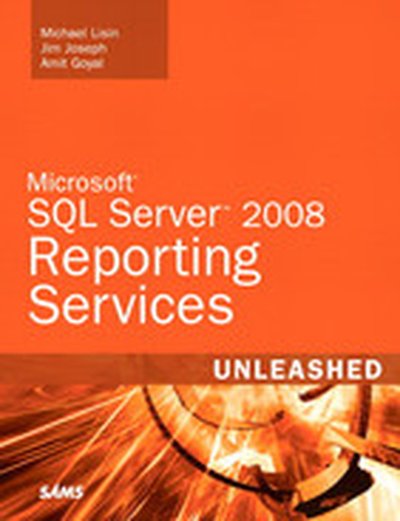
Microsoft® SQL Server™ 2008 Reporting Services Unleashed

Microsoft® SQL Server™ 2008 Reporting Services Unleashed Michael Lisin Jim Joseph Amit Goyal The authoritative, example-rich guide to Microsoft’s powerful reporting platform With Microsoft SQL Server 2008 Reporting Services you can quickly deliver relevant business intelligence data wherever it’s needed–across the entire enterprise, and through the entire reporting lifecycle. SQL Server 2008 Reporting Services Unleashed gives you all the authoritative information you’ll need to make the most of Microsoft’s most powerful reporting platform as a database professional, manager, or user. In-depth coverage makes this book an ideal reference, and its extensive set of practical examples help you address virtually any challenge in deployment, configuration, administration, or report building. The authors have extensively expanded this edition with deeper reference information, many more practical examples, and insider perspective into Reporting Services 2008’s powerful new enhancements. You’ll discover how to take full advantage of Reporting Services’ significant architectural changes, its flexible new Tablix control, improved visualization through charts and gauges, deep SharePoint integration through SharePoint Integrated Mode, new output presentation formats, and much more. Understand how to Learn about the new features of Service Pack 1 (SP1) and the SQL Server 2008 R2 release Quickly take advantage of Microsoft’s newest SQL Server Reporting Services enhancements Use Reporting Services to identify trends and solve real business problems Master report authoring–from basic, wizard-driven techniques to the cutting edge Group, sort, and aggregate data, and define the right scope for your information Utilize advanced report formatting techniques Work effectively with multidimensional sources Manage report data sources and models Secure reports against attacks and intrusions Customize Reporting Services with embedded functions, custom assemblies, URL access, Web Services, and other extensions Thoroughly integrate SQL Server reporting into any SharePoint site Michael Lisin, lead author of Microsoft SQL Server 2005 Reporting Services, has years of field experience working with SQL Server Reporting Services at Microsoft and delivering solutions for Microsoft’s enterprise customers. Jim Joseph, co-author of Microsoft SQL Server 2005 Reporting Services Unleashed, is an independent contractor with 10 years experience developing custom software solutions in a variety of industries. He has worked with SQL Server Reporting Services since the first beta release. Amit Goyal, lead program manager for Microsoft’s Reporting Services team, has extensive insider’s knowledge of SQL Server 2008 Reporting Services. ON THE WEB: Download all examples and source code presented in this book from informit.com/sams Category: Microsoft Databases Covers: Microsoft SQL Server 2008 Reporting Services User Level: Intermediate—Advanced

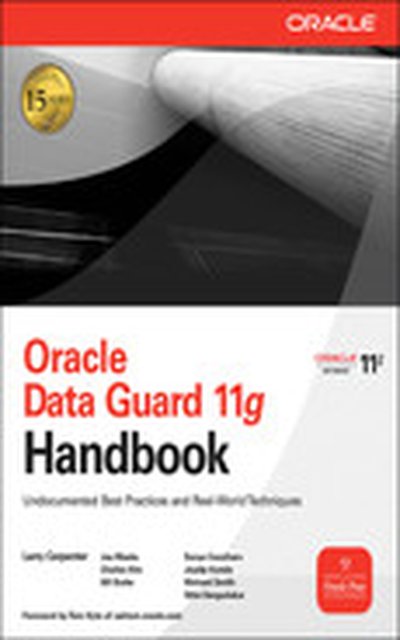
Oracle Data Guard 11g Handbook

Master Oracle Data Guard 11 g Provide superior data protection, availability, and disaster recovery using the tested techniques in this Oracle Press guide. Cowritten by a team of Oracle experts, Oracle Data Guard 11g Handbook provides a sound architectural foundation along with best practices for configuration, monitoring, maintenance, and troubleshooting. You will get full details on implementing deployment architectures to address requirements that extend beyond disaster recovery. This invaluable resource also includes a complete set of monitoring scripts available for download. Develop a disaster recovery plan for your Oracle database to meet your organization's requirements Configure and deploy Oracle Data Guard for your environment Tune and troubleshoot your physical and logical standby databases Implement the Oracle Data Guard Broker management framework Integrate with Oracle Grid Control Monitor your Oracle Data Guard environment Enable read-only services and disaster recovery with Oracle Active Data Guard Configure seamless database and application failover Minimize planned downtime using Oracle Data Guard switchover Handle backup and recovery with Oracle Recovery Manager

Beautiful Data

In this insightful book, you'll learn from the best data practitioners in the field just how wide-ranging -- and beautiful -- working with data can be. Join 39 contributors as they explain how they developed simple and elegant solutions on projects ranging from the Mars lander to a Radiohead video. With Beautiful Data, you will: Explore the opportunities and challenges involved in working with the vast number of datasets made available by the Web Learn how to visualize trends in urban crime, using maps and data mashups Discover the challenges of designing a data processing system that works within the constraints of space travel Learn how crowdsourcing and transparency have combined to advance the state of drug research Understand how new data can automatically trigger alerts when it matches or overlaps pre-existing data Learn about the massive infrastructure required to create, capture, and process DNA data That's only small sample of what you'll find in Beautiful Data. For anyone who handles data, this is a truly fascinating book. Contributors include: Nathan Yau Jonathan Follett and Matt Holm J.M. Hughes Raghu Ramakrishnan, Brian Cooper, and Utkarsh Srivastava Jeff Hammerbacher Jason Dykes and Jo Wood Jeff Jonas and Lisa Sokol Jud Valeski Alon Halevy and Jayant Madhavan Aaron Koblin with Valdean Klump Michal Migurski Jeff Heer Coco Krumme Peter Norvig Matt Wood and Ben Blackburne Jean-Claude Bradley, Rajarshi Guha, Andrew Lang, Pierre Lindenbaum, Cameron Neylon, Antony Williams, and Egon Willighagen Lukas Biewald and Brendan O'Connor Hadley Wickham, Deborah Swayne, and David Poole Andrew Gelman, Jonathan P. Kastellec, and Yair Ghitza Toby Segaran

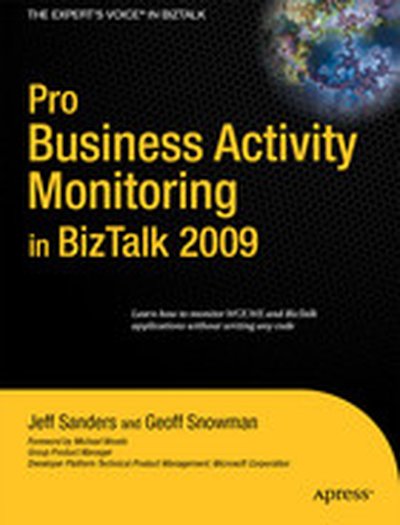
Pro Business Activity Monitoring in BizTalk 2009

Business Activity Monitoring, or BAM, provides real-time business intelligence by capturing data as it flows through a business system. By using BAM, you can monitor a business process in real time and generate alerts when the process needs human intervention. Pro Business Activity Monitoring in BizTalk 2009 focuses on Microsoft's BAM tools, which provide a flexible infrastructure that captures data from Windows Communication Foundation, Windows Workflow Foundation, .NET applications, and BizTalk Server. This book shows why BAM is an important component of any business intelligence strategy because it bridges the gap between business intelligence and business process management. Part One of the book covers the basics of BAM. It teaches you how to install BAM, and then it leads you through a complete but simple project to capture data from a WCF service Part Two of the book describes the BAM tool set. It shows you how to define the data that is captured by BAM, wire up a BizTalk application for BAM, and view BAM data using the BAM Portal Part Three of the book focuses on monitoring applications written in WCF or WF. It also shows you how to use the BAM API Part Four of the book covers advanced topics in BAM. These topics include integrating BAM with Microsoft's BI stack, creating relationships between BAM activities, managing BAM servers, and monitoring BizTalk applications using BAM This book contains numerous exercises to help you learn BAM. Source code for the samples is available from Apress.com. For many CIOs, business intelligence is at the top of their priority lists. Learn why with Pro Business Activity Monitoring in BizTalk 2009. What you'll learn Show users what your application is doing and how their business Implement a BAM solution without writing any code Monitor applications written in WCF, WF, and BizTalk Server Create an observation model to define the data that BAM will collect from your application Use the BAM API to implement custom BAM solutions Manage a BAM solution Integrate BAM with your BI strategy and Microsoft's BI tools Who this book is for This book is for anyone who wants to know what's happening in their organization, right now! Developers building WCF, WF, or BizTalk applications will learn how to monitor those applications without writing extra code. Architects will learn how to bridge service-oriented architecture, business process management, and BI. Decision makers will learn how to see what's happening inside business processes. BI specialists will learn how BAM provides real-time capabilities that supplement any BI strategy. Business users and analysts will learn how BAM allows them to understand what's happening in the business every minute of every day. About the Apress Pro Series The Apress Pro series books are practical, professional tutorials to keep you on and moving up the professional ladder. You have gotten the job, now you need to hone your skills in these tough competitive times. The Apress Pro series expands your skills and expertise in exactly the areas you need. Master the content of a Pro book, and you will always be able to get the job done in a professional development project. Written by experts in their field, Pro series books from Apress give you the hard-won solutions to problems you will face in your professional programming career.

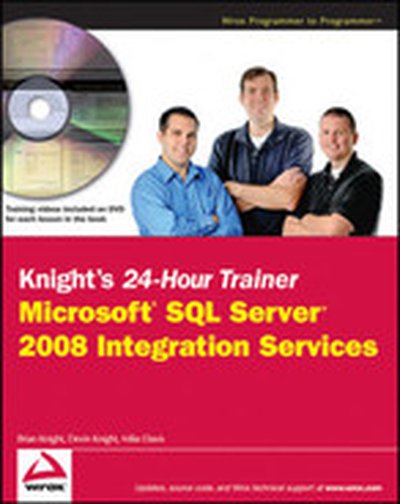
Knight's 24-Hour Trainer: Microsoft® SQL Server® 2008 Integration Services

A unique book-and-video package for Knight's 24-Hour Trainer: Microsoft® SQL Server® 2008 Integration Services If you need a practical, hands-on introduction to Microsoft SQL Server 2008 Integration Services (SSIS), this book and video package from foremost SSIS authority Brian Knight gets you thoroughly up to speed. Each lesson in the book includes three major components: a thorough description of how each SSIS feature or process works; a tutorial that walks you through the process or technique; and a video lesson that demonstrates it. If you take full advantage of this comprehensive package, you will gain enough experience to tackle your first SSIS project with confidence. SQL Server Integration Services 2008 (SSIS) builds on the revolutionary database product suite first introduced by Microsoft in 2005 and is a powerful tool for performing extraction, transformation, and load (ETL) operations essential to data warehousing If you're just learning SSIS, the step-by-step tutorials in this book and video training package will ready you to tackle your own first project Note: CD-ROM/DVD and other supplementary materials are not included as part of eBook file.

Certification Study Guide Series: Foundations of Tivoli Process Automation Engine

This IBM® Redbooks® publication is a study guide for Test 000-017: Foundations of Tivoli Process Automation Engine and is aimed at individuals who want to get an IBM Professional Certification on Tivoli Process Automation Engine.

Learning PHP, MySQL, and JavaScript

If you know HTML, this guide will have you building interactive websites quickly. You'll learn how to create responsive, data-driven websites with PHP, MySQL, and JavaScript, regardless of whether you already know how to program. Discover how the powerful combination of PHP and MySQL provides an easy way to build modern websites complete with dynamic data and user interaction. You'll also learn how to add JavaScript to create rich Internet applications and websites. Learning PHP, MySQL, and JavaScript explains each technology separately, shows you how to combine them, and introduces valuable web programming concepts, including objects, XHTML, cookies, and session management. You'll practice what you've learned with review questions in each chapter, and find a sample social networking platform built with the elements introduced in this book. This book will help you: Understand PHP essentials and the basics of object-oriented programming Master MySQL, from database structure to complex queries Create web pages with PHP and MySQL by integrating forms and other HTML features Learn about JavaScript, from functions and event handling to accessing the Document Object Model Use libraries and packages, including the Smarty web template system, PEAR program repository, and the Yahoo! User Interface Library Make Ajax calls and turn your website into a highly dynamic environment Upload and manipulate files and images, validate user input, and secure your applications

IBM® Lotus® Connections 2.0: Planning and Implementing Social Software for Your Enterprise

The Practical, Complete Guide to Leveraging the Power of Social Networks with Lotus Connections 2.0 IBM ® Lotus ® Connections 2.0 gives businesses all the tools they need to make the most of social networking—easily, securely, and cost-effectively. Now, a team of IBM Lotus Connections experts thoroughly introduce this breakthrough product and covers every facet of planning, deploying, and using it successfully. IBM Lotus Connections 2.0 covers both business and technical issues and presents proven best practices for every step of the implementation process. The authors first help you identify your best opportunities to use social networking for competitive advantage and demonstrate how Lotus Connections 2.0 places state-of-the-art social networking tools at your fingertips. Next, they carefully describe each component of the product, including profiles, activities, blogs, communities, “dog-ear” bookmarking, personal home pages, and more. They present practical coverage of administering Lotus Connections as well as detailed guidance on extending and integrating it. Whether you’re an executive, IT manager, or technical professional, this eBook has all the information you need to put social networking to work—and deliver powerful, quantifiable results. Coverage includes Assessing the potential value of social networking to your business Building dynamic networks of coworkers, partners, and customers that promote innovation and business agility Understanding the core services Lotus Connections 2.0 provides and the unique way in which they integrate Leveraging Lotus Connections’ consistent multitiered architecture Successfully planning for technical infrastructure and organizational change Walking through a best-practice installation and configuration process Building effective communities for employees with shared interests Using blogs to improve communications and overcome organizational silos or time zone differences Helping individuals and groups organize their work through Activities Performing administrative tasks such as customizing look-and-feel, collecting statistics, and troubleshooting Using plug-ins to integrate with Lotus Notes ®, Microsoft ® Office ®, Outlook ®, Windows ® Explorer, Lotus Sametime ®, and WebSphere ® Portal Displaying useful, up-to-the-minute information with prebuilt widgets Utilizing Lotus Connections’ REST-based API to create new integration points and build custom applications

The SQL Programming Language

Ideal as a stand-alone primer or when used in conjunction with another introductory computer science text, SQL: The Programming Language will prepare students for core SQL programming courses offered in CS and CIS. With a clear, concise, and descriptive writing style, students will see real-world examples and cases of SQL functionality in database management. Screen shots and figures throughout the text allow readers to visualize important concepts discussed and student exercises urge them to explore problems on their own.

Developing Web Applications with Perl, memcached, MySQL® and Apache

The only book to address using cache to enhance and speed up Web application development Developers use Apache, MySQL, memcached, and Perl to build dynamic Web sites that store information within the MySQL database; this is the only book to address using these technologies together to alleviate the database load in Web development Covers each of the four systems and shows how to install, set up, and administer them; then shows the reader how to put the parts together to start building applications Explains the benefits of a base perl library for code re-use, and provides sample applications that demonstrate in a practical way the information covered in the previous chapters Examines monitoring, performance, and security, with a problem-solving chapter that walks the reader through solving real-world issues

Mule in Action

Mule in Action covers Mule fundamentals and best practices. It is a comprehensive tutorial that starts with a quick ESB overview and then gets Mule to work. It dives into core concepts like sending, receiving, routing, and transforming data. Next, it gives you a close look at Mule's standard components and how to roll out custom ones. You'll pick up techniques for testing, performance tuning, BPM orchestration, and even a touch of Groovy scripting. About the Technology Mule is a widely used open source enterprise service bus. It is standards based, provides easy integration with Spring and JBoss, and fully supports the enterprise messaging patterns collected by Hohpe and Woolf. You can readily customize Mule without writing a lot of new code. About the Book Mule in Action covers Mule fundamentals and best practices. It is a comprehensive tutorial that starts with a quick ESB overview and then gets Mule to work. It dives into core concepts like sending, receiving, routing, and transforming data. Next, it gives you a close look at Mule's standard components and how to roll out custom ones. You'll pick up techniques for testing, performance tuning, BPM orchestration, and even a touch of Groovy scripting. What's Inside Mule deployment, logging, and monitoring Common transports, routers, and transformers Security, routing, orchestration, and transactions About the Reader Written for developers, architects, and IT managers, the book requires familiarity with Java but no previous exposure to Mule or other ESBs. About the Authors Both authors are Java EE architects. David Dossot is the project "despot" of the JCR Transport and has worked with Mule since 2005. John D'Emic is Chief Integration Architect at OpSource Inc., where he has used Mule since 2006. Quotes A deep, anatomical view of Mule ESB. - Ara Abrahamian, Arachitect, Coauthor of Java Open Source Programming A top-to-bottom example-driven guide I haven't found anywhere else. - Ben Hall, Technical Lead, IBBS Outstanding examples show how to use Mule. - Doug Warren, Software Architect, Java Web Services These guys know what they are talking about! - Fabrice Dewasmes, Java & Open Source Department Director, Pragma Consult Works better than a carrot to get the Mule going. Useful even for experts. - Jeroen Benckhuijsen, Software Architect, Atos Origin

Oracle Essbase 9 Implementation Guide

This book is a practical guide to implementing high-performance multidimensional OLAP solutions using Oracle Essbase 9. It takes you step by step through software installation to the creation of fully-functional Essbase database cubes, helping you develop a solid understanding of multidimensional database concepts and the tools to create analytical OLAP applications effectively. What this Book will help me do Understand the fundamentals of multidimensional database technology and how it applies to analytical OLAP solutions. Construct efficient database outlines including dimensions and members. Import data from various sources into Essbase cubes and process it for analysis. Develop effective calculation scripts to automate complex data processing tasks. Leverage tools like Excel Add-In to produce dynamic, interactive reports for comprehensive data insights. Author(s) The authors of this guide are seasoned professionals with extensive practical experience in Oracle Essbase and OLAP technology. They bring years of expertise in database design, analytics, and performance optimization, ensuring this book provides both foundational knowledge and advanced techniques. Their teaching approach focuses on clarity and step-by-step guidance to make complex topics accessible to practitioners at all levels. Who is it for? This book is ideal for IT professionals with a general understanding of information systems who want to learn OLAP and Oracle Essbase. Beginners will find the step-by-step approach accessible, while experienced OLAP users will benefit from advanced tips and practical examples. If you're looking to enhance your analytics skills or explore Essbase for career growth, this resource is for you.

Mastering Oracle Scheduler in Oracle 11g Databases

In "Mastering Oracle Scheduler in Oracle 11g Databases", you will unlock the full potential of Oracle Scheduler (DBMS_SCHEDULER), a powerful tool for automating and managing database tasks. This book provides a comprehensive guide with practical examples to help you optimize database performance and automate your workflows. What this Book will help me do Understand how to create and manage job schedules using Oracle Scheduler, catering to both simple and complex automation needs. Learn to integrate platform-independent execution of jobs into your Oracle database management strategies. Gain practical insights into debugging, monitoring, and optimizing jobs for enhanced database performance. Explore event-driven scheduling to develop intelligent automation solutions for your business processes. Master resource management techniques to handle large-scale job scheduling effectively. Author(s) Ronald Rood is a seasoned database administrator and developer specializing in Oracle technologies. With extensive experience in database performance tuning and automation, Ronald shares practical insights and expert guidance in his writing. His passion for teaching complex concepts in an engaging manner makes his books valuable resources for professionals. Who is it for? This book is ideal for Oracle Database administrators and developers who want to advance their automation and scheduler management skills. With a basic understanding of Oracle Database Management and proficiency in SQL and PL/SQL, readers aim to optimize jobs and improve overall performance. It's perfect for those transitioning from tools like cron or DBMS_JOB for more robust scheduling capabilities.

Hadoop: The Definitive Guide

Hadoop: The Definitive Guide helps you harness the power of your data. Ideal for processing large datasets, the Apache Hadoop framework is an open source implementation of the MapReduce algorithm on which Google built its empire. This comprehensive resource demonstrates how to use Hadoop to build reliable, scalable, distributed systems: programmers will find details for analyzing large datasets, and administrators will learn how to set up and run Hadoop clusters. Complete with case studies that illustrate how Hadoop solves specific problems, this book helps you: Use the Hadoop Distributed File System (HDFS) for storing large datasets, and run distributed computations over those datasets using MapReduce Become familiar with Hadoop's data and I/O building blocks for compression, data integrity, serialization, and persistence Discover common pitfalls and advanced features for writing real-world MapReduce programs Design, build, and administer a dedicated Hadoop cluster, or run Hadoop in the cloud Use Pig, a high-level query language for large-scale data processing Take advantage of HBase, Hadoop's database for structured and semi-structured data Learn ZooKeeper, a toolkit of coordination primitives for building distributed systems If you have lots of data -- whether it's gigabytes or petabytes -- Hadoop is the perfect solution. Hadoop: The Definitive Guide is the most thorough book available on the subject. "Now you have the opportunity to learn about Hadoop from a master-not only of the technology, but also of common sense and plain talk."-- Doug Cutting, Hadoop Founder, Yahoo!

Databases A Beginner's Guide

Essential Database Skills--Made Easy! Learn standard database design and management techniques applicable to any type of database. Featuring clear examples using both Microsoft Access and Oracle, Databases: A Beginner's Guide begins by showing you how to use Structured Query Language (SQL) to create and access database objects. Then, you'll discover how to implement logical design using normalization, transform the logical design into a physical database, and handle data and process modeling. You'll also get details on database security, online analytical processing (OLAP), connecting databases to applications, and integrating XML and object content into databases. Designed for Easy Learning Key Skills & Concepts--Chapter-opening lists of specific skills covered in the chapter Ask the Expert--Q&A sections filled with bonus information and helpful tips Try This--Hands-on exercises that show you how to apply your skills Notes--Extra information related to the topic being covered Self Tests--Chapter-ending quizzes to test your knowledge

Oracle General Ledger Guide

Master Oracle E-Business Suite's Oracle General Ledger Maintain a centralized, highly automated processing platform across a fully integrated set of Oracle E-Business Suite applications using Oracle General Ledger. This Oracle Press guide explains how to utilize Oracle General Ledger to distribute timely and accurate financial information enterprise-wide. Learn efficient techniques for creating transactions and budgets, defining custom rules and flows, reconciling balances, and easing regulatory compliance. You will also discover how to consolidate financial data, process foreign currencies, and implement the brand-new Oracle Subledger Accounting. Plan, test, and carry out a new implementation or upgrade Work with ledgers, calendars, journals, budgets, and business flows Convert and load data from external systems and spreadsheets Perform company-wide consolidations Render reports using the Financial Statement Generator Handle foreign transactions, translations, and revaluations Centralize accounting rules using Oracle Subledger Accounting Understand implications of setup and implementation decisions