talk-data.com talk-data.com

Topic

data-engineering

3395

tagged

Activity Trend

1 peak/qtr
2020-Q1 2026-Q1

Activities

3395 activities · Newest first

Data Warehouse Design Solutions

"Each chapter is... a practice run for the way we all ought to design our data marts and hence our data warehouses."-Ralph Kimball, from the Foreword. Let the experts show you how to customize data warehouse designs for real business needs in Data Warehouse Design Solutions. To effectively design a data warehouse, you have to understand its many business uses. This guidebook shows you how business managers in different corporate functions actually use data warehouses to make decisions. You'll get a rich set of data warehouse designs that flow from realistic business cases. Two top experts show you how to customize your data warehouse designs for real-life business needs including: Sales and marketing Production and inventory management Budgeting and financial reporting Quality control Product delivery and fulfillment Strategic business analysis such as determining market share, rates of return on investment, and other key analytic ratios. CD-ROM includes All sample data warehouse designs with accompanying preformatted reports in HTML for specific business uses such as marketing, sales, and financial analysis. This title includes additional digital media when purchased in print format. For this digital book edition, media content may not be included. Contact the publisher's customer service directly for assistance.

Oracle Built-in Packages

Oracle is the most popular database management system in use today, and PL/SQL plays a pivotal role in current and projected Oracle products and applications. PL/SQL is a programming language providing procedural extensions to the SQL relational database language and to an ever-growing number of oracle development tools. originally a rather limited tool, PL/SQL became with Oracle7 a mature and effective language for developers. now, with the introduction of Oracle8, PL/SQL has taken the next step towards becoming a fully realized programming language providing sophisticated object-oriented capabilities. Steven Feuerstein's Oracle PL/SQL Programming is a comprehensive guide to building applications with PL/SQL. That book has become the bible for PL/SQL developers who have raved about its completeness, readability, and practicality. Built-in packages are collections of PL/SQL objects built by Oracle Corporation and stored directly in the Oracle database. The functionality of these packages is available from any programming environment that can call PL/SQL stored procedures, including Visual Basic, Oracle Developer/2000, Oracle Application Server (for web-based development), and, of course, the Oracle database itself. Built-in packages extend the capabilities and power of PL/SQL in many significant ways. for example: DBMS_SQL executes dynamically constructed SQL statements and PL/SQL blocks of code. DBMS_PIPE communicates between different Oracle sessions through a pipe in the RDBMS shared memory. DBMS_JOB submits and manages regularly scheduled jobs for execution inside the database. DBMS_LOB accesses and manipulates Oracle8's large objects (LOBs) from within PL/SQL programs. 1. Introduction Executing Dynamic SQL and PL/SQL Intersession Communication User Lock and Transaction Management Oracle Advanced Queuing Generating Output from PL/SQL Programs Defining an Application Profile Managing Large Objects Datatype Packages Miscellaneous Packages Managing Session Information Managing Server Resources Job Scheduling in the Database Snapshots Advanced Replication Conflict Resolution Deferred Transactions and Remote Procedure Calls The first edition of Oracle PL/SQL Programming contained a chapter on Oracle's built-in packages. but there is much more to say about the basic PL/SQL packages than Feuerstein could fit in his first book. In addition, now that Oracle8 has been released, there are many new Oracle8 built-in packages not described in the PL/SQL book. There are also packages extensions for specific oracle environments such as distributed database. hence this book. Oracle Built-in Packages pulls together information about how to use the calling interface (API) to Oracle's Built-in Packages, and provides extensive examples on using the built-in packages effectively. The windows diskette included with the book contains the companion guide, an online tool developed by RevealNet, Inc., that provides point-and-click access to the many files of source code and online documentation developed by the authors. The table of contents follows: Preface Part I: Overview Part II: Application Development Packages Part III: Server Management Packages Part IV: Distributed Database Packages Appendix. What's on the companion disk?

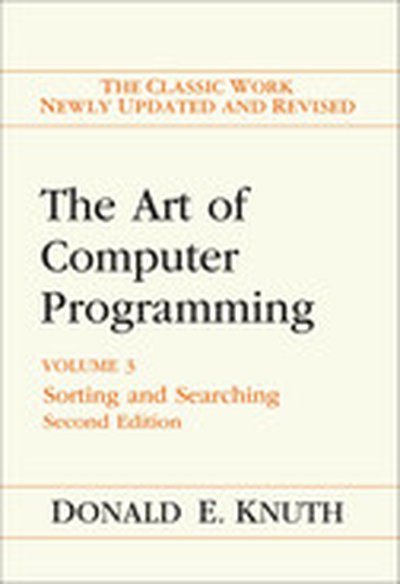
The Art of Computer Programming: Volume 3: Sorting and Searching, 2nd Edition

The bible of all fundamental algorithms and the work that taught many of today’s software developers most of what they know about computer programming. –Byte, September 1995 I can’t begin to tell you how many pleasurable hours of study and recreation they have afforded me! I have pored over them in cars, restaurants, at work, at home... and even at a Little League game when my son wasn’t in the line-up. –Charles Long If you think you’re a really good programmer... read [Knuth’s] Art of Computer Programming... You should definitely send me a resume if you can read the whole thing. –Bill Gates It’s always a pleasure when a problem is hard enough that you have to get the Knuths off the shelf. I find that merely opening one has a very useful terrorizing effect on computers. –Jonathan Laventhol The first revision of this third volume is the most comprehensive survey of classical computer techniques for sorting and searching. It extends the treatment of data structures in Volume 1 to consider both large and small databases and internal and external memories. The book contains a selection of carefully checked computer methods, with a quantitative analysis of their efficiency. Outstanding features of the second edition include a revised section on optimum sorting and new discussions of the theory of permutations and of universal hashing. Ebook (PDF version) produced by Mathematical Sciences Publishers (MSP), http://msp.org .

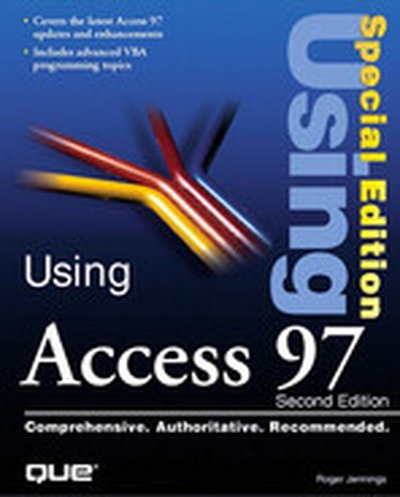
Special Edition Using Access 97, Second Edition

Special Edition Using Access 97, Second Edition, is your authoritative guide to mastering every facet of this powerful 32-bit database development platform. Get started quickly by using the Database Wizard to create a working Access 97 application in less than 30 minutes. Detailed, step-by-step instructions guide you through the process of designing and using Access tables, queries, forms, and reports. Newly added chapters on advanced VBA 5.0 techniques pave your way to Access programming expertise. Plus, you get full coverage of the latest updates to Access 97, including report Snapshot technology from Office Service Release 1 and the Upsizing Wizard for SQL Server 6.5+.

Database Design for Mere Mortals

Sound design can save you hours of development time before you write a single line of code. Based on the author's years of experience teaching this material, Database Design for Mere Mortals is a straightforward, platform-independent tutorial on the basic principles of relational database design. Database design expert Michael J. Hernandez introduces the core concepts of design theory and method without the technical jargon. Database Design for Mere Mortals will provide any developer with a common-sense design methodology for developing databases that work. 0201694719B04062001

Ten Minute Guide to Access 97

The 10 Minute Guide to Access 97 offers simple, practical help for busy people who need fast results. Through goal-oriented, 10-minute lessons, you'll learn all the essential tasks for setting up and maintaining your own database. 10 minutes is all you'll need to learn how to: understand tables, forms, reports, and queries; create a database from scratch or with Database Wizard; add records to tables; change and replace cell contents; add graphics and pictures; sort and filter your data; create mailing labels with the Label Wizard; and insert hyperlinks into your database.

Oracle Performance Tuning, 2nd Edition

The books in O'Reilly's Oracle series are authoritative -- they tell the whole story about complex topics, ranging from performance tuning to the use of packages in PL/SQL to new technologies like Power Objects. And they're independent; they're alternatives for readers who need to know how products and features really work. They're packed with real-world advice and techniques from practitioners in the field, and they come with disks containing code you can use immediately in your own applications. O'Reilly is the alternative for Oracle people who need to solve problems -- and solve them now.Performance tuning is crucial in any modern relational database management system. Too many organizations respond to Oracle performance problems by throwing money at these problems -- by buying larger and more expensive computers or by hiring expert consultants. But there's a lot you can do on your own to increase dramatically the performance of your existing system. Whatever version of Oracle you're running -- from Version 6 to Oracle8, proper tuning can save your organization a huge amount of money in additional equipment, extra memory, and hardware upgrades.The first edition of Oracle Performance Tuning became a classic for programmers, managers, database administrators, system administrators, and anyone who cares about improving the performance of an Oracle system. This second edition contains 400 pages of updated material updating on Oracle features, incorporating advice about disk striping and mirroring, RAID, client-server, distributed databases, MPPS, SMPs, and other architectures. It also includes chapters on parallel server, parallel query, backup and recovery, the Oracle Performance Pack, and more.

Advanced Oracle PL/SQL Programming with Packages

Steven Feuerstein's first book, Oracle PL/SQL Programming, has become the classic reference to PL/SQL, Oracle's procedural extension to its SQL language. His new book looks thoroughly at one especially advanced and powerful part of the PL/SQL language -- the package. The use of packages can dramatically improve your programming productivity and code quality, while preparing you for object-oriented development in Oracle technology. In this book, Feuerstein explains how to construct packages -- and how to build them the right way. His "best practices" for building packages will transform the way you write packages and help you get the most out of the powerful, but often poorly understood, PL/SQL language. Much more than a book, Advanced Oracle PL/SQL Programming with Packages comes with a PC diskette containing a full-use software companion. Developed by Feuerstein, RevealNet's PL/Vision Lite is the first of its kind for PL/SQL developers: a library of thirty-plus PL/SQL packages. The packages solve a myriad of common programming problems and vastly accelerate the development of modular and maintainable applications. The packages provided in PL/Vision Lite fall into three categories: Building block packages: low-level development enhancers, including string parsers, a list manager, and an interface to PL/SQL tables. Developer utilities: programs that improve your PL/SQL development environment, including a code generator, a powerful substitute for SHOW ERRORS, and an online help delivery mechanism. Plug-and-play components: pieces of code that can be used as is in your own applications, including a high-level exception handler mechanism and a generic, reusable logging mechanism. In addition to describing the details of these packages, this book explores why and how they were built the way they were. You'll come away with an increased appreciation of the PL/SQL language and the power of packages. Most importantly, you'll be ready and eager to put that power to use immediately in your own applications.

Moving to Integrated Language Environment for RPG IV

This document is unique in its detailed coverage of the new RPG IV language and aspects of the Integrated Language Environment. The purpose of this document is to provide an introduction to the RPG IV language and guidelines for implementing applications using the Integrated Language Environment. The publication SC41-3606, should be considered a prerequisite to this publication. This document is intended for experienced programmers, analysts, and implementers who are responsible for the creation and maintenance of application programs on the AS/400. It assumes the reader has a fairly good background in the AS/400 programming environment.

Water Management Models: A Guide to Software

Water Management Models: A Guide to Software is designed to make the inventory of modeling tools more accessible to water management professionals. The purpose of the book is to assist water managers, planners, engineers, and scientists in sorting through the maze of models to understand which ones might be most useful for their particular modeling needs. Information is provided to facilitate identification, selection, and acquisition of software packages for a broad spectrum of water resources planning and management applications.

AIX Storage Management

This document provides a general introduction to storage management using AIX on the RS/6000. Concepts and terminology are covered before describing in more detail the operating system components: the Logical Volume Manager, and file systems. Using this foundation, it then describes the additional features and functions provided with AIX Version 4; useful commands are also detailed, as well as a guide to organizing storage. In order to illustrate the topics covered, and provide examples of common practical application, a section containing detailed step by step information on a variety of storage management tasks is included. This document is intended for customers and systems engineers who require a more detailed understanding of storage management with AIX on the RS/6000, particularly the additional features provided with AIX Version 4, and who wish to have access to practical examples. Some knowledge of AIX Version 3 is assumed.

Xlib Reference Manual for Version 11 of the X Window System

A complete programmer's reference for X library functions, which is the lowest level of programming interface to X. Reference pages for each Xlib function A permuted index to the Xlib functions reference pages for each event type Description of macros A listing of the standard color name database Alphabetical index and description of structures Alphabetical index and description of defined symbols A list of keysyms and their meanings, including sample characters A list and illustration of the standard cursor font A list of standard fonts with illustration of each font A function group index, for finding the right routine for a particular task Single-page reference aids for the GC and window attributes This reference manual provides reference pages for each Xlib function, a permuted index to the Xlib functions, reference pages for each event type, description of macros, a listing of the standard color database, an alphabetic index and description of structures and defined symbols, a list of keysyms and their meanings, a list and illustration of the standard cursor font, an illustrated list of the standard fonts, a function group index, for finding the right routine for a particular task, and single-page reference aids for the GC and window attributes.