talk-data.com talk-data.com

Topic

data

3406

tagged

Activity Trend

3 peak/qtr
2020-Q1 2026-Q1

Activities

Showing filtered results

Filtering by: O'Reilly Data Engineering Books ×
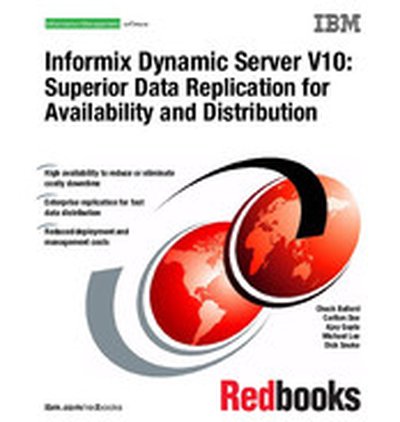
Informix Dynamic Server V10: Superior Data Replication for Availability and Distribution

This book provides an overview of the high availability and enterprise replication features of Informix Dynamic Server (IDS) Version 10, which can simplify and automate enterprise database deployment. Version 10 offers patent-pending technology that virtually eliminates downtime and automates many of the tasks associated with deploying mission-critical enterprise systems. The high availability capability can reduce or eliminate costly downtime through, as examples, the introduction of online index rebuild, the capability to create and drop indexes online without locking tables, and point-in-time table-level restore. Enhanced enterprise replication provides solutions for those customers requiring reliable and quick dissemination of data across a global organization. The replicated data can also participate in the high availability environment with capabilities such as seamless online resynchronization of enterprise replication nodes at startup, for example. There is also enhanced capability for high-availability disaster recovery customers in the form of the ability to resend primary server indexes to HDR secondary servers without requiring a rebuild of the index on the primary server. These significant and powerful capabilities can enable you to intelligently replicate (distribute) your enterprise data to improve the availability of that data to better service the requirements of your enterprise.

SQL for MySQL Developers: A Comprehensive Tutorial and Reference

The Most Complete and Practical Guide to MySQL Version 5’s Powerful SQL Dialect MySQL version 5 offers a SQL dialect with immense power. In SQL for MySQL Developers, Rick F. van der Lans helps you master this version ofSQL and take advantage of its full potential. Using case study examplesand hands-on exercises, van der Lans illuminates every key concept,technique, and statement–including advanced features that make iteasier to create even the most complex statements and programs. Drawing on decades of experience as an SQL standards team member and enterprise consultant, he reveals exactly why MySQL’s dialect works as it does–and how to get the most out of it. You’ll gain powerful insight into everything from basic queries to stored procedures, transactions to data security. Whether you’re a programmer, Web developer, analyst, DBA, or database user, this book can take you from “apprentice” to true SQL expert. If you’ve used SQL in older versions of MySQL, you’ll become dramatically more effective–and if you’re migrating from other database platforms, you’ll gain practical mastery fast. Coverage includes Writing queries, including joins, functions, and subqueries Updating data Creating tables, views, and other database objects Specifying keys and other integrity constraints Improving efficiency with indexes Enforcing security via passwords and privileges Embedding SQL statements within PHP programs Building stored procedures and triggers Using transactions, locking, rollback, and isolation levels Utilizing MySQL’s catalog All of the book’s sample programs are available for download from www.r20.nl. About the Author Rick F. van der Lans is author of the classic Introduction to SQL, the definitive SQL guide that database developers have relied on for more than 20 years. He is a consultant, author, and lecturer specializing in database technology, development tools, data warehousing, and XML. As managing director of the Netherlands-based R20/Consultancy, he has advised many large companies on defining their IT architectures. He chairs the European Meta Data Conference, and writes columns for several magazines. Contents About the Author Preface PART I Introduction CHAPTER 1 Introduction to MySQL CHAPTER 2 The Tennis Club Sample Database CHAPTER 3 Installing the Software CHAPTER 4 SQL in a Nutshell PART II Querying and Updating Data CHAPTER 5 SELECT Statement: Common Elements CHAPTER 6 SELECT Statements, Table Expressions, and Subqueries CHAPTER 7 SELECT Statement:The FROM Clause CHAPTER 8 SELECT Statement: The WHERE Clause CHAPTER 9 SELECT Statement: SELECT Clause and Aggregation Functions CHAPTER 10 SELECT Statement: The GROUP BY Clause CHAPTER 11 SELECT Statement: The HAVING Clause CHAPTER 12 SELECT Statement: The ORDER BY Clause CHAPTER 13 SELECT Statement: The LIMIT Clause CHAPTER 14 Combining Table Expressions CHAPTER 15 The User Variable and the SET Statement CHAPTER 16 The HANDLER Statement CHAPTER 17 Updating Tables CHAPTER 18 Loading and Unloading Data CHAPTER 19 Working with XML Documents PART III Creating Database Objects CHAPTER 20 Creating Tables CHAPTER 21 Specifying Integrity Constraints CHAPTER 22 Character Sets and Collations CHAPTER 23 The ENUM and SET Types CHAPTER 24 Changing and Dropping Tables CHAPTER 25 Using Indexes CHAPTER 26 Views CHAPTER 27 Creating Databases CHAPTER 28 Users and Data Security CHAPTER 29 Statements for Table Maintenance CHAPTER 30 The SHOW, DESCRIBE, and HELP Statements PART IV Procedural Database Objects CHAPTER 31 Stored Procedures CHAPTER 32 Stored Functions CHAPTER 33 Triggers CHAPTER 34 Events PART V Programming with SQL CHAPTER 35 MySQL and PHP CHAPTER 36 Dynamic SQL with Prepared Statement CHAPTER 37 Transactions and Multiuser Usage APPENDIX A Syntax of SQL APPENDIX B Scalar Functions APPENDIX C System Variables APPENDIX D Bibliography Index

Testing SAP R/3: A Manager's Step-by-Step Guide

Testing SAP R/3: A Manager's Step-by-Step Guide shows how to implement a disciplined, efficient, and proven approach for testing SAP R/3 correctly from the beginning of the SAP implementation through post-production support. The book also shows SAP professionals how to efficiently provide testing coverage for all SAP objects before they are moved into a production environment.

IBM System i IP Telephony Configuring the System i Infrastructure

In today’s highly competitive business environment, companies want to extract business advantage from every technology in the enterprise. Many are looking to IP Telephony as a way to lower costs, simplify network management, and use existing systems and resources, while more tightly integrating business applications and customer communication with their voice and data networks. With IBM System i IP Telephony, you can get the business benefits and simplicity you seek from both your telephony and IT environments with one integrated, secure, and reliable solution delivered by two industry leaders, 3Com and IBM. System i IP Telephony delivers the proven solutions of 3Com, a leading supplier of secure, converged voice and data networking, on the IBM System i platform. This IBM Redbooks publication is intended for system administrators and field technicians. It will help them to understand and prepare their system for deploying a System i IP Telephony solution. It introduces the System i IP Telephony environment and the specific benefits of 3Com IP Telephony on the System i platform. It shows how to prepare your system using either direct or virtual resources, as well as how to maintain the IP Telephony environment on the System i platform. It includes information on how to set up the network environment to support IP Telephony, and guides you through all the steps required to set up and install the IP Telephony solution, leaving you ready for your IBM IP Telephony-approved business partner or 3Com installation team to configure your IP Telephony system for use in your enterprise.

Microsoft® Office Access 2007 Security

Web Online Copy Access 2007 security is extremely different than that of its predecessors. For example, Access 2007 security eliminates user-level security. These changes to security have major implications for the applications built by an organization's employees. This Short Cut covers new topics such as using an Access 2007 database in a trusted location, encrypting in Access 2007, and packaging, signing, and distributing an Access 2007 database. It also covers how security works with databases created in other versions of Access. Finally, it covers the process of running unsafe expressions. All of these topics are vital for securing and successfully working with an Access 2007 database. Learn what’s new in Access 2007 security Find out how security applies to databases stored in one of the older file formats Get to know the Trust Center Learn how to package and sign a database Discover how easy it is to place a database in a Trusted Location Explore the new encryption feature in Access 2007 Table of Contents Why This Short Cut Is Important What's New in Access 2007 Security? What Happened to User-Level Security? Trusting a Database Using a Database Password to Encrypt an Office Access 2007 Database Packaging, Signing, and Distributing an Access Database Using the Trust Center Understanding How Databases Behave When Trusted and Untrusted Working in Sandbox Mode Removing User-Level Security Enabling or Disabling ActiveX Controls Enabling or Disabling Add-ins Adding a Trusted Publisher Practice Examples: Securing an Access 2007 Database

Microsoft Office® Access 2007 Inside Out

You’re beyond the basics, so dive right in and really put your database skills to work! This supremely organized reference is packed with hundreds of timesaving solutions, troubleshooting tips, and workarounds. It’s all muscle and no fluff. Discover how the experts tackle Access 2007—and challenge yourself to new levels of mastery! Create tables that support your database design strategy Import and link to data from spreadsheets, text files, databases, and other ODBC data sources Build simple to complex queries to manipulate data Learn advanced techniques for building and customizing user interface forms Design attractive reports to calculate and analyze large sets of data Automate your application with Microsoft Visual Basic(R) for Applications Customize the Office Fluent Ribbon Explore using XML and Windows(R) SharePoint(R) Services to create Web-based applications CD includes: Fully searchable eBook—plus bonus chapters Sample database applications—including query, form, and report examples Articles from the experts: designing databases, understanding SQL, exporting data, and more Links to demos, blogs, and user communities References for finding Access 2003 commands in Access 2007 Windows Vista(R) Product Guide eReference and other eBooks For customers who purchase an ebook version of this title, instructions for downloading the CD files can be found in the ebook.

Understanding MySQL Internals

Although MySQL's source code is open in the sense of being publicly available, it's essentially closed to you if you don't understand it. In this book, Sasha Pachev -- a former member of the MySQL Development Team -- provides a comprehensive tour of MySQL 5 that shows you how to figure out the inner workings of this powerful database. You'll go right to heart of the database to learn how data structures and convenience functions operate, how to add new storage engines and configuration options, and much more. The core of Understanding MySQL Internals begins with an Architecture Overview that provides a brief introduction of how the different components of MySQL work together. You then learn the steps for setting up a working compilable copy of the code that you can change and test at your pleasure. Other sections of the book cover: Core server classes, structures, and API The communication protocol between the client and the server Configuration variables, the controls of the server; includes a tutorial on how to add your own Thread-based request handling -- understanding threads and how they are used in MySQL An overview of MySQL storage engines The storage engine interface for integrating third-party storage engines The table lock manager The parser and optimizer for improving MySQL's performance Integrating a transactional storage engine into MySQL The internals of replication Understanding MySQL Internals provides unprecedented opportunities for developers, DBAs, database application programmers, IT departments, software vendors, and computer science students to learn about the inner workings of this enterprise-proven database. With this book, you will soon reach a new level of comprehension regarding database development that will enable you to accomplish your goals. It's your guide to discovering and improving a great database.

Microsoft SQL Server 2005 Performance Optimization and Tuning Handbook

Database professionals will find that this new edition aids in mastering the latest version of Microsoft’s SQL Server. Developers and database administrators (DBAs) use SQL on a daily basis in application development and the subsequent problem solving and fine tuning. Answers to SQL issues can be quickly located helping the DBA or developer optimize and tune a database to maximum efficiency. Basic questions are easily located on the topics of filtering, sorting, operators, conditionals, pseudo columns, single row functions, joins, grouping functions, sub queries, composite queries, hierarchies, flashback queries, parallel queries, expressions and regular expressions. Assistance on DML, data types (including collections), XML, DDL for basic database objects such as tales, views and indexes, partitioning, and security is also considered. * Identifies the most common issues DBAs face day to day for easy reference *Provides DBAs with solutions actually used by the authors in enterprise environments to resolve common and specialized problems to optimization issues. * Addresses issues that have been introduced by new features which can add more control but reduce performance.

Professional XML

As XML gains popularity, developers are looking to implement XML technologies in their line-of-business applications This book offers readers real-world insight into XML so that they can build the best possible applications Offers an in-depth look at XML and discusses XML tools, services (RSS, SOAP, REST, WSDL), programming (DOM, SAX, Ajax), and languages (.NET, Java, PHP)

XQuery

With the XQuery 1.0 standard, you finally have a tool that will make it much easier to search, extract and manipulate information from XML content stored in databases. This in-depth tutorial not only walks you through the XQuery specification, but also teaches you how to program with this widely anticipated query language. XQuery is for query writers who have some knowledge of XML basics, but not necessarily advanced knowledge of XML-related technologies. It can be used both as a tutorial, by reading cover to cover, and as a reference, by using the comprehensive index and appendixes. Either way, you will find the background knowledge in namespaces, schemas, built-in types and regular expressions that is relevant to writing XML queries. This book provides: A high-level overview and quick tour of XQuery Information to write sophisticated queries, without being bogged down by the details of types, namespaces, and schemas Advanced concepts for users who want to take advantage of modularity, namespaces, typing and schemas Guidelines for working with specific types of data, such as numbers, strings, dates, URIs and processing instructions A complete alphabetical reference to the built-in functions and types You will also learn about XQuery's support for filtering, sorting, and grouping data, as well as how to use FLWOR expressions, XPath, and XQuery tools for extracting and combining information. With this book, you will discover how to apply all of these tools to a wide variety of data sources, and how to recombine information from multiple sources into a single final output result. Whether you're coming from SQL, XSLT, or starting from scratch, this carefully paced tutorial takes you through the final 1.0 standard in detail.

SQL Server Integration Services

SQL Server 2005 Integration Services (SSIS) lets you build high-performance data integration solutions. SSIS solutions wrap sophisticated workflows around tasks that extract, transform, and load (ETL) data from and to a wide variety of data sources. This Short Cut begins with an overview of key SSIS concepts, capabilities, standard workflow and ETL elements, the development environment, execution, deployment, and migration from Data Transformation Services (DTS). Next, you'll see how to apply the concepts you've learned through hands-on examples of common integration scenarios. Once you've finished this Short Cut, you'll have the background and understanding you need to start building your own SSIS integration solutions.

Pro Access 2007

Pro Access 2007M covers the features of Microsoft Access 2007, including working with SharePoint Office Server and customizing Ribbons. The book is aimed at professional developers and power users who are new to Access 2007. Among other topics, youll learn about the new Access menu structure, including customization, as well as new SharePoint features. This book provides good, short, solid information with as little waffle as possible. And the book includes solid examples that thoroughly explain new features. Author Martin Reid is also a working Access developer who is respected by his peers and knows what working developers face, especially at the time of a new release. What you'll learn Creating custom menus using RibbonX Get up and running building Visual Basic for Applications Classes Learn about Microsoft Office SharePoint Server and how it fits into Access Working with SQL Server and using the new Microsoft Access 2007 to SQL Server 2005 tools Code examples provided to highlight real-world issues Use Access and .NET to present information via the Internet

Schematron

Schematron is a rule-based XML schema language, offering flexibility and power that W3C XML schema, RELAX NG, and DTDs simply can't match. You need Schematron and can't settle for other languages if you have to check rules that go beyond checking the document structures (i.e., checking that an element bar is included in element foo) and their datatypes. Schematron is the right tool for checking conditions such as "startDate is earlier than or equal to endDate." Schematron is also the right tool to use if you have to raise user-friendly error messages rather than depend on error messages that are generated by a schema processor and that are often obscure. Schematron builds on XPath. You will need to understand XPath to to get the most from Schematron.

SQL Injection Defenses

This Short Cut introduces you to how SQL injection vulnerabilities work, what makes applications vulnerable, and how to protect them. It helps you find your vulnerabilities with analysis and testing tools and describes simple approaches for fixing them in the most popular web-programming languages. This Short Cut also helps you protect your live applications by describing how to monitor for and block attacks before your data is stolen. Hacking is an increasingly criminal enterprise, and web applications are an attractive path to identity theft. If the applications you build, manage, or guard are a path to sensitive data, you must protect your applications and their users from this growing threat.

Pro Ora cle Database 10g RAC on Linux Installation, Administration, and Performance

Real Application Clusters (RAC) and the Grid architecture are Oracle's strategy for scaling out enterprise systems to cope with bigger workloads and more users. Many books limit themselves by conceptualizing and theorizing about RAC technology, but this book is the first to portray implementing and administering an Oracle 10 g RAC system in a Linux environment. This book features basic concepts underlying Linux and Oracle RAC, design strategies, hardware procurement and configuration, and many other topics. The RAC-specific technologies described include configuration of the interconnect, OCFS, ASM, Cluster Ready Services, and Grid Control. The Oracle features RMAN and Data Guard are also discussed, along with available hardware options. The authors include practical examples and configuration information, so that upon reading this book, you'll be armed with the information you need to build an Oracle RAC database on Linux, whether it is on a single laptop or a 64-node Itanium cluster.

IBM System Storage N Series for SAP

This IBM Redbooks publication provides best practices for deploying IBM System Storage N series storage systems, in support of mySAP Business Suite solutions that run in UNIX and NFS environments that use a DB2 database. We address common storage infrastructure design, operation, and management challenges that are faced by businesses and IT personnel, deploying the latest generation of SAP solutions.

OnDemand SQL Performance Analysis Simplified on DB2 for i5/OS in V5R4

The goal of database performance tuning is to minimize the response time of your queries. It is also to optimize your server’s resources by minimizing network traffic, disk I/O, and CPU time. This IBM IBM Redbooks publication helps you to understand the basics of identifying and tuning the performance of Structured Query Language (SQL) statements using IBM DB2 for i5/OS . DB2 for i5/OS provides a comprehensive set of tools that help technical analysts tune SQL queries. The SQL Performance Monitors are part of the set of tools that IBM i5/OS provides for assisting in SQL performance analysis since Version 3 Release 6. These monitors help to analyze database performance problems after SQL requests are run. In V5R4 of i5/OS iSeries Navigator provides a series of new tools to do SQL Performance analysis that we cover in this book. Among the new tools that we will covering are:

The IBM Virtualization Engine TS7510: Getting Started with i5/OS and Backup Recovery and Media Services

This IBM Redbooks publication provides a getting started level of information about supporting the IBM Virtualization Engine TS7510 under i5/OS, primarily using the Backup Recovery and Media Services (BRMS), 5722-BR1, management product. BRMS is the primary backup and recovery management product for i5/OS. This book cannot make you an expert in i5/OS backup and recovery or in the use of BRMS. It also cannot make you an expert in full usage and management of the IBM Virtualization Engine TS7510 capabilities. More complete coverage of the TS7510 is included in the book IBM Virtualization Engine TS7510: Tape Virtualization for Open Systems Servers, SG24-7189. However, this book does provide sufficient information and examples to get you up and running with the IBM Virtualization Engine TS7510 attached to an i5/OS partition or system using BRMS. This book also helps you to understand where the IBM Virtualization Engine TS7510 can fit into your complete set of backup and recovery processes where multiple systems or servers, or logical partitions have to save data to a common repository. The TS7510 helps you to minimize your backup window, facilitates data sharing among the multiple systems, and helps you to minimize your total cost of ownership (TCO) in the backup and recovery area.

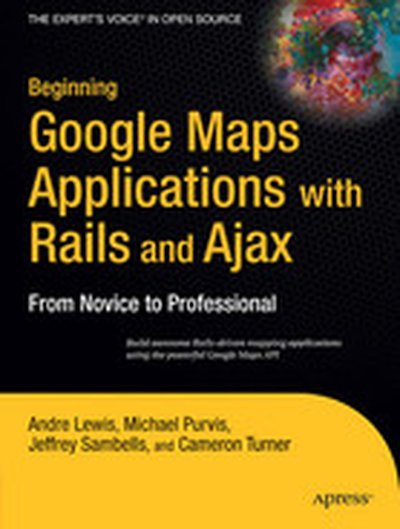
Beginning Google Maps Applications with Rails and Ajax: From Novice to Professional

The Google Maps API remains one of the showcase examples of the Web 2.0 development paradigm. Beginning Google Maps Applications with Rails and Ajax: From Novice to Professional is the first book to comprehensively introduce the service from a developer perspective, showing you how you can integrate mapping features into your Rails-driven web applications. Proceeding far beyond simplistic map display, youll learn how to draw from a variety of data sources such as the U.S. Census Bureau's TIGER/Line data and Google's own geocoding feature to build comprehensive geocoding services for mapping many locations around the world. The book also steers you through various examples that show how to encourage user interaction such as through pinpointing map locations, adding comments, and building community-driven maps. Youll want to pick up a copy of this book because This is the first book to comprehensively introduce the Google Maps application development using the Rails development framework. Youll be introduced to the very latest changes to the Google Maps API, embodied in the version 2 release. It is written by four developers actively involved in the creation of location-based mapping services. For additional info, please visit the author's reference site for this book.

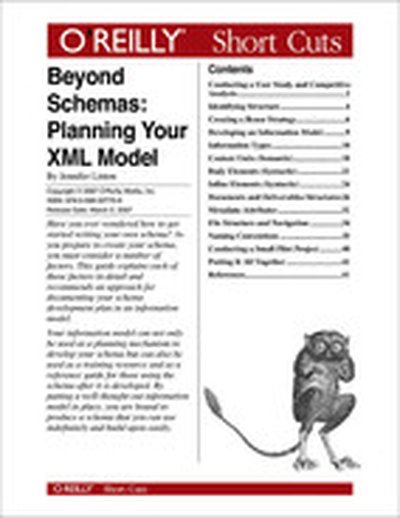
Beyond Schemas: Planning Your XML Model

Have you ever wondered how to get started writing your own schema? As you prepare to create your schema, you must consider a number of factors. This guide explains each of those factors in detail and recommends an approach for documenting your schema development plan in an information model. Your information model can not only be used as a planning mechanism to develop your schema but can also be used as a training resource and as a reference guide for those using the schema after it is developed. By putting a well-thought-out information model in place, you are bound to produce a schema that you can use indefinitely and build upon easily.